
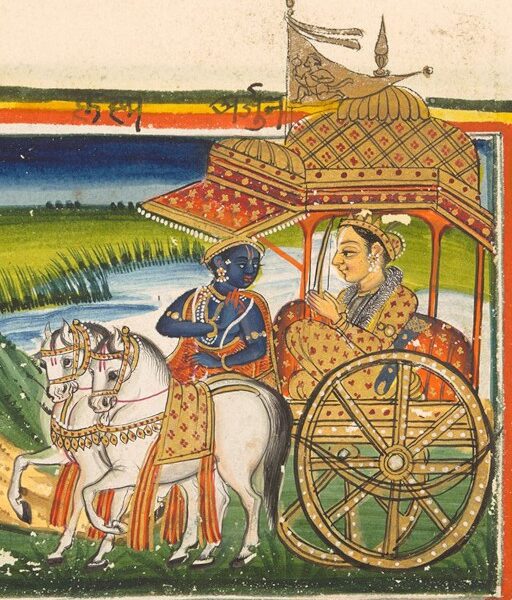
Look at the first in the table of contents, then the adhikarnas and the lessons. The first, Adhikarana 1. Sri Krsna, the Absolute Personality of Godhead, can be known through transcendental loving service. Lessons 1-3.
Bhagavad-gita is the cream of all the Vedas, Puranas, Upanishads, etc., and Sri Krsna, the Absolute Personality of Godhead, reveals Himself as He is in the Bhagavad-gita. I said that only through… Means the Lord can be known through devotional service, the knowledge, the practice, devotional service is revealed through the Gita. Adhikarana 3. Sri Krsna can expand Himself by His material, spiritual and marginal energies. Therefore it is a mistake to conclude that the material world evolves out of its own energy. If it’s everything coming from Krsna, then one should not mistake that the material energy is producing itself. Like that. That’s generally the shakta mentality, is that material energy is what’s producing consciousness, is producing life, everything, right? You just have it there, and at some point it becomes self-aware, and then it takes over the universe, right? You know, you’re a toaster, one day you walk in and there it is, you know, it’s, you know, you got problems, you know. Like that. So the thing is, is there’s no special combination of matter that creates consciousness, and therefore creates life. It doesn’t exist, right? So therefore most of the problems that we think we’re going to get don’t exist. Or the idea that the material energy itself is creating everything, that’s not going to happen. Right? It’s coming from God. God is what is the point. Tadikarana 4. Sri Krsna Himself, or His plenary portion, descends in this material world to keep in order with His creation and material energy. Lessons 15 through 17. So the Lord, He Himself comes, or His plenary portions, they expand, and then all the different elements are happening. That means, it’s not that the material energy maintains itself, it’s because the Lord is there. Material energy manages it, just like, let’s say, in a company you have a manager, right? But the manager is only working under the power of whoever they’re managing for, right? You have a supervisor of a floor, he has his potency only because he’s been given that power. He knows what to do, so it’s not that for everything, you know, he doesn’t have to go to the boss and says, you know, boss, the floor’s a little dirty here, you know, should we have it swept? You know, and besides that, the broom’s old, should we get a new broom? You know? Like that. No, he knows what to do. So he just goes on and everything just happens on its own. Does that make sense? So that’s how maya functions. It’s not that she acts independently, and it’s not that she has to bother him over every little thing. She knows her job. She knows if someone does this, then these modes, then… Right? Does that make sense? Yeah. How is this going to be made important? Prabhupāda. No, this would be, this would be, this would be sambandha, means just defining Kṛṣṇa. Means like when in the Athātāsa-mūla, then the first is śāstra, that you must have. So this is establishing also that element there, the authority of the śāstra. But the next thing is then you establish Kṛṣṇa. So Kṛṣṇa is the all, you know, the all-pervading Personality of Godhead. He’s the Supreme. So that’s who He is. He’s the Absolute Truth. And that He is expanding through everything. It’s through His energies, right? The only thing we don’t touch on here is rasa. So technically when you’re dealing with Gītā, that will, that will get into when we look at the back of the check, is you have the nine pramāyas. There’s a connection between the dāsa-mūla and the nava-pramāyas. So the nine pramāyas are what the Vedānta -sūtra is made on. So all it is, is that rasa is left out. Because rasa is something you discuss amongst devotees. So the idea is that, that, that if you try to establish the philosophy, people are just trying to learn that they’re not the body, that they’re the soul, there’s God, there’s the creation. Then you, you work with the nava-pramāyas, like that. Or you know, in other words, it just means you skip rasa, right? But when you get into a relationship in that, then you have to include that. Just to establish the facts of, there’s God, the living entity, and material energy. You don’t necessarily have to bring that point up. Once somebody’s accepted that, then you introduce rasa. Otherwise, if they can’t accept that, then when you bring up the point of rasa, rasa will in itself be a manifestation of either the soul or the material energy. Rather than rasa is one, one thing, it’s Kṛṣṇa. Rasa, Kṛṣṇa is rasa, so that means that He’s pervaded everything, then that means rasa’s in everything. The problem is, is that if we perceive it in connection with the Lord, then it becomes, how do you say, you know, I mean, it becomes elevated. If we don’t, we can find Him. Right? Because we’re the controller and we enjoy it. So controller is who’s who. Who’s got what position, who’s in charge. And the enjoyer, enjoyer means then there’s enjoyer enjoyed, so then you’re talking rasa. Right? So the first thing is to cut is who’s the control. Right? Then you can deal with who’s the enjoyer.
Because people know that they want to enjoy, but they’re not necessarily. Right? So therefore, the whole point is who’s in control. If you already establish that we’re not in control, God’s in control, then automatically it’s very easy to establish we’re not the enjoyer either.
So ādhikāraṇa one. Śrī Kṛṣṇa, the Absolute Personality of Godhead, can be known through transcendental loving service. Lesson one. Śrī Kṛṣṇa, the Absolute Personality of Godhead, can be known through transcendental loving service. Real happiness is obtainable only through transcendental loving service. He can only be known through service, and our real happiness can only be gained through service.
Does that make sense? So that’s the nice thing is that the abhidheya creates prayojan. Abhidheya is based on sambandha. Right? Abhidheya means the combination of both. Does that make sense? You’re combining abhidheya and, I mean, sambandha and prayojan. That’s abhidheya.
Yes. So knowing Kṛṣṇa and real happiness are interdependent?
Yes. Because it means you can only have real happiness if you know Kṛṣṇa. There’s no question of not. It’s just a matter of Kṛṣṇa’s potency is pervading everything. Right? And so we perceive that potency, though we don’t know that’s what we’re perceiving. You know, just like, let’s say, you have a new toaster. Right? Since we were discussing toasters before. Because you got rid of the old one because it was… Yeah, because the old one was… Yeah, it means you had to go into the garage, get one of those big wrenches, you know, like that. Yeah. It was messy. It was bad. It was bad. Yeah. Yeah. So whatever it is. So then…
Yeah. Get a new one.
I guess you could throw it in the dishwasher and just turn it on and it would electrocute itself. Yeah. That’s probably true.
So, we have this new toaster and it’s shiny. Right? Isn’t it? So we look at it, it’s a nice, very shiny toaster. Right? So we like it. Right? But the shininess, is the shininess actually the toaster? What if it’s pitch black? Is the toaster shiny?
But if the shininess is the toaster’s nature, it would be shiny.
You understand? So the toaster’s only reflecting the light that’s there in the room. I mean, the light’s on, the light’s coming in through the window, or, you know, you’ve just, you know, you’ve got that, you know, how you say, nice bright brush teeth, you know, so they’re shining like that. And the glint goes ding, you know, and it shines off of the toaster. Right?
Yeah. Sorry. Everybody knows that. Yeah, of course. You know, like that, you know. Or whenever the teenager walks in the room with their braces, you know, like that. You know, the toaster becomes shiny. So it’s only, the point is, is light has a nature. And light can be reflected off of something that has that ability to reflect. So off a mirror, off of something shiny, in other words, that kind of element. So therefore you see it. Like you don’t see the effect of the light in your wooden spoon or in your rolling pin. Right? Does that make sense? Like that. So the toaster only has the nature that it can reflect light. Therefore it’s shiny. So the shininess is you’re actually appreciating the light that’s in the room. Just you don’t attribute it to the light. So you think the toaster is what’s shiny.
Does it make sense? So everything in the material world is dead matter. And so then we see something about it we like. You know, it looks new, it looks fresh, or it looks happy or sad, or like this. That potency is God’s potency, because he’s rasa. He is qualities.
Right? So the rasa we perceive, you know, the child is happy. The dead matter is not happy.
You know what I’m saying? The soul is happy. And that is reflected because then there is that form of happiness that will reflect it. Does that make sense? The soul is happy. Therefore the modes of nature put the body in a particular, you know, how you say, form. That therefore the happiness can reflect through that. Does that make sense?
So, so, so.
Right? Because, and that is not the form, the form has to match. There’s a mood there. You know what I’m saying? Somebody’s sitting there and he smiles. You think nice, but he’s smiling. Like that. You get worried, right?
But he’s smiling. It’s the same smile. But what it is, because the mood’s different.
Do you understand? So it’s the mood, it’s the rasa that’s being reflected in the form.
Does that make sense? You know, it’s just like, let’s say your toaster, you like it. It’s nice and has that stainless steel look to it, like that. But let’s say, you know, your teenage kid comes in and changes the lights in the room. And, you know, now it’s there. He’s put yellow or green or put in those, you know, fluorescent, you know, how you say, one of those kind of lights, you know, makes the posters go. Yeah, the black lights, you know, like that. So your toaster now suddenly doesn’t have the same, you know, like that, you know. But, but, you know, the drawings on your cabinets do, you know, like that. So you understand? So it reflects what’s there. You know what I’m saying? So then it changes it, even though it’s light. But it’s the same shininess, but it carries a different mood. Right? Does that make sense? So that’s why it is this, there’s only so many movements.
But the mood behind it then carries those things. You know what I’m saying? You know what I’m saying? You feel butterflies in your stomach, you’re scared. You feel butterflies in your stomach because something exciting is about to happen. It’s the same chemicals. It’s the same feeling, but you interpret it differently because of the mood.
You know what I’m saying? You know, if the guy goes out and goes, Taxi! We don’t have a problem. Right? But if he goes, Heil Hitler! We have a problem. It’s the same thing. Same hand movement. Yes? So we say that the energy of energy is limited.
Limited, yes. It’s limited, but… What about this control? It means that the point is, is there, it actually is that rasa. It means here you have the rasa in the spiritual world because it’s non-different from the living entity. But here you’re dealing with dead matter. So how to get dead matter to give those experiences? So it has to be done through mechanics and chemicals.
Does that make sense? But it’s still coming from the self of the gross. The conscious is there, therefore the mind, therefore the body. The principles are the same. So in the spiritual world, because they don’t have to do this, all the dead matter… They don’t have hormones, no. So it’s limited there, the expression is… No, no, you’re not catching the point. The point that the discussion is, is that you have the dead matter and it doesn’t, it itself is not what’s manifesting what we’re experiencing or what we’re attracted to. That’s Krishna’s potency.
So the jivas are also God’s potency. So the potency is what we’re experiencing. There’s forms that it’s coming through. You know what I’m saying? So that there are mudras, then that’s standard. But what’s happening is the material energy is arranging the mudra. It means, because it’s like… Whatever country you go, whatever community it is, whatever age, whatever social position, if someone smiles, you know they’re happy. Or if they’re not happy… Look, why is that? Because the modes of nature arrange that mudra.
You understand? We don’t know what’s happiness and what it should look like. You know, it’s not like the little kid decides, well, for me, happiness is going to be something else. You know? Does that make sense? No, the material nature arranges it.
Does that make sense? So that’s what we’re looking at. So the limit… But we brought out that extra was just that in doing that, it even does that through, you know, just the muscles and this and that, but it also uses all the different chemicals in the body, so then we get the feelings. So the mudra is there by the muscles and the feelings are there by the chemicals. But we think it’s the dead matter, but it’s not. It’s the Lord’s potency that gives us the experience. But maya arranges it so it looks like it’s the dead matter. But if we actually understand and we know that it’s the Lord’s potency that’s pervading it, that’s what’s giving the experience.
Does that make sense?
So here, then, your abhidheya delivers the prayojana, so therefore the prayojana can only be gotten through that abhidheya. Right? And you can only know through transcendental service. It means I learn knowledge, right? But until I apply it, I can’t realize it. And by realizing it, then you can become happy.
Right? But that knowledge can only come from the Lord himself. That’s what we got before. If you want to know the Lord, it means I have knowledge, then I can perform activity. That activity will give me, therefore, the result. Right? But that knowledge, where does that come from? That has to come from the Lord. That’s not going to come from the matter itself. It’s not going to say, well, I figured it out. No, but where did your brain come from? Right? It’s still part of the field.
Lesson three. Man tries to remove his difficulties by work, and when baffled in that attempt, he tries to get rid of material bondage by an exercise of the mental faculty. The real happiness does not lie either within the bodily or the mental plane. Right? You try to get rid of your difficulties by work. When that work, actually the results of that, don’t get rid of your difficulties, then we tend to go to the mental platform, where we get into speculation. So, therefore, it’s not real, and nothing is real, and it doesn’t matter, and if I live or die, it doesn’t matter. You know, the guy, how you say, is really, you know, there’s no, it doesn’t mean anything, there’s no meaning in life, so he drives his car onto the, you know, there’s, all the train tracks are there, so he drives his car onto the train track, and he sits there, and, you know, this is it, and the end, and then the train comes, but it’s not on the same track that he’s on, it’s on the next one over, so the train goes by, and then he goes, oh well, you know, and then drives off, and goes, you know, to visit his friends, you know. As I said, this is mental speculation, you come up with all these different ideas.
Does that make sense?
So, yeah, so that’s the things that come up, so the Mayavadis, they come up with their ideas, the Buddhists come up with their ideas, you know, of all these, you know, pessimistic philosophies, oh, it doesn’t matter, it’s all this, that, so it doesn’t matter what we do, and this and that, but you’ll notice that the guys that say it doesn’t matter what we do are always doing something that will give them pleasure. But, it doesn’t matter what we do means it’s against the moral principles. They’ll break that, but they won’t break the moral, but they won’t sit around and, you know, you know, yeah, I’ll take a, yeah, give me another bottle of that, and then smash it over your head, hey, that was good, give me another one, you know, it’s like, they don’t do that.
You know what I’m saying? They just don’t care for the laws governing their activity, but what their activity is always trying to be happy. So that’s the thing, even the pessimist is trying to be happy, he just figures that work won’t do it, so now mental speculation will do it. So here’s the point is that neither, neither work nor mental speculation can give you that. So, only devotional service, so that’s the point that’s here. The Lord can only be known through devotional service. He can’t be known through, through, you know, work or mental speculation. It means karma again. But, Bodhi Yoga is the knowledge that’s coming from God, connected to God, and the work is connected to God. Therefore, then we can know God. That’s called devotional service. Adhikarana 2.
Bhagavad Gita is the cream of all the Vedas, Puranas, Upanishads, etc., and Sri Krishna, the absolute Personality of Godhead, reveals Himself as He is in the Bhagavad Gita. Okay, so that’s also lesson 4. So that’s the Adhikarana, it opens with that. That’s something one has to get used to. The modern wouldn’t tolerate this at all. You’d have to give another heading to this Adhikarana because it’s a lesson, or get rid of it as a lesson. But then, you know what I’m saying? But the problem is that if it’s not like this, you won’t know the overallist establishes point. And then what would you use as a sub-point? Because you have to study the Adhikarana itself. And then it has all the sub-points.
Does that make sense? To bring it out, right? So then we can say they’re all Adhikaranas, but this is the main one that they’re all working on.
Lesson 5, Sri Krishna is recognized by Arjuna as the Supreme Personality of Godhead, not only on the strength of the authoritative recognition of the great saints and sages, but also on his own transcendental personal experience as a constant friend and companion of Krishna.
So not only do you by the acaryas and by the scriptures understand, it’s by your own practice.
That’s by Krishna’s grace. He’s arranged that you do this, and he’s pleased.
In other words, he arranges it. It’s not that we work and we get the result. You’ve pleased him, and you get the result. But to please him, then he gives a way of working to do that.
You know what I’m saying? Like that. You know, if it’s the anniversary, you don’t go out and buy your wife a new titanium supercharger for the car. Like that. Unless, of course, she’s a NASCAR racer or something. Then you don’t do that. But it was a nice gift, and it was probably way more expensive than the flowers are going to be. I mean, way more. And they’ll last longer. She can use this on her car for the next five years, like this. So the flowers will be gone in five to ten days, depending upon the shop and everything like that. Does that make sense? But it’s a matter of the medium is important, right? So in the application, you will know. It means you apply the knowledge, and through that, then you’ll appreciate.
Does that make sense? So it’s not just the thing. It’s not that… Yeah. Okay. Sixth, for the materialist, Krishna is perceived in the impersonal display of the material energy. So He’s perceived in the impersonal display, but they don’t even understand it’s the impersonal display. That’s why it’s maya. But He only manifests to them as Brahman. So the bottom platform of anything is Brahman.
Right? You don’t realize Brahman. You’re an illusion. But you’re still functioning within Brahman. Right? You understand it’s Brahman. You’re Brahman realized. Right? Then you understand this Brahman is being controlled by a person. That’s Paramatma realization. Then when you understand the nature of that person himself, that’s Bhagavan. So there isn’t actually technically anything lower than Brahman. They’ll say, oh, that’s Brahman. You know, we’re devotees. But that’s the basis. Sat is the basis. If there’s no sat, where does the Chittanananda situate itself?
So you have to have a situation.
Right? And that’s Brahman.
Right? So He’s perceived in the impersonal display.
Right? But, as you were saying before, like the toaster, they don’t understand it’s the light that makes it shiny. They think it’s shiny itself.
Right? Does that make sense? So Krishna’s quality of childness is what makes the child behave like a child. You get that experience. And the modes of nature do that, because you come back in ten years and, you know, and the head’s all square and everything. You don’t get the child flavor anymore.
You understand?
Lesson seven. The whole material existence is maintained by His material energy, and He keeps watch over it by His plenary portion known as Paramatma. So He watches. He’s the observer. Material energy manages it herself. Right? But He, it’s His potency and He sanctions. But once He sanctions, He knows what to do. Right?
Lesson eight. Sri Krishna, in His personal feature, eternally enjoys in the transmittal realm. Right? So therefore, Brahman, the impersonalist, perceived through Brahman, I mean the materialist through Brahman, then the yogis can understand Paramatma, but it’s actually Him in His eternal personal feature where He’s enjoying Himself. Lesson nine. Sri Krishna’s perceived. The other two are just, that’s just job description. If you’re God, then you do these other two things. Right? You pervade into everything and you control everything. Right? That’s just, that’s what, that’s God’s job. Right? But enjoying Himself in the transmittal realm, that’s what He does for fun. Right? Does that make sense?
Sri Krishna, lesson nine, Sri Krishna is perceived by the transcendentalists in His three transcendental features, namely, one, impersonal Brahman, two, His plenary portion, Paramatma, and Parusottama, the Supreme Personality of Godhead. So the transcendentalists, they perceive all three. If you only perceive one of them, right, if you only perceive the impersonal Brahman, then you’re an impersonalist or the Mayavadis think they do, you know, the Buddhists, but they have some glimmer of it, but not much. You know, other speculators, they have a glimmer, but not much. But you can say you’re an impersonalist, they have a, you know, a solid realization. But it’s not complete, because they don’t know where it comes from. The yogis, Paramatma and Parusottama, it’s only, you know, if it’s only Paramatma and you don’t know how He pervades everything, how does He control? If you know Bhagavan and don’t know how He expands His creation, then it’s also limited. So unless you come immediately to the stage of of Prema, you know, from zero, then one could say, by only knowing the third one, you know, how would you be situated? But we see His mother, Dashoda, she’s pretty good at defeating Mayavad philosophy. You know what I’m saying? The Goswamis, you know, they’re able to write in detail all this different… It’s just that’s not the important point. Let’s say you have the world’s top… Well, no, we won’t take that one. I was going to say the world’s top quantum physicist, you know, and he’s interacting with his children, but he can’t, he’s in a wheelchair. So… Yeah, so you take someone other than the top, you know, next to him. Now, if he’s interacting with the family, is his quantum actually important?
He knows all the math, but that’s not what’s important. So it’s not that the residents of Vrindavan don’t know the philosophy, it’s just it’s not important.
You know what I’m saying? And they’re not necessarily scholars, in that they know all the grammar and all these different things, so they’re free to present, but they know the points. They know all the principle. It’s just that they may explain it very simply or not. Tungavidya knows all the Shastras, so she can give very elaborate explanations.
You know, but other… Then it’s just, you know, according to their nature, then it’s there. It’ll manifest. But they know the principle, so that means they know philosophically beyond the greatest material scholars. Right? Because they just know the techniques of scholarship, but they don’t actually… aren’t actually scholarly about the topic matter, because they don’t know what it’s for. Let’s say I can tell you everything about a car, but I have no idea what it’s for. I wouldn’t have a clue what it’s for. I can tell you about the tires and what they’re made of and what particular patterns of zigzags on the treads, you know, and proportions and all that, and which formulas it makes and all that, and exactly how much, you know, what is the particular curvature of the rubber, you know, as the car’s sitting there, so it has a particular pattern and all that. I can go into such detail about this. I’ve done multiple PhDs on it, one just on the tires alone, just like this, but I wouldn’t know why those zigzags are there because it gives traction to the tire when it goes down the road. I wouldn’t know that at all. I wouldn’t know that the car people drive it around. I don’t know any of this. Would you actually accept me as a real scholar?
No, so that’s what we mean, is that the persons nowadays that claim to be scholarly are not actually scholarly, because they have no idea. They may use scholarly method. Fine, but that doesn’t make you a scholar.
You know what I’m saying? That’s the point. It doesn’t actually make you a scholar.
Okay? Does that make sense? So that means there’s not a problem. Those who say you only know the Purushottam and not the other two, generally we categorize them as sahajiyas, because for them it’s only the bhava that’s important.
Like that. No, you have to know the philosophy. Otherwise, how do you know your bhava is spiritual and not material? Because otherwise the point is, it’s bhava, just like the Mayavadi. It’s just speculating what’s important. So the other one is just bhava. But how do you know your speculation is spiritual? How do you know your bhava is spiritual unless you know the philosophy?
Lesson 10. Impersonal Brahman is his transcendental effulgence. Comprised of spiritual rays.
Lesson 11. Paramatma is his plenary portion who pervades the whole existence. Lesson 12. But Sri Krishna Himself is the Absolute Personality of Godhead. So here we see, we always sum it up, then expand it into details.
So Adi-karma 3.
Sri Krishna can expand Himself by His material, spiritual and marginal energies. Therefore it is a mistake to conclude that the material world evolves out of its own energy.
Lesson 13. Sri Krishna can expand Himself by His material, spiritual and marginal energies. By His material energy, He creates this material world made up of earth, water, fire, air, sky, mind, intelligence and ego. By His spiritual energy, He expands Himself as Brahman, Paramatma and the Personality of Godhead, as above mentioned. By His marginal energy, He expands Himself as different living beings.
So these are how He expands. Lesson 14. Because He is conscious of us, but we’re just not necessarily conscious of Him. So that’s why for Krishna it’s all one, it’s just Him. For us it’s two. That’s why you have a cinta-veda-veda -tattva. It’s one and two simultaneously.
We look at it as two, He looks at it as one, but it goes on at the same time.
Adhikarana, four. Sri Krishna Himself… So you also notice that in each adhikarana it has its logic, it proves itself. But the adhikaranas are also in an order of natural development.
Adhikarana, four. That’s why they’re also known as jnaya.
Panca-jnaya, it also means adhikarana.
Adhikarana means panca-jnaya.
Lesson four. Sri Krishna Himself or His plenary portion descends in this material world to keep in order His creation of material energy. That’s also lesson 15. Lesson 16. Such incarnations of Godhead are innumerable, but they are not created by man-made ideas. They are all described in the scriptures, such as the Vedas, Puranas, etc. So He descends Himself, but it’s not that we create it, it’s not that we decide it. We take the man and then we stick, how do you say, crocodile head on that, and hey, why not give some wings also, stuff like that, and then that sits over there, and who is that? Ra. You know, like that. And then this one over here, and he’s got another kind of head on him, stuff like that. Lesson 17.
Sri Krishna appears Himself once in a day of Brahma, the Lord of the universe. So it means Krishna Himself personally.
That’s why I am Krishna, once in a day of Brahma. Other times then it’s always His expansions.
So He will come Himself, means He establishes.
Does that sound like sense? So it almost would appear, depending on what it is, is that it goes with the part one. Because then where this ends is He appears, then that means you get that knowledge from Him. So that’s its natural place.
So Adhikara one.
Sri Krishna, the Absolute Personality of Godhead, can be known through transcendental loving service. So this is explained in verse 1855 and 7.3, 1855.
One can understand Me as I am, as the Supreme Personality of Godhead, only by devotional service. And when one is in full consciousness of Me, by such devotion, he can enter into the kingdom of God.
One can understand Krishna only through devotional service. The Supreme Personality of Godhead, Krishna, and His plenary portions, cannot be understood by mental speculation, nor by the non-devotees. Means it just can’t. So therefore it’s not a matter of that they’ll figure it out. No, it means, like we’ll say, oh, you know, they’ll say they’re very spiritual people, you know, they’re into new age, they’re into yoga, they’re very eclectic, they study all kinds of things, so they’re very spiritual. So it’ll be easy for them to understand. It may not be. Because it’s a matter of if you accept Krishna or not, it’s whether you can understand Him or not. There’s no qualification. Otherwise, if that was the qualification, then it would just be those who are, you know, very knowledgeable and practice in these fields, then they would be the great understanders of transcendental knowledge. Because sometimes they’re the ones that have the most trouble with it. Sometimes if they’re sincere, then it’s easy for them, because it’s not new or strange, the concept that there is something beyond. As someone who hasn’t dealt in that, it may be that there’s too many steps in between their understanding and the full understanding.
You notice that? Does that make sense? So there’s all these other avenues that you could, you know, reincarnation is accepted. Or the concept, you know, maybe the soul is separate from the body. You know, these other things are there. It just makes it easier, because then you can give those logical steps. But if the body is the soul, right, and there is no rebirth, there is no karma, then it becomes hard to explain a lot of things. Does that make sense? So only because of that it’s easier. It’s not because they have that knowledge, therefore they’re qualified to understand God. If that was the case, then the big, big Mayavadis would be, you know, they’d be our men, you know, big Buddhists. Because they know a lot of this.
If anyone wants to understand the Supreme Personality of Godhead, he has to take the pure devotional service under the guidance of a pure devotee. So it means pure devotional service will get, because if it’s mixed, you’ll advance, but you won’t actually, you know, the understanding will be less. How much is mixed means it’s not the understanding. The service is pure, the understanding is pure. Service is mixed, the understanding is mixed. Does that make sense? It means, you know, it won’t be complete. What you may know may be nice, but you don’t connect all the points together, so you don’t get the full understanding.
Otherwise, the truth of the Supreme Personality of Godhead will always be hidden.
I mean, because that’s just the way He is. He’s hidden. He’s in everything, but you don’t see Him. You know, so He has the effect, you know, just like, like you have a, a, a, a, a letter.
You know, generally it’s at the end of the word. It changes how you say the word, but it doesn’t, it doesn’t do it. You don’t, you don’t, you don’t see it. Right? So in the Sanskrit grammar, you have the word is there, but by the grammar, those ones that don’t make any sound are dropped. So you don’t see them, but the word is, is, is the way it is because of that part that’s dropped.
Does that, does that make sense? So you don’t see what’s actually the effective point. So that’s, Krishna’s pervading everything, so you don’t see it, but He’s the one that’s actually making it happen. Yes? To have that guidance of the pure devotee while you’re doing devotional service seems quite an intimate relationship.
Intimate means intimate. What’s intimate? So pure devotional service, the soul, the pure soul, and another pure soul. What’s the, I’m saying, we’re not saying, we’re saying you’re right, but how to define what is that intimacy? Okay, well, I want to know how you get that. I mean, for me, to get that association of a pure devotee and that guidance of a pure devotee seems like that the pure devotee would be there making sure you’re doing the service correctly or you could not. No, that’s what you do with your two -year-old child. Okay. Okay, move your hand like this, now sit there, now do that. Do you understand? I understand, yes. So the point is that intimacy is by how close the relationship is, not how, I mean, let us say you’re riding on, you know, the bus or the train to Calcutta. Now, if we define physical proximity as intimacy, you’re real intimate with a lot of people. You know, a bench for three people, there’s five people there, right? So that’s pretty intimate, right? Not only that, there’s another five people standing in between the two seats. So you basically, you’re real intimate with ten people there, you know, like that. Does that make sense? So intimacy means, this is the depth of the relationship, that you’re taking what they’re saying and following it. I mean, the word is guidance here. Yes, so that’s the point, is guidance is what creates the intimacy. It means they give you that guidance, but you follow it. Does that make sense?
I don’t know, I just feel that maybe, I’m just talking about myself, maybe I should be communicating more with a fewer devotees to make sure I’m guided correctly. That’s there, but unless you, as was the last point, you know, that was being made.
This is the one you have to do yourself.
That’s why you know it must be God. Let me just read something where it’s like you yourself have to be able to figure it out.
Yeah, here, this one. Śrī Kṛṣṇa is recognized by Arjuna as the Supreme Personality of Godhead not only by the strength of the authoritative recognition of the great saints and sages, but also by his own transcendental personal experience as a constant friend and companion to Kṛṣṇa. Right, so what does friend and companion mean in the nine processes of devotion?
You know what I’m saying? That was Hari Kāriṇā II, Lesson 5. So, the nine processes of devotional service, when we say sākhyam, friendship, that doesn’t mean we’re in a friendship rasa with God. So how is friendship defined?
Being the well-wisher. Being the well-wisher. You understand? So that’s the intimacy. Because they’re the well-wisher, you take that instruction, you follow it. So therefore it’s not constant proximity. Because you can be standing next to the person and not doing anything connected to them. It’s that you are constantly contemplating. Like Śrīla Prabhupāda, he’s constantly, intimately connected with the spiritual master because he’s always contemplating his instructions.
That’s the intimacy we’re looking for. That physical proximity, that comes up because of the need for rasa, but we interpret it as that rasa is based simply on the body. And that’s why, then, therefore, the Dīkṣu-guru, we like to be as close as possible. Like that. Sikṣu-guru is then its instruction. The Dīkṣu-guru is as close as possible. You know what I’m saying? You see the line that we get there? Yeah, but it’s a matter of what you do. Let’s say you have a…
We’ll throw out something that, is a theoretical possibility. Now, whether anybody has experienced this or not, and we’re not saying that this has any… Any person or persons that may coincidentally happen to appear like this, it’s just a coincidence.
Like that. At the end, you always say, any events, any situations. Let us say we’re having a Vyāsa-pūja. So, here’s that one time when you can really get down to… This is Vāpu-pūja.
We’re saying the body is there. And then you’re going to have that disciple. You may have that disciple who is oh so ever devotional. And he’s always there. He’s in everything. And anything you want, anybody else wants to do, he gets involved. And they’re bringing something, he’ll take it and give it. And he’s like this. Now, after the Vyāsa-pūja, he doesn’t follow any of the instruction of the spiritual man. He just lives his own life as he lives it. Now, will everybody be pleased?
All the other disciples that are there, are they going to be saying, wow, look what devotion. But he’s the most physically close and most intimately interacting. But is he actually an intimate disciple?
Yeah.
Hypothetically. Yes, hypothetically.
As already stated in the Bhagavad-gītā, 7 .25, na ham prakāśa sarvasya.
He is not revealed to anyone, to everyone. Footnote 1. I am never manifest to the foolish and the unintelligent. For them, I am covered by my internal potency. And therefore, they do not know that I am unborn and infallible. So I say, I am covered by his internal potency. Kṛṣṇa is always covered by Yogamāyā. But when the materialist deals with Yogamāyā, then they don’t see Kṛṣṇa. So if you deal with Yogamāyā and you don’t see Kṛṣṇa, how does she manifest to you? Mahamāyā. So in other words, the materialist is covered by material energy and Kṛṣṇa is covered by his internal potency. So that way, therefore, they can’t see.
Yeah. For them, I am covered by my internal potency. And therefore, they do not know that I am unborn and infallible. Bhagavad-gītā, 7.25. No one can understand God simply by erudite scholarship or mental speculation.
Means those who are erudite and tend towards speculation won’t believe this because their identity is their intelligence and they think by operating their intelligence this is going to get them everything. Right? But it doesn’t. It’s just the way it is. Otherwise, if it was, so many people in the past would have already figured out God. Right? And there’d be a singular, consistent understanding. Because of the realized souls, there’s one understanding only.
Right? Every resident of the spiritual world doesn’t matter which realm. They all have the same understanding of Godhead. What their particular, how they want to relate with Godhead through the rasa. You know, the particular rasas and the particular mediums of rules or, you know, focus, emphasis on the rules or not. That defines the realms and all the different tastes.
Does that make sense? You know, you have food. Then someone likes this, someone likes that. There’s so many preparations. But it’s all food. They all understand. So the proportions will be different. Someone eats a lot of rice, a little bit of dal. Someone else eats a little bit of rice, more dal. You know what I’m saying? But it’s still the same principle.
So therefore, there would be one understanding.
But because there’s as many scholars as there is, there’s understandings. That means it’s not dealing with the transcendental aspect.
Does that make sense? But otherwise, the principle of Godhead and that, amongst all the Atrayas, there’s no difference. Now, depending on rasa, therefore, they’re bringing out different aspects. So they’ll emphasize different practices that will bring out that kind of mood. Does that make sense? Yeah.
It seems that the point of rasa is sometimes going, not in conflict, but in contradiction to the erudite scholarship and things like that. It’s in contradiction to it. Not contradiction, but it’s kind of rasa-bas. It means we’re rasa-bas or they’re rasa -bas. What I mean is that in Vrindavan, you see village people. They personalize it to be simple. But simple doesn’t mean that there’s not something sophisticated about it. Like we don’t see those big monies around. But have you ever talked to them?
No. It means the scholarship is understood by speech.
Yeah, because generally we take it because it means, well, if you look at it, let’s say, let’s say you have someone, he’s the lecturer on the subject.
And he’s popular.
There’s a good chance that he dresses well, interacts well.
Some natural qualities are very prominent. He’s very gregarious or very consistent or authoritative or something. That is a nice combination. So it’s very easy to identify them, their uniqueness and their ability to interact with you.
And so that means socially and everything. Generally speaking, they’re a bit up-to-date. There’s some aspect that they’re doing that the kids are doing. Some little thing like that. Not everything. But there’s something, so you know they’re up -to-date. Or language they’ll use.
So then you’re comfortable with it. The students know that he’s not something from the prehistoric age. The only reason he’s around is the last dinosaur didn’t step on him before they fell over and died. Like that. Does that make sense? But now, in the end he’s an expert. Right?
Otherwise, why would there be… Or he has to be a real BS artist. You know, like that. But then, that’s not going to fly at the university. Right? There’s only so much… It means you have to be doing standard amount like this. It means you’re doing something that they wouldn’t consider. Right? Now let’s say you take the guy who is the top researcher in the field in the world. In that. He doesn’t know necessarily have social skills that you would call necessarily up to date. How he dresses. Like Einstein. He had five of the same suits. They’re not like, you know, these modern suits that are two sizes too small. You know, they fit nicely. I mean, they’re cut properly, but if he gained five kilos or lost five kilos, it wouldn’t matter. Right? They’re five. They’re exactly the same. Each item is interchangeable with the other. So it doesn’t matter. Right? Does that make sense? Like that. The only change might be, you know, shoes or house slippers. You know, like that. Does that make sense? So, then the point comes up is that you’re not necessarily going to recognize that if the first professor walked down the hall, you know, and students are around and you can tell he’s the center of attention, he’s an authority, you know, there’s something happening here. You’ll recognize it. But let’s say the other professor, he’s shuffling down the hall, completely absorbed in his own head because he’s actually thinking about it. You know what I’m saying? So, and no one else is around him. And if somebody does come up to him, they’ll look like a real nerd. You know, like that. So you wouldn’t want to necessarily be hanging out with them. You know? And so then, then, he’s having a lot of fun.
And so then, then they’re, that’s okay, I just say it’s fun. And so then, then you’re not going to recognize his position.
Right? Because for him, it’s just part of his life. It’s not, the other one, it’s his occupation and he’s good at it. But the other one, it’s his life.
Does that make sense? Because, you know, what I was mentioning before, I was mentioning your general, you know, quantumness, that the top guys, when the kids do play, they are figuring out the universal principle. You did like that and they did that and picked it up and put it down and let them sleep. You know, what’s the pattern, you know? They’re all doing the same pattern. Like that and they’re sitting there scribbling on something and getting, you know, yeah, they do do that. That’s why they’re considered nuts and, you know, their family divorces them. That’s, that’s, that’s not what it does like. It does this, like, you know, thing about Rasa, you know, like mathematics, you know. Does that make sense?
So, does that, does that make sense?
You didn’t make the connection? Oh, okay. So the point is, is that the, that local simple village Brasbasi, they’re so deep in the practices of Krishna conscious, it’s just how they do. So there’s no necessarily anything for us as sadhakas to catch, you know, the external points that they do. Okay, you know, you have the guy there, you know, and he’s a little buff, you know, and he’s got his mudanga and he’s got, you know, tilak marks, you know, tattooed on, you know, and stuff like that. You know this guy’s a serious devotee. It’s obvious, right? You know, like that. But your local Brasbasi may not have that. So, they just look simple.
You know what I’m saying? So that’s why we, as sadhakas, don’t associate with them because what is the depth of their devotion and where? And, what is their weakness also that is also not apparent because that’s why they’re born again as Brasbasis, right? Otherwise, they would have been born on the other side of Viraja in Bras, not on this side. Does that make sense? So that’s why we don’t get too involved. If there’s something that they do that would be an example for our sadhana, then we can take that as confirmation of our sadhana. But if they do something that doesn’t fit with our sadhana, then it’s just they’re Brasbasis. We don’t worry about them.
You know what I’m saying? Like that. The kid stands up and says, Hey, Krishna! And then everyone goes, Oh, how cute! And then after that, he wets his pants or something. So then we don’t go, Oh, well, you should chant and then wet your pants. That’s the example, right?
Because they’re innocent. They’re so natural. There’s no… You know what I’m saying? We don’t do that. No, that part you take. The other part you leave that to them. You know, kids, they wet their pants. So Brasbasis do what they do. So we don’t take example from that. But if there is something that fits what our Acharyas give us, then that’s okay. Then you can confirm it from there.
Does that make sense?
I saw many devotees leave from Russia. They stay in Radha Poon and, you know, they start having associates, Brasbasis. So will they become Brasbasis one day? They might, but you have to also understand that dogs and turtles are also Brasbasis.
No? But since they are quite serious to serve Brasbasis, chanting, you know, circumambulating the hills, will they become Brasbasis one day?
The form of devotional service isn’t devotional service.
The form is what you express devotional service through. So if someone is very expert at operating the forms of devotional service, that doesn’t necessarily make them an advanced devotee.
You understand? It’s the mood behind it. The point is, is who at Radha Poon is authorized.
Who’s authorized?
He got some inspiration, but hey, you know, the girls walk by and the brahmachari has got some inspiration. Suddenly the kirtan goes up in your hair. It’s all happening, right?
Inspiration is just something different and new.
How many people are at Radha Poon? How many Russians are at Radha Poon? I heard there are more than 500.
But how many devotees in our movement?
In our movement. Our whole movement.
Yeah, okay. So now, 500 would be unique and special.
Right?
Yes or no? We’re just talking math here. Yeah, they look… Not they look. It’s 500. If 500 are doing something that 100,000 are not doing, then you would call it it would be unique. Different. Yeah, different. Right, okay. So, the whole point is is one, the neophyte is still, as the materialist, is worried about his uniqueness and his specialness.
So then, they’re inspired that we’re here at Radha Poon and no one else is.
Right? But because they’re all Russians, they get along. But if it was a mix of communities, then you’d find there’s a whole trip for them. And if you actually check Radha Poon, some of the most intense politics are going on at Radha Poon. Some of the other day was just discussing with me about land at Radha Poon. It’s so cutthroat. I mean, it is cutthroat.
Because there’s very little of it. So before, people weren’t worried. You’d come by and you were there and you wanted… There was a veranda, you know, and you just went and slept on it. And if things work out, you might be there. You come back after 20 years, there’s still the Babajis sitting there chaining their job on their veranda. But nowadays, they won’t let you sit on their veranda because then you might claim it. But before, there was no sense of proprietorship.
So, they’re at Radha Poon, but how are they at Radha Poon?
You know what I’m saying? How many of those guys are on the Internet? They got 2G at Radha Poon and they’re about to… Maybe by now they have 3G installed.
Radha Poon. Not that it just happened to be they installed it somewhere else and it works at Radha Poon. They’re installing it at Radha Poon.
So that’s how those 500 Russians are there. Out of 500, maybe a few are there and don’t get into all this, but most all of them. So they get some inspiration. That’s because it’s new, it’s different. Come back after, you know, some year, how many are there? If you kept the census, how many are there? So the 500 are there, but how much is the turnover?
Do you understand? So the point is, what is their authorized, how do you say, association?
Because Lord Caitanya didn’t authorize it.
You understand? So what association they’re getting that’s authorized?
Even if they’re from a bona fide Vaishnava Sampradaya, but are we supposed to associate with them? Generally, Brajbhasis are not famous for being Sampradaya. They’re just Brajbhasis.
You know what I’m saying? And if there’s 500 Russians there, that’s the Russians. What about all different other places? How many Bengalis? How many this? How many that? So are they Brajbhasis?
They’ve also come there to practice sadhana.
Her example was Brajbhasi mean, you know, they’re there, the farmer that’s out there, he’s born there, his parents were born there, their parents were born there, goes way back.
You know what I’m saying? So she was talking about, about the Vasi, not the Nivasi. Nivasi means someone who comes and makes it their place.
Right? The Brajbhasi is someone who’s, that is their place.
You know what I’m saying? If the Nivasi is there long enough, you don’t make a distinction. But generally, in these circles, it’s long time. What did I say? 20, 30 years. Then you start talking.
Does that make sense? So after 20 or 30 years, we can call it a Vasi.
Are we having the same conversation?
The conversation was the relevance of the practices of the Brajbhasis in our lives.
And so then the point was is that the Brajbhasis…
Are you an academic?
Yourself? Are you an academic? Yeah. Okay. Now I understand. Okay. See, because I was working on the principle that the intellectual discussion was to get to a conclusion not to just create intellectual inspiration. Now I understand. Because what you do is this. Oh, it’s a new point. I didn’t think about that. So after 20, 30 years, that’ll be bona fide? That wasn’t the discussion. Your question wasn’t that. Your question is is it all right for them to be erotic when associating with these people since you said it’s not?
And then when I make the point to conclude it, then instead of going yes, you go, so it’s okay to associate with them? You understand the technique your mind is using? That’s what’s called mental speculation. It’s all right to use as long as you conclude and then move on to the next point. But without concluding, because that’s the nature of the Muni is they don’t conclude. Because then you leave all options open. Otherwise, now the mental speculation on associating with Braj Vasis is closed. You know, now we can discuss, okay, about, you know, Vasis and Nivasis. But the point is, are they a real Nivasi if they’re not following a bona fide line?
You know what I’m saying? And even if they are, the point is, do we want to take their example? You know what I’m saying?
It’s like that. We have one devotee who stays here in the locality. He’s been here since the 70s. Like that. But while he was present here, then, you know, he got distracted by all these kinds of sahajiya stuff and thought that he was one. So with time, he just, you know, shifted out and made his own place and all that. So he practices what Gaudiya practices he’s interested in and doesn’t practice those ones that he’s not interested in. Associates with the local people, you know, and takes their directives and ideas on devotional service as authority. And, you know, is cons, you know, what’s given in Prabhupada and Sampradaya is not so important.
But he’s been here since the 70s. So, technically, you could say he’s a local. He’s a Mayaprabhasi. But what kind of local? It’s not Sampradaya. So, being so attached to the Dham, rendering service, so aspects of it are proper service, but so much of it’s not. So how much of it will be recognized? Well, because he likes, he’s attached to the Dham. He’s attached to performing activities connected with Gaudiya Vaishnavism, no matter how distant. Right? Then, in his next life, then he’d be born as a local here.
Right? Does that make sense? But the mentality to still practice non-Sampradaya Gaudiya Vaishnavism would still be his mentality.
Does that make sense? So, that’s what I’m saying. If he does anything that would be what we would do, and you could take it as an example, but it’s not that he’s an example. He’s just further established.
You know what I’m saying? So, then it’s all right. But other things that he does that aren’t in line with us, you know, we’re not interested in at all. You know, if I read, oh, material world, birth, death, old age, and disease. So, there’s a sick person. Right? So, that confirms the Shastra. So, that sick person now becomes a spiritual authority because he’s sick.
That’s the whole point. In other words, see the whole picture, the field that we’re working with, and then the conclusion that we’re trying to come to in that based on the angle we’ve taken because the field is very broad. Now, you’re taking a particular perspective on that field that creates a doubt. That’s being discussed so that then the field gets seen in a balanced perspective. That in that you’re going to focus on different elements within the field. But, just focusing on those and just going, moving around from them, that is not what, that is not what constitutes actually real intellectual endeavor.
The endeavor is that you see those connected with the field and the principle being discussed. Then the field becomes more solid. Then, it may arise, raise another question. Just like Sukadeva Goswami establishes stuff, it’s accepted, but in his discussion then there’s another point.
Do you know what I’m saying? So, do you catch the point? So if you understand, okay, so that means there are 500 there, they’re not necessarily authorized to be there, and they’re associated with the local taking their directions on devotional service. It doesn’t mean that it’s going to be auspicious for their advancing and becoming a real, you know, serious member of Rupa Goswami’s party in Braj. Because they want people who follow authority and aren’t whimsical. Right? You know, like that. Because if someone’s whimsical, you don’t know what they’ll do. You tell them to do something, they may not do it. Because they saw something else, you know, they’re fanning like that, and then they see someone else who’s making garlands. Oh, it would be so nice to make garlands. And then they leave the fan and go make garlands. Would you want something like, someone like that in your group? No. Yeah, because then nobody’s fanning Radha-Krishna.
Right? But you’re fanning and you’re happy fanning and all that, then they come and tell you, leave the fan, go collect flowers. You’re working under authority. They take it that Braj is this Bob, however you like, whenever you want. It is Bob, but it’s very, very structured.
Otherwise, how do we get us to Kali Yuga?
It’s structured. In the morning, Krishna gets up. Not that he decides, well, I’m not getting up today. You know, it’s Bob. It’s just whatever you feel. No. Spontaneous means you’re natural and inspired within structure.
Right? Let’s say you have a genre of music. You call it that because it uses a particular method. Right? But you have a musician. He can think of all varieties of newer and newer ways to put together the elements to come up with sounds that are different than others in the field make. Right? So you’ll say he’s an inspired musician.
But he’s still doing within that field so you can still identify it. So you can still say, yes, this is pop or this is R&B or this is rock or this is classical or this is, you know, how you say you understand what I’m saying? Otherwise, how do you identify it?
That’s rock.
But don’t try to say that, no, it’s just sporadic. Whatever you feel like. It’s whimsical.
No. It’s within the form. So you have Bengali cooking. It’s Bengali because of certain elements. But within that you can put it together in unlimited ways. That’s spontaneous. That’s inspiration.
You understand? So this is how Rupa Goswami defines it. People may or may not like Rupa Goswami’s definition, but being a Raganuga and being, going to be serving under him, it’s nice to follow, it’s good to follow his instructions. Otherwise, if he’s not pleased, why will they invite you to take part?
Yes.
When someone is on the stage of art, he’s playing so expertly that we can’t, we actually cannot catch what he’s doing and that’s why we cannot come from him. Yes. But, but if they’re too, you know, the mantra is there and they’re too fixed on the mantra, then it may be the correct mantra, but it doesn’t quite, you know, it’s not inspiring because the focus is so much on the regulation of the mantra. And it’s being played right. I’ve seen that. I’ve seen, even the Madanga teachers, they, they can play it so perfectly, but in the kirtan it doesn’t sound good. But one of their students, they just play it very naturally and it sounds better. Same mantra.
You know what I’m saying? Because they know how, like there’s little, little adjustments in it. The art is there, like you said. The recipe is there and they’ve done exactly according to the recipe. But in that, they put a little more of this or dropped that a little bit or made some adjustment and that’s how, wow, this is so, you know, so special. But it’s, it’s the same preparation.
Okay. So, you’ve said that and they, they can’t do that. And so, if they’re there, but what’s going to be the benefit? Okay. So, then we’re not supposed to, we as sadhakas, we’re not supposed, we’re not authorized to associate with the Vrajabhasis and that’s our direction. That’s our, it doesn’t mean that when we’re there we’re not nice to the Vrajabhasis or when one lives next door we don’t interact or give him something and he gives us something. But it means that their example of devotional service is not our principle of how we run. Our example is given by the acharyas and if they do something within that, they may be very inspiring to inspire us within our own sadhana. But it’s not that we take direction from them about it because they, you know, they have their own path. You know what I’m saying? So they’re in a different category. You don’t worry about them. So the ones that are living there that are locals we don’t worry about. The ones that have moved there because they think it’s cool, those ones we don’t get to, you know, we get even less close to them. You know, very worried about them. Yeah. So you understand? So understanding that, okay, now, how do you identify since we’re talking Vrajabhasi? Okay? How do we identify? And because if someone’s there long enough and they take on that mood of the Vrajabhasi, how do we define between the Vasi and the Nivasi? Is time, is time actually just all it is? Okay, they’ve been here 20 years and now you’re a certified Vrajabhasi, you know, like that. But how could, what about him? No, no, he’s only been here 19 and a half, you know, but after six months he’ll be a, like that. You know what I’m saying? So then that’s another discussion. You’ve closed one and then it goes to the next. That’s the difference between the Vedic scholarship and the modern. Or let’s say, Vedic Vaishnav scholarship and other forms of scholarship.
You know what I’m saying? That’s why it’s difficult having a conversation with, with, with those who aren’t accustomed to Vaishnav way of thinking. Because you’ll say something and as soon as it triggers a word or something it’ll go into a different topic. And that’s why Right? And so as long as they’re winning, they’ll keep going but as soon as you’re making a good point then they’ll use that word to bring up a new topic. And then within that topic they have issues so then they’ll make their point but it’s got nothing to do with what you were actually discussing. So just keep going, going, going so you can never actually conclude a discussion. You understand? So you have to watch out for that. But you utilize this just within the association with the Vaishnavs or in preaching. But if you’re actually dealing with other academics never use this. You’ll make them highly uncomfortable and you become very unpopular which is not good in the academic circle. You know what I’m saying? In other words, understand that this is a way of thinking but it’s not the way of thinking. So when you’re dealing with these others then you use it. You just create, you understand what creates for them intellectual or mental inspiration to discuss intellectual subject matter and then figuring that out do that and they will be very happy with you. But understand for your own contemplation it’s useless other than the point of contemplation but that it lacks conclusion therefore it’s not very useful. Does that make sense? Because I noticed somehow or another previously you wouldn’t do that as much so you must have progressed further in your academic pursuits because you’ve taken on more of this mentality most likely from some mentor. Because last year and the year before you didn’t do this. But this year it’s been consistent so that’s why today it just struck me oh, well maybe he’s you know, an academic now. Does that make sense? So that’s your occupation. It’s not your ashram. It’s not your lifestyle. You know what I’m saying? So you do that at wherever it is at the school or the office but with devotees at home don’t use it. It’s not useful.
Does that make sense?
Otherwise then it creates difficulties because you can’t conclude anything it keeps moving and moving and moving.
Only one who is actually engaged in Krishna consciousness and devotional service can understand what Krishna is. University degrees are not helpful.
Very next point.
We should take this as a sign from God.
Becoming Brahman does not mean losing one’s identity. So it says are not helpful but you don’t know but it teaches you how to think. It does not teach you how to think at all. My worst intellectual discussions on philosophy that I’ve ever had over the last 30 years are with devotees who identify as academics. Absolute worst because along with teaching you how to speculate you learn this attitude of absolute empowered ego that you are an intellectual and everybody else is not. They’re absolutely disgusting to talk with philosophy and culture. You want to just discuss something some topical point it comes up and they keep it out of their realm of scripture it’s fine but as soon as they touch on that devotees should consider this at that point it gets so messy and their ego is so big that to go into to wade into that and try to deal with it is not there. Of course if you want to contemplate it when you get good at taking it and using the same method and just kind of move it off just like you take let’s say you take this big block like they take cotton or wool I think it is yeah any of those they take it and they press them into these huge blocks and they weigh I don’t know tons you know and so you can’t you can’t move them one person can’t move them but they get it up on the corner so it’s on the corner one person then with these hooks can move it so you have all these guys and they’re stacking them in the containers or on the on the boat stacking they do it all by keeping it on the corner so this guy one guy comes down or two guys come down and they spit it down like a top the other guys on the next level up but they have this way I don’t know how they do it but it’s off balance so just they put the next level and the next guy goes to the next level because it’s off balance so you can keep them off balance by spitting them in their own their own juices there you know then it can be worthwhile but the problem is is then you know you have to have the inclination to work within them so if you want to work with them and convince them to know their system and use it in that field like that I so far unfortunately have not gained interest to do that so therefore it’s either don’t bother conversing or steamroller yes can it be useful to explain this phenomenon to people who are not necessarily in that way but oh yeah no to them they can understand it the point is is academics they don’t have other than being expert in their particular area as individuals they don’t have a good reputation your common people don’t really like them because they talk in such a way and make you feel so stupid yeah that’s all that’s the whole point because if they can make you feel stupid then their ego is boosted it’s not that they’re trying like you see Indian scholars you know that are in traditional practical area they want you to understand like you go to the Indian doctor I mean the western doctor you know you ask what about this oh don’t worry about it because you’re a layman you could never understand you know but the Ayurvedic doctor will say in your life that you’re eating like this you’re eating irregular therefore the digestion is off therefore there’s more acid therefore that acid going in the system is creating this rash so therefore you regulate your diet you’ll get rid of this rash and the point regulation of diet will create health because then everything like that they want you to understand that’s the difference modern intellectuals don’t want you to understand because otherwise what’s their uniqueness what’s their specialness that’s why why the Vaishnav philosophy unhinges them you know the outside don’t deal with it they can’t handle it because conclusion so even our own devotees as academics they can’t handle the conclusion is so strong and it’s so much stronger than their ego because their ego actually their only authority is that the universities told them they can have it not that they deserve it you know what I’m saying the universities don’t even have it yeah where did they get it from so that’s what I’m saying it’s speculative they just made it up it’s their own like that so that’s the whole point we acknowledge that they’re very intelligent and they enjoy using that intelligence and applying it like let’s say if I give a short paper or something to an academic and say I’d like to discuss this with you he’ll take it home and read it 20 times before the discussion so that ability is very special the ordinary man does not have that at all so you have to acknowledge they’re very intelligent but they only they read it 20 times but there’s no depth but they technically what goes to what what words were used and why that because he used this word does he infer this or does he mean that you know so many things so when you go to discuss it they can really get into a discussion but there’ll be no depth but intellectually it will be very very strong you know what I’m saying but as far as actual Krishna conscious understanding it won’t get anywhere you know what I’m saying so the devotees that therefore use it to understand this is how they think so therefore this is the path of how you present it and then when you get it to there then as a person you bring it to the conclusion you know or if not at least they recognize that your pattern of thinking is very good very logical though they respect you for that so then then you might be able after some time throw in a conclusion here and there but you have to take it real slow it’s like dealing with birds because birds are vata so intellectual is vata so it’s like you deal with birds they have the bird there sitting there but they want to feed it they don’t know the bird they have to take what they’re going to feed them and it takes 20 minutes to half an hour to go from here to here because if you move any quicker the bird will freak out so therefore it has to be that slow so you have to have that patience that’s what I’m saying if you have that patience to be able to deal with that nature great then that’s a very nice area to preach but unfortunately as of yet I haven’t seen it I haven’t seen it they’ve been accepted they have jobs in the area they can come up with their own thesis but they can’t say that this is the thesis it just has to be accepted that this is the speculation we’ll use as our basis you know what I’m saying so my point is is that there’s 300 people in that class that are only there well most of them are only there because they need the credit a few are there because they’d actually like to know the knowledge so therefore outside the classroom you could preach to those 300 and make them a devotee what does it matter if the professor never becomes you know what I’m saying we made more devotees in the university preaching before when we weren’t academics than we do as academics you understand why because university degrees are not helpful in understanding Krishna they’re useful for getting a job that’s what it’s for it’s not for understanding Krishna you don’t need to go through their academy to understand Krishna our academy won’t let you understand Krishna their academy gets you a job that’s what it does it’s a vocational trait even then it’s debatable yeah even then it’s debatable that’s why Shalapati in Bombay is so successful in their university preaching yeah because they’re there but they just preach to them they come as devotees they come as devotees and preach as devotees in other words they preach to the person on ashram side not on varna side we have this idea we’re going to change varna by preaching no you can’t not that academy it’s not defined like that you know what I’m saying it’s just like coming into the kids are there with picked up a few sticks and they’re fighting with each other you know like that they’re flying through space this and that and their sword has magical powers and all that now a real martial artist comes in and wants to teach them martial arts it’s not going to happen they’re doing it just for fun does that make sense om hare krsna hare krsna krsna krsna hare hare hare rama hare rama rama rama hare hare rama rama hare hare