
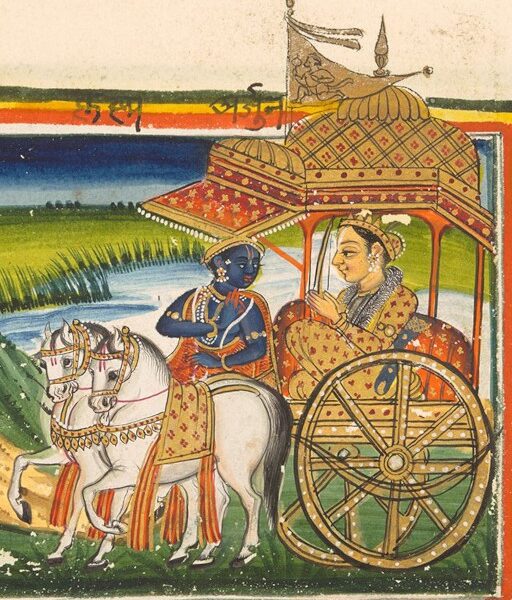
I am the Supersoul, O Arjuna, seated in the hearts of all living entities.
I am the beginning, the middle and end of all beings. So He is the cause of the creation, the cause of the maintenance and the cause of the destruction. Of the Adityas, I am Viṣṇu. Because the Adityas, the twelve Adityas abominate. He is Viṣṇu. Of lights, I am the sun. So all lights are there, but the source of all light comes from the sun. Of Maruts, I am Arici. And among the stars, I am the moon. This is great. So you see, always it’s the greatest. Whatever is the principle of it, or the most outstanding of all of them. Because He is the light of all the stars, but it’s the moon that you really appreciate. So of stars, He is the moon. But it’s not that He’s not the light of the stars also.
Of the Vedas, I am the Sama Veda. Of the demigods, I am Indra, the king of heaven. Of the senses, I am the mind. Because the mind controls all the others. Indra controls all the other demigods. Sama Veda is considered to be… If the Sama Veda is being chanted, then it’s said that… If you’re studying another Veda at the time and chanting… But if you hear the chanting of the Sama Veda, then you’re supposed to stop the chanting of your Veda. So it’s more principled than the others. They’ll interpret it that it’s… Because there are rites like that that are used when somebody dies. So then they’ll take it that, well, that means because it’s inauspicious. No, it’s because it’s actually more prominent.
Yes? Whenever the Ati procession comes in and the evening program is going on, is there any of that principle there? Is there any of? Is there any of that principle of one being predominant over the other? No, no, no. If you’re doing parayana like that, then you chant whatever this, because you can only chant one at a time. Or if you’re doing a yajna where they’re all there. This is when you’re studying.
That’s the rule of study. You know, the drums.
The Ati procession comes into the temple room, and then the kirtan is going on at the same time. So, you know, the mantras are being chanted for that. Yes, so is the kirtan. You know, so it’s all just a devotional cacophony.
In living beings there is a life force, consciousness. So here, life force. Because if you’re conscious, then that’s the symptom of life. Of all the Rudras, I am Lord Siva. Of the Akshas and Rakshasas, I am the Lord of wealth, Kuvera. Of the Vasus, I am fire, Agni. And of mountains, I am Meru. Of priests, O Arjuna, know me to be the chief, Brhaspati. Of generals, I am Kartikeya. And of bodies of water, I am the ocean. Of the great sages, I am Bhrgu. Of vibrations, I am the transcendental Om. Because you can’t chant any mantra without Om. So he’s the basis. But the ocean is the basis of all other water, right? Because then the sun evaporates the water. Then there’s rain. Then you get all your other lakes and rivers and everything. So the ocean is here. Of the great… no, okay. Of sacrifices, I am chanting of the holy names, Japa. And of immovable things, I am the Himalaya. Of all trees, I am the banyan tree. Of sages among the demigods, I am Narada. Of the Gandharvas, I am Citraratha. And among perfected beings, I am the sage Kapila. Of horses, know me to be Ucchaisrava, produced during the churning of the ocean of nectar. Of lordly elephants, I am Airavata. And among men, I am the Marana.
Of weapons, I am the thunderbolt. Among cows, I am the Surabhi. Of causes of procreation, I am Kandharpa, the god of love. And of serpents, I am Vasuki. Of the many-hooded Nagas, I am Ananta. And among the aquatics, I am the demigod Varuna. Of departed ancestors, I am Aryama. And among the dispensers of law, I am Yama, the lord of death. Among the daitya demons, I am the devoted Prahlada. Among subduers, I am time. Among beasts, I am the lion. And among birds, I am Garuda. Of purifiers, I am the wind. Of wielders of weapons, I am Rama. Of fishes, I am the shark. And of flowing rivers, I am the Ganges. Of all creations, I am the beginning and the end, and also the middle. O Arjuna, of all sciences, I am the spiritual science of the self. And among logicians, I am the conclusive truth. Because it means you have the 14 books of Vedic knowledge, but the Paravidya, transcendence, that one is the prominent. All the other ones are supportive of that. And then among logicians, I am the conclusive truth. That means when you’re going through the logical process, and you come to actually conclusive truth, then that’s Krsna. If you’re just following the logical process to win an argument, that’s not Krsna.
Does that make sense? Because logic is meant to establish truth, not to win an argument. The point is, it’s because someone may have an argument with the conclusive truth, therefore there’s a logical process.
Of letters, I am the letter A. And among compound words, I am the dual compound.
Yeah, because it’s the beginning of the alphabet. Everything’s stopped there. Letter A is the most used, probably, of all of them. And then of Om, then he’s the A in Om.
I am also inexhaustible time. And of creators, I am Brahma. I am all-devouring death. And I am the generating principle of all that is yet to be. Among women, I am fame, fortune, fine speech, memory, intelligence, steadfastness, and patience. So it mentions that these are all, you know, the high-grade feminine qualities, right? So women, it means everybody may have them, but if the woman has these, then they’re considered very…
Of hymns, in the Sama Veda, I am the Brhatsama.
And of poetry, I am the Gayatri. Of months, I am Amargashirsha, November, December. So it’s basically what we’re in now.
November, December. Actually, no, we’re in the next one. It was last month. Last month, before last Purnima.
After Rasapurnima, between Rasapurnima and the last Purnima. That would be that month. Because it’s very nice, it’s not too hot, it’s not so cold, it’s pleasant. Is this Magha? No, it’s after the next Purnima.
I just remember Prabhupada said, you know, about cooking in the summer, and then taking a bath in the month of Magha. Magha, yeah. So you’re worried it’ll get more cold. Kind of.
And of seasons, I am flower-bearing spring. I am also the gambling of cheats.
In other words, the gambling is what means those who are cheaters, that’s one thing, but it’s the gambling that actually makes them what they are. That’s what drives them, that’s what they’re so connected to. So that potency is Krishna. Otherwise, how can you be so attached to losing money?
Because if you’re a gambler, generally speaking, you lose money.
So how can you be so attached to that? So that potency is Krishna. Just like you have faith in the demigods, Krishna has to give that. You want it, so then Krishna gives it. We’re not saying it’s good, just like having faith in demigods. It’s not good, but that’s what the living entity wants. So Krishna has to make that happen.
And of the splendid, I am the splendor.
In other words, whatever catches the attention as something great and wonderful, He’s that greatness. Yes? Arunachala, what makes the Parabhridya prominent as opposed to all the other 14 books? Because that’s transcendental. It tells you about the soul and God and like that. All the others will talk about grammar and ritual and medicine and arts and histories and like that. Right. So this section that we’re reading at the moment, it’s basically a small slice of the Parabhridya?
Yeah, I mean the whole, the Bhagavad-gita is Parabhridya. Like that. So this would be here. And it means, in other words, the areas themselves are not necessarily, but Krishna within that, He is, these are all the elements within that. Just like cheaters are not exactly Parabhridya. But what drives it, that potency, that’s Him. So then this is pointing out how you can see Krishna in everything.
I am victory. I am adventure. And I am the strength of the strong.
Because, you know, people like you are adventurous things and move, but that adventure, that sense of adventure, that sense of victory, that’s Krishna. That’s why it’s so attractive.
Of the descendants of Vrsni, I am Vasudeva. And of the Pandavas, I am Arjuna. Of the sages, I am Vyasa. And among great thinkers, I am Ussana. Ussana is Sukacarya.
Among all means of suppressing lawlessness, I am punishment. Mano also mentions that punishment is directly given by the Lord.
The principle of it is given by the Lord. And it’s very powerful, so only qualified persons can use it.
And of those who seek victory, I am morality. Yes, so then it says that the victory itself is Krishna. At the same time, of victory, then he’s morality. So within victory, then it’s the morality that is special.
Because someone who follows the laws and rules, then they will be victorious. That’s one element, right? Don’t you think?
No, no, no, because it says, of those who seek victory, I am morality. So the person who’s using that as a tool of niti, then they’re seeking victory. But the point is, what’s actual morality? Real morality is what’s connected to the Lord.
Of secret things, I am silence.
And of the wise, I am the wisdom.
Furthermore, Arjuna, I am the generating seed of all existences. There’s no being, moving or non-moving, that can exist without me. O mighty conqueror of enemies, there’s no end to my divine manifestations.
What I have spoken to you is but a mere indication of my infinite opulences. Know that all opulent, beautiful and glorious creations spring from but a spark of my splendor. And those are the good ones, the spark of the splendor. So it doesn’t take much to deal with the ones that aren’t as great. So in other words, whatever one’s looking for, then one knows where to find Krishna in it. That’s the idea. Because anything that has a value, everything that creates attraction or need, then the essential point is Krishna, but you have to know what the point is. Because it’s not the form of it, it’s not the activity, because he never said that. He says what’s the essence of it. What makes it work or what makes it attractive.
Does that make sense?
It means you put something out in the wind and it purifies it. Like you take your chudder and put it out in the wind. Because sun, moon, wind, you know, water, all these can purify. Time, but wind, he is wind. So that works quite good.
Because you can do so many things, like your house has been closed up too much for the winter, so you have somebody at one end of the house open that door and you open the other door, and then the wind will purify it.
10.42 But what need is there, Arjuna, for all this detailed knowledge? With a single fragment of myself, I pervade and support this entire universe.
The Supreme Lord is represented throughout the entire material universes by his entering into all things as the Supersoul. So all this is detailed knowledge. So if you understand the Supersoul, then all this is understood. Because he is the one that is that potency of everything. Because Supersoul is the universal form. So, Maharaj, it means Supersoul is in every living entity. So, Krishna spoke about the man-opulence, but if somebody understands, can perceive the Supersoul in every living entity, can see the beauty of Krishna. Yes. Yes, sees their connection to Krishna like that. It’s not necessarily that there’s beauty or this or that. It means whatever is there, if it’s beauty you’re looking for, then yes, that beauty is Krishna.
It can be also the destructive element, something about destruction. Means what makes destruction work. So that potency of destruction, then that’s Krishna. Right? So he’s saying of destroyers, he’s time. Because something might destroy something, something might. But with time, everything will be destroyed. So therefore, that’s the most powerful. But still, that power is there in anything that’s destructive.
It’s just, you know, how much power is there. You know, it’s like they drop an atom bomb, it destroys so much. You know, it destroys one city. But with time, the time will destroy the whole country. You know, the whole country. I mean, it’s like that. So it’s much more powerful. You just have to wait a little longer. You know, it’s like…
The Lord here tells Arjuna that there’s no point in understanding how things exist in the separate opulence and ground here. He should know that all things are existing due to Krishna’s entering them, the Supersoul. Right? That’s the most important. From Brahma, the most gigantic entity down to the smallest ant, all are existing because the Lord has entered each and all and is sustaining them. So whatever one is, you know, interested in, it’s because Krishna’s entered it that it’s special.
In the Padma Purana, it is said, the one who considers the Supreme Lord Krishna in the same category with demigods, be they even Brahma or Shiva, becomes at once an atheist. Right? Because theistic means you actually understand the person. Atheistic means you’re not understanding.
If, however, one thoroughly studies the different descriptions of the opulences and expansions of Krishna’s energy, then one can understand without any doubt the position of Lord Sri Krishna and can fix his mind in the worship of Krishna without deviation. The Lord is all-pervading by the expansion of His partial representation, the Supersoul, who enters into everything that is. Pure devotees, therefore, concentrate their minds in Krishna consciousness. So when we say all-pervading, then the Supersoul is more the important element. Right? Because then you can see the person.
Pure devotees, therefore, concentrate their minds in Krishna consciousness, in full devotional service. Therefore, they are always situated in the transcendental position. Devotional service and worship of Krishna are very clearly indicated in this chapter, in verses 8 through 11. That is the way of pure devotional service. How one can attain the highest devotional perfection of association with the Supreme Personality of Godhead has been thoroughly explained in this chapter. Srila Baladeva Vidyadusa, a great acarya in Vaisnava succession, from Krsna, concludes his commentary on this chapter by saying, quote, from Lord Krsna’s potent energy, even the powerful sun gets His power. And by Krsna’s partial expansion, the whole world is maintained. Therefore, Lord Sri Krsna is worshipful.
So, whatever has potency, that’s coming from Krsna. And just as His partial expansion, He’s maintaining everything. Right? So what is there is His potency. You know, what is working is His potency. And it’s being maintained by Krsna also.
So, 9.950,
Sanjaya said, O King, having spoken thus, the Supreme Lord of all mystic power, the Personality of Godhead, displayed His universal form to Arjuna. Arjuna saw in that universal form unlimited mouths, unlimited eyes, unlimited wonderful visions. The form was decorated with many celestial ornaments and bore many divine upraised weapons. He wore celestial garlands and garments, and many divine scents were smeared over His body. All was wondrous, brilliant, unlimited, all-expanding. If hundreds of thousands of suns were to rise at once into the sky, their radiance might resemble the effulgence of the Supreme Person in that universal form. He said, might resemble.
At that time, Arjuna could see in the universal form of the Lord the unlimited expansions of the universe, situated in one place, although divided into many, many thousands.
Then, bewildered and astonished, his hair standing on end, Arjuna bowed his head to offer obeisances, and with folded hands began to pray to the Supreme Lord. Arjuna said, My dear Lord Krsna, I see assembled in Your body all the demigods and various other living entities. I see Brahma sitting on the lotus flower, as well as Lord Siva and all the sages and divine serpents. O Lord of the universe, O universal form, I see in Your body many, many arms, bellies, mouths and eyes, expanded everywhere without limit. I see in You no end, no middle and no beginning. Your form is difficult to see because of its glaring effulgence. Spreading on all sides like blazing fire or the immeasurable radiance of the sun. Yet I see this glowing form everywhere, adorned with various crowns, clubs, discs. You are the supreme primordial object, objective. You are the ultimate residing place of the universe. You are inexhaustible, and You are the oldest. You are maintainer of the eternal religion. The Personality of Godhead, this is My opinion. You are without origin, middle or end. Your glory is unlimited. You have numberless arms, and the sun and moon are Your eyes. I see You with blazing fire coming forth from Your mouth, burning this entire universe by Your own radiance. Although You are one, You are spread throughout the sky and the planets and all spaces in between. O great one, seeing this wondrous and terrible form, all the planetary systems are perturbed.
All the hosts of demigods are surrendering before You and entering into You.
All the hosts of demigods are surrendering before You and entering into You. Some of them, very much afraid, are offering prayers with folded hands. Hosts of great sages and perfected beings, crying all peace, are praying to You by singing the Vedic hymns. All the various manifestations of Lord Siva, the Adityas, the Vasus, the Sadyas, the Visvadevas, the two Asvinis, the Maruts, the forefathers, the Gandharvas, the Yaksas, the Asuras and the perfected demigods are beholding You in wonder. O mighty-armed one, all the planets with the demigods are disturbed at seeing Your great form with its many faces, eyes, arms, thighs, legs, bellies and Your many terrible teeth. And as they are disturbed, so am I. O all-pervading Visnu, seeing You with Your many radiant colors touching the sky, Your gaping mouths and Your great glowing eyes, my mind is disturbed by fear. I can no longer maintain my steadiness or equilibrium of mind. O Lord of lords, O refuge of the worlds, please be gracious to me. I cannot keep my balance seeing thus Your blazing death-like faces and awful teeth. In all directions I am bewildered. All the sons of Dhrtarastra along with their allied kings and Bhisma, Drona, Karna and our chief soldiers also are rushing into Your fearful mouths, and some I see trapped with heads smashed between Your teeth. As the many waves of the rivers flow into the ocean, so do all these great warriors enter blazing into Your mouths. I see all people rushing full speed into Your mouths as moths dash the destruction of blazing fire. O Visnu, I see You devouring all people from all sides with Your flaming mouths, covering all the universe with Your fulgence. You are manifest with terrible scorching rays. O Lord of lords, You so fierce a form, please tell me who You are. I offer my obeisances unto You. Please be gracious to me. You are the primal Lord. I want to know about You, for I do not know what Your mission is. The Supreme Personality of Godhead said, Time I am the great destroyer of the worlds, and I have come here to destroy all people. With the exception of You, the Pandavas, all the soldiers here on both sides will be slain. Therefore, get up, prepare to fight and win glory. Conquer Your enemies and enjoy a flourishing kingdom. They are already put to death by My arrangement, and You, O Savyasacin, can be but an instrument in the fight. So even though he’s an instrument, still Savyasacin, means that he’s ambidextrous, he can shoot with right side or left side. So that’s a very unique skill. So even though he’s been mentioned as an instrument, still he’s a very good instrument. So that’s being recognized. It’s not that you’re just an instrument, so you’re nothing. No, you’re an instrument, so then that’s what’s special.
Drona, Bhisma, Jayadratha, Karna and the other great warriors have already been destroyed by Me. Therefore, kill them and do not be disturbed. Simply fight and you will vanquish your enemies in battle. Sanjaya said to Dhrtarastra, O King, after hearing these words from the Supreme Personality of Godhead, the trembling Arjuna offered obeisances with folded hands again and again. He fearfully spoke to Lord Krsna in a faltering voice as follows. Arjuna said, O master of the senses, the world becomes joyful upon hearing Your name and thus everyone becomes attached to You. Although the perfected beings offer You their respectful homage, the demons are afraid and they flee here and there. All this is rightly done. O great one, even greater than Brahma, You are the original creator. Why then should they not offer their respectful obeisances unto You? O limitless one, God of gods, refuge of the universe, You are the invincible source, the cause of all causes, transcendental to this material manifestation. You are the original Personality of Godhead, the oldest, the ultimate sanctuary of this manifested cosmic world. You are the knower of everything and You are all that is knowable. You are the supreme refuge above the material modes. O limitless form, this whole cosmic manifestation is pervaded by You. You are air and You are the supreme controller. You are fire, You are water and You are the moon. You are Brahma, the first living creature and You are the great grandfather. I therefore offer my respectful obeisances unto You a thousand times. Because Brahma is the first living creature.
And then from Brahma comes everybody else. But he is the source of Brahma. So that makes him the grandfather.
And here a great grandfather. Because then Brahma’s sons would be all the Prajapatis. They would be all the… How do you say?
Yeah, progenitors of the universe. So you could say they are the fathers. So Brahma is the grandfather, right? And so Krsna is the great grandfather. He is the source of Brahma.
I therefore offer my respectful obeisances unto You a thousand times. And again and yet again obeisances to You from the front and from behind and from all sides. O unbounded power, You are the master of limitless might. You are all-pervading and thus You are everything. Thinking of You as my friend, I have rashly addressed You, O Krsna, O Yadava, O my friend, not knowing Your glories. Please forgive whatever I may have done in madness or in love. I have dishonored You many times, jesting as we were last, lay on the same bed or sat or ate together, sometimes alone and sometimes in front of many friends. O infallible one, please excuse me for all those offenses. You are the father of this complete cosmic manifestation of the moving and the non-moving. You are its worshipable chief, the supreme spiritual master. No one is greater than You, nor can anyone be one with You. How then could there be anyone greater than You within these three worlds? Right? So no one is greater, so no one is equal like this, so it’s just automatically that He is the greatest of all.
You are the Supreme Lord to be worshiped by every living being. Thus I fall down to offer You my respectful obeisances and ask Your mercy. As a father tolerates the impudence of his son, a friend the impertinence of a friend, or a husband the familiarity of his wife, please tolerate the wrongs I may have done You. After seeing this universal form, which I have never seen before, I am gladdened, but at the same time my mind is disturbed with fear. Therefore, please bestow Your grace upon me and reveal again Your four -armed form.
O universal form of thousand-armed Lord, I wish to see You in Your four-armed form, with helmeted head and with club, wheel, conch and lotus flower in Your hands. I long to see You in that form, form hmm, as the personality of Godhead.
So it’s different forms, so it’s probably form A, form B, so this is form M.
Or then you can see, or another way to do it is, if you’re talking about the British schools, then you have the top of the school, and the school is the sixth former, right? You know, the senior most of all the students. So this is form M, this is beyond the sixth form.
O Lord of Lords, O abode of the universe, the Supreme Personality of Godhead said, My dear Arjuna, happily have I shown you by my internal potency the supreme universal form within the material world. No one before you has ever seen this primal form, unlimited and full of glaring effulgence. Then 11.48. O best of the Kuru warriors, no one before you has ever seen, that’s what we were just reading.
No, same thing. I don’t know, seems to be some mix -up. For neither by studying the Vedas, nor by performing sacrifices, nor by charity, nor by pious activities, nor by severe penances, can I be seen in this form in the material world. So still it’s even just by the Lord’s grace that you can see Him. So it’s not, also again, says Brahman, Paramatma and Bhagavan are the Lord. Then any of these aspects you can’t see just on your own. It still is only by the Lord’s grace.
Can I be seen in this form in the material world?
11.49. You have been perturbed and bewildered by seeing this horrible feature of mine. Now let it be finished. My devotee be free again from all disturbances. With a peaceful mind you can now see the form you desire. Sanjaya said to Dhrtarastra, the Supreme Personality of Godhead, Krsna, having spoken thus to Arjuna, displayed His real four-armed form and at last showed His two-armed form, thus encouraging the fearful Arjuna.
9.4. By me and my unmanifested form, this entire universe is pervaded. All beings are in me, but I am not in them.
Lord Sri Krsna’s name, fame, pastimes, etc. cannot be understood by material senses. Only by one who is engaged in pure devotional service, under proper guidance, is He revealed.
So, yeah, it means you have pure devotional service under proper guidance. So technically you can’t get to pure devotional service without proper guidance. And so, to that person, then, Krsna will be revealed. So that’s the idea. Q.
That universal form you have shown to Arjuna, was that just to really clarify who he is?
A. Right. You thought another form would be better? Q. No, no, but I think… A. Humphrey Bogart or something. Q. No, I’m not thinking like that. I just thought that, you know, for us, also, will Krsna reveal to us in a big way that, yes, I’m you? A. Well, I mean, it didn’t go down so well with Arjuna. He was much happier with this other. So the point is, we wouldn’t be happy with just him as Krsna? Q. Yeah.
A. I’m saying, because through here, one gets that experience, one gets that association, so one can appreciate what that is.
Does that make sense? It’s not that, you know, this is like, you know, it’s the, you know, the Krsna show, and so then he has to put on a really good show, you know, about the, you know, the whole thing.
Yes.
Q. The Charas say that the numerous forms displayed so that in the future, bogus claimants to the Incarnations, they will also have to manifest in such a way. A. Ah, OK. Yes, that’s also, yeah.
Yeah, good. And Krsna does many things at once. So like this, then, he’s also arranging that in the future, that others cannot, you know, basically, you know, imitate.
Q. Prabhupada says in one morning, well, you know, some, there’s one Indian gentleman, he says, Prabhupada, you know, you know, about one of these impersonators, you know, he’s saying that, yes, I am Bhagavan, like this and that, like that. And Prabhupada says, you know, so what did you ask him? And he says, well, you know, I asked him this and that. He said that he can, he, they said, Prabhupada said, did you ask him to show his universal form? He said, yes, we asked him, and he says, but you are not qualified to see it. So then he, so then that’s like that. And then Prabhupada said, a man? And then he said, and then nothing.
And he says, so the next question should have been, so then he has disciples, so none of them are qualified to see it? None of your disciples are qualified to see it? And then he says, no, none of them are qualified. So he says, so why, why are you a guru if you cannot make your disciples qualified to see your form?
Q. Can you explain the nature of fear? A. Nature of fear? Q. Because he, you know, the devotee is fearless, but he is afraid of Krsna. A. He’s not afraid of Krsna. He’s afraid of what’s the relationship. Because fear is based on fear of relationship with the Lord. You know what I’m saying? So for the Mayavadis, they don’t, they’re fearful of the Lord as a person.
Right? But for the devotees in this case, they’re fearful because the relationship that they, you know, felt that they had doesn’t appear to be, you know, correct, you know, or applicable. Right? So him as a friend, you know, it’s not like he’s going to be buddy-buddy with the universal form, you know? You know? You’re sitting there and, you know, you ask him if he wants something to eat while he’s there, and all these different people are going into his mouth and being chewed up and everything like that. So it may not kind of work out so great, you know?
The firing, all the linen curtains, you know, all that. It’s not going to work out. You know? They make a big mess. You know, your mother-in-law’s going to get upset. You know, it’s going to be a distressing situation.
That’s there, just like Lakshmi when Nrsimhadeva manifests. So how does she interact? How does she serve? So she was fearful. The demigods were fearful because they thought they were going to die. You know? But Lakshmi is just fearful of what’s the relation, how to relate. So if you’re dependent upon Krsna, then you can’t see how to relate, then you become fearful.
Does that make sense?
But he wasn’t afraid. No. Because he saw, because he knew that he came to protect him, you know, from his demonic thoughts. So he understood what was happening. You know, Lakshmi’s coming to the scene a little bit afterwards.
Because here you’re protecting, so it’s all right. But in this case, it’s not. You know, Lakshmi is where…
What would be the interaction?
Ninth form. By me and my unmanifested form, this entire universe is pervaded. All beings are in me, but I am not in them. Okay.
In Brahma-samhita, 5.58, it is stated, One can see the Supreme Personality of Godhead, Govinda, always within Himself and outside Himself, if one has developed a transcendental loving attitude towards Him. Thus, for people in general, He is not visible. Here it is said that although He is all-pervading, everywhere present, He is not conceivable by the material senses. So that’s not going to… It means through the senses you’re not going to perceive Him. It’s through the blessings that have come down through the parampara. That one will be able to appreciate.
Here, this is indicated here by the word avyakta-murtina, but actually, although we cannot see Him, everything is resting in Him, as we have discussed in the Seventh Chapter. The entire material cosmic manifestation is only a combination of His two different energies, the superior spiritual energy and the inferior material energy. Just as the sunshine is spread all over the universe, the energy of the Lord is spread all over the creation, and everything is resting in that energy. Yet one should not conclude that because He is spread all over, He has lost His personal existence. To refute such an argument, the Lord says, I am everywhere, and everything is in Me, but I am still aloof.
It means He has entered into everything, but that doesn’t mean He’s become that. He’s still separate as a person. Because otherwise, He takes something and distributes it everywhere, then its original form is no longer there, but He still exists in His original form. That’s His potency. That’s His mystic power. He can expand everything, but still, He Himself is still Himself.
9.5. And yet everything that is created does not rest in Me. Behold My mystic opulence. Although I am the maintainer of all living entities, and although I am everywhere, I am not a part of this cosmic manifestation, for Myself is the very source of creation. He’s not part of it because He’s the source of it. So it’ll rest on Him, but He is not in it. He’s still separate.
The Lord explains this fact. Although He is the maintainer and the sustainer of the entire material manifestation, He does not touch this material manifestation. Simply by His supreme will, everything is created, everything is sustained, everything is maintained, and everything is annihilated. There’s no difference between His mind and Himself, as there’s a difference between ourselves and our present material mind. So whatever He thinks, that’s what happens. He wants it to happen, that’s what happens. Because this is His energy that does it.
Because He is the absolute Spirit. Simultaneously, the Lord is present in everything, yet the common man cannot understand how He is also present personally. He’s everywhere, but nobody can understand.
He is different from this material manifestation, yet everything is resting on Him. This is explained here as yogam aisvaryam, the mystic power of the Supreme Personality of Godhead. So even though it’s all coming from Him, it’s all resting on Him, still it’s different. And even though it’s coming from Him, you can’t see Him.
So all these are interesting.
Yes? This is what it means when we understand Krishna’s transcendental nature in pastimes, and then know that they’re transcendental, and then we can think of Him at the time of death, because we realize there’s nothing here.
Yeah, because that’s the point. The point is that there’s nothing here. What’s actually here of attraction is Krishna. So therefore, if we absorb ourself in thinking of Krishna, that will be the best.
9.6. Understand that as the mighty wind blowing everywhere, rests always in the sky, all creating beings rest in Me.
So the wind is blowing, so many things are in the wind, so much is happening, but it’s resting in the sky. The sky is undisturbed. The sky is not rushing around, it’s just there. So in the same way, everything in the creation is resting on Krishna.
But at the same time, the sky is separate from the wind.
Air can’t function except in the sky, but the sky is still separate from the wind.
For the ordinary person, it is almost inconceivable how the huge material creation is resting in him. But the Lord is giving an example which may help us to understand. The sky may be the biggest manifestation we can conceive, and in that sky, the wind or air is the biggest manifestation in the cosmic world. The movement of the air influences the movements of everything, but although the wind is great, it is still situated within the sky. The wind is not beyond the sky.
So in a sense, the material creation is not beyond the Lord. Similarly, all the wonderful cosmic manifestations are existing by the will of the Supreme God.
Existing by the supreme will of God.
And all of them are subordinate to that supreme will. As we generally say, not a blade of grass moves without the will of the Supreme Personality of Godhead. Thus, everything is moving under His will. By His will, everything is being created, everything is being maintained, and everything is being annihilated. Still, He is aloof from everything, as the sky is always aloof from the activities of the wind.
9.7-10 O son of Kuntī, at the end of the millennium, all material manifestations enter into My nature, and at the beginning of another millennium, by My potency, I create them again. The whole cosmic order is under Me. Under My will, it is automatically manifested again and again, and under My will, it is annihilated at the end. O Dhananjaya, all this work cannot bind Me. I am ever detached from all these material activities, seated as though neutral. This material energy, which is one of My energies, is working under My direction. O son of Kuntī, producing all moving and non-moving beings, under its rule, this manifestation is created and annihilated again and again. So this is all the imminent. As we say here, He is in everything, but we can’t see Him.
42.
So that was the examples of how He is imminent and transcendental.
So now then, further discussions.
Lesson 42. In the spiritual world, He is personally present, first as Paramātmā, 15, 16 through 19, then as Bhagavān in the transcendental world. So here we’re saying He’s making a difference between spiritual world and transcendental world.
Sometimes if we’re not using both, then when we say spiritual world, transcendental world, we mean the Vaikuṇṭha planets. But if we’re making a distinction, then one means the spiritual situation and one means the planets, spiritual planets.
Because He can be situated spiritually and not be in the spiritual planets.
15, 16 through 17. There are two classes of beings, the fallible and the infallible. In the material world, every living entity is fallible, and in the spiritual world, every living entity is called infallible. Besides these two, there’s the greatest living personality, the Supreme Soul, the imperishable Lord Himself, who has entered the three worlds and is maintaining them. So anybody who’s here is fallible.
That’s how you got here. But once one is in the spiritual world, then everyone there is infallible. They will never come here. Is that so? So it’s based on that. One is God-conscious, one is infallible. One is not God-conscious, one is fallible.
5.18. Because I am transcendental, beyond both the fallible and the infallible, because I am the greatest, I am celebrated both in the world and in the Vedas as the Supreme Person.
No one can surpass the Supreme Personality of Godhead, Kṛṣṇa. Neither the conditioned soul nor the liberated soul. He is therefore the greatest of personalities, because otherwise the idea is that Jñānīs, I think, the liberated soul, also then becomes equal with the Lord. So here it’s that no one can do that, liberated or conditioned.
Now it is clear here that the living entity and the Supreme Personality of Godhead are individuals. The difference is that the living entities, either in the conditioned state or in the liberated state, cannot surpass in quality, quantity, the inconceivable potencies of the Supreme Personality of Godhead.
It is incorrect to think of the Supreme Lord and the living entities as being on the same level, or equal in all respects.
So they’re never on the same level. And there’s equality in certain aspects, but not in all aspects. When God is independent, we’re independent. You could say so there’s an equality there. But the volume of independence would have minute independence. He has unlimited independence. So therefore, they’re not equal in all respects. There’s always the question of superiority and inferiority between the personalities. The word uttama is very significant. No one can surpass the Supreme Personality of Godhead. 5.19 Whoever knows me as the Supreme Personality of Godhead, without doubting, is the knower of everything. He therefore engages himself in full devotional service to me, O son of Bharata.
There are many philosophical speculations about the constitutional position of the living entities and the Supreme Absolute Truth. Now, in this verse, the Supreme Personality of Godhead clearly explains that anyone who knows Lord Krsna to be the Supreme Person is actually the knower of everything. Because Krsna is everything. So you know Krsna is the Supreme Person. Then you know everything.
The imperfect knower goes on simply speculating about the Absolute Truth. But the perfect knower, without wasting his valuable time, engages directly in Krsna consciousness, the devotional service of the Supreme Lord. Throughout the whole of Bhagavad-gita, this fact is being stressed at every step. And still there are so many stubborn commentators on Bhagavad-gita who consider the Supreme Absolute Truth and the living entities to be one and the same.
Yes. Maharaja, what does it mean, what does it mean when Krsna says, without doubting? Without doubting? Yes. Why, you doubt? I have a doubt. Hmm? I have a doubt. So what is this doubt? And what stage of Krsna consciousness is one at whenever there are no more doubts? When there are no more doubts. So you have a doubt about doubts.
But it’s good to doubt doubts, because doubts are no good anyway.
Slash them. Yeah. So the doubt, doubt means that you’re not sure. Like that. So you want to be, that you’re convinced. There’s no aspect of karma or of jnana that is equal to or superior to the Lord. He is the supreme subject. He is the supreme controller and enjoyer. He knows everything about it. So we get distracted by these other things. So it’s not that we don’t understand Krsna as the supreme goal, but it’s not that we don’t have other goals. So as that goes down, then we become more established in that understanding. Is that, so whenever the intelligence goes from Bahurusaka to Ekeha, then it’s… Yeah, you could say when the consciousness is focused. Because one means it’s focused on the Lord. Yeah, because what’s distracting is all those other elements. Yeah, that’s a good one.
And then when the intelligence is focused like that, then that’s Guru yoga, and then gradually the Lord takes over. Yeah, yeah. Yeah. Yeah.
Cleared. Hmm? Cleared? No, just cleared. No doubts about doubts. No doubtful doubts.
8.20 Yet there is another unmanifested nature which is eternal and is transcendental to this manifested and unmanifested matter. It is supreme and is never annihilated. When all in this world is annihilated, that part remains as it is. That which the Vedantas describe as unmanifest and infallible, that which is known as the supreme destination, that place from which, having obtained, one never returns, that is my supreme abode.
So they describe as unmanifest and infallible.
So just as it means you can’t see the universal form, like that. And this is his Brahman and Paramatman manifestations, and he can’t be seen. So let alone the Bhagavanas.
So then they always talk about the Vedantas, they talk about which is beyond, which is transcendental and all that. So that’s actually talking about his abode. Like that.
The supreme abode of the Personality of Godhead, Krsna, is described in the Brahma-samhita as cintamani-dhama, a place where all desires are fulfilled. The supreme abode of Lord Krsna, known as Goloka Vrndavana, is full of palaces made of touchstone. There are also trees called desire trees that supply any type of edible on demand. And there are cows, known as surabhi cows, which supply a limitless supply of milk. In this abode, the Lord is served by hundreds of thousands of goddesses of fortune, Laksmis. And He is called Govinda, the primeval Lord, and the cause of all causes.
The Lord is accustomed to blow His flute, venum konantam. His transcendental form is the most attractive in all the world. His eyes are like lotus petals, and the color of His body is like the color of clouds.
He is so attractive that His beauty excels that of thousands of cupids. He wears saffron cloth, a garland around His neck, and a peacock feather in His hair.
In Bhagavad-gita, Lord Krsna gives only a small hint of His personal abode, Goloka Vrndavana, which is the supermost planet in the spiritual kingdom. A vivid description is given in the Brahma -samhita. Vedic literatures, Tattva Upanisad 1.3.11, state that there is nothing superior to the abode of the Supreme Godhead and that that abode is the ultimate destination. Purusanna param kincit sa kastha paramagati.
When one attains to it, he never returns to the material world. Krsna’s supreme abode and Krsna Himself are non -different, being of the same quality. On this earth, Vrndavana, ninety miles southeast of Delhi, is a replica of that supreme of Goloka Vrndavana, located in the spiritual sky. When Krsna descended on this earth, He sported on that particular tract of land known as Vrndavana, comprising about 84 square miles in the district of Mathura, India.
It’s interesting how the first part of the purport is just going through the first verses of Brahma-samhita.
4.82. The Supreme Personality of Godhead, who is greater than all, is obtainable by unalloyed devotion. Although He is present in His abode, He is all-pervading and everything is situated in Him.
So that, this was… Oh, He is firstly… So His first is Paramatma and then is Bhagavan. So when we see the transcendental platform, we’re dealing with Paramatma, and then we’re dealing with Bhagavan. So that means all His pastimes. Brahman, Paramatma, is dealing with the material phenomena.
But Bhagavan, He’s dealing with, you know, the spiritual world.
Lesson forty-three. A transcendental word is said here.
In the spiritual world, the Absolute Personality extends Himself as many personalities.
8.8. He who meditates on Me as the Supreme Personality of Godhead, His mind constantly engaged in remembering Me, undeviated from the path, He, O Partha, is sure to reach Me.
8.22. The Supreme Personality of Godhead, who is greater than all, is obtainable by unalloyed devotion. Although He is present in His abode, He is all-pervading, and everything is situated within Him.
In that abode, there is only one Supreme Personality of Godhead, whose name is Krsna. He is the supreme, merciful Deity, and although situated there as one, He has expanded Himself into millions and millions of plenary expansions. The Vedas compare the Lord to a tree standing yet bearing many varieties of fruits, flowers and changing leaves. The plenary expansions of the Lord, who resides over the Vaikuntha planets, are four-armed, and they are known by a variety of names. Purusottama, Trivikrama, Kesava, Madhava, Aniruddha, Hrsikesa, Sankarsana, Pujumna, Sridhara, Vasudeva, Damodara, Janardana, Narayana, Vamana, Padmanabha, etc.
The Brahma-samhita, 5.37, also confirms that although the Lord is always in the supreme abode, Goloka Vrndavana, He is all-pervading, so that everything is going on nicely. Goloka eva nivasaty akhilatma-bhutah.
As explained in the Vedas, Sri Caitanya-caritamrta Upanisad, 6.8, parasya saktir vividhaiva sruyate subhaviki jnana-balakriya ca Madhya-lila, Caitanya-caritamrta, Madhya -lila, 13.65, His energies are so expansive that they systematically conduct everything in the cause of manifestation without a flaw, although the Supreme Lord is far, far away. So through His energies everything gets done, whether He is perfect, what He desires, that happens, because He and His energies are not different. Though He, then, in His personal feature, then how He interacts with the devotees and all that, that’s where His attention lies. His energies will take care of everything else, because they are the same as Him, but non-different. I mean, same but different. So they can carry on and do whatever they’re doing, at the same time as He can do whatever He likes. He can know all that’s going on, at the same time not be absorbed in it at all. So this is what makes Him special, makes Him different.
Can that be compared to our breathing, our heartbeat happens by itself, but we can still choose consciously what to do? Yes, that’s there. It means you could give that as a broad example, at the same time as He is the cause of why those happen. So we’re not in control of the heartbeats and this and that. But like that, it means all this goes on at the same time as we can be focused on something else. In that principle it would work, yes.
These names of the Lord in the Vaikuntha place, they’re called sepulchrary names, but these are primary names, aren’t they? They’re not secondary names.
Meaning? It means that the relationship you’re having with these aspects of Krishna, primarily that they’re connected with Vaikuntha, rather than this. Yes, but it doesn’t mean… The point is, like this, He is established everywhere.
Because still what we’re doing is we’re establishing who Paramatma is, as Bhagavan, like that. And then it’ll get to Krishna. Because we’re starting from the material manifestation and how He’s controlling everything and that, but He’s in the spiritual realm.
It means, yes, because the Purusa avatars are taking on the mood of, I am creator, maintainer and destroyer, while in Vaikuntha there’s no creation, no destruction. There’s only maintenance. So He doesn’t just say, I am the maintainer. No, it’s just, I am God.
Because that’s the mood there. He is God, and so then it works, like that. But here then, all these other aspects will be seen, so therefore the creator, the maintainer, the destroyer.
How does sometimes the sevaks in the Vaikuntha world get promoted?
Promoted to what? Sevak, first class. So they get some stars, then they wear chudders, how you wear the metal, like that. I miss the power just hangs there, even last night.
Oh.
How do they get?
Why would they want to be?
They’re saying they’re happy where they are. See, you just worry about getting yourself there, and anybody else in this material world that you can convince to also go. Like that. Once you’ve done that, then if you want to go and preach in Vaikuntha, then you can worry about that.
You know what I’m saying? But that’s just the nature of those living entities, so they’re satisfied there.
So you’re enthusiastic to do Vaikuntha Sankirtan.
Yeah, only problem is somebody will take you to the side and go… Yeah. Like that, so… How’s that respect? There is God. That’s there. But also there’s just saying, this is the way we like it. This is their relationship.
Because that’s their nature, so they won’t change. Like Murai Gupta, he understands that Radha and Krsna couldn’t give up worship of Sita Rama.
10.42 But what need is there, Arjuna, for all this detailed knowledge with a single fragment of myself, I pervade and support this entire universe.
After seeing this universal form, which I have never seen before, I am gladdened, but at the same time my mind is disturbed with fear. Therefore, please bestow Your grace upon me and reveal again Your form as the Personality of Godhead, O Lord of lords, O abode of the universe.
There are innumerable planets in the spiritual sky, and in each of them, Krsna is present by His plenary manifestations of different names. Thus Arjuna decided to see one of the forms manifested in the Vaikuntha planets. Of course, in each Vaikuntha planet, the form of Narayana is four-handed, but the four hands hold different arrangements of symbols, the conch shell, mace, lotus and disc. According to the different hands, these four things are held. The Narayanas are variously named. All of these forms are one with Krsna. Therefore, Arjuna requests to see His four-handed feature. I guess another way you could also look at this. In the spiritual world, the Absolute Personality extends Himself as many personalities. Oh, that’s this one. Okay, that’s the Vaikuntha.
So here the point is, He’s one with Krsna. That’s why we don’t make that much distinction. That is a different flavor, but it’s still the same person. Lesson forty.
Yes.
Yeah.
No, it would be the full form of Vishnu.
But the point is, it’s just all these flavors are there because those who are attracted by that aspect, then they go to that planet.
Because otherwise you have twenty-four Vishnu-murtis. So that means there’ll be a slight difference in the flavor of the personality in that, different aspects of that. So from that, then you get all the different devotees, then they worship the Lord in that way, but in that particular, in that particular manifestation.
Yeah, yeah.
At least for us. For them, the point is, this is Vishnu, so it doesn’t matter. This is just a particular flavor that they are interested in. Like that. Yes.
In Ramana Mahashtaka, Ramana Mahashtaka addresses Ramana as Vishnu also. Also he is, so what is, he is, in one hand he worships Bala Gopala, but he’s addressing him as Vishnu. But he’s not Vishnu? He is, but is it not, you know, what kind of, can you worship Vishnu with this vision? No, that’s another thing there. He’s pointing, it means he’s the Supreme Personality of Godhead. So, you know, everything’s coming from him, all the worlds rest in him, the spiritual world, everything like that. But he’s, even though he’s that, he’s allowing himself, who’s unlimited, who can’t be caught by anyone, and no one is greater than him, or even equal to him. But Mother Yashoda ties him up with a rope. You know what I’m saying? Because we just say, Krishna got tied up by Mother Yashoda with a rope, okay, cool, you know. Now, you know, but here’s that understanding that he can’t be tied, but because of the affection of Mother Yashoda, that’s what binds. Mother Yashoda does not know him as Vishnu. But still, the point is, is that he is Vishnu. So no one can tie him up, whether they know who he is or not. So Devadatta, when he’s moving, he knows he’s Vishnu, and he just verifies him through this testament of Damodara. It’s just like this. The man is there, he’s on his hands and knees, right? And he’s crawling around the room, because there’s a three-year-old on his back, telling him, okay, go over there, and now go here, and all that. So does the three-year-old understand that he’s the prime minister of the country and what that means? No. But for those who understand that principle, then that’s something special. So the song is not for Mother Yashoda. The song’s for us.
Not that she wouldn’t appreciate it, but the point is, is that the song is… Here is that Vishnu, who is beyond everything, the controller of everything, the creator of everything, who is unlimited in that, and he’s allowing himself to be tied by Mother Yashoda. Catch the mood.
Okay.
I don’t think he’s trying to do that. We’re just appreciating Mother Yashoda does that. We don’t hear that Mother Yashoda does that, and all other senior gopis in her line are also doing that. You know, she ties a rope, and then they all come and tie a rope, and after a while, then there’s only ropes.
His mood would be different. You know, there… One who prays, etc. I mean, mood would be different. No, but why are you using that element? Just because he mentioned Vishnu, that that means he has to be a Vaikunthavas, you know, bhakti. I’m just trying to… No, it’s just like the gopis, when they complain that Krishna doesn’t know how to deal with the other gopis, then they give reference to how he cut off Suparnaka’s nose, so therefore he doesn’t actually know how to properly deal with girls. So does that mean now they’re all rambhaktas? No, I was just waiting. You understand like that? So that’s the point, is that he’s using that to point out how, you know, it’s out of affection, but just so that people would appreciate it and not just think it’s another pastime. You know, that here is that Supreme Lord and all that, because it’s not that when, you know, devotees come here, they can’t explain all that. It’s just that’s not the attractive feature.
You know what I’m saying? Krishna is the attractive feature. So that he’s the unlimited Godhead, that’s not so… That’s nice, that’s who he is. You know what I’m saying? It’s just like the man is the prime minister, but that’s not the relationship with the kid. You know, that doesn’t matter to the kid. You know what I’m saying? So that’s the higher principle, is that he can be the prime minister or not, who cares? You know, to the guy’s wife, it’s the same thing. To his mother, it’s also the same thing. He may be the prime minister, but that still doesn’t mean she doesn’t lecture him about, you know, he’s not getting enough sleep, working too hard. She’d get all these other people to do it, make sure he goes to bed on time, eat properly and all that, make sure he wears warm socks and doesn’t catch a cold. You know what I’m saying?
The prime minister’s mother doesn’t understand he’s the prime minister. Right. But does she care? Not as far as their relationship with him. Like that.
Does that make sense? Yeah. So these two… Tattva means what is the position. Rasa means how you interact with the person in that position.
Okay? So there he’s pointing out the element of tattva, so you understand the greatness, so it brings more appreciation of the pastime. You know, like that. Because Krishna cannot be caught by anything but devotion. Is that okay? Is that good? Okay. Okay.
Okay.
Okay, so then we’ll continue. Monday, what’s lesson 44? How much more is there left? We’re getting almost to the end.
So… Depending upon whether we touch on an issue or not, we could either finish in the morning session or take three days.
Hare Kṛṣṇa, Hare Kṛṣṇa, Kṛṣṇa Kṛṣṇa, Hare Hare, Hare Rāma, Hare Rāma, Rāma Rāma, Hare Hare, Śrīla Prabhupāda ji, Śrīla Vedā Bhaktivedanta ji, Jaya Nityāi Gaurukula.