
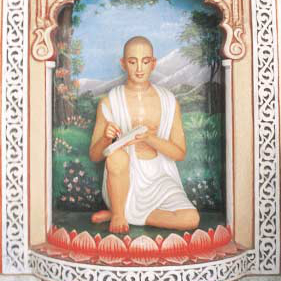
The word jana means both female and male beings. Srila Rupa Gosvami has written in the Bhakti -rasamrta-sindhu, a devotee should associate with devotees who are more advanced.
Scriptures often state that without the association of the Lord’s devotees, bhakti-devi does not manifest in the heart. It is most necessary for sadhakas to associate with devotees. Therefore, in this context, the word jana-sanga is understood to mean persons who are devoid of devotion. That is why Srila Rupa Prabhu has included the instruction to give up worldly association as one is the limbs of devotional service. In the Bhakti-rasamrta-sindhu, 1.2.43, it is said one who desires to attain devotion to Krsna should carefully give up the association of worldly people.
That means the devotee should not engage in the activities mentioned in the fourth verse of the Upadesa Amrta, with worldly people. Activities like talking with worldly people in the course of one’s work is not considered association. When the same activities are done with affection for someone, then that is considered association with that person. This is very important. It is said that it means that someone who performs sinful activities, then to associate with such a person is also considered a sinful activity.
But then it is very careful to point out that just sitting with them, eating with them, riding in the same carriage with them, that is not association.
But at the same time, as later on, when he is defining association, then he says it is exactly the same thing. You understand? So then it would be confusing because you are eating with them or being involved like that. The difference is when it is done with affection, it is association. When it is done without affection, it is not association.
Parents. I see.
Basically. So in other words, it is being done, you are interacting with them on the… See, in other words, they are materially worldly -minded. So then that means that all they are going to deal with is on the worldly platform. Right? So whatever is the appropriate etiquette of worldliness and interacting, then that much is done. You know what I am saying?
They are doing it out of affection. They are talking about the weather and this and that. You are doing it because that is the etiquette. Does that make sense?
Yeah?
Okay. It does not mean that what is appropriate, the proper way of talking or tone of voice, then that is fair.
Does that make sense? It says that the true association is advanced devotees. But you know, the most problematic is to associate with those who are on the same level because the ego is the biggest. Ego is the biggest if it is on the same level. Yeah, because it said here that the true expression is also the least effective.
So, why would equals? Then what? I am just saying, how do you get to the point of the equals?
It just says, most necessary versatile is to associate with devotees because it said, scriptures often state without the association, then Bhakti Devi does not manifest. So, that means you have to associate. Here, devotees should associate with devotees who are on the level. Yes.
So, it is the most beneficial.
Yes. But the most, it means it will help us the most. Yes. But there are three types of associations.
Right.
Equals. But how often do you actually meet an equal?
Every day. Every day. Because generally they are either a little above you or a little below you. Like that. The ones that you have that, you know, that chivalry is with them generally when they are exactly equal. You know what I am saying? But then that is more fun. But for others who are in the, you would say the category of equal, then yeah, generally there is more difficulty there. It can be. But it can happen anywhere. So, the point is that you, in other words, in that then you associate with that quality within that person that you feel is the special feature. Like that. You know, you focus on that. And then those that are not, then do not worry about them so much. So, shall I paraphrase this? It is better, the most beneficial association is the one that is more advanced? Yes. Among the three types. So you should always seek the more advanced associations? Yeah.
Yes. I mean, one is looking for that, but the point is that it is done in the association of devotees. But one should be trying to associate with those more advanced than oneself. So that can either be they are all around more advanced, or you are associating with whoever it is through that quality that you find is of value. You know, like that. So that way even though they may not be across the board more advanced, that particular quality you will respect. Is that so?
Every practicing devotee should know the various kinds of worldly people. Therefore, we are hereby most unwillingly enumerating these people, right? Because before it was mentioned that Prajalpa means talking about others, right? So pointing out weaknesses or faults or other things like that. So only because it is beneficial, therefore, it is being talked about. So he is not happily discussing this, you know, as one might discuss other topics, right? Otherwise, one will think, well, he talked about it, therefore, we know. It is just a matter of what is. These worldly people are of seven kinds. One, Mayavadis and atheists. Two, sense enjoyers. Three, those who are, those, I guess it is those who are fond of the sense enjoyers. Four, women. Five, womanizers. Six, the hypocritically devout. And seven, the ill-behaved, foolish outcasts.
Basically covers it, right? Well, yeah. Anyone left out here? No, I don’t think so. I was just wondering that… Means he will go through and explain them all. OK. Yeah, let’s just… Then when it gets to there, it will probably be more clear, right? Yeah. The Mayavadis do not accept the eternal name, form, qualities and pastimes of the Supreme Lord. They consider the living entity and the process of bhakti temporary manifestations of maya, right? It is the same as in the other one. All the Mayavadi conclusions are opposed to the principles of devotional service, and therefore, by associative Mayavadis, one’s devotion gradually disappears, right? So they are, you know, they are the worst. Association with sense enjoyers is harmful because they are filled with blasphemy, envy, violence, quarrel, argument and hankering for sense enjoyment. Their lust is never satisfied, and thus they never have time to hear topics about Krsna. Whether pious or impious, the sense enjoyers are always devoid of sambandha-yam. So this is someone who is committed to, you know, enjoying their senses. It doesn’t… It’s not specifically meaning the common person, right? But at the same time, they are also committed, so in that way you could say anybody. But these are specifically ones being careful because here it’s that, whether through pious means or impious means, but they’re always busy trying to take care of the senses, right? So that’s the point. So there’s no time for hearing about Krsna. And they’re very enthusiastic, committed to the idea that you can enjoy in the world. So the Mayavadis, that there’s nothing here, it’s all illusion, and there’s nothing in the spiritual world, so it’s all just illusion. So that doesn’t make much for devotional service. Here it’s that they’re just engaging in the sense of simply enjoying themselves. So they’re the center of attention. They’re the controller and enjoyer. And they’re always busy doing these things. Besides that, because they’re so committed to that, then all these other qualities, blasphemy, envy, violence, quarrel, argument, hankering, those are all very prominent, right? Because the more you endeavor, then those qualities will come up, right? You’re trying to control those, then those come into control, right?
Those who accept externally sense objects just to maintain body and soul together, but internally engage in their constitutional position as servants of Krsna, are not counted amongst these sense enjoyers, right? So it’s not that the senses are connected or the sense objects is the problem. It’s your commitment to that connection that that’s the source of happiness. That’s very important, because otherwise they will say, oh, he’s a nicely situated grhastha with all facilities, he’s a sense enjoyer. No, that’s not what it means. It means someone who’s committed to that. It’s not someone who, yeah, in the course of their duty, maintain body and soul like this, that there’s interaction of the senses and sense objects. I think most devotees, this is where we have that problem. This is the problem between the temple and the community, or between the brahmacharis and the grhasthas.
Yes, people don’t see that each person has their quota, basically. Yeah, everyone has their quota. Someone has more, someone has less. It’s the idea that everything should be equal. Then that’s not the thing, because if everything should be equal, how should it be equal? Who defines equality, right? So therefore this brahmachari has very little, everyone should be equal, so everybody should be like him. No, no, no. It won’t work like that. The idea, when the person who says it should be equal, means equal according to his standard and his definition, right? That’s the point. So it’s not actually about equal, it’s about everybody doing what they want. Who was it that said we’re all equal, it’s just some are more equal than others? Yes. Snowball. Snowball and animal fun. Snowball. Yeah, yeah, yeah. That was the particular name of the pig. His name was Snowball. So, quoting Snowball. Yeah. Yes. I’m not sure it’s bonafide. It’s very bonafide.
Snowball.
You don’t like Snowballs? I like them very much. OK. So, the…
Kodas, senses. Brahmacharis, kodas, senses. Yes, so the… Thank you. The idea is that these subtleties, because it says who externally, who accept externally, but it doesn’t mean internally that’s the mood. It’s when internally it’s accepted, that’s when the problem is there. Does that make sense? And sense enjoyers means they’re focused on that. It doesn’t mean someone’s focused on devotional service and there’s some distraction, some anarchist. That doesn’t make them a sense enjoyer. Right? That may be the area of weakness that they have to work on, but it doesn’t make them a sense enjoyer. It’s about seeing yourself as the controller. Yeah, it’s about seeing yourself… Because a sense enjoyer means he’s busy making, you know, plans and arrangements how he will enjoy himself.
Devotees wouldn’t be counted as basically any of these worldly people, because he said in the… The word jana means both male and female beings. Right? So the point is that if one’s a devotee, one’s not counted as the seven. But if one is not a devotee, then one generally falls into one or many of these seven categories.
Yeah.
Yeah, they could probably end up being all seven of them, you know? That wasn’t a question earlier. It means could you be all seven? Could you actually max it out there? Well, let’s say it means… Going by means only because you mentioned it this morning. If you go by your position, then if you take a, how do you say, homosexually inclined female, then she would be a woman and a womanizer.
Right? And she could therefore be focused on that. She would most likely be a sense enjoyer. And she probably has other friends like that, so she’s fond of them. So she’s fond of sense enjoyers. She could be a Mayavadi or an atheist by the proclivity. She could at the same time, you know, be some other kind of, you know, how you say, religious sentiments. And be from a very uncultured background.
That beats you on an essay. Yes, that beats me on an essay.
Okay, so there you have it. It’s not far-fetched. It’s not far-fetched. Probably if you check in Amsterdam, there’s quite a few. Amsterdam, Berlin, you know, there’s probably quite a few.
Okay, that’s probably why you asked. So, uh.
I gotta go. Excuse me.
Okay.
There are some people who are not themselves sense enjoyers, but they take pleasure in associating with sense enjoyers. Their association should also be renounced, because they will soon become sense enjoyers in bad association themselves. You know, like they have a group, you know, of people. There’s the one, there’s the wild guys who all, and then there’s the guys that just like being around and just singing and stuff like that. So it’s just a matter of time before they become like that.
There are two types of sense enjoyers. Those who are extremely attached to sense enjoyment, and devotees who are attached to sense enjoyment. Associating with those who are extremely attached should be totally rejected. The devotees who are attached to sense enjoyment are also of two types. Those who have included the Lord as part of their sense enjoyment, and those who have kept the Lord in the center of their sense enjoyment. Associating with the latter type is preferable to the association with the former. Right? In other words, with sense enjoyers, there are those who, you know, extremely attached, and devotees who are attached. So generally the devotees aren’t extremely attached, but in any case they’re attached. So the non-devotees are extremely attached because that’s all they have. Now of the devotees, then you have those who, Kṛṣṇa’s part of their sense enjoyment, or who Kṛṣṇa’s the center of it. The one who Kṛṣṇa’s the center, then that is progressive. The one who is just part, then it won’t be as progressive. So of the two, then, you know, yeah, does that make sense? Elaborate on that. Elaborate. Let’s say someone, you know, they really like eating nice food, so then they always are, you know, cooking for Kṛṣṇa and doing nice things for Kṛṣṇa, but they like also eating, so then, but it’s connected to Kṛṣṇa. But you have the other person who’s just, you know, he likes nice food, and he likes nice arrangements, and he likes hanging out with his family, and this and that, but it’s, Kṛṣṇa’s not exactly the center. It’s prasāda, but it’s not that Kṛṣṇa’s the center of the enjoyment. It’s that, you know, he connects it to Kṛṣṇa, but it’s not, Kṛṣṇa’s the center of it. That’s grihasta, grihamedhi. Grihasta, grihamedhi, yeah, it can also be that depending on how it is, it could be grihasta, but it’s not so nicely, consciously the center, you know, like that. It’s grihamedhi, it’s, yeah, he is, we’re talking about devotees. Yeah, well, can we classify them as grihamedhi? You can, because it’s, Kṛṣṇa is, as part of their sense, in other words, they’re devotees, but their family, or their money, or their security, or their other issues are most important, and then Kṛṣṇa’s part of that. So, you generally, as a normal thing, wouldn’t classify them as a grihamedhi, but technically they are. Just like the devotee is engaged in karma yoga, you don’t classify as, you know, he’s a karma-misrabhakta, you understand? You only use that when you’re dealing with the actual exactness of the anartha, you know what I’m saying? Because, I mean, he’s pointing out, grihamedhi in that Kṛṣṇa’s not the main focus, like that. So then that can put him there. In other words, if their intent that Kṛṣṇa’s the main focus, but they’re not so good at it, you wouldn’t count them like that. But it’s like, they’ll have their philosophy of why they only do so much, you know, direct devotional activities, or only take part now and again, and they’re just being practical, and, you know, they have to take care of themselves and the family, they have duties, you know, they’re not irresponsible like others, and, you know, all this, they go blah, blah, blah, blah, blah, blah. Did I miss something? No, okay. So, like that. I mean, the blah, blah, blah covered it all.
So then the point comes up is that, that you would say is that the weaknesses, they’re situating themselves like a grihamedhi. Their intent, I’m sure, is not to be one. So technically you wouldn’t count them as one. You know what I’m saying? But the point is, is the grihamedhi is doing what is right. We generally take it grihamedhi means the gross, disgusting materialist. They are also grihamedhis. But the example given to Bhagavatam is a pious person following the Vedic culture. Right? So they’re pious, they’re good, they’re nice, they do everything wonderful. So because we will make the mistake of counting piety as devotional, then we can sometimes not understand that just being pious is not Krsna in the center. When it’s devotional, then Krsna is in the center.
Does that make sense? Right? In other words, these kind of discussions aren’t for general use. They’re for analyzing one’s own self and if one can help with others. Or analyzing that, okay, I should be careful in this association. But it’s not for general discussion. It’s not a general terminology. It’s about always finding the constructive. Yes, you’re trying to find a constructive angle. But it doesn’t mean that constructive isn’t the glass is half empty. But the point is, it’s being dealt with in a constructive way. How to take this and apply this of use to one’s Krsna consciousness.
But it’s not that we just say it’s useful. You have to make it useful. Because you say it, that’s nice, but you have to make it useful. You have to take the responsibility of taking it to that degree that the person understands it and see how to practically use it. Good.
Okay.
Although those who are engaged in sense enjoyment according to religious codes are better than the sinful sense enjoyers, still the practicing devotee should not associate with them until they become devotees. Right? Because, mentioned before, the sense enjoyers may be pious, whether pious or impious. You know, like that. So even they’re pious, one should avoid associating with them. Right? Remember, association means with affection. You have some business with them, some reason for interaction, that goes on. But one doesn’t become close or intimate until they become devotees. So now they’re pious, they’re devotees. Now they fall into the category of the devotees where maybe Krsna is the center or Krsna may be part. You know, included. Right? Does that make sense?
Considering all this, the practicing devotee should give up the association of sense enjoyers and those fond of them and engage in devotional service in a secluded place or, if he is fortunate, in the association of genuine devotees. In other words, if there’s no one else, no genuine devotees, then one might be on one’s own. But it’s not a preference. It’s not that this is the best thing for devotional development. You know, it’s not nirjan-bhajan. No, this means that there’s no one else. Like that. If there’s no food to eat that won’t make you sick, then better you fast.
You know? Does that make sense? So like that. But if he’s fortunate, then he’ll get the association of the devotees.
Could you say a little bit about without affection? Dealing without affection. OK. I thought you said dealing without a faction. And a faction means, you know, a party, you know? I thought that was just part of the northern Surya. How do you deal without, you know, the greens and the oranges? How do you deal without that? The guy’s autumn, obviously, is green.
Yeah, but he’s an orange.
Saffron. Yes. Saffron. The saffron faction.
It means that you’re dealing according to the etiquette. It doesn’t mean you’re not good at it. You know, as we said before, the person performs their part or their role. It’s not that they’re not good at it. You know what I’m saying? It’s not that the guy has to think he’s King Lear or love King Lear to be a good actor. He plays the role appropriately. But it doesn’t mean… Does that make sense? So one deals very nicely with what’s appropriate and things like that. But the point is, is one’s seeing it because they’re actually servants of Krsna, whether they understand that or not. That’s another thing.
You know what I’m saying? But when they understand that they’re servants of Krsna, then you can become close.
Does that make sense? So you give association. You don’t take association.
It’s not that you’re not performing the role on their level, but you’re not dealing on the same level of consciousness.
You know what I’m saying?
A lamenting session about the body, then you don’t have to go. There’s all kinds of important other things to do, you know, like that. You know, you say, oh, very nice. Well, thank you very much. I’m so happy you considered me and all that. But fortunately, I already have something I got to do. What’s that? Oh, I’ve been invited to a, you know, being really happy about, you know, being on the Transcendental Platform meeting. So it’s like a sorry to conflict, you know.
It’s a tough one. Yeah.
So with parents and family and such, sometimes, just in general, like conflicts may arise because they used to see you engaged in activities that you’re no longer engaging in. Yeah. And so then having respect towards your parents and dealing nicely compared to having these principles, sometimes it’s a little difficult to… No, but the point is, is they have to accept people change because they don’t mind that you’re not, you know, smoking dope and doing other things now. So they shouldn’t also mind that you’re doing those things that make it so you’re not doing those.
You know, the point is, is if you interact nicely, there’s not a problem. You know, the point is, is you eat something different or these things. It doesn’t matter as long as you interact nicely. But if you get all preachy about it, in other words, they eat what they eat, you eat what you eat. So, you know, work on the principle they don’t bother you, you don’t bother them, you know, like that. You know what I’m saying? But if you make what you’re eating interesting, they might want to check what you’re eating. And so then they get some benefit.
You don’t need to check, period. I heard an interview with Baba Nanda. And he was saying, well, back in the day when he joined, it was like suddenly his parents, his mom’s pots were contaminated. She was contaminated. The house was contaminated. He was talking about… The whole of Jersey was contaminated. Yeah, that was kind of like the… The only benefit was the Hudson River.
But the point is, is it’s how you deal. You know, the point is, is it’s… It’s the… You see, the newness of it, then one can’t discriminate. So better they remain Krishna conscious, but due to their lack of discrimination socially, it doesn’t necessarily go so well that you’re a devotee. Because being a devotee is more important than being, you know, socially so perfect. Yeah. So, but the point is, is as one develops, one should be able to be a devotee and be able to interact properly. That’s all. So it’s just the newness of it. It’s not that devotees can do any better nowadays. Some do. You see, you’ve seen your mature devotees. They’re able to do. But a lot of the others, they can’t. They either completely stay away or totally involved. They don’t know how to, you know, maintain your position at the same time, be very pleasant and nice.
Does that make sense?
Yeah. It’s kind of… Yeah, yeah. It reminds me sometimes… What is it?
I don’t know. What’s their company? One of them, when they start, you know, on their little thing, you know, it goes…
It starts… Like that. So it’s kind of like…
A little starry one. They can play over it. Yeah, yeah, yeah. It’s already on for you. Yeah, yeah. Yeah, yeah. Like that. You can also use that star if you’re in a meeting with Mayavadis. Huh? You can use that beginning if you’re in a meeting with Mayavadis.
Oh, yeah. Yeah, yeah, yeah. Yeah, yeah. Yeah, they’d probably appreciate it.
Yes.
Okay. Okay. A practicing devotee should not associate with women. On the other hand, when a woman is engaged in sadhana bhakti, she should not associate with men. Associating with the opposite sex is very inauspicious for the advancing devotee. When a man and woman are married according to religious principles, there’s no sin in their touching and talking with each other. Rather, this touching and talking is beneficial because of the scriptural sanction. There is, however, no provision for illusory activities other than the execution of reciprocal duties. If they are illusioned by each other and they engage in activities other than prescribed duties, then that is called stri-saṅga, or puruṣa -saṅga, or association with the opposite sex. For those who are engaged in worshiping Kṛṣṇa, such association yields inauspicious results. If either one is guilty of such association, then they become an obstacle for the other party. Considering these points, the practicing devotee should very carefully give up the association of women and persons fond of women.
As stated in the Śrīmad-Bhāgavatam 3.31 .35, the infatuation and bondage which accrue to a man from attachment to any other object is not as complete as that resulting from attachment to a woman or to the fellowship of men who are fond of women. For a renunciate, there cannot be any type of talking or touching a woman. Otherwise, his practice of devotional service will be completely spoiled. Association with such a deviated person should be totally rejected.
So, here then it means that someone’s not married, then there’s, except for the basis of service, then there’s no need of interaction. If it’s based on service, then the service is going on. But just to, to, how you say, social exchange, right, that, that’s not important. That doesn’t mean if it’s, you know, means here someone’s known or someone’s senior or someone’s, you know, related or something like that, you’re not saying hello or something. But it just means that there’s no, there’s no need of just, like you’d hang out with the boys, or the girls hang out with the girls. You don’t do that. That kind of thing’s not there. So if someone’s married, then if they’re associating, you know, interacting, they’re talking, they’re touching, then that’s not a problem, right, because that’s what śāstra recommends. But he said according to śāstra. So what’s according to śāstra, that’s not a problem. If it’s not according to śāstra, or one is, it means, you know, how you say, what, illusory activities, means one is not seeing the cultural element, I mean, the śāstric element of this. And one thinks that this is the cause of one’s enjoyment. That’s a problem.
Does that make sense? That’s a problem. So if one or both are in illusion, that’s going to be a difficulty. But if it’s seen properly and it’s according to śāstra, then there is no illusion here. So it won’t get in the way of the devotional development.
Yeah, so someone who is under that illusion, or someone who is, yeah, if one is illusioned about it, or dealing with a woman who is an illusion, or a man who is an illusion, that should be given up, and given up the association of those who are in that illusion, and therefore find this good.
Right? Does that make sense?
Because it says that there will be, the infatuation and bondage you’ll get from this association with women, there’s nothing that’s going to be more than that, because it’s all inclusive, right? Anything that there is in the world, basically one can involve it in the association with women. Does that make sense? Other things, you know, you have a friend, you can’t involve as many things.
You know, you and your friend are, you know, fixing your pickup truck and all this and that, and then you stop and go, hey, it’s the sunset, you know, let’s sit in the back of the truck and watch the sunset. You know, it doesn’t matter, right?
You know what I’m saying? So, there’s not as many things, you know what I’m saying?
True, we won’t go into that. Yes?
Can it be considered as an anarta? Can it be? Yes, it’s an anarta. Because you’re practicing and what?
Yeah, no, it’s an anarta. It means all these things are things to be given up, so anything to be given up would be considered to not have given up, that’s an anarta. One’s given it up, then that’s favorable, but if one hasn’t, anarta means that which is not favorable that hasn’t been given up yet. Does that make sense? So, it’s a matter of the attitude. We see in it, it’s not the situation, it’s the attitude, right? Of course, there are ones who are situation, right? You know what I’m saying? But it’s more the attitude. You know, like the gross sense enjoyment, enjoyer, is someone who, they have faith that they’ll be happy through that. The devotee is engaging the senses, but he doesn’t have faith that this is what’s going to make him happy. By habit, he’s involved in things like that. Does that make sense? But it doesn’t mean that he has the faith that this is the main thing, so therefore, he’s in a different category than the gross sense enjoyer. But of those, those who see it connected to Krishna and those who, it’s not so well connected, then the one who’s connected is proper. So, for oneself, then this thing is that, therefore, understanding the connection between man and woman and connection with the scriptures, like that, and devotional service, then that’s not a problem. That’s not this Sri Sangha or Purusa Sangha that he’s talking about. Right? But if one doesn’t, then that can be a problem.
Does that make sense?
Once you give up the association of dharmadvajis, the hypocritically devout, the dharmadvaji is, he makes a big show out of his devotion. Everybody has to know, you know, like that. With special care, means that he gives up. Those who accept the external signs of dharma but do not actually follow dharma are called dharmadvajis. Means if he’s actually following in that and he just wants everybody to know, then that just means he’s got a big ego. You know, he’s like that. But, so it’s not as good or pure as Prabhupada. But one who makes the show of it, but it’s not really, then that’s the… How does sahajiya compare to this? Sahajiya?
There’s a little similarity, I think. There’s a little similarity, but it’s also… Yeah, yeah.
Yeah, but the point is that they’re making a show out of sanatana dharma instead of just any other old dharma.
Well, see, he’s going to get into it here. There are two types of dharmadvajis. The hypocrites and the fools, or the cheaters and the cheated. Such hypocrisy in janakanda and karmakanda is also condemned. In devotional service, this hypocrisy ruins everything. Better associate with sense enjoyers, for in this world, there is no worse association than the dharmadvaji. So here he’s applied this dharmadvaji in jnana, karma, and also in devotional service. So that would be the sahajiyas.
Right? But someone’s a big, you know, thinker or a big renunciate, but it’s only a show, or someone’s a big, how do you say, karmakanda. But show means that they know they’re making a show out of it. It doesn’t mean that they’re attempting to, but they’re not doing a good job. Does that make sense?
Yeah. Um.
Yeah. Are you throwing in any gold stars in his teeth? Yeah. He’s got to have a gold chain, right?
Like that, you know. Try not to kick the tires.
You can, I mean, these would be the externally, you know, hypocritical attitude, but the principle is there, but they may be applying it within it, making a show that they’re very devotional and so worried about it and all this and that, but they’re not necessarily. There’s another purpose.
Does that make sense?
Pretender, yes. Pretender. Yeah. It means hypocrite as a pretender.
But they make the show that they’re not pretending.
That they’re sincere, but they’re not actually. There’s a purpose. In other words, there’s agenda other than pleasing Krishna to their, to their, you know, devotional activity.
You understand? It’s not that you won’t have due to false ego and pride and all these things coming up. You have to see that this is their basis of their association.
Does that make sense?
What’s his name? I’ll have to try to… Manu gives very exact definition.
What are the qualities and how they work. When are we dealing with Manu?
That may be this after Gaurapurnima.
Like that. Because we’ll just take that slot and every year it works out.
But the Bhakti Anujana, I’m not sure how long it will take. It might take the full 12 years also.
Because somehow I can’t reduce it below what, you know, the essential points. So I don’t know how long that will take.
All right. Better enjoy sense enjoyers because it’s direct. You know that they are sense enjoyer. They claim to be a sense enjoyer and they’re involved in sense enjoyment. You know what I’m saying? At least it’s direct. But it’s still bad. And it’s supposed to be given up. So the point is this is worse. They’re presenting themselves not as sense enjoyment but as religious and all. But they’re not actually.
Externally exhibiting the symptoms of a Vaisnava while internally remaining a Mayavadi is actually pseudo-Vaisnavism or hypocrisy. In Sri Caitanya-caritamrta, Antya-lila 13.93 .109-1010 there is a description of Ramadasa Visvasa who was externally a great Vaisnava devoted to Lord Ramacandra.
Ramadasa had renounced everything and was going to see Lord Jagannatha. While traveling, he chanted the holy name of Lord Ram twenty-four hours a day. When Ramadasa Visvasa met Sri Caitanya Mahaprabhu, the Lord did not show him any special mercy although this was their very was their first meeting. Within his heart, Ramadasa Visvasa was an impersonalist who desired to merge into the existence of the Lord. And he was very proud of his learning. Being the omniscient Supreme Personality of Godhead, Sri Caitanya Mahaprabhu can understand the heart of everyone and thus he knew all these things.
Unless one gives up the association of this type of dharmadwaji, one cannot purely engage in devotional service. So that would be your jnana-kanda dharmadwaji, you know, like that. It seems like atheists like to project these types of behavior onto all religious people.
Yeah. Well, that’s there because they themselves are… Kind of like that. Yeah. It means it means finding the fault is the easy point, but the point just because the fault has been found doesn’t mean that that’s the that’s the the volume of it is considerable or important. You know what I’m saying? Because there’s always… The point is is within the area is it good? Like George Washington. He’s the… You know, he was a great statesman. He was a great general. I think he was… He may have… When he was fighting in the war as a general he was 21 years old.
So, so, so… You know, and so these things… You know, his honesty was very good you know, in that area. Then he was a great statesman. You know, he worked out a… You could probably say the most stable and sustainable democratic political system. So from that angle then you’d have to say he was good. But then on the other side you don’t bring up you know, halfway through that when everyone’s yes, he’s this and he’s that and go… But he died a syphilis.
You know what I’m saying? It’s a different discussion.
Does that make sense? So, the difficulty is is that we have to see that we don’t use that. And that’s generally what will be used is that they don’t have faith so they’ll always find the fault. But the point is is those who are atheists you can also find the fault. So the point is finding fault that’s the easy thing to do. Being able to find something’s of value that’s more difficult. Right? It’s just like you go into some of these big department stores. It’s all schlock. Right? Now to be able to find something in there of value that’s something.
Yeah. You know what I’m saying? But, you know it can be done.
Of course, it’s easier to go into a boutique. It’s easier, but you know what I’m saying.
Ah. Unless one gives up the association of this type of dharmadwaji one cannot purely engage in devotional service. Here comes the good part. Most of the people in the world are of this type.
Right? They look religious but you ask them God, he’s impersonal. So technically it’s their you know sub-variety of dharmadwaji.
Therefore, until one gets the opportunity to associate with the pure devotee he should pass his life engaged in devotional service in a solitary place. So therefore better alone than with such personalities.
Sorry?
It’s true. There’s two fifteens.
Yeah, the other day we had one and it went back and I was reading from the thing before and somehow the sentence just basically worked. It connected. But in the context it didn’t. But you know you could discuss it and bring it into the context until someone pointed out no, I think it’s the other page. Okay.
Okay. One sixteen.
The worship of Krishna is not enhanced by associating with ill-behaved foolish outcasts. Okay. What did he He gave the seven.
The hypocritically devout and the ill-behaved foolish. So he gave the different varieties of hypocritically devout.
So you see is that you have the sense and joy those who associate or appreciate women those who associate.
Right? Like that. So there’s always that you know element.
They are naturally attached to eating meat and drinking wine. And they are not situated in varnasrama dharma. Their character is always unregulated. By associating with ill-behaved persons the mind becomes polluted. But if those persons become faithful in devotional service by associating with a Vaisnava and they gradually get a taste for worshiping Krishna with a pure heart then their association is auspicious.
Even if they commit abominable actions for some time due to the former nature still they are sadhus.
In other words someone who has taken up the devotional process even if they are new to the process even if they have so many bad habits but when you are associating with them you are associating with them just on the devotional platform. Right? You are not going back to their house and engaging in all kinds of stupid things. Right? They are at the temple they are there they are enthusiastic they are chanting they are helping they are doing all these things. It doesn’t mean that they still don’t have bad habits. But they are considered sadhus because of their commitment to the devotional process. Does that make sense? You associate with them on that level.
In Bhagavad Gita 9.30.31 it is said even if one commits the most abominable action if he is engaged in devotional service he is to be considered saintly because he is properly situated in his determination. This is determination is to be Krishna conscious. He may not be so expert at the practice but that’s his determination. So the determination defines.
He quickly becomes righteous and attains lasting peace. O son of Kunti declare boldly that my devotee never perishes.
The purport is this if the outcasts attain faith in unalloyed devotional service by some good fortune then it can be said that they have attained the genuine path. Now you can understand also the difference here is that when Bhaktivinoda Thakura was there then the Dharmadwajis were the most people of this world. And so 150 years later then the foolish outcasts seem to be more prominent.
But you know here is taking those who you know consider themselves religious and like that.
So one could be a foolish outcast and be a how you say a Dharmadwaji.
If the outcast attains faith in unalloyed devotional service by some good fortune then it can be said that they have attained the genuine path. There is no doubt that in a short time they too will become pure and peaceful by following the footsteps of Haridas Thakura. Peace means there is no material desire. That means for karma or jnana.
Ill behavior due to one’s nature unnecessarily remains for some time. Even then such association cannot be called bad. In the Srimad Bhagavatam 11.20.27-29 the symptoms of such person is described as follows. Okay. So having awakened faith in the narrations of my glories being disgusted with all material activities knowing that all sense gratification leads to misery but still being unable to renounce all sense enjoyment my devotee remains happy and worships me with great faith and conviction even though he is sometimes engaged in sense enjoyment. My devotee knows that all sense gratification leads to a miserable result and he sincerely repents such activities. When an intelligent person engages constantly worshiping me through loving devotion devotional service as described by me his heart becomes firmly situated in me. Thus all material desires within the heart are destroyed.
The conclusion is that the association of pious and sinful persons who are bereft of Krsna consciousness is undesirable. On the other hand the association of devotees who are sinful yet devoted to the Lord is desirable. In other words you are not associating with them on the platform of their performance of sinful activities. Does that make sense? But when they are engaged in devotional service and you are associating with them at that time their association is not bad. So this whole idea is that oh there is this fault in that devotee so there is nothing good about their association and they should be cast out. Right? That doesn’t fly. That’s the meaning of there’s still sorrow because the devotional those are good. Right? Where they are weak that’s another thing.
Yes. It will go away because it’s by bad habit. Remember we are talking here about the foolish outcasts.
Then they take up devotional service. He didn’t mention this point with anyone else. Though it can be there but it would be there in a milder form. Right? In other words what is the problem with means the husband and wife are associating based on Shastra. Right? So that’s fine. But let’s say that basis on Shastra they are in illusion about the material happiness that they will gain from it. That’s the weakness.
You know what I’m saying? But the point is what they are doing that’s improper is still according to piety.
Does that make sense? Yes. But here we are talking about the foolish outcasts. The ill behaved foolish outcasts. Here then by necessity is going to continue with his sinful mentality.
Does that make sense? You know it says he was you know how you say their character is unregulated. Right? They are not situated in Varanashram Dharma. Right? They will be unclean. So those things might continue. They can’t we are still discussing whether Varanashram is important or not. Right? Varanashram means human life. Right? If we discuss the five symptoms of human life right? Protecting women, cows, you know brahmacharis, old men and brahmins we only discuss them one at a time and even that’s political.
Right? You know the women’s movement it’s a political movement. It’s not part of the Varanashram system. Right? The gurukulis then it’s a political movement. You know what I’m saying? Or they get into cows but it’s only because they’re into cows so everyone should be into cows so it’s occupation. It’s not ashram.
Does that make sense? Like that. Old men then it’s a it may be some will understand it appropriately but some will just see it as welfare.
Right? Brahmins aren’t discussed.
You know except for how to control them they shouldn’t be managing so we should take care of their money.
Does that make sense? So the point is it’s still these are weaknesses so it’s understood but that doesn’t mean that the devotees aren’t sadhus.
You know what I’m saying?
So their association is desirable.
You know? Does that make sense? But you’re not associated when they’re being unclean or non-Varanashramic or you know what I’m saying? Of course you would also avoid if they’re eating meat or wine. You know? So like that. So does that make sense?
So those are the obvious ones we’re bringing out the more subtle.
The Bhakti Rasamrita Sindhu 1.2.51 quotes the following verse spoken by Maharshi Katyayana in the Katyayana Samhita. It is better to accept the miseries of being encaged within bars and surrounded by burning flames than to associate with those bereft of Krsna consciousness. Such association is a very great hardship.
So that so intellectually interesting but it might be too crass. I was going to say those those in the how you say? It was better to accept those misery means if we go back to the Spanish it was better to accept those than to associate with the Dharmadwajis who put him in that situation.
Not overly presentable.
Yes, not at all. But it’s not that the person in the cages weren’t also Dharmadwajis. So that’s that’s that weakness here. While practicing the devotional service one should carefully understand this subject and act accordingly.
Srila Prabhupada describes Jana Sangha as follows. One should also avoid association with Mayavadis who simply blaspheme Vaisnavas, devotees. Bhaktikamis who are interested in material happiness. Muktikamis who desire liberation by merging in the existence of the formless absolute Brahman. And Siddhikamis who desire the perfection of mystic yoga practice are classified as atyaharis. It means in other words eating more than what you need. To associate with such persons is not at all desirable. Right? Because here atyahara means over, means anything to overeat. So to overly accept something. So to overly accept something not useful in devotional service is also atyahara. So, you know, impersonalism, you know, bhukti, mukti, siddhi, kami, all that’s not desirable.
Sixth, summary of Srila Bhaktivinoda Prabhupada’s essay on lalyam, ardent longing or greed.
The meaning of the word lalya lalya is restlessness, greed and desire. Interesting because one devotee was saying he’s restless, you know, he gets restless and so Prabhupada said read the books. Sit and read. I mean one is that if you’re restless you don’t want to sit down. Instead of having to sit down you get purified. But by reading you get purified and then it goes away. In other words it’s a symptom of lalya. Otherwise what makes you restless?
Right? Like someone who always has to travel, what is it called?
Wanderlust, right? So it comes to this that, you know, this kind of, you know, so much desire and what, you know, so, so it’s just similar, just applied in a different way. Restlessness is of two kinds. Restlessness of the mind and restlessness of the intelligence. The material mind follows the dictations of the senses which give rise to attachment and aversion. Thus, restlessness of the mind is of two types. Restlessness due to attachment and restlessness due to aversion.
Right? So then the mind will be connected to the senses so it’s either the senses want to be connected to something or they, or one doesn’t want to connect that. Right? So, so both one is restless. Right? In order to overcome the restlessness of the mind, one should dovetail all sensual activities in the service of the Lord and the attachment to sense gratification should be transformed into attachment for the Lord. Then the mind becomes, because you’re attached to the sense gratification because there’s a result but that result being for Krishna then you become attached to Krishna. So you’re, the sense engagement becomes connected to the Lord and the Lord becomes the goal. Right? So then from both those sides then the activities dovetail so then it becomes, becomes purified.
Then the mind becomes fixed in devotional service by taking shelter of that attachment. Right? Means the mind’s going to go to the attachment but you connect the attachment to Krishna.
You know? Does that make sense? Like the person is attached to food so you offer the food to Krishna. Then by eating, by being attached to the food he’s actually connecting himself to Krishna. So he becomes purified. So that’s, that’s, that’s the trick.
So now you can get out your bucket, right? The bucket is back. The bucket is back.
One has to arouse a mood of devotion in all sense objects, taste, form, smell, touch and sound and enjoy them. Then devotional service is cultivated. Right? In other words, you see a connection to Krishna so you’re happy in connection to Krishna. Therefore, then you’re cultivating that. It’s slow. It’s indirect. But it’s, it’s progressive because by it you’ll gain knowledge and detachment so that you’ll become freed from it. You have knowledge so you become freed from it but the cultivation of it in connection to Krishna that will develop the devotion. So it’s attraction to Krishna then that will carry on. Does that make sense? You know, that’s all what we were discussing previously about the, the, the method of bhūti -yoga. You know, how to connect the senses and the mind, intelligence and senses to the Lord.
Among the objects of the senses, aversion should be applied on any that are unfavorable for devotional service and attachment should be applied on any that are favorable for devotional service. Right? So in other words, the, the, the senses, one of, the mind wants to engage the senses so you’re applying the aversion and attachment. So those things you’re attached to that you can engage in the Lord’s service, then that attachment is what’s cultivated. If the, if, if attachment is not going to work then aversion is what is cultivated. Right? But still, attachment and aversion are still duality. The point is this, as we said before, what we’re, the, the previous point was about indifference. Right? That’s actually neutral. Right? Because we’ll take it that I’m attached so if I’m, if I’m averse then that’s advancement. No, that’s how the Mayavadis would look at it. It’s that I’m attached and then, so if I’m indifferent that’s advanced. But indifferent doesn’t mean the modern indifferent where indifferent means you don’t interact nicely. Indifferent means you have no need. You know what I’m saying? Does that make sense? The brahmacari is averse to women so they’re, and therefore when it comes time to serve prasad he just goes down the line quickly and, you know, you know, gets out of there and is like that. He can’t do a proper job like that. You know, so that will annoy the women. So the brahmacari who’s attached to the women he’ll come down very nicely and this and that and all that. That also annoys the women. Right? The brahmacari who’s indifferent then he has nothing to gain and there’s nothing to lose so therefore he will serve properly. Does that make sense? So that’s the point. Indifference on the Vedic standard means you’ll be able to do it very nicely because you have no, no, no motive.
Does that make sense? Well, in the modern context unless you have motive it’s considered you won’t do a good job.
But until the restlessness of the intelligence is vanquished how will the restlessness of the mind be checked? When the restlessness of the intelligence is vanquished the mind can regulate attachment and aversion for sense objects by the strength of the intelligence.
Okay, so then the mind means you can overcome the restlessness of the mind by dovetailing by the sense objects either positively or negatively. Right? But that will be difficult because the mind is attached to the senses and the restlessness so therefore by cultivating the removing the restlessness of the intelligence then that intelligence will be able to guide the mind to overcome the restlessness of the mind. Does that make sense? Yes? In the Krishnamurti it’s mentioned that one should learn the secret of if the desires are too big reducing, shrinking the desires. Yes. Yeah, it means you’re engaging here the restlessness of the mind. Right? The greed, the desire. But you’re using the intelligence to see what is important and what’s not. Because otherwise it’s everything. But you reduce it. You know what I’m saying? It’s just like in the previous one it was discussing about engaging the senses. So the association of women so then the idea is that women are desirable.
Right? So then that’s not going to happen. If you look at it actually in reality you know you’re going to be able to enjoy all the women or all the men of the planet. No, that’s not going to happen. Right? So one has to reduce it down to what is actually practical. So that one could be with one man or one woman.
Does that make sense? You know, so like that then it’s just you know it’s because the mind just wants but if you think about it then it only wants certain things. So by knowing those certain things then you’ve reduced it down to otherwise it could be anything. You know, your options are left open. That’s what the mind does. It just leaves it open. But if you don’t leave it open you know it’s exactly this and then those you think about how to connect to the Lord either through using the attachment or the aversion. Then it works very nicely. Does that make sense? So the point is this you’re using a technique. It’s not that it’s itself ideal. It’s only a part of the devotional process. So therefore in using this then the grihastha being attached to the family engaging that in the service or the brahmachari being averse to those things it’s being used to control the mind. But it’s not ideal. You can say well the brahmachari you know this and that they have to you know but the point is is yeah but the grihastha is the same.
You know what I’m saying? It’s no different. Aversion and attachment are no different. So if you point out the brahmachari’s aversion is bad well the grihastha’s attachment is bad also. They’re both the same. The point is is they have to understand that it’s only a technique being used to get themselves to the proper platform.
You know. Does that make sense?
When the restlessness of the intelligence is vanquished the mind can regulate attachment and aversion for sense objects by the strength of the intelligence. The intelligence is that which discriminates between the mind’s good and bad propensities. That intelligence is of two types. Resolute and many-branched.
There is one there is one type of resolute intelligence and there are unlimited types of many-branched intelligence.
As stated in Bhagavad-gita 2.41 Those who are on the spiritual path are resolute in purpose and their aim is one. O beloved child of the Kurus the intelligence of those who are irresolute is many-branched. So in other words those on the spiritual path there is only one perspective. So it doesn’t matter what’s the Sampradaya or anything. It’s the devotee serving the Supreme Lord. So they’re resolute in that. You know. What is the form of the Lord? What is the methods of serving? That’s detail. But that resolution of being focused just on the Supreme Lord and His service then that’s one. There is no other determination.
So you don’t have any difference. That’s why we can say Vaisnav because it’s one determination.
Right? But when we talk about the materialists then we talk about so many. Right? Because always you’re just talking about Vaisnav. We’re talking about more or less advanced but it’s not a category. It’s still Vaisnav. But the others then you have the Mayavadis you have the, you know, the Kali-Sansangaryas those attached to the Sansangaryas the Dharmadvajis you know, like this.
Those whose intelligence is fixed in samadhi are transcendentally situated and have steady minds. Their symptoms are given in Bhagavad-gita 2 .55.56 as follows. The Supreme Personality of Godhead said O Partha, when a man gives up all varieties of desire for sense gratification which arise from mental concoction and when his mind thus purified finds satisfaction in the self alone then he is said to be pure in transcendental consciousness.
One who is not disturbed in mind even amidst the threefold miseries or elated when there is happiness and who is free from attachment fear and anger is called a sage of steady mind.
So when the desire for sense gratification is given up because mental concoction why do we use the word mental concoction? Because the idea that you can enjoy by it, it’s a mental concoction. And if you go to apply it and it doesn’t work which it can’t work because it’s a concoction then we’ll come up with a new concoction. Oh, because we didn’t do it this way that’s why it didn’t work. And like that we just go on and on and on so it’s mental speculation. So we use mental speculation to concoct new ways to be happy. Does that make sense? But there is no happiness. It doesn’t make sense but for the mind it doesn’t have to make sense. That’s why the mind should be controlled by the intelligence.
So when it’s thus purified that it doesn’t do that and it’s satisfied in just the self alone then one is situated in pure transcendental consciousness.
So he’s not going to be disturbed things aren’t going nicely he’s not disturbed things are going very nicely he’s not disturbed. That’s how you tell.
In consciousness when somebody goes to see when somebody goes to the temple to be seen by the Lord as the Vedic form where they go to see the Lord or I’m going to purify myself with this mantra so then this regard of strengthening the intelligence so that restlessness goes away and then controlling the mind then it won’t be a big endeavor unless Krishna blesses one then… It won’t be successful, no. So that’s the point is that sincere endeavor that’s when Krishna becomes pleased with that then he gives the blessing.
You know what I’m saying? Because it’s just like let’s say we’re chanting and the mind goes off someplace so the mind is being brought back but being brought back to?
Yeah. But we’re worried about that it’s going away that’s the problem. No, it’s that it’s not fixed on Krishna that’s the problem. You know, it’s just like is the problem that the kid’s going away from doing the work or that the work’s not getting done?
Yeah, so therefore that’s why you go off and when he goes the next day you go and call him back in and see that he does his work.
You understand? But we might get into the thing that no, it’s just supervising them to see that they’re not doing their work that the work’s not your focus that’s not important to you. So if that’s the mood then how one will… where would be the basis of the blessing? You know, where would be the basis of the mercy? Because you’re not interested in focusing on Krishna you’re interested in not not focusing on Krishna. You know what I’m saying? Though technically they’re the same but one’s subservient to the other but we’ve made the one prominent and focusing on Krishna secondary and the not being distracted as primary.
Does that make sense? So that’s why one has to be able to see the difference. When you’re trying to not be distracted you’re still trying to control yourself. You’re trying to control but if you’re trying to you know, this is what you can do in the process but you understand it’s the devotional process that’s controlled by the Lord and His internal potency.
So we can assist in that. But I don’t know why I said that like when Haridas Thakur was chanting he wasn’t trying to do anything. Yeah, he’s just focusing on the name. He’s just, you know, hearing the name and it’s nice, you know. It sounds nice. Does that make sense? You know, so that’s it. It’s just… Trying to control the mind it seems like a what is it called? a combination of yoga. On one level it is but if you’re trying to control the mind so that you can hear nicely about Krishna then there’s a non-difference. Then it’s always remember Krishna, never forget. But if you just focus on never forget but don’t actually the purpose not forgetting means you’re remembering then that’s where I’m saying the weakness is. You know what I’m saying? But if it’s a matter of you’re controlling the mind so that you can focus nicely on Krishna that’s good. That’s what you want to do. All we’re doing is saying that you know, always remember and never forget are non-different but there is a difference. And always remember is the primary never forget is the secondary.
You know what I’m saying? But remembering Krishna that’s the direct spiritual activity. But the never forget is dealing with the external energy that is making us forget. So because we’re accustomed to dealing with the externals we tend to take that as more important.
You know what I’m saying?
But now you’re bringing it back what’s the purpose?
The beach isn’t in the British Isles. Probably not. Unless you like freezing cold wind.
So Krishna can tell also that you know, you have to put the clothing on and play and stuff like that. You know, you’re like, please control my intelligence and nobody can tell that you’re truly getting more fixed up. So you can control it. Yeah, yeah. No, he can tell the difference. He can tell. The point is, why has one dressed and done all these activities is because you’re doing it to please Krishna even though you’re thinking of something else that’s still progressive. But it’s just a matter of time of keeping at that and slowly, slowly then that will become, one will become fixed. Right? And then…
Yes, there’s hope.
Actually, I may have been wrong. Probably in Berlin, it would have been a chopped Harley. I said probably in Berlin, it would have been a chopped Harley, not a bobbed Harley. I don’t know the difference. And definitely, but it could be a bobbed Marley.
Did we answer your question? Or can we get in between? Yeah. So, in other words, it being done to please Krishna, then that’s what you want. But being done because you make the mistake that just not being distracted is what’s good, that’s not enough. It’s not being distracted means then you’re focused on Krishna. That’s what you want. Because you can’t be focused on Krishna and distracted at the same time. So, the point of not being distracted, it’s important, then you’re focusing on Krishna. But if you’re not distracted, but you’re not thinking of Krishna, then that’s also not so…
Yes, yeah.
That’s what we mean because it’s spiritual. We’re not used to that. We’re used to just… The mechanics are right. It’s perfect. Just like there was this one example of…
You’ve heard of the Japanese bow? They have this really kind of unique bow. And the arrow is fixed at one-third of the string instead of in the middle like other bows. And you don’t pull it… You know, I just leveled it. I put it straight above the head and then pull with both arms straight out. So, it takes a lot of practice during so many things. And then, you know, the arrow is released and it should hit the mark. That’s the normal thing, right? But when it’s done properly, there’s a particular sound that it makes. Right? So, someone will practice it and then when they get to the point where they’re actually able to do it, the sound comes. But one clever Westerner, he understood it was the sound and then just practiced what got the sound.
Right? So, then when he did it and he released the arrow and got the sound, but he didn’t necessarily have the technique or, you know, like that. So, he was focusing on the sound not on the attitude that was there shooting the arrow. Right? Because it’s a form of meditation. You’re just using a bow and arrow as the medium for the meditation. So, he wasn’t meditating on whatever they were supposed to meditate. He was meditating just on the sound. So, then the Master was not overly pleased.
Does that make sense? So, we think that if I have the externals, then I have all the things, you know. I got the outfit, you know. I got the black nails and I got my tattoo. You know, I got my top hat. You know, I got all these things then, you know, I’ve made it. But that’s externals. But, you know, it’s the attitude that’s more important.
You know what I’m saying?
So, we’re used to just getting those things together because that’s how it’s being projected to us. You have the degree, you’ve made it. You know, you have your house, you’ve made it. You have a car, you’ve made it. You know, you have your girl, you’ve made it. You know?
But it’s not… So, we’re used to it’s just if there’s external form. But it’s actually the attitude that’s important. You know what I’m saying? Because when you go to those big high -end parties, it’s the attitude. The guy has money and he has all the things, but no one will associate him because he doesn’t have the right attitude. And he can’t figure it out because, you know, he may be even richer and have more facilities than most of the people there. But still no one likes him because he’s not actually rich by mentality.
Maybe that’s why he’s rich and much… Yeah, could be. Compensating. Yeah. Yes.
Okay.
Om Hare Krishna Hare Krishna Krishna Krishna Hare Hare Hare Rama Hare Rama Rama Rama Hare Hare Jaya Srila Prabhupada ki Samaveta bhaktivedanta ki Jaya Nityai Govardhana