
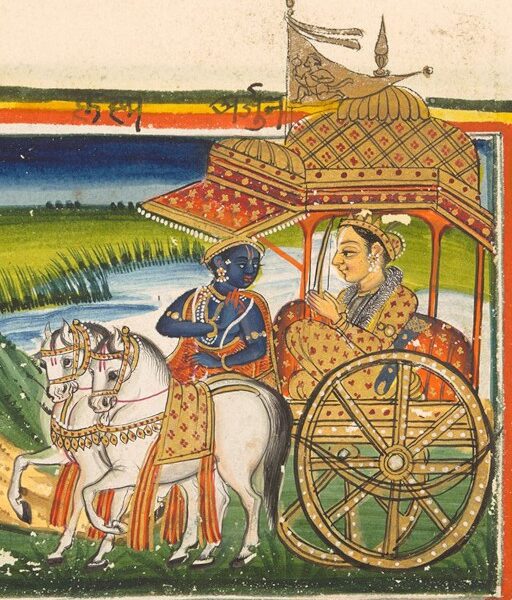
Okay.
2.45. The Vedas deal mainly with the subject of the three modes of material nature, O Arjuna, become transcendental to these three modes, be free from all dualities and all anxieties for gain and safety, and be established in the Self. So here, continuing with this, is that one gets freed from the bondage of works. No, excuse me, the one above that. By this process, the devotee is liberated from all mundane influence, and only in this state of purity can he be situated in spiritual nature. So here, another aspect of that, being freed from gain and safety. So gain will be your material priogeny. Safety will be your material sambandha.
Because your gain and safety is for yourself. But if we’re connected to Krishna, then our gain and safety is connected to Him. We’re simply acting so that He gets results. Because the soul is eternal, so technically there is no need of safety. Safety means that we’re Krishna conscious, so that the thing we’re worried about is dropping out of Krishna consciousness.
That’s dangerous. But otherwise, nothing else technically is dangerous for the soul. I was always wondering, the Sanskrit is yoga -kshema-adhavan. And why is it the word yoga? Can you shed any light on why yoga is also translated as gain? As gain.
Because it means connection.
So the thing is, the yoga connection is… What we’re worried about is connection with the Lord. But you can also… We call the Ashtanga yoga system yoga, because of its connection with the Lord. But at the same time, you can use it to connect to something material. You know, say mystic cities, or good health, or stuff like that. So they’re using it like that. Like today, the modern… We’ll say, yoga is very popular today. But it’s only popular because of health considerations or peace of mind. And peace of mind simply means that the mind is not so disturbed from the day -to-day grind. And then, as soon as it’s peaceful for a little while, that you feel comfortable again, then you go right back into the frame. They’re not talking about coming peaceful like that, and then not doing the activities that create that. Right? You know, they’re not talking about you get your health together so that you can just then focus on spiritual life. Right? You know, that’s not what they’re… So it’s only because it creates some facility.
Right? It makes the body in good shape and makes the mind in good shape. That’s the only reason. That’s the only reason it’s popular. So it’s not that they’re… Oh, they’re getting closer to the spiritual. No, all it is is that they’re more… Situations that we would put ourselves into are not as foreign to them as before. But the idea of being actually spiritual, that’s not. But at the same time, they will call it spiritual, so then in their mind it is a similar thing.
You know what I’m saying? You know, just like we’re saying, the children may think, we’re not playing, we’re just being Krishna conscious. So technically they are in their own way, but they’re still playing. You know, so they think they’re being spiritual, but it’s not exactly. Right.
But the state of mind that one feels about, like, Prahlada Maharaj, he considered himself not playing, but actually he did. So what’s the objective observation? Like, I can see myself being totally Krishna conscious, and for somebody whose level is above mine, he will see that I’m completely nuts. Yeah. So that’s it. You’re having that problem in the house.
No, but, you know, if we take our observation as criteria, it’s not practical then. No, it’s not practical, but the point is, it means there should be the element, at least you should be satisfied that you’re fully engaged. Because if you think you’re not fully engaged, there’s a good chance you’re not. But if you think you’re fully engaged, it means as far as you’re conscious of, see, the difficulty is what you’re not conscious of. You know what I’m saying? In other words, as far as your consciousness goes, you’re fully absorbed. But then someone else, by observing, can see, well, these areas you’re not conscious of. Therefore, if you’re not conscious, how do you be Krishna conscious? So that’s why association with the devotees is so important. Because then we see what they do in that. So even if someone doesn’t say, then by association with time, we’ll notice things that they do that we will then understand we don’t do. Or maybe we’re doing but not as well as they are.
Is that okay? So that’s why association is important. I mean, self-satisfaction is one of the elements. But the point is that self-satisfaction should be based on authority.
So even if we’re looking at it from our perspective, we’re looking at it to see if we’re up to the standard, but it should be that what we’re looking at is authorized by the Guru Sadhana Shastra. So if we make up our own system and then feel, yes, I’m very absorbed in that, our own made-up system, then that’s not very useful. But if the system is given by the acaryas and then we are nicely absorbed in that, then that’s the best that we try to do. But then with practice, then Krishna will reveal where there’s a weakness or through others like that. And so we’ll just gradually, gradually move forward.
But self-satisfaction is one of the points. But then one has to be aware of oneself to be able to be self-satisfied.
Self meaning the soul.
Okay. By Krishna consciousness one can overcome dualities. As long as the material body exists, there are actions and reactions in the material modes. So that’s going to be there. It’s not that you become a devotee. There is no action or reaction in the material modes because the body is made of the modes. So even its functioning is a reaction of the modes.
One has to learn tolerance in the face of duality such as happiness and distress or cold and warm. So we’re saying that that’s going to happen. There will be happy situations and not happy. Cold and warm situations, yes. Could you elaborate on the body is made of the modes? The body is made of the modes. Are there parts of the body that are predominantly in passion or in… I’m not sure exactly how to… Means made of modes means the modes control it.
Does that make sense? So they’re controlling everything that’s there. The modes are like Brahman or all-pervading, right? Yeah, it’s just like your arm is moving. What moves your arm? Passion? I don’t know. No, that’s mechanically. What moves your arm? My soul. My mind? Your soul. My soul has a desire. Okay, now let’s start at the other end. Okay, we can start from that end. Okay, the soul has a desire. Then? You want to move your arm. Yes, so my mind sends signals to… No, no, before that, then? Intelligence? No. Before that, that means… Is it sanctioned or not for you to move your arm? Sanctioned by the Brahman. Okay, and then once he’s sanctioned it, then who takes care of it? The modes. The modes, okay. And then? The arm moves. But what about the mechanics in between? The signals go from the brain to the arm. Okay, well, that’s the fire. But what about before that? See, this is why I asked the question.
Means it moves because of the life air. But we’ll attribute it to the muscle, and not to the electrical pulse coming from the nerves, coming from the brain. But it’s because the air is pushing. Therefore, that’s the mechanics that the air uses to make it happen.
You know what I’m saying? Just like, let’s say you have on your car, you have hydraulic brakes. So actually, it’s the air that is stopping the car. But the air pushes on the piston, that pushes on this, that pushes on that, and finally, you know, it works the brake. You understand? But it’s the air that makes it happen, so the body moves by air. You know? You understand? So in that way, just as the air is moving the muscle, the modes are moving the air. Does that make sense? And your desire is then moving that. Or at least you want to desire they’re moving it. You just have the desire. But it’s only because of your desire it is moving. That’s why, Krishna, things are going on. We’re not the doer, but at the same time, we’re responsible.
You know what I’m saying? Like that.
How do the modes move the air? Where do they interface?
That, I’m not sure.
I’m not sure of the exact thing. We’ll get into Sankhya stuff, then. Because that’s all Sankhya. Yeah, but it means the life airs.
So, I’m not sure. From what I understand, it’s air pushes on fire. You know, so air is the mode of goodness. Fire is the mode of passion. And then that eventually, you know, and the electrical pulses are passion. That pushes on the muscles, which are, you know, earth, which means ignorance. So, basically, that would be, from what I can understand, fire.
Does that make sense?
Could, but I’m not sure that it’s so important that it’s pushing the brain. It may be pushing the brain.
So, does that mean when you’re pushing harder, there’s more pushing in your brains? Actually, hard work is actually dangerous, because it could flatten your brain, or something like that.
So, that’s why the people don’t do much, they’re more intelligent, you know. So, is it that they’re more intelligent, they don’t do much? Or because they don’t do much, they’re intelligent?
Different sides of the same thing. Yeah, you know what I’m saying? Is the intellectual more intelligent because he was intelligent, therefore he’s not doing anything? Or because he’s not doing anything, that’s why he’s more intelligent? The people that do more things, their brain gets flattened, so therefore they’re not as sharp.
The thing that doesn’t get worn off.
Is the brain intelligence, or the mind? Huh? Is the brain intelligence, or is it the mind that has intelligence? Neither. The intelligence is another thing. Mind, intelligence, false ego sit in the heart.
Like that. That, then, you know, the brain does the mechanics, that’s all. It’s not actually the thing that thinks. It’s just, you see the mechanics going on there.
It’s like, let’s say, you’re using a calculator. Who’s thinking? You are the calculator.
Yes. Yes, in a sentence sense.
No, no, no. Stick to the obvious. Are you doing the thinking or the calculator? Oh, I’m the calculator. You are the calculator. I’m doing the thinking, really. Okay, so that’s the whole point, is that the intelligence is doing the thinking, but it uses the brain like a calculator. So you see all the activity going on there. So the scientist notices the calculator, and then says, oh, all this is going on, because without the calculator it won’t come up, and the numbers, and all these things, and this pushes on there, and this little goes through there, and all these different things. But they don’t understand the intelligence that’s pushing the calculator. Yes. But in itself the calculator was made from the intelligence itself. No, no, but that’s crossing…
That’s like saying, is that, okay, who’s doing the cooking? Right? The person, the cook, or the spoon. And you’re going, yeah, but the spoon was made by someone else’s intelligence. So it’s actually that guy in the metal shop around the corner, he’s doing the cooking.
Do you understand? You have to stay within the same context. You can’t mix the contexts.
You know what I’m saying?
Okay. One has to learn tolerance in the face of dualities such as happiness and distress, or cold and warmth. And by tolerating such dualities, become free from anxieties regarding gain and loss.
Because the dualities, things are coming up and down, right? Getting better, getting worse, right? So then one is not worried about gain and loss.
Because the point is, things come and go anyway. That’s just the way it works. It’s not yours anyway. Yeah, it’s not ours, it’s just we can take part in the process. It’s not a matter of…
We have facility, which is our condition, nature.
And we use that in Krishna’s service.
That’s what we’re trying to do. So now, that things go nicely or not nicely, that’s not the anxiety we have for ourselves. We’re only worried about it, that the result’s for Krishna, so we want the better result for Krishna. So worrying about gain and safety means for ourselves.
Right? But if we’re worried about it, doing it nice for Krishna, we don’t call it gain and loss. We call it Krishna consciousness.
Right? It means, let’s say, you’re going along and things are developing, then something goes wrong, and then there’s some loss. So you don’t sit around and go, oh, there’s loss, this, that, and it’s so bad. You just think, okay, how to correct this and make it work. Right? So it’s not looked at as a loss. We’ll say, I gained this, it was mine, and now I lost it.
But the other way, devotional service, because it’s not yours, it’s not a gain.
It’s just nice, it’s come out nice for Krishna. And if there’s a loss, you don’t look at it as a loss, because there was nothing of yours, nothing owned. It just means, okay, there’ll be more work to get it back to what it was.
You understand? So even though it’s the same thing, because it changes into devotional service, then we don’t, it doesn’t use the same definitions. So what we may feel is that it’s a different process.
Right? So we don’t worry about gain or loss, so we don’t worry about, you know, if things go nice for the Deities, or not nice for the Deities, because we’re not worried about gain or loss.
Right? No, so things should go nice, but the gain and loss is not our gain or our loss.
Like that. So we are just absorbing devotional service. Yes. I’m remembering in the ninth chapter, Krishna uses the exact same two words, when he says, I preserve what they have and I carry what they lack. So is that preservation the safety, and what they lack is the gain? Yeah, yeah, could be. You could connect that. That’s always a nice way of analyzing things, is through words. Like that.
Does that make sense? Yes. So you can take the words, and from that, that word here, you know, you find that where it’s used somewhere else. Like that. Like I’ve generally seen, actually I’ve only seen two persons who really do that a lot. You know, Veda and Annamarsa do that, and Sautramarsa do that. They work off the words. You know. Like that.
It’s practice. That’s why it says, one has to learn tolerance. So that means it’s through practice. We get the knowledge, and we practice it. Learn tolerance in the face of duality, such as happiness and distress. Stress means that while happiness and distress is coming, that’s when we practice these things. But as long as the body’s there, these things will come. Because that’s just what the body does. That’s its occupational duty. Right? Yes. It’s an interesting phenomenon. And devotees, when it’s their gain and loss, they fight like anything. And then if something, as you mentioned, you know, deity or festival, you know, obviously somebody made a mistake, and then you come. And devotees, they say, you know, it was Krishna’s plan. And then, you know, we don’t know what to say to this. You know, it’s like, they put all their, you know, they’re just, like, throwing all their responsibilities on Krishna, you know, and it’s not our fault. So… Yes, so they’re taking the worst of both perspectives. Because it should be they’re trying to get the good for Krishna, and then for themselves it’s just whatever is Krishna’s plan. So the gain and loss of themselves… They just do it opposite. Yeah, but that’s the mode of ignorance. The mode of ignorance always turns everything around. Right? So in other words, if the Shastra says one thing and we have a 180-degree perspective, there’s a good chance we’re looking through the, how you say? Spectacles. The spectacles of the mode of ignorance. You know, like that.
If the method is the same, but whose result it is, is different, then that’s passion.
Right? Because mode of passion uses correct methods, but the result is for the wrong person. Right? And mode of goodness, then they’re both correct.
Right? So mode of goodness, action is correct, and the, you know, the perspective is correct. The mode of passion is the action is correct, but the perspective is wrong. The mode of ignorance is perspective and action is wrong. So you’re doing actually opposite of what you should be doing. Then when you don’t get the result, then you become more extreme in doing the opposite. You know? And so then it just gets worse and worse, and they become more and more extreme.
This transcendental position is achieved in full Krishna consciousness when one is fully dependent on the goodwill of Krishna. So it says achieved means it’s practiced. Right? So it’s achieved when one is fully dependent. So as long as we’re thinking, I’ll do it, and it’s mine, then there’ll always be a disturbance by these dualities. But as soon as we’re fully dependent on Krishna, it’s just that whatever happens, it’s not… Because we know that the person’s taking care. You know, it’s not like the child is not so worried. You know, the mother’s taking care, but then if something’s not nice, then they’ll cry, and if it’s something nice, they’re happy. So they’re affected by happiness and distress. But this is where they’re in knowledge, so they know they’re taking care. So therefore, if it’s not a nice situation, it’s just the way it is. You know, you’ve got to take your bath. It’s just, you know, it is for your good. You know, you have to take your medicine, or you have to eat later, not now, or, you know, stuff like that, so you have the understanding. Does that make sense? So you’re not worried.
Okay, Vriti. According to Srila Baladeva Vidyabhusam, Arjuna now asks a question. How will this intelligence arise in one who must study all the Vedas? That study will take a long time, and there is thus possibility of diversion.
In other words, by understanding the Veda and the association to devotee, then you can come to this platform. But it’ll take a long time to study all the Vedas. So what’s going to happen in between? You know, we get distracted in between. What’s to avoid that? Because you’ll be fully… You’re on the transcendental position when you’re fully practiced at it, and you have that full knowledge. So what’s going to happen in between?
The Lord answers, From a large body of water, a person uses only as much water as he needs for bathing or drinking. He does not use the whole lake. In all the Vedas, including the Upanishads, whatever serves the goal of attainment of knowledge of Atma, that much alone is used by the person who studies the Vedas and desires knowledge of Atma.
Does that make sense? So that’s the thing. According to one’s nature, that much will be there.
So only how much he requires is how much… Because the point is to become Krishna conscious. So if a little bit will make you Krishna conscious, that’s all you need. A lot is necessary, but then you have the capacity for that.
4.26 All purposes served by a small well can at once be served by a great reservoir of water.
Similarly, all the purposes of the Vedas can be served by one who knows the purpose behind them. So that’s the whole point, is that you understand the purpose of it, then you actually… Because remember, purpose is the analytical aspect of sambandha, of prayojana. What’s the purpose of the item or the interaction?
That’s the purpose.
So here is that the great reservoir is understanding the purpose. So that’s by Krishna’s grace. That comes through devotional service. So that’s how someone can have a great understanding of Krishna consciousness, but not be that scholarly. Because he takes what knowledge he does know, applies it in his life, and Krishna consciousness is the result of that. Krishna reveals Himself. So that is the great reservoir.
Does that make sense?
So this is like perfect knowledge is not necessarily quantity? No, perfect is not quantity. Perfect is understanding the purpose. In other words, what Krishna said.
Arjuna, you’re quoting Nitya-sastra, Dharma-sastra. There are so many Vedas that surrender unto Me. This is that little well. Yeah, well, here we’re saying the purpose of the Vedas can be served by one who knows the purpose behind. So all purpose is served by a small well. Similarly, all purposes of the Vedas can at once be served by the great reservoir of water, can be served by one who knows the purpose behind it. So the great reservoir is the knowledge of the purpose of the Veda. In other words, the knowledge of the Veda, because that is what’s vast. But it’s not, what’s vast is the purpose of the Veda. And then, applying Krishna’s point, is you only need how much you do. So that little bit of knowledge from the Veda, you understand the purpose, then you’ve understood everything.
Does that make sense? One who knows Krishna knows everything.
So somebody may have to study a lot of the Veda to apply in their life that Krishna will bless them with that understanding. And someone else, maybe very little they have to apply. Like you see that one brahman in South, he couldn’t even read, he’s sitting in the Gita, upside down like that, but he’s crying because he understands the purpose.
While all the ones laughing at him had vast amounts of understanding of the small well.
But he understood the great reservoir.
Does that make sense? Yes, so Lord Caitanya said he’s this color. Not everybody else. It doesn’t mean that somebody can’t have great knowledge of that, but that’s just their ability. You know, I see Bhaktisiddhanta says what he talked about, he had an eidetic memory. So it means he looks at this page, he remembers that the rest of his life. Like that. So then he can just go through what their method is. My mother had a friend like that. She just goes through the whole book, looks at each page. And anytime she wants, she just goes through the pages. In her mind, she just leaps through the book and looks for whatever it is she wants. So whatever it is, you know all that, you have that great vast amounts of knowledge.
But that’s what particular facility you have. But Krishna’s point is not what facility you have, it’s what you do with the facility. The person has ten rupees, and he gives five to Krishna.
That’s something. But the other person has a thousand rupees, and he gives ten rupees to Krishna. So it looks like he gave the bigger donation, but actually he gave the smaller donation. He gave him five hundred rupees. Then that would have been comparable to the other person’s five.
You understand? What we’re taking is, it’s what you do with it that’s important for Krishna.
Because Krishna’s unlimited. He is everything. He’s making it happen. So it’s like, what are we going to do to impress him?
You know what I’m saying? So a little kid comes up on his little car with the little pedals on it, up next to a Ferrari. What’s he going to do to impress him? He’s going to outrun it.
So there’s nothing we can do to impress Krishna.
So the point is, what impresses him is how we use it.
That’s the point.
So that’s the great reservoir.
The ultimate purpose of all mystic mysticism, of all Vedic mysticism. Oh, mystic mysticism, I didn’t get that.
Mystic. Oh, I see. The T-I-C looks like the D -I-C. Okay.
The rituals and sacrifices mentioned in the Karmakanda division of the Vedic literature are meant to encourage gradual development of self-realization. So gradual. They’re all meant that you’ll be self-realized. Because at some point you’re going to ask, what’s this for?
I mean, you should. But that’s why it says gradual. It doesn’t say how many thousands of lifetimes we’re talking about here. And the purpose of self-realization is clearly stated in the 15th chapter of the Bhagavad -gita. 1515. The purpose of studying the Vedas is to know Lord Krishna, the primeval cause of everything. I am seated in everyone’s heart, and from me come remembrance, knowledge and forgetfulness. By all the Vedas I am to be known. Indeed, I am the compiler of the Vedanta, and I am the knower of the Vedas. So that’s what we’re supposed to know from all this. All right. The Vedas primarily were meant for people who are intellectuals, kind of, because the Brahmanas, like this Brahmin who was illiterate, he’s an exception, he’s not the rule. And so we may say that if the person is more intellectually inclined, whatever, it will be easier for that particular person to be Krishna conscious? Not necessarily. It’s a matter of they’re interested in being Krishna conscious. Because intellectual is a matter of contemplation.
The point is that everybody’s contemplating.
You know?
Like, let’s say, the unlimited consideration that the head cheerleader is thinking when she’s walking with her groupies down the hall in the high school, who she’s looking at, what she’s wearing, what everybody else in the whole hallway is wearing, is vastly complex. That’s why she’s who she is, because she can do that. So she’s contemplating, but it just has nothing to do with philosophy or anything. You know what I’m saying? So contemplation isn’t a problem for anybody. Everybody contemplates. Even the dog sits there and contemplates what you have over there. What it eats.
Even if it’s covered, it can’t see it, but it’s still contemplating what it could be. So contemplation is there. That anybody can do. What we’re talking about is having, you know, how you say, that ability to… It means everybody’s studying their area. It’s a matter of being able to study the academic knowledge.
So if one has some ability in that, it will always make it easy. Because if the intelligence is cultivated to some degree, then it won’t be purely on the sentiments that the mind will come up with, which is more dangerous. It means if they’re connected to Krishna, then it’s fine. Like, you know, the point being made about the gopis. They’re not great scholars, but their mind is connected to Krishna. So that makes them the best devotees.
So it’s a matter of contemplation.
The academic ability is secondary. If someone has, it’s quite useful, because then when they study the Shastra, they won’t become bewildered. But the Vedic system is such that even you don’t have, someone else does. There’s always someone who does.
So therefore, if they’re studying more, and then they speak about this, and we associate with that, then we’ll get the benefit. They sat, they studied, they contemplated, now they give you their understanding. So then you didn’t have to go through all that. You know what I’m saying? Like the Upanishads, they give all this analytical elements. You’re supposed to take that, analyze it yourself, come to the conclusions. But then, you know, Vedanta Sutra has already done that. And then for that, then Bhagavatam is already done. So Bhagavatam, then anybody can read. Does that make sense?
So, if one has, good. But if one doesn’t, it doesn’t matter, as long as you can, you associate with devotees, and you’re trying to be sincere and following the instruction of the spiritual master. One’s not doing that, and one’s not very intellectual, then it can be a very weak position. Because then one’s sentiment will carry it, because you’re distracted into food of activities. And the food of activities, even if they’re pious, they’re distracting, let alone impious.
So, self-realization means understanding Krishna, and one’s eternal relationship with Him. That’s what we’re looking at. So that can be, whether one has vast academic knowledge or not, everybody can do that. The relationship of the living entities with Krishna is also mentioned in the fifteenth chapter of Bhagavad-gita, 5.7. The living entities in this conditioned world are my eternal fragmental parts. Due to conditioned life, they are struggling very hard with the six senses, which include the mind. Right? So the five senses and the mind, that’s what they’re struggling with. So that was what Manu was focused on. He didn’t get into all the other elements. He just got into these, because that’s what you work with. The senses bring in information, the mind makes a decision of what you do with that information. And it may use the intelligence in the process, but still it’s the mind and the senses.
The living entities are parts and parcels of Krishna. Therefore, revival of Krishna consciousness by the individual living entity is the highest perfectional stage of Vedic knowledge. Vedanta is the last word in Vedic wisdom. And the author and knower of the Vedanta philosophy is Lord Krishna. And the highest Vedantist is the great soul who takes pleasure in chanting the holy name of the Lord. That is the ultimate purpose of all Vedic mysticism. So what conclusion is given by all these great analytical śāstras is that one should chant Hare Kṛṣṇa. As we will find as we go through…
Yeah, I think it’s in the second half. It’s in the third part.
So then… No, actually, no, that first part’s in the beginning. Yeah, I think we’ll… like in the third chapter or something. It’s making the point that, oh, maybe earlier, that the brāhmaṇa who is chanting japa, he actually is the best. So he’s actually attained the conclusion of all the Vedic literature.
Like that.
That’s also.
Not just losing fingers.
Noses. Noses. Okay, so that’s the purpose of it. So there’s just various ways. Rituals and sacrifice mentioned are meant to encourage gradual development. So in other words, if somebody’s just into fruitive elements, there’s something to gradually take him forward. If he’s only into academic, then there’s something to gradually take him forward. But either of them only become actually fruitful when you associate with devotees. Because that’s the underlying point. You are pious, you’re doing the rituals. But the idea is that since you have to do that with the direction of brāhmaṇas, if somehow or another you’re sincere, the brāhmaṇas that come to do those things will be Vaiṣṇavas. Then you’ll understand this connection with the Lord. Or if you’re an intellectual, you’re looking at that, you’ve studied all the Vedas, you’ve studied all the Upaniṣads, Vedanta-sūtra and that, you’re actually sincere, then you come across devotee scholars who will then show you how to connect that to the Lord. That’s the point. So it comes to its perfection in the association of devotees. So again, taking us back to the point, is in the association of devotees. Somehow or another, if a fortunate man gets the opportunity of associating with a saintly devotee, he gets the chance of hearing and chanting the Holy Nīrākārya. By this process, the devotee is liberated from all mundane influence and only in this state of purity can one be situated in the spiritual nature.
So 2.47. You have a right to perform your prescribed duty, but you are not entitled to the fruits of action. Everything is always balanced. You can do your duty. No one can say you can’t do your duty, but the results are not yours.
Does that make sense? To me it does. For a materialist, it sounds like the opposite of what you want. Yes.
Yes. You’re entitled to the fruits of action, but you don’t have to do your prescribed duty. That would be… Sounds good. That’s the model. People get out there and fight for that.
Never consider yourself the cause or the results of your activities, because we’re only an instrument. And never be attached to not doing your duty. If there’s a situation where you can’t do the duty, when the opportunity is there, don’t be attached to not doing it. Just to make sure. Yes. So Krishna is getting all sides here. You have a right to perform your duty. The results aren’t yours. Don’t think that you’ve caused the results, because you will think, I did the work, so therefore the result is mine. But no, you assisted in the work, and because you only assisted, whoever you were assisting, it’s theirs. Right? You know, you’re cutting the subji, and then someone else cooked. Then everyone goes, wow, this is a great subji. And then you go, yeah, but I cut the vegetables. If I hadn’t cut it, he couldn’t have cooked it. So actually, you know… Right?
Yeah. That’s the funny thing. They’re so absurd, but we do it all the time, right?
Okay. Performance of duties is the only auspicious path of salvation. Work with results becomes the cause of bondage. Right? Because results means you’re working for results. It doesn’t mean that your work got a result, therefore you’re bound. Right? Therefore such work is not auspicious.
Everyone has his proprietary right in regard to prescribed duties, but should act without attachment to the results. Because if you act according to the attachment, you’re bound. If you act without attachment, then you’re free.
Such disinterested obligatory duties undoubtedly lead one to the path of liberation. Right? Disinterested doesn’t mean you’re disinterested in the process. It means you’re disinterested in the result being for you. Right? Because many might get disturbed.
Disinterested, obligatory, these are all very dry. Right? Disinterested, there’s no relationship. Obligatory, you don’t actually want to be doing it. You know? That would be your thing. So therefore, it means you’re insensitively performing work that you don’t want to do. That would be the modern interpretation of this. But disinterested means it’s not for you. It’s obligatory because that’s your nature. You’re going to do it anyway. So you might as well agree to do it. You know?
Because if you agree, it’s much easier. You have to clean up your room. It takes you five minutes. But you don’t want to clean your room. You’ll sit there for 55 minutes grumbling about it. Right? And suffering. Then finally you’ll have to clean it up. But you won’t do that great of a job. But then your hour’s gone. And now it’s time for homework. You know? So… Right? Sound familiar? Yeah.
So the point is you have to do it anyway. So might as well happily do it. Right?
Arjuna was therefore advised by the Lord to fight as a matter of duty without attachment to the result. Right? As duty means you’re supposed to do it. Because nowadays we think, oh, yes, duty is like that. But if you go back in time, you know, in things a bit more romantic, then it was like, you know, it’s a duty. You know, we have a duty to, you know, man and our country or to the family or the community or, you know, something. And so, you know, our friends. So then it’s an inspiration. That’s why you’re doing it. Because of that feeling. So that’s the point. It’s our duty and how to serve God. We can do this to please the Lord. You know? So it doesn’t have to be dry. You know, we make it dry. So the modern concept of not having a duty, that actually means that nobody’s, nothing is depending on you. So nobody cares. Yeah, it means, it means, it means, the point is that because you’re obligated and you do it, therefore the other person feels obligated. But if you’re not obligated, why should I be obligated? Yeah, everything disappears. But we think it’s, no, only I’ll take advantage of it. You know what I mean? So you have the concepts there in the Western. You have that one, I’m not sure whose it was. Was it Dr. Seuss?
You had the, had the, had the… Green eggs and ham. No, no, no, it wasn’t green eggs and ham. It wasn’t Sam. It was something that it was a day when everybody got out and made as much noise as possible.
Right? And so then one person… I’m getting worried here.
You have a day like that over there when everyone gets out there. Okay.
So everybody makes as much noise as possible. Bangs on, you know, crash candles, blows horns, does this, that, anything to make noise. So one kid thought, wow, you know, I’m so busy making the noise, I can’t enjoy all the noise. So he decided, I’ll just watch. And then, you know, some kind of a discussion, you know, he was talking about that and his friends got like this. And then when the day came for to make all the noise, all noise stopped. It was perfectly quiet. No one was like shocked. You know, silence, you know.
So, so that’s the… I’m not sure how we got into that. I don’t know if it’s doing your duty or not doing your duty. Yeah, but it’s something to do with… All value disappears. Yeah, all value disappears. So everybody, no one does it, so you end up with nothing there.
I would prefer that day.
I mean, I’m just saying.
The birds are too noisy here? No, no, no, no, no. Oh, that’s another thing.
Anyway. Yes.
It’s already explained. Oh, wait. No, yeah. Didn’t get it. Where are we? We were on this side. Okay.
Arjuna was therefore advised by the Lord to fight as a matter of duty. No, I just saw it over here. Only misers desire to enjoy the fruit of their work just to be further entangled in material bondage. Right? So now, instead of being attached to noise, he’s attached to peace. So there’s a weakness in that.
Okay.
His non-participation in the battle is another side of attachment. Such attachment never leads one to the path of salvation. Right? Because he’s attached to enjoying the results. Right? Because the idea is that war is there, you’ll get results. He wants to enjoy those results. He won’t enjoy those results, so he’ll go to the forest.
Such attachment never leads one to the path of salvation. Any attachment, positive or negative, is cause for bondage. Because we have this idea, if it’s negative, oh, I’m so useless, I’m so disgusting, I’m so this, I’m so that, that somehow or another that’s spiritual. No, that’s just, that’s, it means you’re going to get, inaction is sinful. Right? So you’re going to end up doing nothing. Therefore, fighting as a matter of duty was the only auspicious path of salvation for Arjuna. 60. Śrīla Prabhupāda writes in the Purport to Śrīmad -Bhāgavatam, 7.7.48. As far as economic development is concerned, we should discharge our occupational duties, but fully depend on the lotus feet of the Lord for the results.
karmaṇye vādikāraste mā phaleṣu kadācanaḥ You have a right to perform your prescribed duty, but you are not entitled to the fruits of action. According to one’s position, one should perform his duties, but for the results, one should fully depend on Kṛṣṇa. Narottama dāsa Ṭhākura sings that our only desire should be to perform the duties of Kṛṣṇa consciousness. We should not be misled by the karma -mimamsa philosophy, which concludes that if we work seriously, the results will come automatically. This is not a fact, because they’re saying, you work, therefore you get the results. No, it’s you work, and Kṛṣṇa gives the results, because Paramātmā has to sanction.
So, He’s the one that gave, you work in this way, you get the result, but it’s still, the result is coming because He sanctions it, because you did what He said.
You understand? But they’ll say, no, I did the work, and the result came, therefore my work got the result. So, karma-mimamsa, they don’t even really believe in karma, real karma. Because if it has to be sanctioned, that means you have to have the karma for it. But if they say the work itself gets the job done, and gets the result, then whoever… Yeah, yeah, but it’s called karma-mimamsa. That’s their philosophy. It’s just like Māyāvādīs, that’s what they call themselves. You know, like the guys say, hey, Hare Kṛṣṇa. We call ourselves Hare Kṛṣṇas. He uses it in a derogatory way. But, you know what I’m saying, sahajiyas, that’s what they call themselves.
Because in their mind, sahaj means the easy path. Everyone’s taking the hard path, we’re taking the easy path. We’re smart.
So, it’s the same thing.
But the automatic is not a fact. It’s still the Lord’s sanction, then you get it. Because automatic means without anything else. Like that.
The ultimate result depends upon the will of the Supreme Personality of Godhead. In devotional service, therefore, the devotee completely depends upon the Lord and honestly performs his occupational duties. Therefore, Pallada Mahārāja advised his friends to depend completely on Kṛṣṇa and worship Him in devotional service.
Because otherwise, before, he was presenting that you do all these auspicious things, but still, that’s not going to make you happy. That’s not actually, it’s serving the Lord that’s going to do that. Because otherwise, they’re doing all these things recommended in scriptures. We have to remember, Pallada was going to a gurukula. That’s recommended. He was being taught by brāhmaṇas. The brāhmaṇas were, you know, the, how do you say, sons of Śukracarya. So, he means, you know, they’re not ordinary, you know, just some guys off the street. Right?
So, the point is, it’s connected. You please Kṛṣṇa. So, devotional service, trying to please Kṛṣṇa automatically gets the results because the point is, that’s what Kṛṣṇa wants you to do. So, those results will automatically come. But the karmī māṁsa, he’s thinking the automatic is I did the work, therefore it comes. No, it’s automatic. You do the work Kṛṣṇa says you should do, then you’ll get a good result. Because Kṛṣṇa is the one that set the work and He’s the one that gives the result. So, it’s automatic that if you do the work prescribed, you get the result. Right? But it’s not because you did the work, you’re automatically getting the result. That’s what karmī māṁsa means. You understand? That’s where, that’s all it takes to go wrong in the philosophy, to go from bona fide to bogus. Because otherwise, you’re performing pious activities according to the Veda, according to the ācārya. Like that, you understand pious work, you’re doing everything right, you understand that the Lord is there, He’s sanctioning and all these different things. But the problem is, is you think, because I did the work, the Lord has to sanction it. Right? Rather than, you know, then it’s His free will to sanction it. Right? But He’s not whimsical. So, He will sanction it, but it’s not automatic. That because I did the work, I get it. It’s the Lord’s free will that you do this work, I’ll give you this result.
You understand? So, that’s in terms of what you stated before, that the different systems are basically one misconception from the real. Yeah. That’s how your Prabhupāda says, you do a big mathematical calculation, you get one calculation wrong. Maybe all the others are correct, but that one being wrong, you’ll get the wrong conclusion. So, it’s the same thing. So, all these Vedic ones, they’re starting with the… That’s why they’re, one, more difficult to understand, because they’re more technical. But at the same time, because they’re more consistent, because they’re based on the Veda. But there’s something wrong there. So, that wrongness is what is taken by all these other systems, though they don’t necessarily take the technicalities. So, they’re not mechanically very developed. But they’ll take these things, well, whatever I do, then that’s what, you know… Whatever I feel like, that’s what’s right, that’s what’s true. You know, stuff like that. They just take part of something, and then try to, you know, make a whole.
Does that make sense?
2.48. Perform your duty equal poised to Arjuna. Abandoning all attachment to success or failure. Such equanimity is called yoga. Right? So, attachment to success or failure means for ourselves. We’re trying to get the result for Krishna. So, whenever Krishna sanctions it, it will come. So, that means we’re going to work however long it takes to get it. Because we’re always trying to get the result for Krishna. We’re only doing these things to please Krishna. And it’s done through devotional service. So, being active in Krishna consciousness is what we want to do. So, when the result comes, it’s not finished, then we’ll do something else.
Does that make sense?
Yoga means to concentrate the mind upon the Supreme by controlling the senses.
Krishna tells Arjuna that he should act in yoga. And what is that yoga? Yoga means to concentrate the mind upon the Supreme by controlling the every disturbing senses. And who is the Supreme? The Supreme is the Lord. And because He Himself is telling Arjuna to fight, Arjuna has nothing to do with the results of the fight. Gain or victory are Krishna’s concern. Arjuna is simply advised to act according to the dictation of Krishna. So, that means the prescription of how to perform the duties.
The following of Krishna’s dictation is real yoga. And this is practiced in the process called Krishna consciousness.
So, the dictation, then you practice that, that’s called Krishna consciousness. So, it’s not just the philosophy or just the application, it’s a combination.
By Krishna consciousness only can one give up the sense of proprietorship. Because otherwise, I and mine goes all the way back to the platform of Vasudeva’s sattva. Before again you fall into the next creation.
So, only Krishna consciousness can go beyond that. One has to become the servant of Krishna, or the servant of the servant of Krishna. Caitanya-caritamrta, Madhya-lila, 1380. That is the right way to discharge duty in Krishna consciousness, which alone can help one to act in yoga.
So, again coming back to the point of taking advantage of the association of devotees and following their instructions.
So, footnote 61. Srila Baladeva Vidyabhusana writes in his commentary 248, Krishna says, Giving up desires for results, and giving up thoughts of being the doer, being situated in yoga, perform such duties as fighting. By desiring results, you become entangled in maya. And by thinking yourself the doer, you steal the quality of independence which belongs to the Lord. By this identity as a doer, you end up in opposition to the Lord’s maya. Therefore, you should give up these two conceptions.
By desiring the results, you’re entangled by maya, and by thinking you’re the doer, then you’re taking the quality of the Lord. And then you’re opposed to maya, because she’s subservient to Krishna. And you don’t want to go up against her. She’s one quarter of the cosmic manifestation. So, she’s big.
House always wins.
It means Krishna is the independent one. We have the quality of independence of choosing whether to work under Krishna or not. But that the work itself got done, that we didn’t have anything to do with. You know what I’m saying? It’s just like, let’s say, oh, you weren’t here yesterday. I didn’t see you. Oh, I went to Calcutta.
No, the bus took you to Calcutta. The guy driving the bus got you to Calcutta. Right? And the city arranged that. So, actually, the transport minister got you to Calcutta. But I’ll say I got to Calcutta, I went to Calcutta, because I made the choice to get on the bus. Right? So, I’ll attribute myself with it. So, as far as culturally goes, that’s fine. But the point is, is that we think I’m the doer. Then, we’re not actually. We can only decide to take part in the process. That’s our independence. That’s why it says, our independence is minute. But Krishna’s is unlimited, because He’s the one that actually makes it work. So, it’s His independence that He said, if you do this, if you do this sacrifice, then you go to this heavenly planet. But that’s His free will to do that. So, you follow it. Then, you go to that heavenly planet.
You know? Does that make sense? But it’s His free will. So, we’re not the doer. Like that.
Krishna’s the doer.
On this level. But the reason that those things are happening is because we identify as the doer. Therefore, the reaction of it comes to us. We say the result’s ours. But what we’re looking for is only the good result. We’re not looking for the bad result. Right? The person stole money. So, he’s looking for the good result of having the money and enjoying himself. He’s not looking for the bad result of the police catching him and putting him in jail. Right? But the point is that he gets it all.
Right? So, the point is, if one works for Krishna, then one is not a thief. Right? Something from the forest, it belongs to God. So, if that’s taken and used for service to God, where is it stealing? Right? If I go to somebody’s house, and in their house, use something from their kitchen to cook something for them, you’re not a thief. If I go to their kitchen and cook something for myself, you understand? Like that. So, that’s the thing. The duty doesn’t change, the activity, it’s the consciousness.
2.49 O Dhananjaya, keep all abominable action far distant by devotional service, and in that consciousness, surrender unto the Lord. Those who want to enjoy the fruits of their work are misers.
Except for working Krishna consciousness, all activities are abominable. So, that also then answers our other question. You know, what is abominable action? So, abominable action means anything that’s not Krishna conscious.
You know what I’m saying? So, that’s all. So, it means something’s dirty, it’s dirty. You know, you can have more dirty, less dirty. But, you know, but we’ll take it that oh, this activity not in Krishna consciousness is abominable. But this activity not in Krishna consciousness is okay.
You know what I’m saying? So, so, it can be applied wherever.
Like that.
One who has actually come to understand one’s constitutional position as an eternal servant of the Lord gives up all engagements save working in Krishna consciousness. As already explained, Bodhi-yoga means transcendental loving service to the Lord. Such devotional service is the right course of action for the living entity. So, this engagement of our, our conditioning, of using the, the body, mind and words, so the, you know, the, means the, how you say, the meditation, focus on Krishna, the senses being engaged, the intelligence, understanding what’s the best way to do something, that’s being used for Krishna, that’s Bodhi-yoga. Right? So, that’s devotional service.
Does that make sense? So, we’re defining on that level. We’re not saying, in this case, only prema is devotional service. No, okay. You’re applying, you’re conditioning to Krishna. It’s devotional service. Right? Then, pure devotional service means it’s free from karma and jnanas. So, there may, devotional service, it may have some mix, but it’s not pure devotional service. Pure devotional service means you advance, that’s removed.
Such devotional service is the right course of action for the living entity. Only misers desire to enjoy the fruit of their own work, just to be further entangled in material bondage.
Right? Except for work in Krishna consciousness, all activities are abominable. Because they continually bind the worker to the cycle of birth and death. One should, therefore, never desire to be the cause of work. That I’m the doer. So, that’s the other. You desire the results, then you’re bound.
Right? And then, if you think that I’m the one who’s doing it, you’re also bound.
Everything should be done in Krishna consciousness for the satisfaction of Krishna.
So, either way, you become… You want the result, then the karma, or you think I’m the doer, or I’m the controller, and then I’m the enjoyer. The result’s mine, I’m the enjoyer. I’m the one who’s doing the work, I’m the controller.
So, these two are always mentioned, because these two are what we like to do. Right? In other words, why mention something that you don’t do wrong? You know what I’m saying?
Does that make sense?
Always, you know, there’s no need for me to tell you to, you know, don’t leave the keys laying around for the yacht.
Is there any need? No. There’s no yacht, so therefore there’s no… So, the point is you make a point according to what applies. So, that we always think we’re the controller and enjoyer, it’s always mentioned over and over again in different ways, because this is what we do do.
You know, like that. That’s the… Like a thief. Hmm? Like a thief. Yes, like a thief. Yes, so that’s… So, but different angles, like, means we look at it, analyze it, it’s again saying controller and enjoyer. But we’ll think, oh, well, you know, it’s just, okay, we just heard that over here about being, you know, it means if you’re attached to the results, you get bound. And if you think you’re the doer of it, then the results are yours, therefore the reaction’s yours, so you’re bound. Right? You’re bound by the attachment, you’re bound by the, by the implication in the work. Right? In other words, the result, you’re attached to the result, you’re bound by that. You know, I’m the one doing it, and then you’re bound in the works of it, the workings of it. Does that make sense? You know, like Mano mentioned, an offense on the platform of the, of the, or an activity performed in the platform of the mind, the result will be gained in the mind. Right? Something done with the intelligence is gained in the intelligence. Something done with the body is gained in the body. Does that make sense? Like, you speak something, the reaction for that will come by speaking.
You know, like the guy just before he runs over you, the guy leans out of the window of the Mack truck and says, Hey! Move out of the way! And then he runs you over. So, you know, it came by sound.
But you can understand, just like this, we’re talking about something that just doesn’t fit into the paradigm. You know? So we’re discussing with a Buddhist brain and then we say it just doesn’t calculate.
So in the same way as with us, this idea that we’re not the controller and enjoyer does not compute.
You know, so we’re thinking of so many different things. It’s always saying the same thing. It’s like, we don’t catch it because it’s, you know, because if we catch it it means we have to surrender. Right? We’re not the controller and enjoyer.
And these two ideas are always together. Yeah, they’re always together. So you’ll always see that sambandha and prayojana always go together. You know, abhidheya will be according to what that is. I’m the controller, I’m the enjoyer, the abhidheya’s material. I’m the servant, the results of Krishna, the abhidheya’s devotional service. So that’s why you only need to focus really on those two.
Does that make sense? So one should never desire to be the cause of work. Right? So desire, that’s pradyumna. Right? And then the cause of work. Right? So that’s the prayojana.
You understand? You only have to mention these two. Everything should be done in Krishna consciousness. For the satisfaction of Krishna. So here, the activity is there and the result’s for Krishna.
And then you’re bringing out devotional service is the thing. Because devotional service means your identity is connected with Krishna and the result’s for Krishna. Right? The identity’s connected with Krishna’s devotional service. The result’s for Krishna becomes pure devotional service.
Right? So by being situated in devotional service, then the other two are automatically there. Right? Because if you’re doing material activities, means you have these two wrong.
So in analyzation, generally we only have to analyze these two. Because we either have it wrong in our identity, or who’s doing it, or who the result’s for. That’s where the main problems are. If we’ve accepted those, devotional service isn’t a big step.
You know, that’s not the difficult thing because the activity will be exactly the same. Right? It’s that I’m the controller and enjoyer or I’m the servant. And the result’s for Krishna. That’s the big step. That’s where Prabhupada says there’s a vast difference. It means in that consciousness. But the activity looks exactly the same.
250-51 A man engaged in devotional service rids himself of both good and bad reactions, even in this life. Because good reactions will keep you here also. You know?
Like that.
Yeah. Because you have to give up good and bad. Because otherwise, what do you think? Anar could get rid of all the bad stuff. No, it means get rid of the attachment to the good. It doesn’t mean you get rid of I’m good at something. It means you get rid of the attachment to it. Right?
Yes.
Yeah. They’re burnt up because the gopis couldn’t go to the rasa dance because of residue, pious activities.
So only when that’s gone, then they could go. Because it has to be its only devotional service. Otherwise, it’s not… Because here is we will take those there’s always absorbed in Krishna. But the point is is the standard of always absorbed is more focused than that absorption that those particular gopis were in. You know? Means they’re always thinking about Krishna. But it’s focused where it’s samadhi.
That wasn’t obtained. Right? So coming to samadhi means it’s only on Krishna. That means everything else is burnt up. Then one is qualified.
You know, like Mother Yashoda, she was doing something for Krishna. But Krishna still got upset because she was personally interacting and then she stopped to go do something for him. You know what I’m saying? So there’s a difference in doing something for something and directly interacting with them.
Right? So on that level he could feign being upset. But he’s not actually upset because she’s doing it for him. But, you know, it’s one of those more notable pastimes.
Therefore strive for yoga, which is the art of all work. Right? Because yoga means you’re actually connecting it. So that is the art of all work. By thus engaging in devotional service to the Lord, great sages or devotees free themselves from the results of work in the material world. Right? Results meaning, as I said, good and bad. In this way they become free from the cycle of birth and death and attain the state beyond all miseries by going back to Godhead.
Okay. So we’ll stop here for… We will continue with the monument for the ascetic. Yes? I’ll take back from that idea about shortening the morning.
Talk to a few people? I spoke to a few people. The, like, it’s the whole description basically. There are some that think that we should actually have less break and we should just go on with the full the full class as we are now and just focus. There was a suggestion that we could have like in the wintertime five, ten minute breaks and that would actually clear up you know, the concentration gap.
Then there are some on the other spectrum that would really like that we cut the first class short and make the break bigger especially with the masochism and the on the Gerasta side. So I think, you know, from who I asked it was equally basically from both sides maybe a little more on the side of cutting the first class short Well the other is that it means you can run it straight through is that we can go from seven to ten and just take a ten minute break in the middle then you can have both things in right straight through done for the morning you know, but the thing is is that the consideration is, you know, how you say if there’s other obligations and that so people who don’t have other obligations and they’d like it to all be done at one time and those who have other obligations you know, you can get in other words that half hour makes a lot of difference in what you can get done We have until the 20th of April we have five weeks so that’s twenty days of, you know, full lectures and then from then we have two weeks where we can have as far as I understood one class per day Yeah so that’s like twenty-four days and eight days of four o’clock and we have quite some time to finish Yeah, that’s there but the idea of checking this is if this can work then we would use the schedule in the winter and so then because the philosophy is going to go through where, you know, that’s not as much the work because that’s designed to fit into there but the difficulty is the Spakumuchana fits fitting because it was originally designed to fit into the same amount of time it was also supposed to get the hundred and eight days of class like that but then, you know, we tried to do it some other ways and it hasn’t worked so now we’re going back the other way to see if it fits Publication, Maharaj, that is pretty universal Shraddha Shraddha Shraddha Publication Practice Shraddha Yeah, there was a problem to go all the way through the hot prashadams only available from say the brahmachari kitchen or somewhere else around nine o ‘clock See, that’s the brahmachari’s problem because he must have to eat at six o’clock and be at seven and be happy and sit here until ten no problem. So as I was saying is that there’s always going to be these considerations.
Same time as I think you gain more by the shortening, because the thing is this, because unless I’m, what I’m worried is that like in here, there’s more devotees falling asleep.
You know what I’m saying? Well, if you have that extra time, they could even take a nap or it’s just there’s more variety of things to do, the mind will refresh itself. But here in the Iron Head, it’s not that much that you actually do that. But it’s a problem for those who, you know, come over here, sit here, eat their breakfast here and then to sit another half an hour here, that’ll be a problem. But for those who go back and all that, then it’s, so you have that element is also there. And just, you know, we’ll just have to wait till there’s a Brahmachari ashram for these guys. Then they can do six to eight, ten to twelve, and four to six. And you get it six hours a day, like that, with proper break. And it’ll be right there. They don’t have to go anywhere. And we’ll work the breakfast around that. So, but until then, we have to work it out between the Brahmacharis, the Grihasthas, and the boys.
So let’s do this soon.
But first, I’m going to let it slip away. Almost made it. OK, wait a minute.
So break from 8.30 till, we’ve also got from 8.30 till 10 or 8 .30 till 10.30. Yeah, but the one is that you gain the benefit of, by shorter, that the focus being good, that you don’t lose it, but the gap doesn’t then, means in other words, it would do better for the first class, but it wouldn’t add anything to the second, like that. So by having the second stay in the same place, and the first be a little shorter, then that gap being bigger is, the concentration will be more in the first class, though you won’t get as that extra half an hour of information, but I think the percentage of the brain working is a little less, you know. You have to understand, this is from watching all of you, because for me, two and a half hour class, as one class with no break, for me is a good standard block, you get something done. So, the consideration is what works for you guys, you know.
Because, as you said, I start class at 6, you know, and then you go, you know what I’m saying.
So, consideration is that one and a half hours, the focus is more, you get more out of it. And then, by having the bigger break, we’ll get more out of this class. So, overall, it would even out that, even though less time is there, we would get an equal amount, but it would be less, how you say, strenuous. So, the mind will have more of an aspect of accepting it, you know what I’m saying. Because you always have to watch the mind, just like when you have, not that this compares, but just to give an example, is that means, you know, two weeks before the exams, you know, I’m talking about the smart ones. You know, two weeks before the exams, you start, you know, just studying, studying, studying, cramming, you know, like that. And then you do the test, you get good marks on the test, but two weeks after that, you could ask them this question, they wouldn’t even know what you’re talking about. Because the mind just rejects it. Like this, I noticed on the, you know, it’s like, let’s say, you’re enthusiastic when you learn shlokas, so you take a shloka and, you know, you memorize that today, you know, it will always work out so, you know, it’s always going to be one shloka a day, you know. I don’t know that anybody gets past a month. Mostly it’s less, but whatever it is. Because the mind just can’t handle that pressure. But like on the Vedic method, the South Indian Vedic method of learning the shlokas, these boys know hundreds and hundreds of shlokas, but they don’t even technically even know that they know them. It’s only because they can chant them that they realize that. Because there was no pressure on putting that in. You just spent the time, but there was no pressure. It’s just a different, so that consideration is there, but we have to find an optimum, because there is a volume. You know what I’m saying? Because to me, for me, ideal would be at least three two-hour blocks, you know, but it’s not going to happen because of the boys’ school. Like I said, you know, six to eight, ten to twelve, and four to six. That would be, to me, good, you know, but it’s not going to work. So this, I think, would get the maximum time with the maximum results.
So, you know, it’s four hours instead of six hours. So it’s a compromise, but I think it will work.
Because the thing is, as we go, there will be more volume of stuff to deal with, so that the extra time that will work better, we have stuff to deal with. Like now, it’s like we, you know, a chapter of Gita every few weeks, but in the Bhagavatam level, it’s two chapters a week. But actually, two chapters isn’t a lot of material to read. You need to sit down for 45 minutes, read one chapter. It’s just getting the mind to agree to do that. So an hour and a half per week, you know, reading, is not actually that much. It’s just getting the mind used to it, that’s all.
Because that’s the idea. Because we have to get through two chapters a week, on average. Some chapters go quicker, some will be slower, you know, depending on what they are. Preeti, in going through with the boys, he says that on some areas you can do two chapters a day. Some chapters, you know, just chronology of names and stuff like that. But you have an average of, you have to do 54 chapters a year. Then in six years, you’ve done the full Bhagavatam.
No, no, next year is a year after.
Like this year is easier for going through and studying and everything. So next year will be like the conclusion of all this, where we go through the Jaiva Dharma and then we go technically into all the six schools. Because we did it before, but no one had any idea, this technical, of our own philosophy. So, you know, it was nice. But, you know, now we’ll be able to appreciate what are those six schools.
And that is just so we have a general idea. Because then when we’re doing the second six chapters of Bhagavatam, we’ll study Vedanta Sutra, which is the, you know, in-depth study of the six schools. Second six cantons? Second six cantons.
And next year we will also have something on other philosophies or… Yeah, that’s the six schools. No, but also Islam, Christianity or… That we have to see. That, technically, it depends upon where we put that. If that falls in the Bhakti-Lucha or falls in here. Because within the histories and all that, that will come there. So how much… There’ll be something. Because the technical debate deals with that. But how much, you know, the whole history of it. If we’re going to get into that, it’s in the third ecumenical council of the Christianity that the East Orthodox and the Catholicism split from each other because of over on how God is Jesus.
Because that’s what the whole thing is. It’s like, is he God, God, or is he God meaning, you know, son of God.
That’s the whole difference between East Orthodox and Roman Catholic.
It’s that one major point.
So like that, then you get… So those kind of things, and who was there, you know. I think one took 30 years, right?
You can imagine what he could have done.
Baishnev scholars sitting for 30 years having discussions. He could get a lot done. He only came to the conclusion that, OK, we’re going to split the church into two because this half thinks that he is God and these think he’s, you know, son of God.
So now we’ve covered that. And then before that, then about 60… Yeah, about 60 A.D., then there’s the split on whether it’s worthwhile worrying about Jesus or not.
Yeah, yeah. No, I’m just saying because the history is in there. See, so we have to remember that history is written… I mean, it’s modern history. We learn it’s secular. So that means religion is always left out. The religious considerations are left out. They’ll say that, you know, the Catholics and Protestants were fighting. But they’ll never bring out that one of the reasons of the French Revolution was people were tired of 100 years of direct fighting between the Catholics and the Protestants. And I forget which side Louis was supporting. But whatever it was, it was the wrong side. And so because of that, then there was the Revolution. They make it sound like the oppression and this and that. They had been oppressed for the last 2 ,000 years, you know. And so they were pretty much used to that. But at least in your oppression, you know what happened day to day. But in this situation, just because you were a Catholic or Protestant, you walk down the street, it’s got nothing to do with the government. Just people will come along and kill you, right? There were these massacres where they just killed hundreds of thousands of people just because they were one denomination or the other. So this aspect won’t be brought out in the modern history that this was a great influence of why there was the Revolution.
So when you add religion and philosophy to the history, it takes on a whole different perspective. Very, very much. It’s very interesting. So that’s all part of, in that degree, it’s part of the doctrine.
Yeah.
Yeah, because it’s boring. It’s dry. Anything that is of interest to the living entity, it’s not included.
We have to remember that all through history, people are killing themselves over religion.
Joan of Arc went out and got herself killed because of religion, not because of something else. So all these things are happening because of that. The whole revolution in England is simply because of religion.
Catholicism didn’t allow divorce, so therefore starting a new religion does.
So those are the parts that are interesting.
So that gets left out. Because then the problem comes is, well, who is that even writing from? So simple.
Yeah, powerless.
Can we say Hare Krishna? No. Hare Krishna, Hare Krishna, Krishna Krishna, Hare Hare, Hare Rama, Hare Rama, Rama Rama, Hare Hare. Shila Prabhupada ki. Sama Veda Bhakti Brindaki. Jaya Tariqat.