
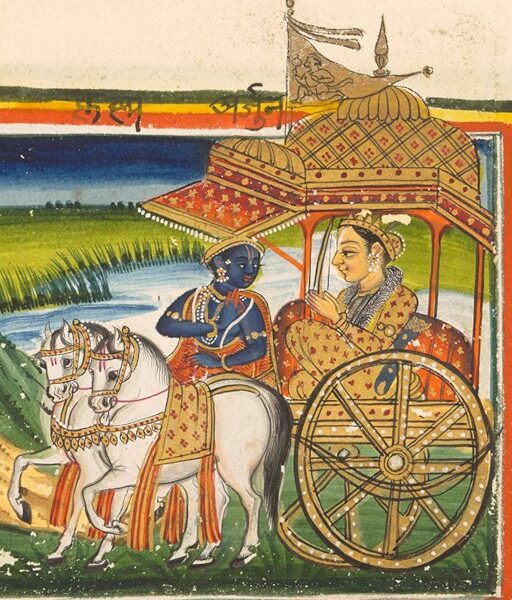
Further explanation. All these living entities, although born under the glance of the Supreme Lord, take their different bodies according to their past deeds and desires. So the Lord is not directly attached to this material creation. He simply glances over material nature. Material nature is thus activated, and everything is created immediately. Because He glances over material nature, there is undoubtedly activity on the part of the Supreme Lord. But He has nothing to do with the manifestation of the material world directly. It has something to do with Him, but He’s not directly doing it. It is His potency by which it happens. The businessman will put an investment into something, but it’s his people that do all the work and everything like that. So because He’s put that initial investment, therefore it has that potency. It’ll run. It can function. Before He does that, it won’t work. People know what to do, everything like that, but they don’t have the potency to do it. So then, with His glance, the material energy then can perform the creation.
Yes? In other scriptures they describe as God Himself creates all those things. Is this a description of the Supreme? The thing is, basically He is creating, but He’s doing so through His offices. So they’re mixing the various things, but the difficulty comes is that if you say it’s not Him doing it, then the confusion comes up that there’s other gods, other creators. If you say it’s Him doing it, then it doesn’t work so good on other levels.
So the difficulty is His potency that makes something work anyway, just like the machine. The machine, you can say, is doing the work, but actually it’s the electricity.
The electricity has just been transformed into heating something, or cooling something, or blending something, or whatever it is.
So the difficulty is not being able to understand the Lord and His potencies are non -different, but at the same time different. Then it becomes very difficult to understand, because then you end up with the problem of God’s beyond everything, so then He’s beyond the senses at all, so that means He has no form in everything. So then when we say that God’s walking in the garden with Adam and Eve, and that’s some kind of heavenly situation, then that must mean that’s not the supreme Godhead, that’s another one who does all the creation and all that. So all the bad things of this world go to that guy. You know what I’m saying? So then that also removes the personal aspect that you want to elevate yourself and again establish your relationship with God, because then in that definition, that’s not actually the Godhead. They have another name for Him, I forget what it is, with a D.
So does that make sense? You get these problems. So they mix up the activities of Brahma, the activities of the material nature, the Paramatma, Garbhodakasaya Vishnu, and the Supreme Lord. They can’t tell the difference between all these, so they can’t tell He’s the one that impregnates His potency, He’s the one that expands into the principles that they function on, and He’s the one that sanctions. But the actual external manifestation and the carrying out of the operation of that external manifestation is not done by Him, it’s done by His empowered servants.
Does that make sense? So therefore, then you have to have a lot of different sittings and discussions and all that, and because none of them are conclusive, therefore you’ll always end up with parties.
Like that, you get different groups.
But when you’re dealing with the proper understanding of Vedanta, especially according to Cinta Veda, Veda Tattva, there is no parties left. There’s only the Supreme Lord and His devotees, because the principle applies to everyone. Other aspects, they apply in a specific situation. They may be broader and broader, but the one that accommodates everything is Cinta Veda, Veda Tattva.
Supporting quotation from scripture, the conclusion, this example is given in the Smriti. When there is a fragrant flower before someone, the fragrance is touched by the smelling power of the person, yet the smelling and the flower are detached from one another. There is a similar connection between the material world and the Supreme Personality of Godhead. Actually it has nothing to do with this material world, but He creates by His glance and ordains. In summary, material nature, without the superintendence of the Supreme Personality of Godhead, cannot do anything.
Yet the Supreme Personality of Godhead is detached from all material activities. It means the flower is there, it has a smell. You can smell it, but you’re not actually in contact with the flower.
This element of imminence, that the Lord pervades everything by His potency, but He’s not actually involved. But through observing that potency, you can understand that it is He that has, how do you say, pervaded everything and making everything happen. Does this make sense? So He’s involved by His glance and by His ordaining, but everything else is done by the material energy.
I was thinking about free will. How does that work? Where would it be obstructed in this definition? No, it just means that if the Lord is aloof, then does He get involved in interfering with the free will of the jiva? Why would He get involved in interfering?
You know what I’m saying? But you’re making, it means the underlying principle that would be established by your statement is the living entity’s free will is being obstructed. You’re taking that as a fact, that the free will is being obstructed. Now, is it other living entities, is it material nature, or is it God? So that’s all we’re discussing. So the actual point of discussing about God isn’t the thesis, that is a sub-point. The main one is why is somebody, whoever that somebody is, messing with our free will? Does that make sense? But by this definition, why would you think the free will is being obstructed? What would give rise to that anxiety?
See because you’re saying He glances, He ordains, so you’re thinking, but ordains means you’re simply sanctioning or not, right? But the sanctioning or not is not like the living entity that is based on his whims. It’s based on your work, right? Just like let’s say you go to the bank, right, and you want to draw money, right? So you’re wanting to draw money is by your whim, right? But now the bank, are they giving you money or not based on their whim? So what’s it based on? What you have in the bank. So if you want 10,000 pounds and you have 10,000 pounds, then you can get it. But if you want 10,000 and you only have 9,000, then what happens?
Means they don’t sanction in that way. Does that make sense? So the point is, is his sanctioning is just whether you have the credits to do what you want or not. So he doesn’t get in the way of the free will in any way.
Does that make sense? But now you could complain that the devotees get in the way of your free will because you wanted to completely and with full absorption enjoy the material energy like that, and then along come the devotees and mess it up for you, tell you that you can’t, it’s impossible. You know, you’re the jiva, you want 10 ,000 to fit the hair, you’re not the one actually doing everything, you know, you’re only desiring. And so in this way they kind of mess it up for you. And if you really want to be happy, you have to please the Lord, you know, like watering the root of the tree and the leaves can’t be watered on their own and be happy, you know, and you just brought a new one of those, you know, tins, you know, with a little sprinkler on the wind so you can water all the leaves. Right? So this is, this is, now this is messing with your free will, right?
Does that make sense? But, you know, you can’t complain that God or the material energy or super soul is messing with your free will, no. That’s, that’s, that’s why we’re still here.
Okay.
Okay, so, yeah, so we see, yeah. So the living entity is, is, is, how do you say, subordinate to the Supreme Lord, right? Because that’s the second point being made. By that it’s, it’s, the facilities that he gets is coming from the Lord and the sanction that he can actually deal with it is coming from the Lord. So he’s actually submissive to the Lord, right? Now the material energy, she is, you know, naturally potent with the, with the ability to produce things, which she can only produce with the Lord’s potency. Does that make sense? So in other words, through his glance, he’s, he’s controlling the material energy and through his sanction, he’s controlling the genes.
Right? Does that make sense? But that’s all his involvement is, right? You know, you know, of course that deals with everything, but, you know, he doesn’t personally do it. He doesn’t get involved. Because it’s not of interest, you know what I’m saying, that the living entity is trying to be separate from the Lord and therefore trying to establish a really nice relationship with dead matter. You know, that’s not important. You know what I’m saying?
Does that make sense? Just like, okay, the child’s playing with the doll. Okay, that’s fine. Right? You like that. But if you come across a real person, you would expect that they would either include the real person in there playing with the doll in that whole scene, or give up playing with the doll and interact with the real person. Right? But if they don’t, you’d say something’s wrong, right? The child is playing with the doll. You’re not going to say what’s wrong with this kid. Right? You know, unless of course they’re 47 and they’re, you know, a top, you know, top lawyer and everything like that, then you might say something. Right? But other than that, then, you know, if they’re small, then you would say it’s fine. Right? But if you come in and start talking to them and they don’t, they don’t pay any attention, don’t notice, and they just keep playing with the doll, then you say there’s something wrong here. Right? So is there any interest for you in that situation?
No. So why would God have any interest in the living entities playing with dead matter and thinking it’s real?
You understand? Does that make sense? So a relationship will begin when you’re dealing with this karma yoga, jnana yoga, you know, when you’re including the person in the play. Okay, you know, here’s a doll, this and that. Okay, you can be, you know, this and that. And then, you know, you can be a part of the whole scene. So like that is I have my house and the family and my money. And so God can be part of that, you know? So it’s a beginning, you know? But then what are you doing? What is the, what is that adult doing? Right? In other words, they’re taking part in the kid’s world. So how much will manifest? How much of your personality you’re going to manifest in that? Right? A small amount, because it doesn’t take much. You know, all you have to be there is that when they look at you, you know, make a face. You do something, that’s all you have to do. Like that. Right? But now, if they’re going to take part in your world, then that’s a lot bigger, you know, than just there on the floor in the closet with all the shoes and everything else and you’ve set up a whole empire. Right? You know, there’s so many other activities and all the social and all that. Then they function in your world. And when the child functions in the adult world, then who’s submissive to who? The child has to work in the adult’s sphere. Well, wouldn’t, wouldn’t the adult? They’re including them. That’s why there’s a submission. But the point is, is who sets the rules? The adult. So that’s what we’re saying, the submissive. We’re talking about the personal interaction. You know, they say, but in the other one, who sets the rules? You know, you just came along and now, okay, now you’re the, you know, you’re the knight. You know, like that. I said, okay, you know, cool. Okay. Now here, you sit here, you know, this is your horse and you know, like, okay, you know, it’s like, that’s what it is, is, you know, so here it is, here’s my house and you know, you know, you’re the lord of my house, you know, the way I want. We’ll make the offering when I want, what offering we want, when we want. And like that, okay, cool. You know, it’s like that. Where do I sit? Yeah, you can sit over here. We made a nice place for you. You know, it’s a, does that make sense? So that’s the process is what, you know, especially nishkama, I mean, sakam karma yoga, this means it’s basically all you and they have a little part in it now and again. So whenever you’re playing with the dolls like that, they just sit there because they don’t do anything. But when you do turn to them, then they smile and interact. Then you go back to the thing like that. Nishkama means then you’re including them fully in it, but it’s still coming from your situation. The pure devotion means you start with the person. Now, what could you do with that person? What would please that person?
You understand? So therefore, there’s nothing for the lord of interest in the material world, right? Simply, you know, through his expansions as Garbhodakṣe Viṣṇu, I mean, as the puruṣa avatāras, then he takes care of it. And even that, he doesn’t have to personally do it, right? He has his officer, you know, Maya, she takes care of it. Because that’s all it takes. The quality and depth of what’s going on is very minimal, right? Because it doesn’t take a whole lot to manage illusion, right? Like that. It’s done, but one person does it. You know, unless you get something like, oh yeah, I guess if you had to put on all the credits for, you know, the illusion created by Maya, well, you have the 33 million demigods and that, you know. You know, nobody get through the credits, right? Like that, you know, stuff like that. Opening credits, yeah. Eyelids, you know, eyelids, tick, tick, tick. Yeah, yeah. Eyelashes. You know, first eyelash, second eyelash, third eyelash.
Yeah. Bug-bitten between the fourth and fifth blink, you know, provided by, okay. Lesson seven. Godhead in his impersonal feature is all-pervading, including the material nature and the living entities. 9.45, right? So this is coming as your next point in your Adhikarana. Then you say nature and the living entities are all subordinate to Godhead. That’s the thesis that’s being presented, right? Because that’s in answer to the previous Adhikarana, having established the living entities being subordinate, there may be a doubt that the material energy is subordinate, right? Does that make sense? And so now we’ve established that both are subordinate, but then how he’s doing that, right? In other words, what’s the reason that you can make that statement, right? Because the point is, is you’re saying that there’s fire on the mountain, but why? What is the reason? Because there’s smoke, right? That’s your reason. So the living entities and material nature are subordinate, but how? Because the Lord is all-pervading in his impersonal feature, right? So that’s how, you know, he’s pervading everything and therefore they’re subordinate to his position.
So 9.45, 9.4. By me and my unmanifested form, this entire universe is pervading. All beings are in me, but I am not in them, right? So the point being made is, how is the Lord spread all over the creation? And what is explained here is the mystic power of the Lord. Although the Lord is all-pervading, everywhere present, he is not conceivable by the material senses. This is indicated here by the words avyakta -murtina, but although we cannot see him, everything is resting in him. As we have discussed in the seventh chapter, the entire material cosmic manifestation is only a combination of his two different energies, the superior spiritual energy and the inferior material energy. Just as the sunshine is spread all over the universe, the energy of the Lord is spread all over the creation, everything is resting in that energy, right? So everything’s resting in the sunshine, everything’s working because of the sun. If the sun stops shining, basically even the scientists would say in three days and that’s it, and they’re just going by, you’ve covered the earth, they’re not going by the rest of the universe freezing, right? Does that make sense? They’re just worried about this place freezing, but now if the rest of the universe is freezing, this place freezes a little quicker, right? You know, like that.
So, you know, it’s a great concern, right? When that one, I can’t remember her name, but one of the, you know, noted as one of the five main chaste women of the universe, when she, you know, stopped the sun from rising, then the whole point is that all the living entities, it means all of them in the whole universe will die if the sun doesn’t perform its duties, like that. And her point is, you know, she’s talking to Lord Brahma. So you’re saying, that’s your problem. You’re in charge of all the living entities, but my problem is my husband. So I’ll worry about my problem. You worry about yours.
Yeah. So then, you know, so then Brahma has to strike a deal. He’s not going to, he’s not going to work on, you know, this kind of thing. It’s no, no, you know, think of everyone and like that. So no, it’s, it’s, it’s a matter of, no, I got my job and I’m doing it. I can’t worry about the, I can’t save the universe. So it’s not my job. I can save my husband. So, so if, you know, there you go, the universe is yours. So then, you know, then they strike a deal. So then, then, then it all works out. So the sun means in other words, the husband was a leper, right? So he couldn’t walk and move around and all that. So Brahma says, okay, so he’s been cursed to die when the sun rises. So let the sun rise so that nobody else dies and he’ll die, but I’ll bring him back to life in a new, fresh body with no leprosy and everything like that. So then she considers, okay, that’s it. That’s better for him. That’s good. Because if it’s just a matter, I’ll bring it back as a, you know, what’s the difference? He’s already alive now, you know? So, so like that, then they worked something out. So, but the point is, is that if the sun doesn’t function, then the whole universe doesn’t function. So this saying is that using the, the sun rays, that is the basis for the whole manifestation to function is very fitting, because if the sun rays aren’t pervading the universe, the universe does not function. Right? So like that, he pervades everything. And so in this way, then, then everything’s there, because wherever you go, the sun is there. Right? Does that make sense?
And here is that only two of his energies, right? The, the soul, the jivas and the external energy. So his internal potency is not what’s making it function. Right? Because this is the reflection. Right? So you have internal potency, and that reflected is the external potency. So the external potency is doing everything, not the internal.
9.5. And yet everything that is created does not rest in me. Behold my mystic opulence. Although I am the maintainer of all living entities, and although I am everywhere, I am not part of this cosmic manifestation, for myself is the very source of creation.
Simultaneously, the Lord is present in everything, yet the common man cannot understand how he is also present personally. He is different from the material manifestation, yet everything is resting on him. This is explained here as yoga-aishvaryam, the mystic power of the Supreme Personality of Godhead. I forgot about the second verse, because I was really trying to figure out, where is he talking about the mystic power in the first one? Okay.
So, so here he’s making the point that he’s present in everything, at the same time he’s not involved in it. You know? So he’s not involved, but he’s the support, but at the same time he’s also present. So he’s pointing this out, this is my mystic power, right? So he very directly says, behold my mystic power here, right? Because others can’t do that. You’re the support, you have to be there. If you’re not the support, you know, if you’re not supporting, you’re not there, but he can do both, right? Because he’s God. So this is the fun, right? Behold my. That’s why that’s an exclamation mark after opulence. Yeah, yeah. Usually it’s just a thought. Yeah, but it’s here. Behold. It’s some fun. Check it out, what I can do. And the other guy’s supposed to go, cool.
Yeah. Okay. So he says, so by his impersonal, he’s pervading, including the material nature and the living entities, right? Because the, because the, the, the, the Lord is in everything. He’s in every atom, between every atom, right? So when we say in every atom, we’re not specifically talking about the atom meaning, you know, what they’re conceiving of today as an atom, which is not the atom, you know, just as the, the molecule wasn’t, it was, wasn’t the atom. Then they had to make this with, sometimes they’ll have to figure out there’s something smaller again, right? So he’s in the atom, right? Between every atom, right? Within the living entities. So he’s pervading everywhere like that.
Lesson eight, material nature means potency. Everything that exists is an emanation of Godhead.
Eight, ten, eight. I am the source of all spiritual and material worlds. Everything emanates from me. The wise who perfectly know this engage in my devotional service and worship me with all their hearts.
So how can one become truly, a truly learned man? Lord Kṛṣṇa is the source of all generations, and He is called the most efficient cause of everything. He says, because everything is born of me, I am the original source of all. Everything is under me, no one is above me. There’s no supreme controller other than Kṛṣṇa.
One who understands Kṛṣṇa in such a way from a bona fide spiritual master, with references from Vedic literature, engages all his energy in Kṛṣṇa consciousness and becomes a truly learned man. In comparison to him, all others who do not know Kṛṣṇa properly are but fools. Only a fool would consider Kṛṣṇa to be an ordinary man. We’ll say, no, but they’re intelligent, they’re doing so many nice things. But the point is, is the kid also considers, it was really fun throwing the rocks through Mrs. Seymour’s window, like that. It was fun, and it took skill. Most kids pick it up, they can’t get it that far, if they throw it, they’ll hit something else, like that. Does that make sense? But the problem is, is that just because we may feel it’s something really nice, it doesn’t mean that it necessarily is. So intelligence being applied, if it’s not seen in connection with the Lord, then, basically speaking, is useless. So one’s a fool. To apply your intelligence into something that’s useless, then you’ll say that’s foolish. Why are children considered foolish? They apply their intelligence into useless things, doing useless stuff.
So therefore, a truly learned man is someone who knows Kṛṣṇa. That’s why we always have to take note of the adjectives that are used, much of the time. In other words, what is defining the noun, or defining the verb? We have to notice that. Because here, a learned man can be someone, in other words, who has knowledge, who’s studied, or who’s practiced, like that. That may be a devotee, or it may not be. But a truly learned man is only a devotee.
Does that make sense? So many times you’ll see this, like that. The most efficient cause of everything. Because it’s his potency that makes it work. The efficient cause is what’s getting it done.
So the living entity is doing something, material energy is doing something. Does that make sense? But he’s the source of that, so he’s the most efficient cause. But it doesn’t make him the efficient cause. Because the efficient cause has a definition, according to the philosophical definitions.
Then efficient has a meaning, whether it’s meaning which of the four aspects of causation. So nobody, in all their philosophies, never gets into actually up to the Supreme Lord. Though they’ll still have four, but they don’t get up to that the fourth one’s actually the Lord.
So nature means potency.
Here’s further reasons. So nature means potency. Now, he is the all-pervading. Nature means potency, and that exists as an emanation of him. Because you’re establishing that he is pervading everything. So just as the sun rays, he’s pervading. And the material energy is based on that, so therefore, it can’t function without. The last one, it just showed the situation of the material energy being based on Brahman. But here, it can’t function without that original connection with the Lord. So it’s giving another aspect of the same point.
And then nine, which is the last of these three reasons. Godhead is omnipotent, and therefore, he is the master of all potencies, namely the material, spiritual, and marginal. 8.22. The Supreme Personality of Godhead, who is greater than all, is attainable by unalloyed devotion. Although he is present in his abode, he is all-pervading, and everything is situated within him.
Okay, so now describe how Kṛṣṇa is the Lord of all spiritual, material, and marginal potencies. The supreme abode of Kṛṣṇa is a place where everything is full of spiritual bliss. Nothing there is material. All variegatedness manifest there is of the quality of spiritual bliss.
So they point this out is because they’ll say, no, but if there’s variegatedness, it can’t be spiritual. So they’re making the point is that, no, it’s spiritual, and there’s variegation.
So that is the spiritual world.
As far as this material world is concerned, although the Lord is always in his supreme abode, he is nonetheless all-pervading by his material energy, because material energy is him, right? So it’s still Brahman. Does that make sense? Just like you’re not your hand, but you can be conscious of it, like that. But if something more important is going on, you’re conscious of that, not of your hand. Does that make sense? You know, so when there’s a devotee doing something in the material world, then he becomes conscious of it, something worthwhile is going on. But if not, then the hand just does what it does. You don’t have to think about it like that and get rid of the mosquito. You’re not thinking about it. It just does that, because it’s been empowered as such to do so. Yes. Oh, OK. So your hand was connected, the way you put it, like this hand. So is that by your potency expanded? So you’re not raising your hand, but the hand is being raised.
So by his spiritual material energies, he is present everywhere, right? So generally we look at it as the brahmajyoti, he’s pervading everything. But the point is, is the Brahman is not a separate thing. The Brahman is manifest as spiritual and as material. The point is, is when we say material, it means the material world is his material energy. He’s pervading as his material energy. Then there’s the material world. Does that make sense? Material world is the manifestation of the material energy in forms that we want to interact with, in situations that we want to be in, getting results that we’re looking for. Does that make sense? So the material world means our illusion that the material energy is not the Lord’s energy. Does that make sense?
Does that make sense to you? Are you thinking or this is one of those kind of like, blank, pleasant blank looks like it doesn’t. Yeah, the mouth is moving and he’s saying something, but I wouldn’t have a clue what he’s talking about here.
Even that gets no response.
Okay.
So in other words, what’s being pointed out here is that the material nature is Brahman.
So it is Kṛṣṇa, but he as a person is not involved.
Then that particular manifestation that the material energy herself is carrying out.
Does that make sense? So we have to be able, in general, when we say the material world, we mean the energy with the illusion, because the point is, who’s just seeing the energy, no illusion. But for defining, so we can tell the difference very clearly on its application, the material and spiritual, then we have to be able to make the distinction that there’s the material energy and then there’s the material illusion.
Does that make sense? So let’s say we have something, right? We have some item that is, let’s say, socially very popular at the time. So that item is made out of material energy. Right? That’s a fact and it exists. It’s there. There’s a particular combination of the five elements. It has that particular form and function, right? You can get particular results. So that’s real. That’s material energy. But now that you think this is a really great thing and it’s so important and I got to have one of these and if you have one then there’s so much, you know, then the social prestige and this and that, that’s the material energy. That’s the material world. Right? That’s the illusion. Does that make sense? So that’s why the same item the devotee can deal with and they’re just dealing with Brahman, though inferior Brahman, in Kṛṣṇa’s service. Right? So there’s no difference between that and the spiritual world, that you’re taking whatever the Lord’s energy and using it in His service, according to your nature. Does that make sense? Like that. So they’re doing the same thing, just they’re situated here instead of situated there. So it’s just a matter of situation. Right? Still it is a spiritual situation or still the devotees who are dealing with that is there in a spiritual situation? Means, means that’s looking at another aspect. That’s their consciousness is spiritual. But the point is, is they’re situated in the material energy, but it’s Brahman. So they’re not, they’re not bound by the material illusion. So they’re liberated, though they’re standing in the same place as the other God. You know what I’m saying? You know what I’m saying? The one person pulls out the gizmo and he’s, you know, all enamored by it and he’s using it and checking if anybody’s noticing that he’s using it and like that. And the devotee is using it just to serve Kṛṣṇa. He’s not worried about anything else. So they’re both using the same item in the same place at the same time. One’s in the material manifest, material world. The other one is on the Brahman platform, right? But it’s the inferior Brahman, not superior Brahman. But his consciousness being spiritual, he’s situated transcendentally. While the other one, his consciousness is in illusion. So he’s situated within the material manifestation.
You know what I’m saying? That they’re standing next to each other. That’s why it’s important. Otherwise we think the activity is what makes it spiritual and material. Therefore, then, you know, the brahmacārī has some money and he’s doing something with it. But that can’t be right. It can’t be devotional. It can’t be a brahmacārī because it’s money. And money, you know, defines, you know, the thing. No, it’s how you use it that defines.
Does that make sense? So that’s why it’s important to be able to tell the difference. Otherwise, then one simply works on the externals. And as long as the external is sitting down and chanting your japa or standing in front of the deity and singing kīrtana or offering arati, you know, you got your nose in a bhāgavatam, you know, or something like that, then only you can tell it’s devotional service and nothing else you’ll be able to tell. Why? Because it’s not.
Does that make sense? The person who can’t distinguish, it means the activities that they’re doing that are not direct activities is not devotional service. Right? But it’s still a devotee because when the opportunity to do direct service is there, they take it. Right? Just like the demigod. Because when things get rough, they turn to the Lord. They’re called suras. When things are not going rough, they don’t remember the Lord. But they’re not called demons because when it gets tough, you know, when the going gets tough, you know, then the tough turn to the Lord. Right? You know, like that. So.
Does that make sense?
Yes. When we see material energy connection with Krishna, still material energy is acting according to the laws here? Yeah. I mean, the laws here and the laws there are the same, basically. There’s a time and space is, you know, a limitation. But otherwise, you know, a fire here, you use it to cook and the fire there, they use to cook. Right? You know, like that. You take a bath with water here, you take a bath with water there. It’s a reflection. You know what I’m saying? So what you do in real life is how the mirror works. You know what I’m saying? You put a, you know, took one wall of your living room, the full wall and put a mirror on it. You would notice that everything you do happens in the mirror. Right? Does that make sense? So that’s the way it works. So how you vacuum your rug is how they vacuum it. You know what I’m saying? That’s how it works.
Right? They don’t vacuum the rug because they don’t keep them. So that’s, you know, you don’t need a vacuum if you have a wall-to-wall carpet. Right? If you don’t have a wall-to-wall carpet, you don’t need a vacuum cleaner. So they don’t keep them. But the principle of rug, that comes from the spiritual world. And keeping it clean, that comes from the spiritual world.
Does that make sense? So it’s just a matter of understanding situation.
Right? It’s just a matter of where it’s situated and what you’re dealing with. Right? You’re situated in one place and you’re situated in another.
But let’s say someone has an enterprise. Right? And so they sell a particular kind of goods. But they distinguish between the high end of the same goods and you’re more common. So they have more of a boutique outlet and they have, you know, a big kind of like, you know, common or warehouse kind of outlet. Right? But as far as business goes, it’s the same business, just in two situations. Right? One’s dealing with superior goods, one’s dealing with inferior goods. Right? Does that make sense? But they look the same. Right? You know, one is actually from Switzerland and the other one is from China. Like that. But they both look the same.
Does that make sense?
No? Yes? Does things get dirty? The concept of things get dirty is there, though nothing gets dirty. It doesn’t mean if you fall in a mud puddle, you don’t get mud all over you. But generally speaking, they don’t fall in mud puddles. Right? That’s the one thing you could probably say is there are no schlemiels or schlemazels in the spiritual world. Right? So therefore, it’s not a problem. Because the schlemiel falls in the mud puddle. Right? And the schemazel is the one that’s standing next to it that gets splashed also. Right? So you don’t have that. But they’re always cleaning. Like it mentions when it’s defining Vaikuntha that all the lady devotees there are dusting the palace, even though there’s no dust. They’re doing it to please the Lord. So the concept of cleanliness is there, but it doesn’t get dirty.
Here we only clean because it gets dirty. Otherwise we wouldn’t clean. But there they like to clean. Right? But because they like to clean for Krishna, therefore they’re giving the blessing that there’s no dirt.
Right? And here we say, well, then what’s the use? Because we’re thinking, I’m doing something and I’m accomplishing something with that accomplishment. Then I can feel, yes, I’ve done something. But there their only purpose is to please the Lord. So there’s no need of feeling I’m the controller and enjoyer. So they happily dust, though there’s no dust.
Does that make sense?
Because the skin is like broken down, isn’t it, by a mode of ignorance? Skin’s broken down by a mode of ignorance. So then it falls off and that’s predominantly what dust is made from. Dust is made from old skin. In the house. In the house. Now I think that’s in your pillows and mattresses. That’s what’s there. But on the floor, it’s kind of what wafts in through the window. That’s the air picking up small molecules of earth.
Just like if you notice that if you live next to a main road, then you have to dust more often than if you live out in the country. So it’s not that by living next to the main road, it creates by the sound or the other chemicals that more skin falls off. Like that. So someone who has a problem with weight, then it’s recommended they live next to a main road. And the bigger the highway, the better. You know, all the skin goes off quicker.
The only problem is, is their heads keep getting smaller also. That they didn’t want to do. And so even though, yes, they lost 50 pounds, but so did their heads. It didn’t work out so good.
I take it you have one of those little miniature vacuum cleaners that can pick up an elephant and stuff like that.
Yes? I think it’s more in connection with the heavenly planets. I mean, they may mistake it for the spiritual world.
Because if you’re taking material, meaning it’s all kinds of problems, so if you have a situation that doesn’t have any problems, then that is called the spiritual world. So in other words, what we call piety and impiety, then they call material and spiritual.
And what would be called, how do you say?
Yeah, basically. Like that. So spiritual doesn’t even come into it. They really don’t really know about spiritual.
But you have Gandharvas. They fly around. They sing nice.
So they have wings like that. And the little halos is, how do you say? The effulgence of Krishna and all that, that comes from there. So somehow or another, then they’ve attributed that to others and all that.
And mainly reasons why certain ones get into it and certain don’t is because you’ll have the ones where it’s an effulgence. That’s more common. But when you have an actual halo, the difficulty is the mechanics of holding it up. So therefore, you have to have kind of like a cross mechanism that connects the halo onto the head. Otherwise, it’ll fall off. Right? So that’s why you see that. But if it’s just an effulgence, then it’s not so much of a problem.
Does that make sense?
Yes? No? Okay. Yes. Just to confirm my understanding of this slide, what do you explain about distinction between material energy and illusion? Is it how it is consciousness? Consciousness makes distinction, not activity, right? Yeah, it’s consciousness. It’s conscious. Because the activity may be the same. It may also be because consciousness is different. They’ll take up activities that don’t have a usefulness to be engaged in the Lord’s service. So that’s not what we’re discussing. We’re talking about appropriate activities that would be considered recommended activities, that you can do that for your own pleasure or elevating yourself to the heavenly planets, elevating yourself to the platform of Brahmā, or use it in Kṛṣṇa’s service, like that. But the point is, what distinguishes is consciousness.
Okay.
So by his spiritual and material energy, he’s present everywhere, both in the material and in the spiritual universes. The Brahma-saṁhitā, 5.37, also confirms that although the Lord is always in the supreme abode, Goloka Vṛndāvana, He is all-pervading. So everything is going on nicely.
As stated in the Vedas, Svetasvatara Upaniṣad, 6 .8, Okay, that’s quoted in the Madhya-līlā, 13.65, purport. His energies are so expansive that they systematically conduct everything in the cosmic manifestation without a flaw. Although the Supreme Lord is far, far away. So depending upon how you’re taking His energies, He is doing everything. But He is not different from His energy, so that’s how He’s doing that. But at the same time, He as a person is not involved. So this is His mystic power, like that. So the energy itself is still His, but when you glance at it, just like you’re aware of your hand, then you can do so much more. You’re not aware of your hand, it doesn’t do much. Does that make sense? So that would be, does that make sense? So when He glances at the material energy, that focus is there, so then so many things are happening. But at the same time, the material energy is His potency. So He is that. But at the same time, He as a person is not. Does that make sense? So these are the points where it kind of gets where it’s a little beyond, you know, one ten thousandth the tip of the hair to fully grasp. At least if we’re appreciative of the concepts, then it works.
Yeah, it works on its own. You know, it’s just like you turn on the machine and then it runs on its own. But if you don’t turn it on, it won’t run. And you’re providing the potency that makes it run. Right? And it’s your machine.
Does that make sense?
Okay. Then the next, who are expansions of Kṛṣṇa? Give an example to explain their relationship with Kṛṣṇa. In the supreme abode, there’s only one Supreme Personality of Godhead, whose name is Kṛṣṇa. He is the supreme merciful deity. Although situated there as one, He has expanded Himself into millions and millions of plenary expansions. The Vedas compare the Lord to a tree standing still, yet bearing many varieties of fruits, flowers, and changing leaves. The plenary expansions of the Lord, who preside over the Vaikuntha planets, are four-armed. They are known by a variety of names. Puruṣottama, Pravikrama, Keśava, Mādhava, Aniruddha, Hṛṣīkeśa, Śaṅkarṣaṇa, Pradyumna, Śrīdharvāsudeva, Damodara, Janardana, Narayana, Vāmana, Padmanabha, etc. Let’s continue.
Okay.
So all the different expansions are there. The first being Baladeva, who then expands into Mahānārāyaṇa, who then expands into the Vaikuntha deities and into the Puruṣottama avatāras.
Right? So…
Yes. So even His expansions, that’s being carried out by Balarāma. Right? So this puts Kṛṣṇa in a unique position, that He doesn’t technically, personally have to do anything. Right? Because as far as energies go, then His internal potency, external potency take care of everything, and all the expansions, then Balarāma takes care of. So that leaves Him in a very unique position amongst His energy and amongst the other expansions. So that’s why all other aspects worship Kṛṣṇa. Right? Everybody is a devotee of Kṛṣṇa. All the Viṣṇu-mūrtis are all devotees of Kṛṣṇa. All the energies are devotees of Kṛṣṇa. Right? We get caught up, okay, when this one’s a devotee of here, they say, that’s Jīvas. Right? But the internal potency, they all worship Kṛṣṇa.
Like that. The Viṣṇu-mūrtis, like in your main Vaikuṇṭha temples, like in South, your Charapati, your Śrī Rangam, and that, in the room where He sleeps, then they have mirrors and that on the walls, and they have pictures of, you know, Kṛṣṇa’s pastimes in Vṛndāvana. Right? So that’s how He likes it.
Right? Right? Is that what you’re saying?
Okay. He is omnipotent, therefore He’s the master of all potencies, namely the material, spiritual, and… If He’s omnipotent, it means all potencies are coming from Him, so it’s natural that He is the master of those potencies that come from Him. Right? So you won’t get this thing where He creates the world, but then it gets out of control and He doesn’t create it anymore. You won’t have that as an option to try to explain how God’s not… He created it, but He’s not actually controlling it.
Lesson ten. Now we move into the examples.
Lesson ten. Earth, water, fire, air, ether, mind, intellect, and false ego are all products of the material energy, potency. So, from seven, four. Earth, water, fire, air, ether, mind, intelligence, and false ego all together these eight constitute my separated material energies.
Right? So, as we said before, if you have an energy that’s not separated, then it functions… I mean, Krishna’s directly involved, but when it’s separated, then it functions on its own. Right? By His potency, but it still functions on its own.
Describe the manifestation of the material energy. In the material energy, the principal manifestations are eight, as above mentioned. Out of these, the first five manifestations, namely earth, water, fire, air, and each sky are called the five gigantic creations or the gross creations. That’s the Mahābhūta, within which the five sense objects are included. They are the manifestations of physical sound, touch, form, taste, and smell.
Material science comprises these ten items and nothing more.
So, that’s where it is. So, when we say earth, water, fire, air, ether, mind, intelligence, and ego, then we mean that’s what you’re working with, because then you take the Mahābhūtas. You know, why the Mahābhūtas? Because everything is a manifestation of them. So, earth, water, fire, air, ether, then they are sound, taste, touch, and everything, and they are the sense object itself. I mean, the sense object and the sense are made up of them anyway. Your tongue and your note is made up of these five, and what you’re dealing with is these five. So, it’s the potency of seeing.
So, the material scientists never get beyond this.
But the other three items, namely mind, intelligence, and false ego, are neglected by the materialists.
Philosophers who deal with mental activities are also not perfect in knowledge, because they do not know the ultimate source, Kṛṣṇa.
So, your scientists, they don’t deal with these other areas, mind, intelligence, false ego, they don’t deal with it. There are people who will consider what they’re doing is a science, but they’re not technically accepted by the scientists as scientists. Because how do you actually judge? Because if you can’t, by mathematics, judge it, how do you tell? So, that’s science. If you have to actually make some decisions about it, then that means it becomes subjective, so it’s not a science anymore. So, anything dealing with the mind and the ego, all these other elements, they’ll consider are not real sciences. Or, if it’s considered really politically incorrect, then they’ll call them soft sciences.
Anything based on math, that’s a hard science. So, soft means it’s kind of gooey and flexible, and you can do something with it. Does that make sense? So, that’s what Prabhupāda is saying, they don’t deal with it. Then he’s saying philosophers who deal with it, but it’s imperfect, because they don’t know the source of it. The others are just dealing with what goes on here. Though they’re claiming to try to find the source, that’s going to be pretty impossible. Right? Does that make sense?
Yes?
About these five elements, Mahābhūta, we have seen before, with Śrāvakā, I think he was only using four. Four, yeah, because ether they don’t count. But according to what Śrīla Prabhupāda said here, the modern science comprises ether. Yes, because they say there’s space, but they don’t know how space works. Because they say everything in creation is packed into one infinitesimal point, as if it would be possible.
And then it only explodes.
If you take something and squash it, it burns, it doesn’t explode. So it’s not even…
Everything’s in there, including space. But if space is in there, where does it expand into?
They’ll say, OK, well, the space is moving a little quicker. But the problem is, how do you consistently get that, since it’s random? So that should be, there’s parts of the cosmic manifestation that are more than that, and there’s some gaps here and there that don’t make any sense, unless that explains black holes or something. But you know what I’m saying? It’s very inconsistent, because how could you expand into something that there isn’t something to expand into? So that means space is creating the space. No, space has already existed.
You know what I’m saying? So there’s some serious problems there. Though they deal with it, they don’t understand it. The Charvakas don’t worry about space. Because the point is, you’re just trying to enjoy. So it’s not necessarily the space you enjoy.
You enjoy what’s in the space. Even if you say, you go out into nature and say, oh, nice, it’s big, and like that, but you’re enjoying something that creates the sense of space.
You know what I’m saying? You go to the Grand Canyon, you’re on this side, the other side is way over there, and it keeps going forever, and there’s nothing around. But it’s still, it’s defining. So therefore you have a sense of the feeling of the space. But it’s the earth, water, fire, air, and ether, I mean, earth, water, fire, air, that is defining the space that you’re enjoying. So you’re not actually enjoying the space. Or even they are, they’re not able to appreciate it. So, you know, it’s always there’s some shortage.
And so the Mayavadis, they want to remove the other four and only have space? Well, no, even technically space would be, because then it’s all Brahman.
I’m trying to picture space without anything in it. Well, that’s the thing, is that’s why they don’t do a good job of it. So they have to put a cloud and an om sign there, and then they’ve got to get something to focus on, right? You know, or if you’re a little more zenny, then you just pick a wall or something like that. You know, in other words, there’s no such thing as that. That’s why you can’t picture it. You know, you can only picture something that’s within your, how do you say, experience.
You know what I’m saying? So it’s the same with illusion. You can only have illusion because you have a concept of relationships in that. You know what I’m saying? That you don’t have to, it means, in other words, to a child, you never have to explain what a mother-father is. You never have to explain that there is a thing called relationship. You may have to describe particular relationships, right? You know, but the concept of relationship, you never have to explain to them the concept of being happy and not happy. Maybe what makes you happy or makes you unhappy, but not the principle of it. So in other words, the principles that life is based on, you never have to explain because you already have that experience. Right? You come to the material world with that concept. Now, by free will, since you’re not able to enjoy, you use your mental speculative powers to try to put together various combinations of these elements to create forms and activities that you say will create your happiness.
Right? And so for that, so to keep you busy so you don’t get bored too quickly, then there’s 8,400,000 major branches of opportunities. And then within each one of those, you have so many.
You know what I’m saying? Like that. You know, this person’s a dog. Right? So that pretty much kind of, you know, establishes what they could do. Right? They’re going to bark, they’re going to slobber. They’re going to, you know, like this, wag their tail. So they could bark inside. They could bark outside. They could bark inside and scratch on the door. Or they could bark inside and scratch on the window. You know, so like that, then there’s so much more variety is added in little detail. Right? So this way you get billions of combinations. So it keeps you busy.
Philosophers who deal with mental activities are also not perfect in knowledge because they do not know the ultimate source, Krishna. Notice here it’s also very subtly. He says, material science comprises these ten items and nothing more. So it’s just we’re saying, okay, it’s a fact. Then he says, philosophers who deal with mental activities are also not perfect in knowledge. So what does that infer? That the scientists are not perfect in knowledge. You know, it’s just like the one Hindu is talking to Prabhupada, you know. What do you think of Ramakrishna? I don’t think of Ramakrishna. What do you think of Vivekananda? He’s another rascal.
So what does that mean? It means the first one was also a rascal, right?
So expert at this.
So here he said is that it’s this and nothing more. Because if it’s nothing more, it means it doesn’t include God. So that means it’s limited. It may be very vast, but it’s the end. Vast being the opposite term. It may be very vast, but it doesn’t mean that it’s doing anything. It doesn’t mean it’s God conscious, right? And so then here he’s then saying, he’s then taking the next thing. You know, they’re also not perfect in knowledge. So we can understand is that if it’s nothing more, it means the knowledge is not perfect.
Right? But unless you want effect, you know, say the Mayavadis, they’re like that. They’re not perfect in knowledge. You know, the materialist, he’s like that. He’s not perfect in knowledge. The yogi, he’s not perfect in knowledge. But the devotee, he does like this. He’s perfect in knowledge. So you’ll sometimes see that the shastra will use that as a literary, what do you call those things? Embellishment or ornament. Yeah, device like that to make the point. But also because if you use it too regularly, it’s not an ornament anymore. Right? So therefore the subtleties of you said the thing and it’s not complete. Then you go to the next one and say it’s also not complete in knowledge. So you’ve made the point that it’s only that from the previous one. And in the previous one that it’s incomplete in knowledge. Right? Because they only deal with the mind. They don’t deal with these other things.
The false ego, I am and it is mine, which constitute the basic principle of material existence. Right? The basic principle means this is the foundation of why we do what we do. Right? This would be your, what do you call it? The original sin.
Which constitute the basic principles of material existence. Includes ten sense organs for material activities. Intelligence refers to the total material creation called the mahat-tattva. Right? Because your, what happens in the mahat that’s different from the pradhan?
Activity. Activity. And then, but how is that, what’s the symptom of that activity? What has happened between the two? Differentiation. Differentiation. Right? In other words, pradhan is all just merged together. It’s not that there’s no distinct, you know, earth, atom, fire, atom, earth, water. They’re just all mixed together in such a, you know, homogeneity.
Right? That it’s indistinguishable.
But mahat means that they’ve been distinguished. So you have earth, you have water, you have fire, you have that. You have the combinations to make the senses and the sense objects and everything. Does that make sense? So it’s intelligence. So the senses function by intelligence. So therefore, intelligence pervades everything. Yes? Is the pradhan unmanifest? Pradhan, it means, it doesn’t mean that it doesn’t exist. It means that the particular detail of form and activities and results is not manifest.
Does that make sense? Yes. That’s why I said it may be efficient in getting these done. But the ultimate cause of the efficient cause is the Lord. Right? Because it’s His potency that allows it to happen.
Is each mode a person? Is each mode a person. So you want to know if you offend the mode of ignorance by giving up its association.
There’s a picture of Krishna and a man who’s moving some pot of man and his boss. Yeah, but who’s moving it? The three modes. Yeah, but who’s moving the three modes? I think if there, if you check, there’s mayas there, and then Krishna’s behind that.
You know what I’m saying? In other words, the material energy functions by the three modes. That’s the mechanical process, what she uses. Does that make sense? She gets things done by the modes. That’s how she works. Right? And then that manifests different things. But they still function according to the modes. The modes create the form, but the form still works according to the modes. Right? So what it’s created from is what it works from. Does that make sense? In the spiritual world, then you have samvit, sandhini and hladhini. Right? So everything is manifest and moves according to that. Does that make sense? So let’s say sandhini. It means your cows are created from sandhini. But the rasa is that of appreciation.
Right? Because sandhini manifests those rasas. So anything to do with appreciation only, that means the whole situation. All the animals, all the trees, the land, the buildings, anything that creates situation, that is the sandhini potency.
Right? But it works by that also. Does that make sense? So this is a reflection of that. So the point is, we’re under the control of the modes of nature, so we’re under control of maya. But if we’re under the control of the sandhini, sandhini, hladhini, then we’re under the control of the internal potency.
Does that make sense?
It means they would be persons, but we generally don’t worry about them. Just like the Gita is a person. In Brahma’s court, all the shastras are there personified. So the 18 Puranas are there as people. And so then when they discuss shastra, you don’t have to have a pundit who knows the shastra, you have the shastra itself discussing the court. Right? So if you want to know something about the thing, then dharma shastra will say, yes, so like this, and then, you know, it’ll explain.
Right? So in somebody’s court, then you’ll have the three modes of nature sitting there, but generally that would be in maya’s court. Right?
Make a good play. Huh? Make a good play. Yeah, yeah, you could pull it off. Who’s in whose court?
Yeah?
Some examples of, you explained about samvid-photu or samvid-mokti, which creates the situation. And what about the samvid-gadhini?
Means, it means your, your, your samvid is your, your parental friendship and servant of Rasa’s. And gladhini is gandhini.
Intelligence refers to the total material creation called the mahat-tattva. Therefore, from the eight separated energies of the Lord are manifest the 24 elements of the material world. Because these are all the different, also, egos. Right? You’re going to have the false ego. Right? It’s I and mine. Then you’re going to have the senses from the intelligence. Right? Then you’re going to have the mind. Right? Does that make sense? Then you’re going to have the polluted consciousness that I’m the controller and enjoyer. Does that make sense? So, the polluted consciousness is whether one is devotional or not. Right? That’s its manifestation.
Then, then for the false ego, then that’s the body that you see. Right? The intelligence, it’ll be the senses. The mind, it’ll be the emotions and feelings. So, when we say, when we’re discussing false ego, technically there’s four kinds.
Right? Right? Does that make sense? These four means, means the polluted consciousness, the mind, the intelligence and the false ego. And delusion, how does that? All that’s delusion. It’s just different aspects of delusion. Yeah, then there’s manifestation of that. You know, I’m the controller and enjoyer, but unless something manifests, how do you, how do you endeavor for that or prove that?
Yeah, so this way you get the 24 elements. Yeah? Therefore, from the eight separated energy, a manifested 24 elements of the material world. Right? Because you have the eight, but then you take the five, and the five, you get the, the, the, the ten senses, and you get the, the, the sense itself. So right there, that’s 20. Right? Then mind, intelligence, false ego. Right? And then, let’s say, polluted consciousness. So then 24 you get.
Right? Or you say the modes of nature. You know, it depends upon how you’re… Yes? So, pure consciousness is just the spiritual equivalent of polluted consciousness?
No. It means, rather than say, spiritual, how do you say? No, it’s just… It means, in other words, material consciousness is covered pure consciousness. Because the consciousness is covered. It’s not that the consciousness itself becomes transformed. It simply becomes covered. But we identify with that covering. Right? Right? Just like, just like, you may be, you know, how you, you know, in your… You’ve taken a bath, clean clothes and everything. You’ll say, I’m clean. Okay? Now, you know, going back to our, you know, Shlomil and Shmazil example. Now, if you happen to be either one of these, right? And there’s a mud puddle, then what’s the next comment you’re going to make as you look at yourself? I’m not clean. I’m dirty. Right? You understand? But the point is, is it’s just the covering is there. We identify with it. Therefore, we say, I’m not clean. Right? In other words, the natural state of pure consciousness is covered by the polluted, you know, the desire to control and enjoy. So therefore, we will say that now this is material consciousness. Right? So the pollution of the consciousness, isn’t that the other 23 elements? No, that’s 23 elements are what is the forms that we identify with to say we’re polluted.
You know what I’m saying? Because you can say you’re polluted. But how do you prove you’re polluted?
You know what I’m saying?
Yes. Maharaj, when you mentioned that feelings is based on the mind. So when somebody is expressing, not necessarily a mood, but a view or their point of view, they use the term, well, I feel like this and this and this. Yeah, that’s the mind. That’s basically the mind. It is the mind. It is the mind. Yeah. It means, in other words, the intelligence discerns it, but that you, what you accept from it. Like the mind, I mean, the intelligence, the senses can see all kinds of things. But whether the mind will accept that or not, that’s another thing.
And we always…
Yeah.
Is that make sense?
Therefore, from the eight separated energies of the Lord are manifest the 24 elements of the material world, which are the subject matter of Sankhya atheistic philosophy, right? Subject matter of atheistic philosophy because it’s only dealing with the material world. Right? If it’s dealing, the same subject, but in connection with the Lord and how He’s created, how He’s controlling and how by, we become illusion from not understanding that, how we’ll become freed from the illusion by, you know, seeing its connection to the Lord. Then that’s the Sankhya as given by Kapila Muni. He’s the son of Devahuti.
They are originally offshoots from Krsna’s energies and are separated from Him. Right? But atheistic Sankhya philosophers with a poor fund of knowledge do not know Krsna as the cause of all causes. The subject matter for discussion in the Sankhya philosophy is only the manifestation of the external energy of Krsna as it is described in the Bhagavad-gita. So even they’re dealing with it, they’re not necessarily dealing with… They don’t understand.
They’re only seeing the living entity and His involvement and the material energy and its involvement. Right? So the two energies that Krsna said. But what they’re missing is that He, it’s His energy. So He’s the cause of all causes. So that means He’s the fourth of the causations. Right? And His internal potency is the third. So their interaction is what reflects and then makes the activity of the living entity thinking they’re God and Purusa and the material energy is they think is their potency.
Does that make sense? So God interacting with His energy. Right? The Purusa with the property. That reflects here is the Jiva thinking they’re the Purusa interacting with the property which is the material world. So the atheistic Sankhyas only deal with these two aspects.
Right? They may refer to some subtle in this and that but they’re still only dealing with the mind, intelligence, false ego. They don’t actually deal with spiritual. So that’s why it’s atheistic.
Does that make sense?
Good? Any other points? No?
Okay. So this is not yet your example. Then another example would be the next, lesson 11. Living entities are products of spiritual potency. Right? So we’ve defined the material energy now, saying He’s all-pervading and so material energy is this and this is how it works. Now living entities. 7.5. Besides these, O mighty-armed Arjuna, there is another superior energy of mine which comprises the living entities or exploiting the resources of this material inferior nature.
Okay. How is it understood that the living entities belong to the superior energy of the Supreme Lord?
34. Oh, here it is. The living entities belong to the superior nature or energy of the Supreme Lord. The inferior energy is matter manifested in different elements, namely earth, water, fire, air, ether, mind, intelligence and false ego. Both forms of material nature, namely gross, earth, etc., and subtle, mind, etc., are products of the inferior energy. The living entities who are exploiting these inferior energies for different purposes are the superior energy of the Supreme Lord and it is due to this energy that the entire material world functions.
So here, it’s a point like this is where Mayavadis and others will consider. See, it’s the jiva that makes it function, so the jiva is God. But here, it makes it function means that it’s because of their desire, therefore, the material energy responds and makes the arrangements. But the jiva is not actually doing it. You know what I’m saying? It’s just like you have a whole playground.
Right? But who made the playground? Right? Did the kids make it? No. You know, how it functions. Did the kid decide that a teeter-totter works this way or a slide works this way? No, because it was up to the kids. You’d sit on the bottom and slide back up to the top. That’s slide to the bottom. You know, why do we have to walk around and go like that? You know, it’s like that. You know what I’m saying? So they didn’t make it up. So then, but the swing is swinging and the teeter-totter is teetering. Why?
I guess it would teeter and totter. Right?
Yeah. So why? Who’s doing it? The person who made it? Yeah. The kids. Modes of nature. Yeah. What I’m saying, but the point is, is that the kids are the ones that do it. Right? But it’ll function because of the modes of nature and all that. So the point is, is that the living entities are the reason that the material world functions. Otherwise, the swing just sits there. But the swing moves because the living entity, the kid got onto it. So if the living entity wants to enjoy in that particular way, therefore the material energy will create the environment and create, you know, the movement of the environment that the living entity identifies with. And the living entity thinks, yes, see, I’m moving the swing. Right?
You know, our example, taking what you’re saying, here is that the small child, they’re too small. Their feet don’t touch the ground. Right? So if they want to swing, what happens? Somebody has to push them. But what does the kid say? I’m swinging. Yeah. They’ll say, hey, daddy, look, I’m swinging. You know, like that. Right? You know, mommy’s pushing. So the swinging is like that. So that’s how it works.
It doesn’t always work out so good for us because the example always has to come back down to some, you know, completely oblivious, but pleasant, nice kid. Right? You know, so. You know, so.
Right?
Without jiva, there is no material energy. Without jiva, no. It means the material energy is there because what’s these… Jiva means what is in between the spiritual and material. Right? So the material energy is there. But there would be no need of manifestation if jivas don’t choose material energy over superior energy to interact, you know, in their interaction with God. You know what I’m saying? So when the interaction with God through his energy, one is conscious of God, then one’s dealing with his spiritual energy. If one is dealing with the Lord’s energy but not conscious of God, you’re dealing with material energy. Does that make sense? It doesn’t matter what you’re dealing with. Right? It means you have the arctic lamp. So for the pajari, is it spiritual or material energy?
It’s spiritual, right? But for the thief, what is it? It’s material. He’s not thinking, wow, this is spiritual. I get a lot more for this on the Black Monday. I put it on eBay, that’s savings from my import. Yeah, it’s spiritual. Oh, that’s another thing. You know what I’m saying? So the point is, they’re not appreciating, they’re only seeing the external.
So, therefore, they’re dealing, because there’s only one energy. But you’re conscious, then it’s spiritual. You’re not conscious, it’s external.
Does that make sense? So it depends upon how you see it. So the jiva means it’s in between these two. So the material manifestation is there, because we see Krishna’s energy separate from him. So, therefore, the illusion is there within being applied on the external energy.
You know what I’m saying? So, yeah. Does that make sense? Because the point is, is the internal potency is conscious.
So, therefore, if we apply illusion onto that, it’s not going to be appreciated. The external potency being unconscious, it’s not a disturbance. But the internal potency being conscious, it’s a disturbance. Therefore, when we’re dealing with the Lord’s energy, if we don’t see it in connection with the Lord, we’re actually dealing with the external potency.
That’s why Ravana, he didn’t steal Sita, he stole Maya Sita.
Because spiritual can’t be touched by material consciousness.
Right? The jiva has senses, it has a mind, it has intelligence, it has an ego. But if you don’t see it in connection with the Lord, then you’re dealing with material ego, material consciousness, material mind, material senses. So those can’t perceive spiritual, so you can’t touch spiritual.
That’s why I said, with a spiritual body, then you can see the Lord face to face.
Yes. So, when the jiva gets distracted, is that when the Pradhan turns into Mahasattva? When the jiva gets distracted, is that when… No, he’s not the cause of that. Because that’s the point, he’s the one that… What do you call it? That the world, it is due to this energy that the entire world functions. It’s not what makes it actually mechanically function, it’s why it will function. The baby’s crying, that’s why the mother makes something to eat. So the Mahasattva is there regardless of the jiva? No, Pradhan is there regardless of the jiva. But the point is, if the jiva chooses that, then he will be put into the material manifestation. Which means he will go in through the Lord’s glance. So that means the Lord glances at this Pradhan, but by his glance, then it’s Mahasattva.
So the Mahasattva means the jiva’s time and false ego have entered.
Because the false ego means coming from Sadashiva.
So, because the material energy is that transformation, that reflection, so therefore the purusha is also, that same adjustment is made.
So Shiva is the Lord of the material energy. So that’s why naturally he’d go along with. The glance goes, but only Sadashiva doesn’t actually enter. It’s only Shambhu enters.
Because Sadashiva is not different from Vishnu. It’s just a different mood. That or I’m the destroyer.
Haradhi Garbha is I’m the creator, Vishnu is I’m the maintainer. But Shiva is the demigod in the material world, that’s different.
That’s taken, that transformation is such an easy connection. So therefore you have the false ego, means that the Lord of the material energy. You have the jiva, so she has her Lord. The jivas are there, who think they’re the Lord. And then you have time, which is the basis on which interaction can happen.
Because time is movement, so through movement only you can separate the elements. This is Mahasattva. That’s Mahasattva.
Can the material nature be unconscious or be a person?
The point is this, she is that potency, so she is a person. The same time as the nature of the energy is it’s not conscious. Doesn’t mean she’s not conscious of it, but it itself. Means this rock is not conscious. So that’s why it doesn’t get disturbed if you use it materially. But in the spiritual world the rock would be made out of internal potency. And so therefore it would get disturbed.
And because it’s a rock it can’t get up and walk away. So therefore it’s a problem. So it’s arranged that you walk away.
The causal manifestation has no power to act unless it is moved by the superior energy. Because the point is this, what does material energy do?
If the material energy did something then we could complain that our free will is being impinged upon. But it doesn’t. You do something, it responds.
You put the coin in the machine, you can get something from machine. Which button you push is what you get.
Does that make sense? You don’t push the button, nothing happens. You don’t turn the key, the car doesn’t start. You don’t turn the wheel, it doesn’t move. You don’t push on the gas, it doesn’t go. You don’t push on the brake, it doesn’t stop.
Does that make sense? So therefore all there is, is free will. But the problem is, is simultaneously with the free will, there’s the results of our free will. Right? Does that make sense?
You know, you turn the corner, you know, and you’re going really fast and you didn’t pay attention that it’s a dead end, then it doesn’t work out so good for you. Right? But that’s because it’s just the result of your endeavor. You could have turned the other way where it’s not a dead end, but you turned left instead of right. So, you know, you get to enjoy the free… Yes, so, in other words, we’ll say when that happens, where’s my free will? No, it’s your free will that you got yourself into that situation. And it’s your free will now what you want to do with it. You know what I’m saying? You can yell and scream, you can chant Hare Krishna, you know, so many options.
So when we complain about free will, it’s just our ignorance of the situation. Yeah, it’s just our ignorance of the situation, and we’re just annoyed that another thing has proven that we’re not the supreme controller and enjoy it. Right? It means just like this, you’re sitting in your apartment, and it’s another boring day. Right? Nothing to do. And you’re really like that. So even you’re finding it difficult to engage in your free will, because it’s just so ordinary and boring. Right? Then there’s a knock on the door, and when you open the door, then there’s a man there, and he says, you know, he gives you the thing, says, here, sign here, and then you sign that. Right? Okay? And then you walk inside, you know, sit down, and all that, and you open it, and, you know, there’s a check in there for ten million dollars. So are you complaining about your free will now? Where’s my free will? You know, why is this ten million being forced upon me? I didn’t ask for it. I didn’t want it. Why is it… Right? Isn’t it? I’ve never tried it, so I’m not sure. Okay. But just at least in theory, think about it. You know, there’s a good probability. I’m guessing, though. Yeah, yeah. Like that. Does that make sense? So the point is, is when things are going good, and you didn’t arrange it, you’re not complaining.
In fact, often people, they are enjoying themselves like that. They go on rides where they have no control, and they enjoy that very much. You put yourself in control. Yeah, not in control. So the experience… Because the point is, is in other words, if you can relate to the experience, then you say it’s good. Or movies. Yeah, anything. Like that. Yeah. Because you’re just subjecting yourself. You’re giving up your free will. Because the point is, is that it’s that voluntarily giving up of the free will for some other benefit that is where one will find happy. If that ultimately comes back to you, then that’s called selfish. But if it’s done for others, it’s called sacrifice. If it’s done for the Lord, that’s called devotion.
But yeah, you have to anyway. But, so if it went nice, then you don’t have a complaint. If it didn’t go nice, then it’s got to be someone else’s fault. Right? Why was I forced to surrender to watch this stupid movie? You know, like that. You know, like that. You know, it’s like, you know, oh, I can’t watch. You know, like that. You got to stand and he’s just, you know, he’s just, yeah.
Yes.
God’s knowledge of everything.
No, it’s not a matter of predestined. It’s not that he does that. It’s just that’s what you’re going to do. He knows so much that he can see what you’re going to do. But it’s your free will what you do with it. It’s your free will that gets you to there. He can just see that. You know, it’s just like you see some guy sitting on a branch. Right? And he’s got a saw. Okay? Now, he’s sawing on the branch that he’s sitting on. But not on the part of the branch that’s on the outside of him and the tree, but the part between him and the tree. So now, what can you say about this?
He’s going to fall. So does that mean now you’re a great mystic and then because you knew that happened, therefore you are forcing him. You lost all his free will. No, it’s just you know that. You know, it’s just like that. Does that make sense? Give a little bit more extreme example. You know, you sit down at a chess board. Right? And you’re sitting on one side. And on the other side is sitting one of those, you know, Russian masters. Right? You look at the board, you know, for five minutes. Then you go to move your hand towards the piece. And even before you’ve touched the piece, he’s already seen 30 moves ahead what will happen. So therefore, you know, and then you pull back. And then you go to another piece. And then he sees another 30 moves like that. Right? So then whichever one, as soon as you move that, he just immediately moves the other piece.
So they’re always seeing, you know, like that. 20, 30 moves ahead. Because they just know when this happens, this will happen and this will happen. That’s all. So the point is, is God created. So the living entity is here. Then you know what’s going to happen. So all it is, is you check which stage he’s in right now.
You know what I’m saying? You know, is he still, you know, halfway through the branch? You know, is he falling through the air with that bewildered look on his face? Has he hit the ground? You know, has the ambulance come yet? You know, so it’s just a matter of which stage is that. But you know the whole thing. Right?
Yeah. And then you know if you visit him at the hospital and say, I don’t know what happened. Right? You just know that that’s what it’s going to say. And as soon as he says it, you nudge your friend next to you. Right? Yeah. Yeah. You know. And then you know the two of you will go out to lunch. Right? You know, like that. What an idiot. You understand?
So that’s why for God, being all-knowing and omnipotent, omnipresent, that’s not something special for him. What’s special is working under his yoga maya where he doesn’t know what’s going to happen and it’s just dependent upon what are the desires of his devotees. Right? In other words, you voluntarily put yourself under someone else’s control. Right?
Does that make sense?
Yes. So when something happens to us, whether we think it’s good or bad, should we be thinking that this is just a result of my past and Krishna knows what I’m going to choose to do? Or when is it okay to think, oh, maybe Krishna put me in this situation so that I can learn something from it? Or should we just not even speculate on that? No, no, no. The point is this. You’ve done an activity. Right? And you’re going to get a result. Right? So do you create the result?
No. Just like you put something in the blender. Right? And it comes out blended. Did you actually blend it? Or did the blender blend it? Right? So you only had a desire to be involved in that process. But the material energy carries it out. Right? So you’re in a situation, that’s only a result of your previous activity. Right? Does that make sense? Right? So, but now, if the activity is good, right, you generally don’t worry about it. You know, if you’re in a great situation, you go, why am I in this great situation? Why isn’t everybody respecting me? And, you know, everything’s going great and no obstacles and that. You know, this is really going to be a problem for my Krishna consciousness. Right? You know, I’m going to be so distracted from Krishna. Right? Is that how we think, right? No. Okay. So, the thing is, is we’re there in that situation that now we’ve done something.
And if that something’s not right, you’re going to get the result of that. Right? So that result is meant for your education or your correction. Right? Now, if you apply your intelligence to it, then you can actually correct yourself. You don’t. You just respond to it, you know, just from the, you know, how do you say, your subjective platform, you won’t learn anything from it. Does that make sense? So, the situation you’re in today is based on your previous activity. If it’s not good that you’re considering, now, why did this happen to me? Generally, why I mention that is you’re not going to say, why did this happen to me if it was good? You’re going to say, why did this happen to me if it’s bad? So, if it’s bad, that means it’s a reaction of a previous bad action. And we didn’t arrange the situation. The material nature did, but it was sanctioned by Krishna. So, therefore, we can say it’s happening to me because of my previous karma. And we can also say it’s happening to me because Krishna wants me to learn something.
So, it’s both.
But it’s not that because Krishna sanctioned it, it’s his fault. Well, he could have not sanctioned that. But it’s also, we could have not done that.
But it’s not then that Krishna puts us in a situation that has nothing to do with our karma.
Why would he have to? In other words, where are the mistakes in your own behavior, your own mentality, from someone else’s behavior? It’s from our own. Right?
So, you never have to be in a situation that’s not yours. You can’t claim this is nothing to do with me, I don’t want this, this is unjust, and I shouldn’t have been in this situation. No, you should have. Just we can’t make the connection.
You know what I’m saying?
The opportunity to take up Krishna consciousness. Right? Is it merciful that, let’s say, there’s a guy next to you and you see him, he pulls out a gun, loads it, does everything with it, like that. And you’re sitting there looking a little uncomfortable, not sure, checking if there’s any security, like that. And then you suddenly see what he’s doing, like that, and then after he’s done that, he pulls out his wallet, and then after a moment then pulls out a picture from the wallet, and then looks at the picture, then with a big sigh, suddenly puts the gun to his head and pulls the trigger. Okay? Right? And then you’re thinking, well, at least it wasn’t me. Now, if the gun didn’t go off, and the guy’s looking at the gun, what happened, you know? Like that. And then you, out of your mercy, because he wants to kill himself, you say, oh, sir, it’s because the safety’s on. You take the safety off, then you can shoot yourself.
Right? That would be the merciful thing, right? No, but he wants to kill himself, so if you’re being merciful, you’d help him, right? Does that make sense? So the point is, is the living entity is, you know, drowning himself in an ocean of material engagement and suffering, and so Krishna’s mercy means he removes you from that, not that he involves you in it more.
Does that make sense?
Yeah? Yeah.
In other words, mercy is becoming Krishna conscious.
Because the point is, is the opportunity to do good work is there for everybody.
You know what I’m saying? It’s just you take it or not. So why is that opportunity there? Because Krishna’s given it.
Right? Why is good work defined?
So that you can do it and get a result that you want on the material platform. Someone wants to go to the heavenly planets, so the definition is there how to do what activities to get yourself to the heavenly planets.
Right? You want to become wealthy? You do this. You want to become powerful? You do this. You want to become knowledgeable? You do this.
Right? So that’s the Lord’s mercy.
But the point is, is you do something wrong with it. Let’s say you have money. And as soon as you get money, then you go to the casino. You go to the big hotel. You have parties. You throw the money around. And then you wake up the next morning, and the guy knocks on the door and says, here’s this, here’s the bill for that. You go, yeah, no problem. Go over and find there’s no money in your wallet. Because you spent it all. Okay? So now what happens? Now you get in trouble.
So is that getting in trouble a kindness or not? Would it be kind to let you go on, you know, not knowing how to deal with money and always losing it? Or to teach you to be more careful about it?
You know what I’m saying? The problem is, is we only want everything to be nice and rosy. He could have been more encouraging and all that. But when he was, you didn’t take note.
You know what I’m saying? Because if you think back, this situation happened. Was there any indication that this could have happened? Did anybody say anything? Did I get any feelings about something? If you go back, you probably find that, you know, it goes back quite a ways. You know, you notice something yourself. Before anybody else did. Then people start to notice it. And they start to say things. Still you don’t care. Then you go on. Then it gets really this. And then you start to see more signs. Right? And then it just falls apart. And then we’re surprised. How did this happen?
So Krishna has been trying to. But you don’t respond in the subtle. So therefore the gross is there.
Does that make sense?
Is that okay now?
The cosmic manifestation has no power to act unless it is moved by the superior energy, the living entity. Energies are always controlled by the energetic. And therefore the living entities are always controlled by the Lord. They have no independent existence. Right? So here a very nice spin on it. Because energies are always controlled by the energetic, therefore the jiva is the energetic. No. But both energies are controlled by. So what we’re saying here is material energy is controlled by the jiva, but the jiva is controlled by God. At the same time it’s also been mentioned that material energy is controlled by God in the ultimate sense. So the jiva is only involved in dealing with small, little, little things. But actually how it functions and overall and the final sanction, that’s the Lord.
So when he says here they have no independent existence means the jiva and the material energy. Okay. So that’s the first part. Okay. How can one understand that the living entity is not as powerful as the Supreme Lord? Only the unintelligent think that the living entities are as powerful as the Lord. The distinction between the living entities and the Lord is described in Srimad Bhagavatam 10.87 .30 as follows.
O Supreme Eternal! If the embodied living entities were eternal and all-pervading like You, then they would not be under Your control. But if the living entities are accepted as minute energies of Your Lordship, then they are at once subject to Your supreme control.
Therefore, real liberation entails surrender by the living entities to Your control. And that surrender will make them happy. And that constitutional position only can they be controllers. Therefore, men with limited knowledge who advocate the monistic theory that God and living entities are equal in all respects are actually guided by a faulty and polluted opinion.
Yes. So in other words, here very cleverly, though they say, therefore men with limited knowledge, right, who advocate the monistic, are actually guided by a faulty and polluted opinion. So what does that mean?
You’re guided by a faulty and polluted opinion. Huh? You’re an illusion?
Yeah. But also here is by, only the unintelligent think that the living entities are as powerful as the Lord. So you’ve just very pleasantly called them unintelligent.
Right? Does that make sense? So here is that we have to make these connections. Otherwise, we’ll say, okay, here the word unintelligent used here. You know, but why is this? Because they’re unintelligent because they have limited knowledge because they don’t know the unlimited. Right? You know the Brahman is unlimited. Yes. But the point is, is the unlimited Brahman is still based on Krishna. So you actually only really know the unlimited Brahman when you know the source of that unlimited Brahman. Then you’re not, then you don’t have limited knowledge.
Like that. Does that make sense?
So it’s only the unintelligent think they’re equal because the others, I would say they’re God and this and that, the gross materialists and stuff like that. You always have some guy who thinks he becomes the king and he thinks he’s great like this. But, you know, that’s pretty soon proven wrong when, as he says that, then his cousin steps around from behind the throne and stabs him in the back. And then after, you know, that dramatic, you know, there in the face and the surprise and this and that and all these things, he slumps to the ground and kind of pushes him and he rolls down the steps. Then the cousin sits back and sits on the throne. You know, like that. Does that make sense? So it doesn’t work out so good for them. Like that. But the monists, then they think that they’re quite good. So here it applies to both. But here it specifically is you’re not in control.
How does the living entity forget himself and why? While exploiting the gross and subtle inferior energy, matter, the superior energy, the living entity, forgets his real spiritual mind and intelligence, right? Real spiritual mind and intelligence. So it means by the covering, he forgets to use these faculties in the Lord’s service. You use it. That’s the spiritual mind and intelligence. You don’t. That’s the material. Does that make sense? This is similar to the consciousness. Yeah, conscious. It means, in other words, the living entity thinking, I’m this body and I’m here and I have all these engagements and it gets complicated and all that kind of stuff is all an illusion. The living entity is just Krishna’s part and parcel. There’s a person that, you know, servant of the Supreme Lord. So all you have to do is change that consciousness and everything else then automatically is spiritualized.
You know what I’m saying? It means you’re working with the spiritual mind, intelligence and ego. Right? So you’ve spiritualized what we call the material and the body then is spiritualized right now.
Does that make sense?
Does that make sense? So it’s not that you have to go somewhere to have that happen. That can happen here. Right? Does that make sense? So that’s why we think, okay, the advanced devotee. But we’re not talking about the advanced devotee that from here came up to the advanced platform. We’re talking about the one that came from there.
You know what I’m saying? Does that make sense? Because when we say the nitya-siddha, what are we indicating? That they came from there.
Does that make sense? Because otherwise we have a bias about those living entities in the material world. So even though we’re criticizing the other like that, we have a bias towards living entities from here. Though we can become a great devotee, no one else actually can like that. So it’s a natural bias. Does that make sense?
This forgetfulness is due to the influence of matter upon the living entity. By association with something that’s dead, unconscious, you become unconscious.
But when the living entity becomes free from the influence of the illusory material energy, free from the influence, it doesn’t mean that the material energy goes away, but you’re not influenced by it.
He attains the stage called mukti or liberation. So even though he’s situated in the material energy, he’s liberated because he’s not under the illusion.
His actual position is realized when he’s liberated from all material ideas, including the conception of his becoming one in all respects with God. In all respects. It doesn’t mean that there’s not oneness in some aspect, but it’s not in all aspects. It’s just what is there for that particular relationship. Does that make sense? You’re doing puja. So there’s a oneness because there is the pujari.
There’s the puja and who the puja is being offered to. Seva, sevya and sevaka. So there’s a oneness there because it’s all puja.
But there’s a difference, otherwise if there’s no seva and sevya, I mean there’s no sevaka and seva, then how is it going to… excuse me, sevaka and sev… Yeah, I did say that. Right? Then there’s not going to be. So the oneness is only in how much is required to establish a relationship of interaction. So if you say in all respects, then that ruins relationship.
Right?
You know, it’s just like you have two friends and as long as there’s a common ground where there’s a oneness. But if you say, you know, everything you can do and think and every… I can do also… It’s like, what’s wrong with this guy? You know, you’re two living entities, you know, but there’s a common ground of oneness.
Right?
Then final point. When does the living entity realize his actual position? Therefore, when they conclude that the Gita confirms the living entity to be only one of the multi-energies of Krishna and when this energy is freed from material contamination, it becomes fully Krishna conscious or liberated.
So here is… we didn’t… means in this, because we’re trying to establish that the living entity and the material nature is subordinate to the… to God. Now here if we’ve proven that the material energy on one level is subordinate to the living entity. Right? But we’ve already proven the living entity is subordinate to God. What does that mean? Material energy is subordinate to God. Right? So we’ve proven material energy both directly and indirectly is both subordinate to God. Directly… Yeah. Well, both are indirect. Because living entity thinks he’s directly, but he’s indirectly. Right? So… Okay. So therefore, since we’re trying to prove that, then instead of using the more encouraging element as that, therefore when they conclude the Gita confirms that the living entity to be, be the, you know, the servant of Krishna. Right? But he says, confirms the living entity to be only one of the multi-energies of Krishna. Because you can’t get puffed up. Okay, I’m not this and that, but I’m a devotee of Krishna. No. You’re just one of multifarious energies.
Right? And here we’re just talking about three main. If we get detailed, there’s unlimited and we’re just one of them. Right? There’s not a variety of Jivas, but there’s a variety of the other poses. Internal, unlimited variety. You know, we just have condition or not.
Does that make sense? So it puts us kind of in the focus, we’re just an energy of Krishna. So that means we’re just an energy, we’re not God. So that means we’re not the controller, we’re not the enjoyer. Having accepted that, then one can be fully Krishna conscious and enjoy on that platform as a devotee. Does that make sense? Because otherwise the false ego will get in the way at some point.
Right? Does that make sense? OK. Thank you. Om Hare Krishna Hare Krishna Krishna Krishna Hare Hare Hare Rama Hare Rama Rama Rama Hare Hare Jaya Srila Prabhupada ki. Jaya. Sama veda bhakti-vrindiki. Jaya. Jaya. Am jaya to that. Go with repayment now.