
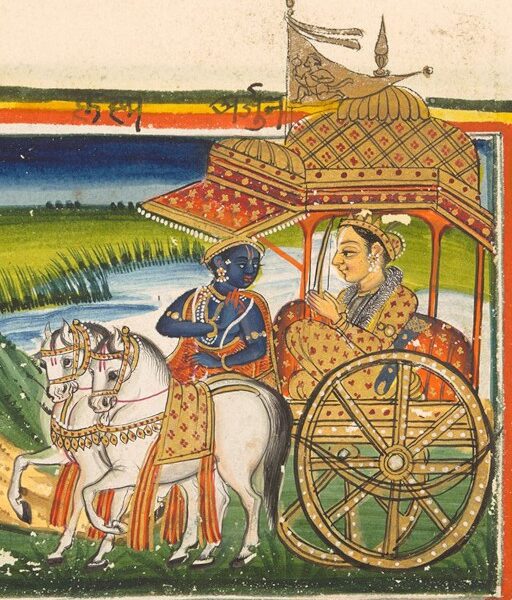
And perfection in the material world, there isn’t such a thing, you know what I’m saying? We have this idea, we have a false idea that there is perfection in the material world, right? The only perfection is connecting it to Krishna. Other than that, there’s no perfection.
Does that make sense? So, we’re laboring under this problem because of these illusions, Vaikuntha Brahma and Ananda Brahma. So, because the soul by nature is, you know, sac-cid-ananda, so sat means eternal, so that means the material world is, you know, is also going to be lasting in its particular situation, right? So, that’s Vaikuntha Brahma, that the material world will, you know, not be temporary. And Ananda Brahma is because of the element of Ananda being happy, therefore, I can be happy in this, right? Does that make sense? So, these two Brahmas, that’s your sambandhi and your prayojana. So, naturally, what’s the endeavor?
Material, you understand? Now, if we understand the material world is temporary, there is no pleasure here, right? But the soul is eternal, so on the platform of Krishna consciousness, and that’s where one will find happiness. So, the sambandha and the prayojana are set in this way. What’s the abhidheya? Yes, spiritual endeavor, devotional service. You understand? So, much of the time in these equations, you only have to cover those two, sambandha and prayojana. If they’re covered, then abhidheya automatically follows whatever is that sambandha and prayojana.
Right?
So, here’s to that equilibrium, so that one does not become disturbed by the situation, right? Because one is feeling, I’m doing this, I should get a nice benefit. But the point is, is that nice benefit doesn’t really exist.
Does this make sense? So, that’s where it will naturally be the next stage.
Right? So, not only one’s regulated oneself, so one will consider that an element of being equipoised, right? Because before it was just a concept, and you kind of do it, and when you weren’t feeling like it, not. But now you’ve come to the point of bhajana-kriya. Right? Because sraddha is there, you appreciate it, then sadhu-saṅga, you somehow or another associate, somehow or another practice. That’s why it’s somehow, because it’s not specifically regulated. Then bhajana-kriya, then you’re following. Then you have to get, be, not be disturbed by worldly gain or loss.
So, the humble stage by, 5.18, the humble stages, by virtue of true knowledge, see with equal vision, a learned and gentle brahmana, a cow and elephant, a dog and a dog-eater.
Right? So, that equal vision means here, the similarity, okay. The bodies are material productions of different modes of nature, but the soul and the super -soul within the body have the same spiritual qualities.
A Kṛṣṇa conscious person has full knowledge of this, and therefore he is truly learned and has equal vision. It’s not that he takes the bodies, that they all get the same facility. That, you’d have to say, is foolishness. Right? That’s the fun part is, modern man, though he prides himself in being so educated and so developed and sophisticated, he doesn’t actually have the intelligence to see the difference in the situations.
Right? Because the equality is not in the situations, but is in the nature of the soul. Right? Super-soul is everywhere, soul is everywhere. But, the point is, is the ant is an ant. Right? The dog’s a dog. The man’s a man. The bodies are like that, they’re controlled by those modes. So, if you want to interact with those forms, you have to interact according to the modes of nature that govern those forms.
Right? So, since human life is meant to be established in goodness, therefore these other forms that are established in passion and ignorance, then aren’t so important. Right? Right? So, they don’t have an equal status. Does that make sense? Just like, let’s say we have a rock and a lump of dirt.
Right? There’s a difference in, you know, in their quality, what you can do with them. You might build your foundation with the rock, but you wouldn’t use the dirt.
Does that make sense? If you want to put mud on your floor, you’d use the dirt, not the rocks.
You understand? So, that means that we apply our intelligence to know what it is, but the quality, because it’s a rock or a dirt, doesn’t make one superior to the other. It’s the situation only. One situation, one superior, another situation, the other superior.
Yes. So, we could say that dealing with the specific mode which each element is situated in is illumination rather than acting according to what I think how it should be dealt with. Yes, yes. Yeah, okay. That’s a good point. So, here then you have the element is that, okay, if we’re seeing them, even we see them, okay, the soul is same, Paramatma is same, so that transcendent equality, but the bodies are different controlled by the modes. Now, you can either, like this, follow in the way of regulation, you know, according to Shastra, or we can make up our own idea.
So, then that again drops it back into ignorance if we make up our own idea. So, to be consistent, then we’re trying to establish the mind in equilibrium, so in the mode of goodness. So, that means also we have to establish our basis of that endeavor on the Shastra.
Otherwise, then it drops to ignorance.
So, then in this footnote, footnote 49, Srila Prabhupada writes in his purport to Srimad-Bhagavatam 7.12.10, Here is another important warning that a man must save himself from attraction to women. Till one is self-realized, fully independent of the illusory concept of the material body, the duality of man and woman must undoubtedly continue. But when one is actually self-realized, this distinction ceases. When we say masculine-feminine, what’s the point that’s being made here? It’s not the form itself. It’s the element that one can see the forms as opportunities for sense enjoyment.
So, when one is self-realized, the distinction ceases because the distinction of one can enjoy in this situation goes away because you’re saying, here’s a soul, you know, servant of the Lord, and we’re soul-servant of the Lord, so how to serve the Lord?
We have to be clear on what distinction.
Because otherwise, then it doesn’t matter who does what and anything like that. You know what I’m saying? Because if we’re saying, oh, man and woman, there’s no difference, then why man and dog?
Right? You need a new temple president, everybody else there, they’ve got political history, but this dog, he’s new. He doesn’t have any, you know, particular, you know, biases or anything. And he’s very, you know, amenable, right? Just feed him something and he likes you, right? You know, it’s no big deal, right? You know, don’t make him upset, he bites, you know, but, you know, other than that, then hey, it’s cool. You understand? We’ll say that’s stupid, so it’s just as stupid as the other one.
Does that make sense? We always have to remember that when you’re dealing with a particular principle, that stupidity is, you know, all-encompassing. It’s not that it only applies here and not there.
The humble sage, by virtue of true knowledge, sees with equal vision a learned and gentle brahmana.
A cow, an elephant, a dog, and a dog-eater. 5.18. So this is the connection.
In other words, what he’s working on are the purports in the Bhagavatam that are commenting on this Gita verse. So that’s the connection being made. On the spiritual platform, the learned person not only gives up the duality of man and woman, but also gives up the duality of man and animal, right? So that’s the thing we’re fighting for within humans, right? But what about everybody else’s rights?
You know what I’m saying? That’s the thing. If you’re going to take it, it’s a principle.
This is the test of self-realization. One must realize perfectly that the living being is spirit soul, but is tasting various kinds of material bodies. That’s the point. He’s spirit soul, but he’s tasting. So according to that, you deal with him like that. Because that’s what Shastra says, not because I feel like it, right? Because the difficulty comes is that we’re whimsically dealing because in ignorance we feel that we are the body. So then even if we discuss it in this way, we will still whimsically look at it and say that therefore everybody can do whatever they like.
One may theoretically understand this, but when one has practical realization, then he actually becomes a pundit, one who knows. Until that time the duality continues and the conception of man and woman also continues.
So therefore the Shastra is regulating on both levels. It’s giving you the philosophy, right? The Vedanta philosophy of how the living entity is the soul, not the body, right? And how super soul is there with them. At the same time, the Shastra gives how to regulate that conditioned nature, right? In such a way that working with both of them, there’s a compatibility. Otherwise, we generally see if we make up our own system, it’s good for one or the other, right? Always, you know, we’re not this body, Prabhu and everything. We completely dismiss the conditioned nature. We don’t deal with it according to how we should, right? Or we say it’s all the same and everything like that. It doesn’t matter. Then we’re seemingly spiritual, but we’re still leaving out how to proper deal and everything like that. You know, so the whimsicalness remains.
So duality remains. As long as duality is there, you follow Shastra. And when, by following Shastra, duality is not there, then we still will follow Shastra. So the point is following the direction of the scriptures, right? While this whole section is on, is that we can only go back to Godhead by hearing from the Lord or the devotee. The Lord sends the devotee. He himself gives the scripture, right? Because what God speaks, that’s going to be documented in scripture. What the devotees speak about God, that will be documented in scripture.
So now one should approach that through the spiritual master, otherwise one may whimsically pick and choose whatever one likes. Well, I like Madhvacharya, what he says over here, and Ramanuja here, and then the Gaudiyas over here, because they’re a little too strict on these things, you know, like that. But then Shankaracharya says some cool things over here, and also Sai Baba did say something really nice here. You know, like this is what we’re going to do. So no, you have to approach through the spiritual master. There’s no whimsical.
Then, trying to apply that, then you come to the stage of actually following the rules according to scriptures.
And now we come to following the rules, you should come to the point of being practiced with equilibrium of mind.
So it’s a natural flow in here. So we always have to remember the point being made, the adhikaranas here, the flow of them is based on following shastra. And there’s not another method.
If we think there’s another method, that’s speculative, so that’s the mode of ignorance.
Does that make sense?
Contemplation of the shastra according to the spiritual master, that’s called vichara.
You’re contemplating it, looking at it from different angles, so you get a complete vision, so you can have a more complete understanding of how to apply it. Now, if you’re contemplating this, but it’s not connected to the Lord, even though it’s based on shastra, it’s called mental speculation.
Because even though it may be shastra, and there may be some nice development, you become very austere, very knowledgeable, very skilled in the practices, still it’s considered mental speculation, because it doesn’t give you the Lord. It’s only the taste of intellectualizing on things, and that you consider your profit. The karmic only analyzes something as much as it’s needed to perform the activity to get the result. The result is his profit.
The endeavor, the getting it, that’s his profit, not the intellectual aspect. That’s just something that you do, just like you want to eat some cereal, you have to open the box. It’s not that you get off on opening boxes.
Does that make sense? Yes, but let’s say it’s a birthday party or Christmas, people like opening packages. The opening has a whole taste.
Does that make sense?
So here then the jnani, his taste is in analyzing, because he’s not going to get any material benefit, so nothing to gain. So it’s still called mental speculation, though it’s based on shastra. So let alone, now one may say, but it’s not based on shastra, but it’s about Krishna. But can it really be about Krishna if it’s not based on shastra?
Because you can only go back to Godhead, which means you know Krishna by following the scripture, Krishna’s instruction. That means the shastra. Right? Does that make sense? So underlying in this inherently is, just as the form is necessary, but more important is that equanimity of mind, which means you’re seeing the spiritual platform. So in the same way as the shastra, the forms that it gives for dealing with duality are necessary, because even if someone’s, you’re not conditioned, the other person’s not conditioned, still the forms act according to the modes of nature. They’re the ones that actually do the work. But now the work is not being done under the modes, but with the modes.
Does that make sense? So being with, you still will have to deal with that form according to shastra. Right? But you’re no longer in duality, but the modes are the modes. Right? And then, but if… Does that make sense? So that bridge between that platform and if we’re conditioned. Right? But the point is the common element is the principle.
Because the principle is that higher point, that equanimity of mind. Right? And the particular detail of application, that’s what you’re dealing with, the duality.
Do you understand? So we’re talking here about the same point, is that you’re working on the principle, the soul is there, and that’s the actual point. And so then the detail is what form this soul happens to be in at present. What modes are they working under? Right? If they’re working in transcendence, no problem. Right? But if they’re working under goodness, okay, it works well. Passion, a little more problem. But still, you can work with shastra, you can work with authority. Someone in the mode of passion does accept authority.
Right? The principle. Even if the principle is they’re the authority. But in any case, authority is accepted. Person in ignorance, they have the problem with authority. Because then it’s like, oh, maybe it’s there, but they’re on mind. Ultimately it’s like, okay, it’s there and I respect and all that. That’s social thing because I’m a nice person. I’m respectful. I deal with people nicely. But that’s the only reason that the principle of authority is accepted, because I’m a nice person. And so respecting authority is a nice thing. I’m nice, therefore I respect authority. Do you understand? But if I decide that I don’t need to be nice in this situation, I don’t respect authority. So ultimately it comes down to what I feel that’s my only security. The only one I can trust is myself. Right? And even the intelligence is a little too cold in calculating, so it’s just my mind.
Understand the danger here? So that’s why these things are analyzed to this degree. Because otherwise, we can so easily fall into this trap and think that I’m doing something spiritual when I’m not. You know?
Okay. So until the time the duality continues and the conception of man and woman also continues. Right? So in other words, it has to be dealt with according to those rules. Right? Just like Sukadeva Goswami, he doesn’t worry about those rules. Right? So he’s walking along, he’s naked, and there’s a whole bunch of ladies, you know. And it’s not necessarily… I mean, you will have a few of the older ladies go out, maybe. You know, but generally, they’re more unsophisticated. Right? But generally, it’ll be the young girls who will be walking along and walking and laughing and giggling and talking and stuff like that. And of course, you’re not going to have the older men, unless the guy’s also, you know, a little bit uncultured. You’re going to have the young punk kids who are coming along and laughing and joking and making… Right? So the point is, you know, generally, according to the rule of Shastra, you wouldn’t stand naked in front of a whole bunch of ladies. Right? Unless, of course, you know, you’re three years old and it doesn’t matter. Right? But he’s 16. But the point is, the principle is that one doesn’t take advantage of those situations. Why? There’s no rule for a three-year-old. He’s not going to take advantage of that assembly of women. Or the 16-year-old most probably will. Right? But he sees the principle of the soul. So therefore, he’s not worried about it. But why doesn’t he have to worry about it? Because he doesn’t see any opportunity for sense gratification.
So that’s why it doesn’t apply.
So the rule is important for dealing with the form. Right? But the principle is the most important.
Does that make sense? Yes. In Vyasadeva’s case, when he was dressed and they kind of… Yes, because he sees the distinction. It says here. Until that time, the duality continues. So he’s seeing the distinction.
For Sukadeva, you can tell there’s difference of bodies, but you make no distinction that one is any better than the other.
But Vyasadeva, because he’s document… He’s compiling the scriptures. Therefore, he’s going to document, okay, you know, a man in this condition would deal like this with a woman, or a woman in this condition like that, and an older man like this, and a younger woman like that, you understand? So, because he’ll be contemplating those things to document them, it is picked up by the girls. Right? As Prabhupada mentions in purport to that, girls have a sixth sense in being able to appreciate these things.
You know what I’m saying? Like that. It says that…
Yeah.
Yes. So, in this example of Sukadeva and Vyasadeva, can we say that Sukadeva has a transcendental vision? He has a transcendental vision, but it’s not that Vyasadeva does not, but he’s applying that transcendental vision through the medium of Varanasi. But Sukadeva is acting outside of the Varanasi because he doesn’t have any need, any connection to it. Vyasadeva doesn’t have a need himself, but he’s establishing an example. Right? So, therefore, within that, distinction is made. But, as we’ll see, is that, you know, the ladies’ interaction with Vyasadeva might be more open than something else. Just Vyasadeva’s running by, all the girls are doing is kind of covering themselves. But it’s not that they’re not talking with him or not being direct and open. Now, if a ksatriya had come by, then it would be a different story. You know what I’m saying? Then you’re dealing with the whole man-woman interaction. Here it’s just, they’re women and he’s a man, but they’re interacting on that brahminical platform. You know what I’m saying? They’re being open and honest and everything like that. Does that make sense? So, within it, within the Varanasi system, they would be dealing with him as the most elevated and transcendental.
Does that make sense? But still within the form. But it’ll be just in its lightest application. Right? But as it goes down, if the king was going by, then it would be a whole different thing. You know what I’m saying? Like that.
Vyasadeva’s acting in this way, outside of it. But we see is then, when they request him to preach, because up to this point he’s not preaching, then he’ll fall within the categories and then, okay, he sits on the Vyasadamsa, and they sit, they do all these different things. Because you just follow the forms. Because the forms are how how the Krishna’s energy works. Does that make sense? Means, here it’s the three modes of nature that controls the elements here. The spiritual world is samvitsandhini and ladhini. They control how it works. So just as over there no one worries about that, here no one worries about it. The point is, is to be connected to Krishna. So you don’t, it doesn’t matter to you if Krishna consciousness is happening and the arrangements for the situation are done by the internal potency or the external potency. It doesn’t matter as long as Krishna is served in the situation.
Does that make sense? You know, that’s what’s beyond.
Can this equilibrium of mind be developed by developing goodness or also by developing transcendence? Means, can this, can this equilibrium of mind be developed by goodness or by the transcendence? It can be done by both, but it’s not recommended, as we’ll see, is that to use, means you can use both together, but to use goodness without transcendence means unless you already have our very pious, you wouldn’t be able to use it. Right? Because look at it, in reality, when we’re talking about these big, big Mayavadis, I mean traditionally speaking, big, big impersonalists, generally speaking, what, what is their, what is their material background?
Right? What, what varna are they from? They’re all Brahmins. Right? Occasionally, you have some Kshatriyas, but you don’t hear of others. Jabbala is the only one you hear of that it’s not understood what he was. But, Gautama can understand his father was a Brahmin.
Mayavadis must be very unsuccessful Kshatriyas. Mayavadis might be. I mean, the absence of action, that’s pretty obvious. That’s, the Prabhupada explains, that’s how the Mughals got into India. Because the Kshatriyas in Rajasthan and Punjab became Jains. So because of that, then this so-called non-violence then ended up in some of the greatest violence in history. Well, if they had just fought the battles, it would have been, you know, them with a few guys on horses, and India would have gone on very peacefully. Right? So, that’s the problem with these non-Vedic philosophies, is they’re very localized. They have a very specific situation. It has some, some benefit of regulation and upliftment. But in the broad sense, and in the ultimate sense, that it always falls short.
Because it’s material.
Because it’s material, yes. And material cannot get you spiritual. So for us, then transcendence is the direct method. It’s the quickest method. It’s the surest method. So that’s why Krishna’s going through all this, is that it’s yoga. So not just that it’s the practice of good qualities, but it’s the practice of good qualities in connection with transcendence. So the emphasis is on the transcendence. And the practice, that’s the detail of application with the forms that you’re working with.
Sometimes, sometimes talking to a devotee who is following the path of goodness, you realize that you can get trapped into that. Yeah, you get trapped, because they feel that just being good is perfect. That is devotional service. Just like you have the person, that they’re good, and somebody is not good. Somebody broke some rules, so therefore he’s bad. But why is that bad? What does it matter? If in the shadow play on the wall, then one puppet beats another puppet.
Then you go, oh, that’s so wrong. What’s actually happening? A bunch of shadows are so-called fighting. Do shadows actually fight? No. Therefore, it’s not real. But it’ll be taken as real. It just dawned on me, it was yesterday, you have devotees who are being liberal in using the term, but they find fault.
They go around and target a certain weakness, or a certain devotee, and then find whatever wrong they can figure out, and then try to publicize it and use the internet to advantage. In doing that, they feel they’re doing devotional service, because they’re finding a wrong, so they’re correcting devotional service. But it’s not. It’s just like Acharya says, kutinam. It’s the worst of all the anarchists.
You know what I’m saying? So it appears as service, but it’s not. Just as the mode of goodness appears that it’s service, but it’s not. It’s only when these things are connected to the Lord, it becomes service. If the person is not doing something that has a problem in the pushing forward of Krishna consciousness, then that is a service. But to just say it’s because you’re breaking the rule, or it appears you’re breaking the rule, that’s not service.
Because you think the rule is the devotion. You think the mode of goodness is the devotion. Now, as we saw before in the previous verses, that in the shastra aspects, Krishna’s point is being made, you have to follow the pious one. Because devotional service means engaging pious activities in Krishna’s service. But the only reason it’s not because piety is better is because Krishna, he himself, his activities are pious. You know, what we would call piety. So, the interaction with the Lord, dealing with the Lord on whatever platform, as Brahman, Paraman, or Bhagavan, is best performed through piety. The activities you call piety. But, unless they’re connected to the Lord, they’re not devotion, they’re only pious. Right? If they’re only pious, it’ll get you a material benefit. If the piety is followed without attachment to the results, then you’ll get liberated. Right? But if you follow it without attachment to also please Krishna, then you go back to Godhead. Right? And if you don’t follow it, then, you know, Yamaraja has 26 nice, you know, how you say, resort locations for you.
Yes. But the devotees who find faults in others, can think that they have the connection to God. They can think, but the point is how do you use Kuntinati in Lord’s service? Is fault finding a service?
You know what I’m saying? You know, Prabhupada established, right? The G.B.C., you have the sannyasis, you have the temple president, he has his officers, right? The secretary, the treasurer, and the fault finder.
Right? Everybody has one. You know, all big organizations, they have the fault finder. When something goes, you know, you don’t know what to do, you call in the fault finder. Right? You understand? It’s not a service. It’s within what you’re doing. The Krishna conscious endeavor, if there’s some weakness that’s going to create that the lack of success in that activity in Krishna consciousness, then it can be pointed out. But the point is, also, there is the thing that don’t disturb the minds of the ignorant. Problem is, someone in the mode of goodness can appreciate that, so someone in the mode of ignorance won’t be able to. So they can’t understand, okay, maybe in this situation the detail is here, but there’s a bigger picture. Or they can’t actually see the Krishna conscious because they think the rule is the Krishna consciousness.
That’s why we have a complaint about smartists.
We take it that the problem with smartists is they follow rules. Not at all. We have great respect for a smartist because he actually follows the rule. He is actually pious. He is actually a human being. Not only human being, they’re Brahmins. The problem with the smarta is he’s not connecting his rules and regulations to Krishna. That’s the fault. That’s all. That’s the only fault that we’ll take out if they follow the rules. Ah, he’s such a smarta. No, smarta is the standard platform of brahminical life as far as rules go. But they’re called a smarta because of their consciousness, not because they follow rules.
What’s the other? The liberal. They don’t follow any rules except for what they make up.
So they’re in the worst position. So then if you say, well, they’re God conscious but don’t follow any rules, how are they going to express that love for God?
It’s like a, how you say, you know, the boy, he’s liberal. He doesn’t follow any rules but he really likes this girl but he’s not about to follow all those rules, you know, roses and poems or candies or taking her out to dinner and all that. It should be just whatever he feels and the expression of the heart. He was down today in the auto shop and all that and he saw this really fabulous camshaft. I mean, it was so shiny and so well made. You know, it was a German thing. Like that. So he thought, I’ll give this as an expression of my affection. Like that. And then, you know, then you wonder why it didn’t work and then the girl’s not broad-minded and somehow I wouldn’t want to be with her anyway. She didn’t appreciate my, you know, like this. In a sense. So the point is, even though it’s well meant, the rules are what make the form, what makes the expression work. But unless you know what the expression is, the form doesn’t really have any meaning. But, still, the devotee is following the rules, though he doesn’t have much realization. Because he knows it’s for Krishna, though he doesn’t understand how it’s connected. He’s better situated than the one who won’t follow rules and think he’s connected. So of the liberal and the conservative, the conservative is rightly situated, though the consciousness still needs improvement. But for the liberal, both sides, he’s this.
Because even if you say, okay, underlying is the Krishna conscious point, great. But how do you express it?
You can’t. You know what I’m saying? So, of the two, the consciousness you change, the form doesn’t have to change. The other one, you change the consciousness, then they’re going to figure out that they have to change the whole form. So more work is there. Of course, of the two to change, the consciousness is more difficult. That’s why you don’t see a lot of smarters joining, and a lot of liberals do.
You know what I’m saying? But the problem with the smart is not that he follows rules. Yes? The liberal is generally a seeker, you could say. You could say they’re a seeker. Yeah, you could say. So you would be more inclined to actually want to join? Yeah, but the problem is their weakness of being an endeavor. Because they don’t know what they want, they don’t know who they are, and therefore they don’t know what to do. So, even though they consider themselves educated, they’re actually very ignorant. While the person who follows the regulations, he knows his position, he knows the endeavor, he knows the results, but he thinks it’s simply because he’s made the endeavor and gotten that result. That’s the perfection. It’s still not. It’s still the consciousness. So you have to combine the two.
You know? So in this way you could say that because consciousness is more important, therefore it’s a greater weakness being the smarter than the liberal. Because even if they become devotional, they’ll still have that thing that the form is there. But the other one has the problem because they can’t accept form. As we gave examples that 40 years into the movement and officially no one knows what Varunashram is. Why is that? Because you’re dealing with a class of persons who their social background is no form. So form is there. It’s easy to understand. You know what I’m saying? So therefore and when they say oh it’s so intellectual, the point is between men and women just another point is you have spirituality and religiosity. Which qualities are attributed to who?
Spirituality and then religiosity. The women. Now religiosity means the rules, the forms.
Right? Does that make sense? And we see according to Shastra when we’re talking about the spiritual transcendental platform then the conditioning of the women because it’s on predominantly on the platform of the mind, it will be the weaker of the two. Right? Does that make sense? So now, you understand the drift where we’re going? Is that if the women are less intelligent on that platform but they can understand Varnashra, so what’s the position of those who can’t understand Varnashra?
They have to be lower. So the women means they’re humans. So that means you have to be lower than human to not be able to understand, means socially.
So that is not a glory. It’s not a glorious position that we don’t understand Varnashra when in fact publicly you can’t even use the terms. You can’t say Brahman or Shivaisha. That means, and now it’s not only that you’re making rules against the Shastra. So it’s totally in the mode of ignorance.
You understand? So the point here is equilibrium means you can deal with all this. You don’t have a problem with dealing with the differences because you’re ultimately on the platform and so there are no differences. So therefore it’s only a matter of what is useful for serving the Lord in the situation. You know what I’m saying? Like you see there’s that little clip you know, the Los Angeles Kirtan. I’m not sure, I think maybe Prabhupada was there and everything in Los Angeles, all the devotees, they’re all dancing and everything’s going crazy and all that. But the camera goes over for a moment and shows who’s leading the Kirtan. There’s a lady sitting on the floor of the harmonium. I think that’s Nilavati. Right? Why is she leading the Kirtan? Because she’s a woman? She’s good. That’s all. So it’s not a matter of, no, women can also lead Kirtan. No, it’s a matter of who’s good can lead Kirtan.
If you’re not good, don’t lead Kirtan.
Does that make sense? It’s not a matter of, oh we’re dancing. We would all agree he was transcendental, right? We’re not going to have any doubts, right? Unless you’re one of these how do you say it? The Diksha Pranali lines or something, and if so, excuse me but I couldn’t care less. But his voice was not good.
Generally speaking he didn’t lead Kirtan. He would always get his devotees who were good at leading Kirtan to lead him.
So when we saw that Kirtan Mila was also that kind of usual suspect who’s, did you see the names? Yeah, yeah, because it’s who’s good at Point is, is if you’re trying to bring together the devotees to chant nicely you want someone who has proven that they can do it. Daily Kirtan it doesn’t matter. They can lead and this and that and then, you know. But here you specifically want the devotees to be able to come together and get a particular result. So you count on those who have proven themselves in that capacity. Does that make sense?
What about verses 3.35 and 18.47 in Gita which specify that even maybe you don’t do something very well but you do something else better. If it’s not your duty, you shouldn’t do it. Yeah, no, that’s there. The point is, this could be good at something may not be something you should do. No, no, no, but here, this, no, yeah, of course. Of course. But here the point was is we’re dealing on on the element of that liberal aspect. You know, we’re dealing with liberality here that the point of their saying is, no, because you know, she’s a woman, therefore it’s, no, it’s not because she’s a woman she was good, that’s all. So it has nothing to do with women’s rights. That’s what we’re addressing here. We’re just addressing the element that the liberals concept of what’s good and right is totally based in the mode of ignorance on their own speculation. You know, while we’re saying it’s the Smarta, though we, you know, have some, we never have much good to say about them, but as far as situation they are situated right here because they are following the Shastra. They’re following a regulated life, but they missed the whole point because they’re not Krishna conscious. So ultimately the point is, it’s Krishna conscious and it’s based on Shastra. You have to combine the two. So it’s not one or the other, because we generally we always like to polarize things and make it it’s this or that. There’s one purport in the 7th canto, Sri Prabhupada says that one cannot become Krishna conscious without following the rules and regulations of the Shastra, but simply by following the rules and regulations of the Shastra, one cannot become Krishna conscious. Yes, yes, yes. It’s necessary, but not sufficient. Yes, it’s necessary, but not sufficient. So that’s the difficulty, is that liberal doesn’t see the necessity. It’s necessary, but as I said, they’ll point out the weakness that it’s not enough. And like Vrishni said, that’s exactly the point. But it doesn’t mean that for that, then you throw the whole thing out. That’s the standard thing. You find a fault in something, you throw the whole thing out.
Are they?
It means they’re controlled by goodness. That’s how they’re still materially bound. But through goodness. So Prabhupada says, it’s like you have a gold chain. You’re still tied up. You’re put in prison and connected to the wall, like that. But it’s gold chains.
Until that time, the duality…
One may theoretically understand this, but when one has practical realization, then he actually becomes a pundit, one who knows. Until that time, the duality continues, and the conception of man and woman also continues. In this stage, one should be extremely careful about mixing with women. No one should think himself perfect and forget the Shastra conjunction that one should be very careful about associating even with his daughter, mother or sister, not to speak of other women.
No one should think himself perfect and forget, because even if he is transcendental, still, the form is what the expression is made through.
So still it’s followed. Like Lord Caitanya means he would also have to admit he’s transcendental. But he would follow the rules. Because otherwise, where’s the expression? If anybody can do anything at any time, anywhere, where is the culture?
You know, you could eat at midnight, you know, toast and things like that, and what’s the meaning of breakfast?
You know what I’m saying?
So, all these different things, it’s like it’s breakfast time, you lay out the table, the candle’s there, everything’s there, and it’s kind of like looking, is this dinner? I thought this was breakfast. No, it’s breakfast. What about the candles? It’s light outside. I like candles. So, it’s a matter of, that’s how culture’s established, is that Krishna likes certain things in certain ways in certain situations. Because the point is, if you’re dealing with that entity, let’s say you’re dealing here with the mother.
But the point is, is the body the mother?
No, it’s earth, water, fire, air, and ether.
So, the point is, the motherness is Krishna’s potency. So, because we want to deal ultimately with Krishna in the form of mother, then in this form, that’s manifest. It can be manifest through that form.
Being through that form, then we can interact. But the motherness we’re interacting with is actually Krishna.
Right? So, therefore, since it’s Krishna, how are we supposed to deal with this form of, this manifestation of motherness?
According to sastra, because that’s how Krishna wants it to be done. Means if it’s spontaneous, you would follow, do what Krishna would want anyway. Right? The spontaneous devotional platform means it’s naturally following the rules, but the emphasis isn’t on the rules, right? But the Vaiti means you’re following the rule because you don’t have that spontaneous affection. So, therefore, to know what you do, you follow what the scripture says. Because you’re dealing with Krishna anyway. The problem is we leave Krishna out and think, no, I’m just dealing with my mother. So, therefore, however I feel like dealing with my, you deal with your mother in your way, I deal with my mother in mine. We have our own relationship. Why are you trying to impress yours? No, in detail, yes, the manifestation, but the point is the principle is still Krishna. So, that means within the detail, it still has to be in line with the principle that the sastra gives.
Yes. I cannot understand why Vaisikanta Sarasvati, so exalted devotee, didn’t receive Kirtan. Why he didn’t? I cannot. Why can’t you understand? Because for less advanced devotees, more important to hear from the Paramahamsa.
Oh, okay, so hearing from the Paramahamsa, so that means every lightbulb should be directly connected to the generator and if it’s connected through the electric line that may go for kilometers, it won’t actually get the full benefit of being lit up, right? That’s what you’re saying.
So, if, so, what’s the point? Is that what makes the pure devotee special?
Right? Because you’re going to be singing with your voice box, which is made out of material nature that’s controlled by the modes, so what makes it special? Why is the pure devotee voice box better than the non-pure devotee voice box?
You don’t know. The point, the consciousness, but that means the chit potency is there. So, the singing, if it’s under the chit potency, it works. Just remember, how did you become a devotee?
Who actually convinced you, you know, at first to get you to start the process or even think about the process? Huh? Prasadam. Like that. But Srila Prabhupada himself personally came to you and made you, right? Or was it a new bhakta? Was the prasadam made by a pure devotee? Yeah, was the prasadam made by a pure devotee. You understand? So, it’s the potency that’s there. If you have an electric cable, right, and there’s a generator and the current’s going, now I’m ten feet away from the generator and I grab the electricity, then it’s not going to be hardly anything, right? Because there’s no real meaning, but if I actually touch the place where it comes out of the generator, then I’m going to get a shock, right? Or is it going to be the same at either side? That’s the point. The potency, if it’s bona fide, if it’s authorized, it has the same potency. That’s why the devotees go out on Harinam. It has effect.
Right?
Otherwise, if that’s there, then we should all pack up, go to the forest, sit down, and when we become pure devotees, then go out and preach.
See, because you’re working on it simply that the word pure devotee has been used, so that’s a better word, so therefore let’s put that into the equation. It has nothing to do with that. Because then it’s only the pure devotee, and everybody else is a schmutz.
Do you understand? Does that make sense? One of your lectures where you said that many devotees like but not so many may go to sit some advanced devotees to hear him.
No, but what is that? Still that doesn’t change the principle. The devotees may more appreciate a good kirtan than a nice lecture. You know, to have more of a universal appeal. But it’s still the same point, is that it’s the potency, the chit potency that’s there. Because this is the age of kirtan. So that’s why it’s the predominant. We only discuss philosophy so we’re convinced to practice kirtan.
Do you understand? Because otherwise we’ll find something else to do.
Does that make sense?
Yes. So what we have to understand is that the pure devotee and anybody connected to the pure devotee, they’re all special.
Right? We just take it for granted because there’s so many devotees that, you know, we’re making a distinction within that, which is fine, but then we just take it as ordinary. It’s not ordinary.
You know, if we’re sitting here seeing an equal vision of learned and gentle brahman, a cow, an elephant, a dog, and a dog -eater, what about devotee? Didn’t he mention here this is all the material platform.
Learned and gentle brahman, so the top of the material platform.
So he sees all of them equally because they’re all servants of the Lord. But he’s going to deal with the brahman in one way, a cow a different way, an elephant a different way, a dog and a dog-eater. Each will be dealt with differently.
But as far as their position, he doesn’t see any difference because they’re all servants of the Lord. That means any of them can be engaged in the Lord’s service.
We were discussing fault finders earlier, so how to deal with them? Generally one avoids. That’s the best. You know, unless you’re in a position to point out something. Otherwise you avoid.
Good.
Because otherwise they’re finding fault and you’re finding fault.
Okay, 519.
Those whose minds are established in sameness and equanimity have already conquered the conditions of birth and death. Right? Because birth and death is based on your conditioning, on duality. They are faultless like brahman, and thus they are already situated in brahman. So when the mind is that, you’re situated in the brahman platform.
In other words, you’d have to be situated on the brahman path for it to be like that. So being situated like that is on the brahman platform. But still, the point is that then the next stage is getting to Krishna consciousness.
Equanimity of mind is the sign of self -realization. Equanimity of mind, as mentioned above, is the sign of self-realization. Those who have actually attained to such a stage should be considered to have conquered material conditions. Specifically birth and death. Because you’re not disturbed by anything else, birth and death, which are the most disturbing, aren’t going to bother you.
As long as one identifies with his body, he is considered a conditioned soul. But as soon as he has elevated the stage of equanimity through realization of self, he is liberated from conditional life. In other words, he is no longer subject to take birth in the material world. He can enter into the spiritual sky after his death.
So if you identify with the body, it doesn’t mean you don’t use the body. Like Bhaktivedanta says, he’s not identifying with the body. So when it’s just the sitting around, he dresses very simply. But if they’re going out on a preaching program, he may dress very nicely so that the persons who are coming will be impressed. Because they’re impressed by the modern Taisei development. So therefore someone who has facility within that, they must be successful, so you want to hear from them. So if you’re dressing how they would consider you’re successful, then they would say, oh, he has something to say.
So therefore, if it’s advantageous, then it’s there. Otherwise, it’s that by dressing like that, it would be better for the preaching. If you don’t, then we’re attached to some form in the mode of goodness, then that’s still duality. No, better duality.
But it’s still not the ideal.
The Lord is flawless because he’s without attraction or hatred. Similarly when a living entity is without attraction or hatred, he also becomes flawless and is eligible to enter into the spiritual sky. So the duality that you mentioned before is there’s attraction. We’re attracted to something material. If there’s a situation where that item of attraction is present, the tendency is then we want to figure out how to enjoy that item of attraction.
But if that’s no longer there, then that means one is liberated. Because one will take birth to be in those situations to interact with that particular item. But if there’s no attraction for it, then there’s no situation in the material world you need to be in. Therefore, you’re qualified to be in the spiritual world because one can only be in the spiritual platform if he’s not attracted.
He also becomes flawless of such persons are considered already liberated and their symptoms are described below.
520. A person who neither rejoices upon achieving something pleasant nor laments upon obtaining something unpleasant. So pleasant and unpleasant are still going to be there. You’re in the material world.
But it’s not that you are rejoicing or lamenting.
You understand? We’ll take it that, okay, everything’s neutral. Therefore, the situation has to be neutral. No, we’re neutral. So the prasadam’s nice, the prasadam doesn’t taste nice. We’re neutral. Right? That’s the point. Not that, oh, to be neutral then the prasad should not taste nice. And if anybody comments, oh, prasad’s nice, this is not equal poise.
Right? Is that the sense?
So that’s what we’re trying to distinguish here, is that otherwise you should, a person neither, you know, how you said, so why, because the two are mentioned. Because there means there are situations that things would be nicer. There are going to be situations things are not going to be nicer. It’s just the way it works.
Who is self-intelligent? Who is unbewildered and who knows the science of God is already situated in transcendence. The symptoms of a self-realized person. Right? So he’s mentioned the he’s established on this platform of equanimity and so therefore he’s free from birth and death. Now he’s giving those qualities. Right? So he’s starting from the principle and working back down to the detail. Yes.
Self, I mean, we’ll get to that. Here, self-intelligent I would think would be understanding the self. Because then you know who the self is so that’s self-intelligent. If you don’t know who the self is then you’re not so intelligent.
He is self-unintelligent.
He is greatly self-unintelligent. What a self- unintelligent person.
The symptoms of the self-realized person are given herein. The first symptom is that he is not illusioned by the false identification of the body with his true self. Because then obtaining something nice or not nice, what is nice? If you get something nice in the material world what is our consideration of nice? Why do we call it nice? It’s nice for the body or nice for the mind. In other words, it’s nice for the gross and subtle, the material identity. Because otherwise we’ll consider it nice. It’s just like we’re considering, oh, it’s starting to warm up now. And this is nice, right? But the polar bears are going, oh no, it’s that time of year again. Yes?
That’s another thing. We’re not discussing that.
We’re discussing the duality of the world. It means that you see it for Krishna, then of course. But the point is are we rejoicing? Why are we rejoicing then? Then we can take it to that. Are we rejoicing because it is nice for Krishna or because we arranged it and finally it happened? As long as all that’s in place then that’s what we’re looking for. That’s what we want. So one always has to remember in this that it’s ultimately that’s the point. This is connected to Krishna.
He knows perfectly well that he is not in this body but is the fragmental portion of the Supreme Personality of Godhead. He is therefore not joyful in achieving something, nor does he lament in losing anything which is related to his body.
So if it’s something that’s connected to Krishna then we’ll see how to improve that. But still, the position of lamentation one always has to be careful of because lamentation is coming from the mode of ignorance. Then you think, oh, I’m so useless, I’m so that. That means actually I think I’m the doer but I’m not very good at being the doer so therefore I’m lamenting. But if I’m not the doer then if it worked out great, it wasn’t me anyway but if it didn’t work out, it’s still not me.
Equal poise means equal poise. It means if it worked out good, we continue doing it like this. If it didn’t work out good, then we should change it. Not that it didn’t work out now to go flog myself.
This steadfastness of mind is called sthirabhuti. Okay, so this is self-intelligent.
Sthirabhuti means fixed intelligence.
Self-intelligent.
He is therefore never bewildered by mistaking the gross body for the soul. Nor does he accept the body as permanent and disregard the existence of the soul.
This knowledge elevates him to the situation of knowing the complete science of the absolute truth. So the complete science, right? So this is science, right? So this is self-knowledge. The self-intelligence.
But the complete science is then knowing the relationship with God and acting within that. So when this is being applied to the Bhagavan platform, that’s complete. So that’s why we within transcendence will point these things out. The complete or the supreme personality of Godhead. Or the supreme personality of Godhead.
Right? So Krsna is the supreme of all personalities of Godhead. Krsna is the supreme personality. Or of all aspects of the supreme, the personality is the top.
This knowledge elevates him to the situation of knowing the complete science of the absolute truth. Namely, Brahman, Paramatma and Bhagavan. He thus knows his constitutional position perfectly well without falsely trying to become one with the supreme in all respects. So it says, falsely trying to become one with the supreme in all respects. Means there’s a oneness, means we understand we’re all Brahman. There’s a oneness in purpose. But we don’t think that we’re one in quantity.
Right? So therefore, there’s a difference. And because of that difference, there’s relationship and interaction.
Does that make sense? So even Krsna, to interact with Himself, expands.
Right? Balarama and Him are non-different, but still He expands His Balarama, then He and Balarama can interact.
Does that make sense? So the point is that difference is important. This is called Brahman realization or self-realization. Steady consciousness is called Krsna consciousness. So the realization is there and when that’s steady, that’s Krsna consciousness. Because we’re situated on this platform of Brahman in connection with Krsna, not otherwise.
Yes, then retraction will be there from the material. So that’s the problem. When we’re attracted to the material, we’re not attracted to Krsna. As we’re attracted to Krsna, we’re not attracted to the material world. So in other words, when we’re attracted to the material, to the material, we’ve retracted ourselves from Krsna. So that’s called bahirmukha. It means the face is away. But as we turn our face to Krsna, then we’re getting attracted to Krsna. That means we’re turning away from the material. So we’re retracting from there.
So in that past time of Murali Gupta and Caitanya Mahaprabhu, when He actually passes urine on His plate, because He was now talking to Rupa, and before He was doing devotion, so He’s chastising him for doing that.
Lord Caitanya mentions it. So that Mayavada says, I pass urine on the plate of those who think that they are one with the Lord.
Yes, yes. I mean, when you’re three, you can get away with a lot. We don’t see Lord Caitanya doing this when He’s bigger. When He was three, then, who’s going to say anything?
Yes. He said that the steadiest mind is called sthirabuddhi.
It’s fixed intelligence. Yes. So it is when the mind is steady, it’s equanimous. Well, the mind can only be steady if it’s based on intelligence.
You know what I’m saying? In other words, when will a woman be stable and confident?
When she’s protected. So that’s the whole point. It’s when the mind is connected with the intelligence, under the protection of the intelligence, then it will be steady. So therefore, sthirabuddhi. That’s why I put the emphasis on the buddhi, not on the mind. We want equilibrium of mind. That is a quality. But that comes because it’s based on working under intelligence. And then intelligence is then based on scripture. And we’re discerning here in the scripture what is connected with the Lord and what’s not. So in this way, then, it comes down.
So now, as we see, we started always at the top, in descent. We started with the Lord, then His instructions, then the devotee. The devotee is the spiritual master, the shastra. Then it comes down to application. And now we’re seeing how that’s working. So it’s come all the way down, and it’s working because it’s connected all the way back up. So we see here you’re not going to be sthirabuddhi.
Because without being it based on gurusada or shastra. Because otherwise, you’ve made it up, therefore, made it up today, but the mind, in its speculative nature, will think, maybe there’s a better way to do this. This is so good. But then one will think, no, but there must be something better. Right? So unless you know that, no, this is the best it is.
Right? Just like, let’s say, we had that, I’m not sure where it was, but state. I think it was Punjab. No, maybe Rajasthan. There was a king back in, I’m not sure when, in the early 19th century. No, early 20th century.
He died of boredom.
Right? So this is one of those guys, they have as much money as you can have. He has his clothes laundered in Paris. Right?
And in those days, you didn’t just drop it off at DHL, like that. That meant, wherever he was, it had to be sent down to the port, put on a ship, and then it gets to London, is laundered, put on a ship back. So you’re talking about quite a few months. You know, like that. So that means quite a few clothes.
So he died of boredom. Now how could he die of boredom if he didn’t have knowledge?
Right? But he didn’t have enough knowledge. He understood that only through pious activity, only through being dharmic, can you get anywhere.
Only through that can you get anywhere.
Right? So he’s followed that, and he’s gotten the maximum in there, and he knows that’s the maximum you can get. So who’s in ignorance will think, okay, but I reasoned that because there’s something more. He knows there’s nothing more.
So because you think there’s something more, then you try something else, and that’s why then they lose what they had was good. But here, he’ll stick to that. But you get bored. So that’s why Krishna Consciousness is so important, because if you follow the scriptures perfectly, you’ll get bored. Because you’ll get everything that you’re looking for, and it still won’t satisfy you. So unless you add Krishna Consciousness.
It’s not boring.
Not boring. Yeah, that’s not boring. So then you won’t have any problem. You won’t die of boredom. Krishna says, I am adventure. I am adventure.
So lesson 32. One should practice concentrating one’s mind only on Sri Krishna, the absolute personality of Godhead, but also not disregard other empowered living beings known as demigods.
Okay, now that is a very big section.
Okay.
So in other words, we should be fixed only on Krishna, but it doesn’t mean we disregard the demigods. So how we have that balance?
9.22 to 23. But those who always worship me with exclusive devotion, meditating on my transcendental form, to them I carry what they lack, and I preserve what they have. Those who are devotees of other demigods and worship them with faith actually worship only me, O son of Kunti, but they do so in a wrong way. So you’re worshiping, but not in the correct way. The correct way is to actually know what you’re doing.
Krishna does not approve the unnecessary worship of demigods.
The demigods are, so to speak, different officers and directors in the government of the Supreme Lord. One has to follow the laws made by the government, not by the officers or the directors. So in other words, they’re in a department and they’re in control of those laws, but the point is those laws aren’t their laws, the laws are… That’s one major aspect of why there can’t be a lot of… One is that, of course, there is order, so that means there must be intelligence. But the idea that there could be many gods also wouldn’t work because all these different gods would have all their own idea. Right? And so then there’d be chaos. So since there’s not chaos, that means there has to be one person who’s made the laws, and they’re consistent.
Right?
Similarly, everyone is to offer his worship to the Supreme Lord only. That will automatically satisfy the different officers and directors of the Lord. The officers and directors are engaged as representatives of the government. And to offer some bribe to the officers and directors is illegal. This is stated here as avidhi purvakam. In other words, Krishna does not approve the unnecessary worship of the demigods. Avidhi means not according to the rules. Right? He doesn’t… So, unnecessary worship. So unless it’s part of his worship, then it’s not considered important. Right? Means the rules have to be followed, but you understand they’re Krishna’s rules, so you follow them to please Krishna. You don’t follow them to please the demigods so that you’ll get the benefits that he offers by following the rules. You worship Krishna so that by following the rules and pleasing Krishna, then Krishna arranges through the officers that they get. As we said, through the modes things are arranged, so that means the officers. So are there specific reactions for worshipping demigods? Specific reactions for worshipping means the tendency is you’ll go to where that demigod is. Because your faith is there, so therefore you’re going to be carried there. You know.
Like that. Destroys bhakti. Yes. Destroys bhakti.
It should be considered already destroyed, right? That means when you start, maybe not, but it’s just a matter of time.
This one is the beginning of the Sankirti. Yes, yes. It destroys bhakti.
3.30.32 Therefore, O Arjuna, surrendering all your works unto Me, with full knowledge of Me, without desires for profit, with no claims to proprietorship, and free from lethargy, those persons who execute their duties according to My injunctions and who follow these teachings faithfully, without envy, become free from the bondage of fruitive actions. But those who out of envy disregard these teachings and do not follow them regularly are to be considered bereft of all knowledge, befooled and ruined in their endeavors for perfection.
These verses were quoted before. Same thing. But that was to establish that one must follow the direction of the Lord.
So now it’s a matter of that the focus should be on Krishna alone. So that’s what the Shastra is directing. One has to sacrifice everything for the Lord. The living entity cannot be happy independent of the cooperation of the Supreme Lord because the eternal constitutional position of the living entity is to become subordinate to the desires of the Lord. Arjuna was therefore ordered by Sri Krishna to fight as if the Lord were his military commander. One has to sacrifice everything for the goodwill of the Supreme Lord. And at the same time one has to discharge prescribed duties without claiming proprietorship.
So you’re working for the Lord’s benefit but you’re not claiming results. As Rupa Goswami is mentioning in the Pure Devotion that it’s being done for Krishna but at the same time without Karmadyan because it could be under Krishna’s direction but with a fruitive desire.
So one has to get without claiming proprietorship. When you say proprietorship then that would even cover the jnana.
Arjuna did not have to consider the order of the Lord. He had only to execute his order. The Supreme Lord is the soul of all souls therefore one who defends. So he didn’t have to decide whether it was good or not. He just had to apply it. So he’ll use his intelligence how to apply it. So he used discrimination, right? What weapon to use at what situation, you know, where to drive his chariot, who to fight first. He’s using discrimination but that’s all under the order of the Lord.
The Supreme Lord is the soul of all souls therefore one who depends solely and wholly on the Supreme Soul without personal consideration or in other words one who is fully Krishna conscious is called adhyatma cetas.
So fully Krishna conscious.
Prabhupada is pointing out these points but you can only do this if you’re fully Krishna conscious. So therefore perform these activities trying to be fully Krishna conscious.
7.7 9.34 18.65
9 .34 9.34
9 .34 9.34 9.34 1. The Lord has multi forms as Vishnu, Narayana, Rama, Varaha, etc. But a devotee should concentrate his mind on the form that was present before Arjuna.
Concentration of the mind on the form of Krishna constitutes the most confidential part of knowledge and this is disclosed to Arjuna because Arjuna is the most dear friend of Krishna.
Yes, so Kṛṣṇa, bringing back, you focus on Him, you look to Him, because already before He’s described, you focus on these others. But He’s also defined as that the faith that one has to even focus on a demigod is coming from Kṛṣṇa Himself. So still the same principle is that they’re worshiping Him, but they don’t know it. So the point is made is whatever you’re dealing with within this world is all Kṛṣṇa. We just don’t understand that it’s Kṛṣṇa. Right? So if we’re Kṛṣṇa conscious, then everything becomes wonderful. If we’re not Kṛṣṇa conscious, then it remains mundane. Mahārāja says here, no one, one should not divert his attention to other forms of the Lord, even when it says Rāma, Rāma. Murali couldn’t do that. No, because he’s, he is, but he didn’t, he didn’t, he couldn’t divert his attention to another form. So he’s following this rule. Oh, so he’s focusing on Rāma, not to other forms. Yes, like that. So the point is, is what? But here is being brought out to focus on Kṛṣṇa, Vraja Kṛṣṇa. So that’s why then that’s considered that, because most of the time these other opportunities are given, but this, this time then that worship is, is given in this way.
We know it’s Kṛṣṇa who’s come in this form. So it’s Kṛṣṇa in His pastime, Nṛsiṁha, or as Bhāmana, or as Rāma. That’s why in the song, keśava-dvīta-nāra -hari, keśava-dvīta-mīna-śarīra, keśava-dvīta, like that. So it’s keśava has come and performed these pastimes. So we don’t think that it’s something separate or get attracted to that as the focus.
10.6. The seven great sages and before them the four other great sages and andamanus, progenitors of mankind, come from Me, born from My mind, and all the living beings, populating the various planets, descend from them.
Kṛṣṇa is the origin of all, all great personalities in the universe. The Lord is giving a genealogical synopsis of the universal population. Ma is the original creature, born out of the energy of the Supreme Lord, who is known as Hiranyagarbha. And from Brahma, all the seven great sages, and before them four other great sages, namely Sanaka, Sananda, Sanātana and Sanātkumara, and the fourteen Manus are manifested. All these twenty-five great sages are known as the patriarchs of the living entities all over the universe. There are innumerable universes and innumerable planets within each universe. And each planet is full of population of different varieties. All of them are born of these twenty -five patriarchs.
So it all goes back to these prajapatis.
Everybody is coming down from them.
So the point here is that if everybody is coming from them and they are coming from Kṛṣṇa, so then there is no need of worrying about anybody else, because here we dealt with demigods and now we are dealing with forefathers, because they are other elements of worship. We dealt with all the living entities.
The thoughts of my pure devotees dwell in me. Their lives are fully devoted to my service, and they derive great satisfaction and bliss from always enlightening one another and conversing about me. The devotees are focused on Kṛṣṇa. Pure devotees, whose characteristics are mentioned here, engage themselves fully in the transcendental loving service of the Lord. Their minds cannot be diverted from the lotus feet of Kṛṣṇa. Their talks are solely on the transcendental subjects. Devotees of the Supreme Lord are twenty-four hours daily engaged in glorifying the qualities and pastimes of the Supreme Lord. Their hearts and souls are constantly submerged in Kṛṣṇa and they take pleasure in discussing Him with other devotees.
Their hearts and souls are constantly submerged. That’s what I’m saying. We don’t mention that with the soul. Yes.
Means, because the heart means is your affections and all that, but the point is those affections should come fully to the transcendental platform. The connected is good, but how much is there, like the consideration of Puṁjā, her affections are directed at Kṛṣṇa. But the point is, it’s not, the platform is not the most ideal. Because here when we’re saying about the soul, then we’re looking at that surrender without anything for ourselves.
So then that element, it’s not as ideal.
Or you could also look at it that they have the proper knowledge and understanding and they have the proper attitude. So that combination is very strong. Because the mind is equal poise and you have the intelligence to know how to apply that in the situation.
So then they’re always absorbed and so naturally they always discuss with others.
11.55. My dear Arjuna, he who engages in my pure devotional service free from the contaminations of fruitive activities and mental speculation, he who works for me, who makes me the supreme goal of his life and who is friendly to every living being, he certainly comes to me.
This is considered one of the main verses within the Gita.
Okay, so free from contamination of fruitive activities and mental speculation. So karma and jnana, right? So pure devotional service, free from karma and jnana. So then it becomes pure, unalloyed devotional service. He works for him. He’s doing the work. He’s the goal. He’s friendly to every living entity. It means the sambandha. So sambandha, abhidheya and prayojana are all connected to him. And he’s trying to please Krishna without any desire for any results.
Krishna is the highest goal of life. The word mat-parama refers to one who considers the association of Krishna in his supreme abode to be the highest perfection of life. Such a person does not wish to be elevated to the higher planets such as the moon or sun.
If you’re going to do that, why don’t you go back there, there’s a pillar there you can lean against to get really good support and just use a bigger lens.
Do you understand? Because otherwise, as soon as you do that, you’re not going to get your shot because as soon as you do that, I put up the fourth wall. And when the fourth wall is there, you don’t get your shot. Do you understand?
So, like that. So if you want to, if it’s just one shot like that, that’s okay. But if you’re going to be like that, then sit back there. That’s why God gave telescopic lenses so that the person getting photographed doesn’t have to be disturbed. On the 8th day. Yes, on the 8th day, he gave the paparazzo a telescopic lens.
But it wasn’t so good.
He said, go forth and take pictures.
That’s the influence of the world.
Such a person does not wish to be elevated to the higher planets such as the moon or sun or heavenly planets or even the highest planet of this universe, Brahma Loka. He has no attraction for that. He is only attracted to being transferred to the spiritual sky. And even in the spiritual sky, he is not satisfied with merging into the glowing Brahmajyoti effulgence. He wants to enter the highest spiritual planet, namely Krishna Loka. Go Loka Vrndavana. He has full knowledge of that planet and therefore is not interested in any other. As indicated by the word Mad-bhakta, he fully engages in devotional service. Specifically in the 9 processes of devotional engagement. Hearing, chanting, remembering, worshipping, serving the lotus feet of the Lord, offering prayers, carrying out the orders of the Lord, making friends with Him and surrendering everything to Him. One can engage in all 9 devotional processes or 8 or 7 or at least in 1. And that will surely make one perfect. So a devotee is always trying to engage in these activities. So that will make… So we have all this analytical aspect. So the analytical aspect just shows what tools one uses, how one situates oneself.
So we understand the technicalities of Sambandha, Abhidheya and Prajna. But the point is that one is just absorbed in the devotional activity.
So the difficulty means it’s very direct when we’re talking just the direct devotional activity and if we’re talking directly what is mundane. Difficulty comes when we’re discussing how to engage the mundane in the Lord’s service. So to be able to distinguish that it’s actually being engaged and it’s not remaining mundane or that it is engaged, it’s no longer mundane. You get both problems. Someone thinks just because I’m engaging in… I’m a devotee so anything I do is automatically devotional service. They can’t distinguish what is devotional, what’s not. That’s deliberate. Like I’m managing the temple, I’m doing everything for the temple and all that, I’m protecting the Lord’s interest but the methods he’s using aren’t actually satisfying to the Lord. So technically there may be some aspect that is devotional but the problem is the methods he’s using aren’t. But he’ll consider that both are there. So as he becomes purified he may be able to appreciate, but if not then… At the same time is that we may take it that the activity being done for Krishna but then on the material platform it wouldn’t be considered necessary, ideal. So therefore it’s not devotional service. You also get that. If somebody did something wrong he can’t be a devotee.
The point is pure devotees don’t do anything wrong. Generally that’s the rule, but Kurura was an eternal associate of the Lord. Things went wrong. It happens. You understand? So therefore to take that also as that if there’s anything wrong and then one can’t forgive for that. Forgiveness is the brahminical quality.
But that forgiveness is not sentimental mundane. It’s based on the spiritual.
The form of Krishna is essential and supreme. In summary, the universal form of Krishna which is a temporary manifestation and the form of time which devours everything and even the form of Vishnu four-handed, have all been exhibited by Krishna.
So here he’s even saying, because here the localized Paramatma, though Vishnu is supreme, still the manifestation that he’s doing is specific for that situation.
Because you don’t have Paramatma where you have have Garbhodakasaya Vishnu or Mahavishnu.
Kirudaksaya Vishnu.
Thus Krishna is the origin of all these manifestations. It is not that Krishna is the manifestation of the original Vishnu. Because some will say he’s the manifestation of the mode of goodness. Or some will say he’s the manifestation of Vishnu. Though he’s the origin of all.
Krishna is the origin of all forms. There are hundreds and thousands of Vishnus. But for a devotee, no form of Krishna is important but the original form. Two-handed Samasundara. In the Brahma-samhita it is stated that those who are attached to the Samasundara form of Krishna in love and devotion can see him always within the heart. And cannot see anything else. One should understand therefore that the purport of this eleventh chapter is that the form of Krishna is essential and supreme. So having described all these things, we know that all these qualities all these manifestations all go back to Krishna. Because Krishna’s manifested this universal form manifested the Vishnu-murti and now he’s come back to Krishna. So Arjuna has tried all of them. So only Krishna’s original form. So again we see everything about it is now that we’ve focused on Krishna, it should be Krishna alone. It should be exclusive. Not yes, okay, we’re worshippers of Krishna. But also everything else. No, it should be exclusive to Krishna.
Okay, so we’ll continue tomorrow.