
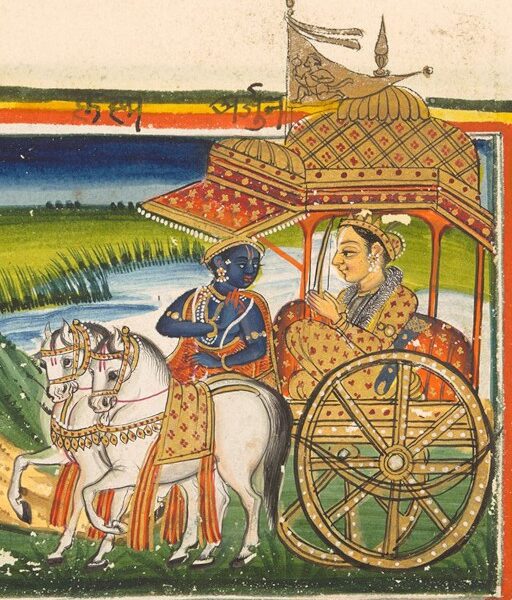
7.19. After many, many births and deaths, he who is actually in knowledge surrenders unto Me, knowing Me to be the cause of all causes and all that is. Such a great soul is very rare.
8. Realization that everything is connected to the Lord precipitates one’s full surrender.
The living entity, while executing devotional service or transcendental rituals, after many, many births, may actually become situated in transcendental pure knowledge that the Supreme Personality of Godhead is the ultimate goal of spiritual realization.
9. At the beginning of spiritual realization, while one is thus giving up one’s attachment to materialism, there is some leaning towards impersonalism. But when one is further advanced, he can understand there are activities in the spiritual life, and that these activities constitute devotional service.
Realizing this, he becomes attached to the Supreme Personality of Godhead and surrenders to Him.
So at the beginning, one is attached to the idea of this, one is giving up the material.
Giving up the material, there’s freedom from anxiety, there’s freedom from all the problems of the world. These are all the different elements that will be prominent.
But the idea is that with time, then one starts to understand that there are activities in devotional service, that it’s not just a mood, right? Like in the beginning, one likes to sit and meditate or do something that frees you from the anxieties of the material world. But the idea of activity on that transcendental platform is not there. In other words, you appreciate the transcendental platform, then you go back to your regular activities. So activities are…means appreciating that the activities themselves are spiritual. That’s something different, that’s something unique.
So then once that’s realized, one surrenders to the person. Because otherwise, as we were discussing before, even in devotional service, performing activities, we’re seeing it in relationship to Brahman and Paramatma.
That it’s activities that are supposed to be done. We’re doing it because they’re elevating, they’re purifying.
Do you understand here? But it’s not connected to the person.
Ultimately, we know we’re connecting the person. We may be making the distinction here between…we understand Krishna is the Supreme Personality of Godhead and we’re His servant. And we’re working for Him. But in the moment-to-moment application of that, we may be looking, I’m doing this because I’m supposed to, or doing this because of this, or this is purifying.
You know what I’m saying? Does that make sense? So that’s the impersonal aspect. But because we’re doing a connection to Krishna, Brahman, Paramatma, Bhagavan, are one substance. Right? So it’s connected to the Lord. But it’s not that at the moment your inspiration is the person.
Does that make sense?
You heard about the office, you know, here’s the Prime Minister and you’d like to meet him, but you consider all the other things about him, they’re also already… Yes, yes, you like that. It means you’re connected with everything connected with, which is fine. This is the process. But you’re not remembering the Lord at that point. But ultimately the goal is to get there. And so it all becomes connected. Does that make sense? But that transcendental feeling of that personal relationship is not experienced.
Does that make sense?
So that’s just, you know, one’s leaning towards impersonalism. It doesn’t mean one’s an impersonalist. It just leans towards the Brahman and Paramatma aspects as opposed to the Bhagavan. Though ultimately it’s meant for Bhagavan, so therefore we’re getting the benefit of that. Does that make sense? You don’t get the same experience as if you appreciate what’s going on throughout the experience.
Does that make sense?
At such time one can understand that Lord Sri Krsna’s mercy is everything, that He is the cause of all causes, and that this material manifestation is not independent from Him. So now all those aspects that before are the leaning towards the impersonal all become connected to the person. So it’s His mercy. You know, He is controlling everything. He is involved in everything. So then everything comes out perfect.
Now the experience we’re getting from all these various aspects is Bhagavan.
He realizes the material world to be a perverted reflection of spiritual variegatedness, and realizes that in everything there’s a relationship with the Supreme Personality of Godhead. So all the variegatedness here, whatever goes on, is a reflection of there. Because we’ll have the idea, okay, there’s a material, then spiritual is different. But it’s not. It’s that spiritual, the difference is that in spiritual they’re fully conscious of the Lord, and they’re involved in the variegatedness for Krsna’s pleasure. Right? While here we’re involved in the variegatedness for our own pleasure.
It’s the same, but the activity is the same. That doesn’t change.
And everything is related to Krsna. There’s nothing that’s not related. You can see everything related. You know, so everything’s by Krsna’s mercy. So it’s His mercy that everything is there, everything’s connected. Right? It’s not that, okay, it’s Krsna’s the taste of water, but it’s Krsna’s mercy that He’s come as the taste of water. You understand? Krsna’s the taste of water, there you’re dealing with the Brahman aspects, or the Paramatma aspects. But that it’s His mercy that He has come as the taste of water. Then that’s, you’re dealing with Bhagavan, but in the manifestation it’s Brahman or Paramatma. You understand? So it takes on a different flavor. Yes. Can you be dealing with the Bhagavan aspect and not fully realize it? Can you deal, means, yes, means, that’s what he’s saying, is we understand Krsna’s the ultimate goal. So there’s nothing, we are personalists, but we’re leaning towards the impersonal manifestations of Godhead, because we’re not thinking of the person.
You understand? Because we’re doing something because we’re supposed to. Or we’d like to do this ourselves, but we are willing to connect it to the Lord. You understand? So they’re not, as the realization of the personal isn’t as strong as it could be, but it will get there, right? By association of devotees, by that determination, then it happens.
Does he thinks of everything in relationship to Vasudeva, Sri Krsna? Such a universal vision of Vasudeva precipitates one’s full surrender to the Supreme Lord Sri Krsna as the highest goal. Such surrendered souls are very rare. So that means that precipitates one’s full surrender. It means if one is a devotee practicing the devotional process, one has surrendered.
But then there’s full surrender, just like there’s devotional service, then there’s pure devotional service. So we’re not saying that there isn’t surrender, it’s a full surrender.
Does that make sense? Yeah. So then that then comes to the point, is that when one is able to appreciate Krsna everywhere and everything, and that it’s His mercy that He’s expanded and is doing all these different aspects, then one naturally fully surrenders.
Right? Yes. As it was said that the demons, they are gliding towards hell, but it seems for the neophyte devotees that it’s a very hard struggle for Krsna consciousness.
It’s much more work to go up. No, it’s not more work to go up than down. Is the budding materialist struggling?
Yeah. But we’re saying the demons are gliding. Hell means that these are the acaryas, the perfected materialists, pure unalloyed materialism.
So then they’re gliding. Just like you see the pure devotees, then they’re very pleasantly connected to Krsna.
So the demons don’t have taste for their materialism? They have taste, they have attachment. They have no doubts that by their endeavor they’re going to be 100% satisfied.
Materialistic prayer? Yes. Well, it’s called lust. So they’re fully situated.
Where the word Vasudeva is used, there’s such a universal reason of Vasudeva precipitates. So is there any specific reason for using Vasudeva name here, Vasudeva precipitates? Vasudeva means Vasudeva Sarvamiti, because he’s used in connection, because Vasudeva is the specific, exact… No, I don’t know. But it would be in connection, because Vasudeva is used generally in connection with creation.
So then being able to see Krsna in everything, then that element is… Because otherwise, if you don’t see Krsna in everything, how you’d be able to think of Him in everything, think of Him, and always be absorbed in Him.
Isn’t it also that this universal vision happens on the platform of Vasudeva Sarvam? So there could be a connection there? Yes, yes. He’s meaning the exact meaning of Vasudeva. Like Govinda means the lord of the senses, and the cows, and like that.
Such surrendered souls are very rare.
So he’s rare but dear to Krsna.
Like that. Because he always sees everything connected to the lord, so naturally the lord will be always thinking of him. Someone’s always thinking of you, you think of them.
When it says they’re very rare, does that mean that it’s in the external energy, in the material world, they’re very rare? Yes, in the spiritual world, everyone is such a person. It means here. Basically means that they’re on their way out. Yes, means you have unlimited living entities in the material world. So such a person is very rare amongst those unlimited.
6.29. A true yogi observes me in all beings and also sees every being in me. Indeed, the self-realized person sees me, the same Supreme, everywhere.
The devotee is the perfect seer.
A Krsna conscious yogi is the perfect seer because he sees Krsna, the Supreme.
Situated in everyone’s heart is Supersoul, Paramatma.
The Lord in His Paramatma feature is situated within both the heart of the dog and that of the brahmana. The yogi sees equally because he sees that all living entities, although in different situations, according to the results of fruitive work, in all circumstances remain the servants of God.
So he sees them all as equal. It doesn’t mean that his interaction with them is the same. It means the dog thinks he’s a dog, so you deal with him as a dog. You can’t deal otherwise, so they’re great safe. You might, in association with others, discuss about Krsna conscious philosophy, but as we mentioned, if you go sit down next to a dog and start talking philosophy, he tends to just get up and move somewhere else because he’s not interested.
I mean, he’s not gross about it. He doesn’t bite your arm off or something. He just lets you know he’s not interested.
But the brahmana, then he’ll discuss with him, is a brahmana. So whatever is their conditioned circumstance, you deal with that because the rules of dharma-sastra are the considerations of the nature of the soul and the conditioning, the specific conditioning.
So according to conditioning, then you define how you deal with somebody.
Does that make sense? If they’re older, you deal one way. If they’re younger, you deal another way, if they’re in this situation or that. So it’s based on the external. We could say, oh, but then with that we’re not. No, it’s not that you deal with the human being as a dog and the dog as a human being, or it doesn’t matter. No, that’s whimsical. Because as soon as we think there’s no rule, then whimsical is our first option.
But he sees that all means all, the results of the previous work, so that’s why one’s a brahmana and one’s a dog. But the souls are the same. So give it time and the one who’s a brahmana now could be the dog and the dog could be the brahmana. It’s just a matter of how many sub -births and things change. While in the material energy, the living entity serves the material senses, and while in the spiritual energy, he serves the Supreme Lord directly.
In either case, the living entity is the servant of God. The vision of equality is perfect in a person in Krishna consciousness. So he’s going to be doing the same thing. He’s the servant of God, he’s the soul, he’s the servant of God, but one is serving and one is not. And depending on how he’s not serving, that’s what kind of conditioning he has.
So this vision of equality is perfect in a person in Krishna consciousness. They can see that nicely. So this sage that they’re speaking about, the perfect seer, the Krishna conscious yogi. Because yoga means connect to the Lord, so he’s able to see everything that connects to the Lord. That’s why he’s the highest yogi. Because the other connects, when he’s doing his asanas, that’s connected to the Lord, and other things are connected to that. But here he sees everyone as the servants of the Lord.
Serves the material senses also.
He’s serving the sense because he has to make the arrangement for the sense and the sense object to come in contact with each other. That’s essentially the relationship between the sense and the sense object, because that’s where it ends. The result of the sense meeting the sense object, this is all one’s looking for. So that makes you the servant of the senses, because you have to make that arrangement. The senses don’t make the arrangement, you have to make the arrangement.
Does that make sense? Like the tongue just tastes. You have to go to all the trouble to go out and make the money and go to the market and do the cooking, pick it up, put it in your mouth, do all the chewing. You have to do the work. And the sense just sits there. Does that make sense?
So a servant of the senses. So the devotee then directly serves the Lord, because he is in a relationship with the Lord. So that engaging the senses is secondary.
That happiness that comes from the vishaya and asaya coming together, and then observing that, the mind observing the happiness of here in the mind, that’s the wishful thinking. Whereas whenever the living entity acts as an instrument bringing Radha and Krishna together, then the happiness is genuine. Yes, yes. Because the vishaya is Krishna, and the asraya is his energy. So we assist the energies, then it’s there. So in any case we’re a servant.
Whether we’re serving the energy, the asraya, for the purpose of pleasing God or simply as we’re serving as the servant of the senses. Because the benefit we don’t really get. Some experience is there, but it’s not that that in itself is of any significance.
You know what I’m saying?
The engagement with the senses doesn’t result in anything other than just what experience is there when the sense contacts the sense object.
Does that make sense? But you’re doing the same thing in Krishna consciousness, but the focus is not on the sense and sense object, it’s on Krishna. So the relationship remains, because our relationship with Krishna is always there. But the sense and the sense object, that direct interaction, that’s as long as it’s contacting, you get the experience. As soon as you put something in your mouth, you get the taste. As soon as you swallow, there’s no taste. It’s gone.
Right? So that’s why it’s so dissatisfying to the living entity, because it doesn’t last, so you have to find more and more sensual engagement to call something a relationship.
Does that make sense? But here is that you’re interacting with Krishna to please Krishna, so whatever the situation is, you’re engaging the senses in that situation.
The happiness or satisfaction comes because of the relationship. So in a sense there is no possibility to have happiness because there is no relationship. Yes, there’s no relationship. The relationship between the sense and the sense object is we’re neither.
So the point is, instead of just the sense and sense object, it’s Krishna, so we have a relationship with Krishna.
And so then that interaction is in support of that relationship with Krishna.
You know what I’m saying? It’s just like if you have yourself and a friend. There’s a relationship. Now let’s say we put some prasad there. Then, you know, you’ll take prasad, but the relationship will be, you know, the focal point. You know what I’m saying? Now we take away the relationship, you only have something to eat.
You know, so that’s all there is. You know what I’m saying? So the other one is in connection with the Lord, so it continues. It’s always there. So since the yogi can see the Lord, you know, everywhere and in everything, so the relationship is always there. You know what I’m saying? That’s why sadhana is there because we don’t see the Lord everywhere, but in certain situations we’ll see the Lord. Like when we’re sitting in the temple in front of the deities chanting japa, then we can appreciate that the Lord is there.
Does that make sense? Right? So that’s why then all these nice activities that are obvious that the Lord is present, you know, those are focused on first because those would be the most inspiring. And those are also the main focuses anyway.
But the idea is that everything being connected to the Lord, then at all times one can see the Lord and be conscious of the Lord.
6.30. The one who sees me everywhere and sees everything in me, I am never lost, nor is he ever lost to me.
Basic principle of Kṛṣṇa consciousness.
A person in Kṛṣṇa consciousness certainly sees Lord Kṛṣṇa everywhere, and he sees everything in Kṛṣṇa. Such a person may appear to see all separate manifestations of the material energy, but in each and every instance he is conscious of Kṛṣṇa, knowing that everything is a manifestation of Kṛṣṇa’s energy. Right? So he, what it says here, he appears to see all separate manifestations, but in his mind he sees the manifestation, the variety that’s there, but he doesn’t consider them separate. Right? Because we’re saying, okay, well, that’s the temple and now this is, you know, the house. No, but it’s, for the devotee it’s all, it’s not separate, it’s all Kṛṣṇa’s.
Right? Because that’s a building that belongs to Kṛṣṇa. This is also a building that belongs to Kṛṣṇa. Right? Because we think it’s my house. No, no, it’s a building. And if everything belongs to Kṛṣṇa, then this also is a building that belongs to Kṛṣṇa.
So there’s no separate manifestation.
Right? There’s the principle of building. That’s Kṛṣṇa. So it doesn’t matter what the building is, it’s still Kṛṣṇa. Right? So the bird, that sense of security and hominess that they feel sitting in their nest is the same as, you know, a human being sitting in the house that they’re comfortable with.
It’s no different.
Right? It’s just that, you know, they don’t have to worry about, you know, taking, you know, eighteen months to build and mortgages and all that. They just go out, find some sticks and, you know, like that, and build a nest, you know, like that.
Nothing can exist without Kṛṣṇa. And Kṛṣṇa is the Lord of everything. This is the basic principle of Kṛṣṇa consciousness.
So there’s nothing that’s existing separately from the Lord. Because we’re thinking something is separate. That’s why that separatist mentality, passion, ignorance, creates that separatism. Right? Ignorance, so you can’t see things as illusion, you can’t see things properly. And the duality, then you see it’s this and that. That’s what’s important about it. This part’s good, that part’s bad. But no, it’s Kṛṣṇa that’s important. So Kṛṣṇa is what’s good. Not seeing any connection to Kṛṣṇa, that’s what’s bad. But it’s still the same thing.
Right? So whatever one’s attached to, it can’t exist, it only exists because of Kṛṣṇa.
Right? And He’s the Lord of it. So that means what we’re attached to, its actual purpose, is to be engaged in Kṛṣṇa’s service. But we think we can engage in separately, just on our own purpose. But the point is we want to be involved with that, so therefore you’re involved with it, just seeing that it belongs to Kṛṣṇa, and He’s the Lord of it.
And its existence is simply because Kṛṣṇa’s involved. Right? So then, therefore, seeing all the sambandha, abhidheya and prayoja in connection to Kṛṣṇa, then we can be involved in the activity, right, be satisfied we’re involved in that activity, but at the same time it pleases Kṛṣṇa. Until such time that we just want to please Kṛṣṇa. And then we perform the activities for His pleasure.
That’s why there’s a point of being God conscious and of being free from karma and jñāna. Because you can be God conscious, but it’s not free from karma and jñāna. Because we’ll say, oh no, you can’t be God conscious if it’s not free. No, you can be conscious.
But being conscious of it, do you want that result to be connected to Kṛṣṇa, or do you want it for yourself?
Right? Is one not God conscious when one’s praying to the Deity to fulfill a material desire? Right? One is God conscious.
Yes.
Because otherwise it’s knowledge of Kṛṣṇa and activity in Kṛṣṇa consciousness.
So that’s why we will get distracted, oh, oh, no, but you know the technical words, karma-yoga again, you know, all these things like that. No, it’s the same thing. The activities of Kṛṣṇa consciousness are what karma -yoga is, is, is.
Right? The knowledge of Kṛṣṇa, that’s what jñāna-yoga is based on. The difference is Kṛṣṇa consciousness means activities for Kṛṣṇa means it’s to please Kṛṣṇa. Right? Karma-yoga means it’s something connected to your conditioning that you’re doing connected to the Lord.
But at the same time as if you’re just referring to activity in Kṛṣṇa consciousness, you can say karma-yoga in a positive way.
You know, you’re just being exact about which aspect of devotional service is being applied.
Yogamīśvara-bhakti here is more of a negative… Yeah, when you say misera you’re pointing out what’s mixed. When you say karma-yoga you’re talking about the positive. When you say devotional service then you’re just talking about, you know, then you’re talking about that devotion which is being performed. So you would then have a tendency to use karma-yoga about the person? And misera-bhakti about the activity maybe? No, no. Karma-misera would mean the mentality because the point is, if it’s connected to the Lord then it becomes perfect. It’s not connected. It’s not. So you’re God conscious so therefore you wanted this activity but you want it for yourself.
You know what I’m saying? So that’s the point. That’s why they’re free from karma and jāna. So that’s what says that this level of understanding precipitates full surrender. Because you’re fully God conscious at all times, places and circumstances. In that you can appreciate this Lord’s mercy and surrender to the Supreme Person.
So we get to that platform by acting in Kṛṣṇa consciousness so then we start to see Kṛṣṇa in everything.
Because it’s not that you have to be conscious of everything. You only have to be conscious of what’s important for you in that situation connected to Kṛṣṇa.
You know what I’m saying?
You might bring in some detective and he’ll see so many things.
The point is, if you’re absorbed in Kṛṣṇa, you see what in that situation you could use for Kṛṣṇa. So if you’re not conscious of anything else, it doesn’t matter. You know what I’m saying?
Does that make sense? So if you’re conscious of everything, the focus means that whatever you are seeing, you’re seeing in relationship to the Lord.
The intimate relationship between the Lord and the devotee. Kṛṣṇa consciousness is the development of love of Kṛṣṇa. A position transcendental even to material liberation.
So Kṛṣṇa consciousness is the development of love of Kṛṣṇa.
At this stage of Kṛṣṇa consciousness, beyond self -realization, the devotee becomes one with Kṛṣṇa in the sense that Kṛṣṇa becomes everything for the devotee and the devotee becomes full in loving Kṛṣṇa. An intimate relationship between the Lord and the devotee then exists and that stage of living entity can never be annihilated.
Nor is the Supreme Personality Godhead ever out of sight of the devotee. To emerge in Kṛṣṇa is spiritual annihilation. Devotee takes no such risk.
So it’s beyond self-realization because self-realization here, in this context, means he’s just understanding the self, that he’s the soul, not the body. You know, he’s Brahman, part and parcel of the Lord. So this is beyond that because it’s all connected with Kṛṣṇa. And so then here is the thing is that becomes one with Kṛṣṇa in the sense that Kṛṣṇa becomes everything for the devotee. So that just mood of, right? Because you think about when they’re saying Brahmananda, what are they talking about? The situation or the experience?
Right? So Brahmananda is what they’re trying to get to. Emerging in Brahman is just the situation or the process.
But what they want is Brahmananda. Right? So that’s where their oneness is. Right? The other is just a fact. So the thing is here is that that oneness with the Lord, that’s experience.
Right? But it’s an experience. It’s not the situation. The situation is you’re separate, the Lord is separate. But because the mood is common, that makes the oneness. Right? Right? Because the soul has experienced the happiness of the complete soul as Brahmananda. Right? But it’s without any definition. Right? That’s why it’s impersonal. Right? But here you’re experiencing the happiness of Krishna.
Right? But it’s personal. It’s with all the different qualities. It’s with pastimes.
Does that make sense?
So that sense of oneness is what people are looking for. They’re just looking. You want to feel part of a group or part of a family. You know? Do you understand?
Of course, the materialist, he’ll be very happy whenever he has a day off and he doesn’t have to go to work. Yes. Because then he becomes one with his armchair. Yes. And the devotee feels that he doesn’t have enough time in the day to serve Krishna. Yes.
Still there’s no anxiety. Well, what is it? What is it that makes the living in the office cease? What is that? Is that calm ability? Yes, it’s ignorance. Because you figure by doing nothing that you’re going to be happy. Because he’s not satisfied as the soul, so he’s always going to tend towards the element of, of, of, what do you call that? Armchair of happiness.
Armchair of happiness. Yes. He’s going to adjust himself.
But at the same time, it’s, it’s, it’s a symptom of the misapplied masculine mentality.
You know what I’m saying? Like, I controlled so much, now I can sit back and not control everything. And I’ll be happy in there. Does it, does it make you remember that, I mean, he, he does something nice for the wife and expects to… It’ll last forever. Yeah, but the point is, is it’s come from, from endeavor.
So how long does the result of endeavor last? You know what I’m saying? That’s one thing. Then the other thing is that’s the situation. But the point is, is the relationship is tasty because of the interaction.
He’s made the mistake that the situation doesn’t generate the experience. It’s working with the situation generates. So the reason he experienced this is because he was working with it. So now if you just sit back, but it’s, it’s no longer being interacted with. So it’s not going to give a continued result. So it’s a confirmation of the purusha bhava. It’s the purusha bhava, but it’s ignorance.
Because what is purusha bhava is simply one’s existence.
But the problem is, is you have to interact with others.
Right? So then that means it brings in another aspect. That we’re only acknowledging just we are the controller. Right?
So how do others fit into that? It’s just who we control and therefore who we enjoy. So all it is, is part of our, our identity.
So people don’t really get beyond identity.
So therefore the ones that are confident, they do better. Once somebody who’s not confident doesn’t do well because the sambandha isn’t established. You understand?
Yeah, but then that’s ignorance.
No, it means he’s done that activity, that’s there, it’s eternal. It’s not going to go away. But what he’s missing is that, that it’s the activity that creates that. Because otherwise then the self-satisfaction is neutral. So you’re appreciating it, you’re appreciating God’s position, the greatness, your position. But you’re not interactive on that platform.
Yeah, you could say Vijnanamoy is the element of, I mean you would be able to take all those and define them on a transcendental platform. But in general speaking when we’re dealing with it, you know what I’m saying, means if the material world is a reflection of the spiritual world, means all the elements of dharma, artha, kama and moksha are there in their original natural forms within, within, within prema. Does that make sense? So it means that nandamaya includes all the others. But in their natural state, not in their perverted state. In their perverted state they become like separated.
So, but according to that then taking it that, you know, dharma, artha, kama and moksha are material and prema is transcendental, we’re not looking at within prema. Then yes, then the Vijnanamoy means where you’re focusing on, you know, where the soul, where not the body, all living entities are connected to Krishna, seeing all that and everything.
But you know that because you know Krishna is a person, that’s why it continues and goes to prema. Well, the impersonalist doesn’t know, he just comes up to that point and stops. You know, so that’s why it’s fun, we play with this, becoming one with Krishna. But what we’re meaning is the mood and all that, we don’t mean it’s living entities. You know, the Mayavada, oh yes, yes, one, because they’re just attached to one. You know, so that’s their issue.
They got oneness issues.
So, got answered? I’m satisfied. Okay, just let him talk long enough, it works. Yeah, yeah. So you don’t have to raise your hand. I don’t have to do anything. Yeah, cool. So then, so if you just wait longer, he brings the bucket then.
I’ve never tried that. That’s it.
Five thirty-eight.
Okay, it is stated in, the devotee takes no such risk because he doesn’t want to risk the relationship.
Because he’s on the liberated platform. This is beyond self-realization. He’s not willing to take the risk that it’s going to just remain at that. He’s going to be involved in the personal interaction.
It is stated in Brahma-samhita, five thirty -eight. I worship the primeval Lord, Govinda, who is always seen by the devotee, whose eyes are anointed with the pulp of love. He is seen in His eternal form of Sama-sundara, situated within the heart of the devotee.
At this stage, Lord Krsna never disappears, so this is the other aspect that’s being given there. Right? I’m never lost, nor is He ever lost to me. At this stage, Lord Krsna never disappears from the sight of the devotee, because He can see Krsna in everything. He sees Krsna’s mercy in everything. Nor does the devotee…
Oh, oh yeah. Lord Krsna never disappears from the sight of the devotee, nor does the devotee ever lose sight of the Lord. Because the Lord being able to be seen is by His mercy. So the devotee is always looking for the Lord in everything. Right? And the Lord is always present in everything. So by the Lord’s mercy, then the devotee can always see Him.
In the case of a yogi who sees the Lord as Paramatma within the heart, the same applies. Such a yogi turns into a pure devotee and cannot bear to live for a moment without seeing the Lord within himself. So he sees the Lord. And so now he’s going to see Him everywhere. And so, with time, then he always just wants to be able to see the Lord. Right? So it comes to the same platform. Just that, you know, he had to go through so much difficulty.
While for the devotee it’s very easy and nice. In other words, the yogi controlling the senses means he has to stop the senses. Pratyahara means the senses are pulled in, means they’re not engaged. But for the devotee, then they just engage them. You take prasad, you see the form of the Deity, smell the incense. So they’re engaged. That’s the difference. And so it’s very easy, very pleasant. As I said, joyfully performed. Although this path of the yogi interested in Paramatma, that’s very difficult.
But from a dualistic point of view, it seems to devaluate devotional service because it’s easy. Yes. We always have this idea that higher must be more difficult. But actually it works much better. You know what I’m saying? You have the cheap bicycle and you have the very expensive bicycle. Expensive. It works better.
Yes. Right? But it’s very simple. You know, it doesn’t have all the decals all over. It doesn’t have all this and that. It’s just very simple. It works better.
It’s easy once you’ve got the right attitude.
Yes. Like I said, the bicycle is one of the severe austerities of controlling the easy path. No, it’s just saying before is that those who, for many births, those who have performed pious activities and done all this, then they can come to the point of surrender.
So it’s been done. But the point is that Krishna consciousness is very easy. Right? Does that make sense?
Because you don’t see the problem.
Let’s give an example.
When did, what’s his name, Bilva Mungal, when he was going to visit his friend, the prostitute, were there any problems?
But did he perceive any problems? No.
That’s the point. If you’re so absorbed, you don’t see, they’re not problems. You deal with, that’s the situation, you deal with it. Yes.
That’s part of the relationship.
Yes.
6.31 Such a yogi who engages in the worshipful service of the Supersoul, knowing that I and the Supersoul are one, remains always in me in all circumstances. So I and the Supersoul are one. He’s not seeing us as separate. Right? When he sees everything’s connected to the Supersoul, then he doesn’t have any problem. The difficulty comes if he only sees Supersoul and doesn’t actually understand the Supreme Personality of Godhead.
So he’s only understanding the Supersoul manifestation of Godhead. Right? Not his manifestation as Kṛṣṇa, as the person as Bhagavān.
There’s no difference between the devotee and the perfect yogi.
7.31 A yogi who’s practicing meditation on the Supersoul sees within himself the plenary portion of Kṛṣṇa as Viṣṇu, with four hands holding conch, wheel, club and lotus flower. The yogi should know that Viṣṇu is not different from Kṛṣṇa. Kṛṣṇa in this form, a Supersoul, is situated in everyone’s heart. Furthermore, there’s no difference between the innumerable Supersouls present in the innumerable hearts of the living entities. Nor is there a difference between a Kṛṣṇa conscious person always engaged in the transcendental loving service of Kṛṣṇa and a perfect yogi engaged in meditation on the Supersoul. So, in other words, when the person has come to jñāna and samādhi, then there’s no difference, because it says perfect yogi. It doesn’t say the practicing yogi, the beginning yogi. No, then there’s, you know, because he’s not focused on the Lord.
The yogi in Kṛṣṇa consciousness, even though he may be engaged in various activities while in the material existence, remains always situated in Kṛṣṇa. So, both of these yogis, they’re absorbed in Kṛṣṇa. Therefore, whatever situations they’re in, whatever activities they’re performing, he’s always situated in Kṛṣṇa.
Because you see everything in relation to Kṛṣṇa. So, therefore, everything is situated in Kṛṣṇa.
No, it’s just one person.
Not many persons are still one person.
Maybe more than many manifestations. It’s just the example that’s given is that you’ve got so many pots filled with water. You know, at noontime, if you look in each pot, the sun is inside each pot. But there’s only one sun.
So, it’s the same person.
Right? But he’s unlimited, so he can be conscious of everything simultaneously.
So, he just has all these manifestations that he functions as. In other words, the mentality is not different.
It’s not like Kṛṣṇa and Balarāma, where they’re different moods. So, therefore, all the Vaikuṇṭhas, the manifestations of the twenty, they all have the same mood. Slight difference, subtlety. But it’s still, I’m God, so there’s only one person there.
It’s Kṛṣṇa.
Just as this is the manifestation of His Godness.
Yeah, no, he’s always looking for Kṛṣṇa.
That’s why he’s not completely satisfied in whatever level he’s at. You know, because he’ll ask a question. You know, so then naturally he has to go somewhere else to find it. So, it just slowly, slowly takes him up through all the different realms.
Vṛtti. The next lesson describes the attractive qualities of the pure devotee, which makes him dear to Kṛṣṇa. Because we’ve already said he is rare, and he’s dear to Kṛṣṇa. If he’s always absorbed in Kṛṣṇa, Kṛṣṇa is always absorbed in him. So now we get the element of what are the qualities, the attractive qualities of the pure devotee. Lesson twenty-four. There are some typical signs in the person of such a pure devotee of Godhead that indicate his purity.
So typical, you know, the standard.
Right here, typical doesn’t mean ordinary. Typical means just, you know, standard. Sometimes you hear, like in the West, they say it’s typical. It’s just, it’s generally, you know, not seen as something special. But in India, if you, let’s say, someone cooks something, right? You know, according to a tradition, you say that’s very typical. You’re meaning that it’s exactly, you know, within the line of that tradition.
It’s a positive thing. Yes, a positive thing. So here, there are some typical signs, meaning that there are very standard signs that can be appreciated.
Twelve, thirteen, and fourteen. One who is not envious but is a friend to all living entities, who does not think himself a proprietor and is free from false ego, who is equal in both happiness and distress, who is tolerant, always satisfied, self -controlled, and engaged in devotional service with determination. His mind and intelligence fixed on Me. Such a devotee of Mine is very dear to Me.” So he’s giving the qualities and then that they’re dear to Kṛṣṇa. It’s rare, and it’s rare because Kṛṣṇa is very satisfied.
So these are the qualities that attract Kṛṣṇa, right? Because He has all these qualities. He’s not doing something because of the benefit He’ll get from it.
A pure devotee accepts all suffering as mercy of Kṛṣṇa. A pure devotee is never disturbed in any circumstances, nor is he envious of anyone, nor does the devotee become his enemy’s enemy.
His enemy’s enemy. Means his enemy’s enemy.
Means he doesn’t become the friend’s enemy’s enemy.
Oh, okay, okay. I was thinking in the political circle. Means your enemy’s enemy is your ally.
You know what I’m saying? Because he has something in common.
And it’s always the one. If you’re here, then the next kingdom here. So you’re his enemy. That means the one on this side is his enemy. So now the two of you are friends. Because therefore if he attacks one, the other will attack. So he can’t do anything. So then everything is very peaceful. So he doesn’t become his own ally.
Yes.
Yes.
He does not become his enemy’s enemy. He thinks, this person is acting as my enemy, due to my own past misdeeds. So it’s better to suffer than to protest.
In the Śrīmad-Bhāgavatam, 10.14.8, it is stated that tat te nukampam sukham ikṣamano guñjāna evād mā kṛtaṁ vipākam.
Whenever a devotee is in distress or has fallen into difficulty, he thinks that it is the Lord’s mercy upon him. He thinks, thanks to my past misdeeds, I should suffer far, far greater than I am suffering now. So it’s by the mercy of the Supreme Lord that I am not getting all the punishment I am due, and just getting a little, by the mercy of the Supreme Personality of Godhead.
Therefore he is always calm, quiet and patient, despite any distressful conditions. Devotee is also kind to everyone, even to his enemy.
He’s just seeing Kṛṣṇa, serving Kṛṣṇa. So there’s no one that’s actually a problem. So then he doesn’t have any problem being nice. It doesn’t mean he’s foolish, but it just means he can be nice.
Does that make sense? You’re not over-friendly, you’re not under-friendly. You’re just what’s appropriate for the situation.
So the past misdeeds, whatever one’s getting, it’s only a portion of what one would be normally allotted.
So the devotee is very, very appreciative of Kṛṣṇa’s kindness.
Devotee’s transcendental qualities enable him to fix his mind on Kṛṣṇa.
Nirmamā means that a devotee does not attach much importance to the pains and trouble pertaining to the body, because he knows perfectly well that he is not the material body. So it’ll have problems, but you don’t attach too much to it, because it’s not you anyway.
He does not identify with the body, therefore he is freed from the conception of false ego, and is eco-poised in happiness and distress.
He is tolerant and he is satisfied with whatever comes by the grace of the Supreme Lord.
Because intolerance comes, you don’t want that situation. No, but it’s whatever comes by the Lord’s grace, then that’s what he works with. If it’s more nice, great. If it’s not so nice, it doesn’t matter.
He does not endeavor to achieve something with great difficulty. In other words, if there’s an idea that this would be a good thing, a good situation for service, he makes that endeavor. If it comes, nice. But if it’s going to be too much of an endeavor, he doesn’t do it. Does that make sense? But if he has the order of guru, then he’s willing to go through all kinds of difficulties.
But he’s not stubborn. He’s saying what’s going to be the best for the situation, and makes that endeavor. So too much endeavor wouldn’t be attached to the endeavor? Yeah, attached would mean something for yourself, some benefit for yourself. Like you go to get something to eat, and there’s nothing there. And then you run all over. So you go, there’s nothing at home, so you go to the restaurant, but they’ve just closed for the break between lunch and dinner. So then you go to the snack shop, and he had to go take his kid to the FRO. So you just, as you go around, then there’s nothing there. So then you just understand, okay, Krishna has a plan. I don’t eat.
So you don’t over-endeavor.
But if you’re supposed to go out and get something for Krishna, then you go and get it.
As far as tolerance comes from, is it in direct proportion to knowledge and attachment?
Um… Tolerance, you say? Yeah, he’s tolerant and he’s satisfied with whatever comes.
I was thinking about this, like a young bamboo, you can bend nicely, but old bamboo is just not…
That’s why you don’t bend old bamboos.
Oh, here we go. I was looking at the wrong paragraph. I said, why didn’t I see that?
No, the point is that whatever is one’s position, one does that for Krishna.
One connects that to Krishna.
Does that make sense? So therefore, whatever the situation is, that’s what goes along with that endeavor. So then it’s not a problem. Because he’s only doing something connected to Krishna. So however the situation transforms, then that’s what he’ll deal with. So he doesn’t become disturbed.
Is Arjuna tolerant of gross attachment? Is Arjuna tolerant?
Yeah, because he would go and individually fight with everybody in that, rather than coming out of Vrahmastra and just, you know, nuking them all at the moment.
He basically could have done that.
Sometimes it can be difficult to see, should I act for Krishna now, or should I be tolerant?
The point is, being tolerant has to be acting for Krishna also. It has to be beneficial to Krishna also. It’s not that, because otherwise the tolerance is just for ourselves. That’s sort of speeding by. We don’t see all these different endeavors separate from the Lord.
You know what I’m saying? Because we’ll say tolerance is good. But why is tolerance good? Only because it attracts Krishna. But otherwise it’s not of importance if it doesn’t attract Krishna. So tolerance is actually the mentality or the antithesis.
Yeah, it’s a mentality. I’m thinking specifically, you know. But you look at all these. He’s not envious. Kind friend to all living. Does not think himself a proprietor. Free from false ego. Equal in both happiness and distress. Tolerant, self-satisfied, self-controlled. Here, engaged in devotional service. Determination. So he’s engaged in devotional service and focused on the determination. Is my intelligence fixed on me?
So therefore it’s the mentality that makes one.
Not identifying with the body? Yes. I’ve been told by other senior mothers that when they get older they have to do a lot more for their body. But it’s not that you identify with it. It’s just like let’s say in the kitchen you’re cleaning the pot. You have to identify I am the pot. Therefore you clean it nicely. And if you think I’m not this pot you won’t clean it properly.
In other words, the pot belongs to Krishna. So therefore you have to take care of it according to its need.
I mean, do you identify, you could be identifying sickness in the body? No, no, no. Identifying with means you think the soul in the body or that soul in the sickness or the soul in the social position, you know, the soul in the happiness, soul in the distress, that’s equal, that’s identifying with. It’s not that you don’t use intelligence and identify. This is talking about the ego. Because intelligent means it identifies something, it deserves. But here the identification meaning as ego.
Therefore, I mean, he does not endeavor much to achieve something with great difficulty. Therefore he is always joyful. Interesting point. He’s always joyful because he’s not over-endeavoring for some activity.
People are miserable because they over-endeavor.
So over-endeavor means more than what you can deal with. Like Prabhupada says, overeating is not defined by the volume, you know, means compare one, compare the other. It’s what you can digest. You’re the one eating it, not someone else. Right? So if you have trouble digesting one chapati, then one chapati is overeating.
Does that make sense? It’s not that, well, hey, he just ate 20 and that’s him. If he could digest it, then fine. You know, so…
So therefore, how much endeavor fits your nature? Right? Ksatriyas can do very big, massive works. Brahmins generally don’t. Right? Unless it’s directly connected to the Lord. But otherwise, it’s not done.
Does that make sense? Just the nature.
He is a completely perfect mystic because he is fixed in the instruction that he has received from the spiritual master.
And because his senses are controlled, he is determined. Right? He is a perfect mystic. He is a completely perfect mystic.
Okay, determination. His mind intelligences.
So his mind is engaged because his intelligence is engaged in following his instructions. So then he becomes a perfect mystic. Because therefore, being fixed like that, he is engaging the senses in Krsna’s service. So he is determined. Right? Because it’s for Krsna, so he’s determined. So it’s different from the point before. He’s not over-endeavored.
Because you make an endeavor if that doesn’t work, so either you have to try something else to get the work done, or that’s not what’s supposed to be done now. It’s not that the work doesn’t get done.
You know what I’m saying? You have a large amount of stuff, you have an idea it’ll fit into this pot, but it’s not fitting into the pot, you know, and therefore it’s getting too full of the pot, and so it’s so full that if you hardly move it, it’ll spill out of the pot. But you’re very, you know, I’m saying determined, yes, to do this, and so then you’ll be very carefully put on fire, spilling it, and this and that, have to wipe the pot, the stuff dripping off the pot, burning underneath, making all kinds of, you know, like this. You know what I’m saying? So that’s over-endeavor. The point was is, go get another pot that’s bigger and then pour it all into there. But you’ll see, no, this is easier. This pot was here, we’re just being practical, and all that kind of stuff.
That’s over-endeavor. In other words, what’s practically working? You make the endeavor where it practically works.
Right?
Yeah.
He is not swayed by false arguments, because no one can lead him from the fixed determination of devotion to service, you know. So, in other words, instructions received from the spiritual master, he’s fixed in that. So false arguments meaning that there’ll be some other process, he’s not swayed by this.
Does that make sense? You know, so others will have some idea of what you should do, so that he doesn’t get distracted.
False arguments, usually also it’s like you can gain so-and-so benefit if you… Yeah, yeah. No, there’ll always be a benefit there. And some will make it more obvious, and some are very expert in making it sound like, you know, it’s for some higher purpose. So you only mention that part that shows the higher, you don’t mention the rest of it. So that’s quoting karma to justify meeting… Yes, yes. Or, yeah, or sense gratification like this.
He is fully conscious that Krishna is the eternal Lord, so no one can disturb him. All these qualifications enable him to fix his mind and intelligence entirely on the Supreme Lord. So the mind and intelligence are connected to the Supreme Lord. If those are connected, the senses and body are automatic, right? Because the senses are part of intelligence and are managed by the mind. So it’s automatic.
So you see here is also his determination is fixed. So that would generally mean that that modular platform is the place where these qualities start manifesting.
Advanced devotional service is attained by accepting the shelter of a bona fide spiritual master. Such a standard of devotional service is undoubtedly very rare. But a devotee becomes situated in that stage by following the regulated principles of devotional service. It’s also important when we say here, we’re going back to the very rare, it doesn’t mean that it means amongst living entities. It doesn’t mean necessarily amongst devotees.
You know what I’m saying? All devotees may have these qualifications, but still, all that group of devotees together in comparison to all the living entities in the universe is rare.
You know what I’m saying?
You know, we think there’s a lot of people, but people don’t compare at all to some of the other living entities that are here. So even a human being is rare.
So then we don’t take it and compare it within the devotional community. It doesn’t matter who follows it, then they’re one of those rare devotees. Everybody can be such a rare devotee.
Furthermore, the Lord says, that such a devotee is very dear to Him. For the Lord is always pleased with all His activities in full Kṛṣṇa consciousness. Because He’s doing all the activities to please the Lord. He’s in full Kṛṣṇa consciousness, means all His activities are done to please Kṛṣṇa.
Therefore, the Lord is always pleased with Him.
12.15. He by whom no one is put into difficulty, and who is not disturbed by anyone.
So, means you don’t put anyone in difficulty, and is not disturbed by anyone, means others are putting you into difficulty. In other words, He doesn’t put others into difficulty, but is not disturbed by someone putting Him into difficulty.
And here also, by whom no one is put into difficulty, means by His endeavor. You know, it’s just like ajāta-śatru.
You know, He for whom there’s no one, an enemy has never been born, means He doesn’t see anyone as enemy. Doesn’t mean that there aren’t people that are inimical towards Him. So, you are not putting, you are not making any endeavor to put anybody into difficulty.
And are not disturbed if someone is making an endeavor to put you into difficulty. But it doesn’t mean that the situation comes up, that you’re not somehow in the wrong place at the wrong time, that someone becomes annoyed with that.
You know what I’m saying? That you’re not making an endeavor to annoy.
Who is equal poise in happiness and distress, fear and anxiety, is very dear to me. He’s equal poise in happiness and distress. Means happiness is there, it’s experienced. But He’s equal poise, it doesn’t matter. In any case, He’s going to be serving Kṛṣṇa. So if the situation is nice or not nice, it doesn’t matter. You will see how to always be absorbed in His mind and His intelligence on the Supreme Lord.
The pure devotee is never disturbed because he is engrossed in Kṛṣṇa consciousness.
No one is put into difficulty, anxiety, fearfulness or dissatisfaction by such a devotee. Since a devotee is kind to everyone, he does not act in such a way as to put others into anxiety.
At the same time, if others try to put a devotee into anxiety, he is not disturbed. It is by the grace of the Lord that he is so practiced that he is not disturbed by any outward disturbance.
Actually, because a devotee is always engrossed in Kṛṣṇa consciousness and engaged in devotional service, such material circumstances cannot move him.
Generally, a materialistic person becomes very happy when there is something for his sense gratification in his body. But when he sees that others have something for their sense gratification, he hasn’t, he is sorry and envious. When he is expecting some retaliation from an enemy, he is in a state of fear. And when he cannot successfully execute something, he becomes dejected. A devotee is always transcendental to all these disturbances. Who is always transcendental to all these disturbances is very dear to Kṛṣṇa.
So here are all these different things. What causes?
What causes anxiety? So, something for his sense gratification or not, it doesn’t matter. The point is that he is going to engage the senses in Kṛṣṇa’s service. So if there is something to engage, nice. If not, he will just remember Kṛṣṇa.
But for the materialist, he is very happy when there is something to engage his senses. And he is very disturbed when there is not.
Yes?
On one level, you could say that is there. In other words, the circumstances for it will be there. But it is not necessarily that he… If someone is expecting some retaliation from an enemy, he is in a state of fear. But if no one is your enemy, there is no fear. It is just you know that he may do something. So you might say that he will make preparation to deal with that.
But it is not necessarily fear.
But even if there is the element of fear, one takes shelter of Kṛṣṇa.
Yes.
It means he is always Kṛṣṇa conscious.
Yes. Does that make sense? Because otherwise what is fearful always going to happen, everything is going to go away. It is that law. But the point is, where is Kṛṣṇa? Kṛṣṇa does not go away. So he is always absorbed in Kṛṣṇa. So it is not that the situations are there. That is why it is being pointed out. In other words, all the situations, happiness, distress, fear and anxiety, that is what Prabhupāda then defines them. Generally a materialistic person becomes happy when there is something for his sense gratification. But when he sees others have something for their sense gratification and he has it, he is sorry and envious. So therefore in distress. So with the distress comes envy.
Because generally speaking, if you have facility, you do not mind someone else having facility.
You are sitting there in the restaurant and you are eating something. You do not mind everybody else is eating something. But if everybody else has something and your order has not come, then you know, it is like a different mentality.
So a devotee is not disturbed by these disturbing situations.
He can easily appreciate that.
So if he can do it there, means he can do it anywhere.
Because he is equal point.
Yes, yes. I would think it is more how he is situated.
Therefore, does not matter how, where the chariot is going, he is always standing, ready. You mean in the middle of the chariot?
Basically. Yes.
Because a poise is a mentality, is a situation. It is not what you are doing.
Because he is engaged in Kṛṣṇa consciousness.
But he is not disturbed by any situation.
So, class is over.
It is a funny time. Sometimes you talk for a long time and think, you are looking, wow, a very short time went by and another seemed very short.
So, it is a funny time.