
But one can come to the stage of knowledge, then to the stage of meditation, then to the stage of understanding the Supersoul, and then to the stage of the Supreme Personality of Godhead. One may take either the step-by-step process or the direct.
The direct process is not possible for everyone. Therefore, the indirect process is also good. But as far as Bhagavad-gītā is concerned, it is the direct method that is stressed. Everyone is advised to take to the direct method and surrender unto the Supreme Personality of Godhead, Kṛṣṇa.
So in any case, you’re giving up the fruits of action for this indirect, because you’ll be acting in such a way that something to do with whatever you’re involved with has to be given up, right? You’re working, you’re giving the fruits of that in charity, doing good work. You’re renouncing. Meditation means you’re renouncing, right? Like that. So any of these kind of elements. So we see the first ones are devotionally. You’re immediately surrendering, following the rules, or at least doing some activity for Kṛṣṇa. Then there is giving in charity, being a Māyāvādī, being a yogi. These are there, but better than those is still the one who is doing pious work. Does that make sense? When it says that the indirect process is not possible for everyone, is it because of too heavy conditioning? Yeah, just attachment, that’s all. They’re not ready, they’re not inspired, so then they won’t want to.
Okay, so it’s basically because they don’t see the value. Yeah, maybe even they can appreciate there’s a value, but they can’t involve themselves in it. You know, it’s like you go sometimes to pious people’s houses, and they appreciate what we’re doing, but they can’t really get involved, right? Because they’re doing so many things, and even if they give you something, okay, they’ve given, so that’s there. But you’ll see is that they’ll give you, you know, 10,000 rupees, but they’re giving lakhs and lakhs away to other charitable institutions.
So it’s just they only feel that that’s a real value. That’s ignorance. Yeah.
It’s also interesting is that knowledge is, because there you know something about it, but then meditation means then having known something, you’re absorbed in it, right? And then being absorbed in it, then you’re performing activity, right? So we see that there’s this gradual, that’s why we’ll say knowledge is the best, but actually better than knowledge is applying it mentally, right? And then the next would be applying it dynamically.
So you’re always going to, it’s always going to go up. Because the point is you’re dealing with a relationship, you don’t know anything, you can’t act properly within it, right? And if you’re absorbed in it, then things will go better. The better yet is when you’re actually doing something.
Hmm? Like earthquake. Yes.
How many Kung Fu kids have been to Gurukul? Yeah, yeah.
It’s one of those. It’s one of those.
I don’t know why, I think that’s why that path is there, so you don’t bother, there’s always that idea that this way, you know, three meters shorter, so you’re going to save those, shave those nanoseconds off of, you know, such important work.
Do we see here? So we see is that there’s, all these things have their different levels, right? Means you have some knowledge, means you have knowledge of the field. The knowledge of how the field’s working is then higher, subtler. You’re performing an activity, giving the results, but you’re performing the activity to please the Lord first, then that will be better. So one will be, does that make sense? Like the Sakama Karma Yogi, and then the Nishkama. So it’s higher like that. And we see when there’s full surrender, then again they’re acting, you know, so it appears that the activities of karma are going on, but it’s starting with Krishna, not starting with Nishkanya or Sakama.
Right? Does that make sense? You know, just like meditation, is that the meditation is seen as at a lower level, because one is only meditating, one’s not acting. You know, like someone in Santara, they meditate on, they’re absorbed in, but they’re not acting. So therefore, it’s not as good. Right? But, if it’s that they’re so absorbed and always engaged in activity, and then on top of that, so within that, then they’re always absorbed in thinking of. Does that make sense? Then that’s better.
You know what I’m saying? So, in other words, if something is being performed not in connection to Krishna and in connection to Krishna, then connection to Krishna is real. If not, that’s useless, no matter what it is. Then within this connection to Krishna, what’s being based on the pleasure of Krishna, then that’s always superior. And if it’s ourselves connecting, just connecting to Krishna, then that will be the junior. You know what I’m saying? So you get both sides of it.
Does that make sense? Nishkama, when not connected to Krishna, is nishkama always better?
Nishkama. I mean, because it would seem… It will always be better. But the point is, it’s better means it’s better than worse. It’s kind of like it was better when it was worse. I’m thinking it’s dependent on who you’re actually performing the work for. If it’s Hitler or Nasser.
So it means Hitler or Nasser has the munchies and you’re preparing a sandwich for him or something like that. You’re not going to get any of the sandwich. You’re not going to get any benefit from the sandwich, other than the continuance of your head on your shoulders. Yes, maybe.
You know what I’m saying? If you’re doing something for yourself that’s selfish, that’s never as good as doing something that’s selfless.
But there’s levels of selflessness.
You know what I’m saying? Because there’s the principle, okay, you’re just following orders, but that means you accept authority. So that principle, you’re respecting authority. So that’s good. But the problem is there’s also quality of authority. So the quality of authority you chose to follow wasn’t very good. So that means by association, you’re going to take on some of that result. So since you have to serve somebody, you respect authority, you’re going to serve authority, then choose an authority that is worth following.
Does that make sense?
So the direct method is devotional service. So therefore we just surrender.
622. Established thus, one never departs from the truth. And upon gaining this, he thinks there is no greater gain. Being situated in such a position, one is never shaken, even in the midst of greatest difficulty. The process of yoga should be followed in connection to the Lord. By practice of yoga, one becomes gradually detached from material concepts. This is the primary characteristic of the yoga principle. And after this, one becomes situated in trance or samadhi, which means the yogi realizes the Supersoul through transcendental mind and intelligence, without any of the misgivings of identifying the Self with the Superself.
So detachment is his primary point. So therefore the element of the naiskandha. Does that make sense? So that’s why it’s always said. Because you detach yourself from the material energy through naiskandha.
Does that make sense? That’s how you elevate yourself. Because you go in the direction of liberation through naiskandha. You go away from liberation by sākandha. So a mother who is performing naiskandha work for her baby is actually sākandha because the baby is part of her extended… Yeah, but I’m saying, but you’ll see in the way of relationship and affection, then it’ll be higher than others because there’s more sacrifice. You know what I’m saying? Like that. You know what I’m saying? So you have to know what you’re looking at. Because you put in, no, no, but it said… That’s another thing, but we’re talking about the cultural quality here. Like we were saying before, authority or respect or cleanliness. So that’s always better because those are Krishna’s qualities. But the problem is that they’re using it for themselves. So in other words, a superior quality, that’s better than an inferior quality. But still there’s how you apply it.
You know what I’m saying?
So that’s the point. That’s why the element of the goal always comes in. So the naishkamya means that giving up the result, but for who? So that element is elevating. It’s always elevating.
But, does that make sense? Yeah.
Yoga practice is more or less based on the principles of the Patanjali system. Some unauthorized commentators try to identify the individual soul with the super-soul. And the monists think this to be liberation, but they do not understand the real purpose of the Patanjali yoga system. There’s an acceptance of transcendental pleasure in the Patanjali system, but the monists do not accept this transcendental pleasure out of fear of jeopardizing the theory of oneness. So that’s why it’s fear. It’s classified as fear. So attachment, fear and anger. So the impersonalism is fear. Because you’re afraid of breaking down the element of oneness. How do you experience oneness if there’s two?
So they’re afraid of this. Does that make sense?
And karmis, that’s anger? No, Buddhists. That’s anger. It’s void. So technically the Mayavadis are angered.
But it has some angers and some fear. But it’s the anger that comes after not getting what you want. So now you’ve tried to become happy by Brahmananda. That doesn’t work. So then you become angry. Right?
And then Bhaktivinoda Thakura will get into that next year. Then he says, when all that doesn’t work, then the tendency is to go towards this personal religious process.
So you just kind of go around in circles.
The duality of knowledge and the knower is not accepted by the non-dualists. But in this verse, transcendental pleasure, realized through transcendental senses, is accepted. Because if you’re going to be true monism, they have to drop the idea of pleasure, technically. Though they always talk about Brahmananda. You’ll be really happy when there’s no happiness.
Yeah. Makes a lot of sense.
And this is corroborated by Patanjali Muni, the famous exponent of the yoga system. The great sage declares in his Yoga Sutras, 334, puruṣārtha-śūnyānāṁ guṇānāṁ pratiprasva-kaivalyaṁ svarūpa-pratiṣṭhāvā citi-śaktir iti This citi-śakti, or internal potency, is transcendental.
Puruṣārtha means material religiosity, economic development, sense gratification, and at the end, the attempt to become one with the Supreme. This, quote-unquote, oneness with the Supreme, is called kaivalyaṁ by the monist. But according to Patanjali, this kaivalyaṁ is an internal or transcendental potency, by which the living entity becomes aware of his constitutional position. In the words of Lord Caitanya, the state of affairs is called ceto-darpana-mārjanam.
Caitanya-caritamrta, Antya-līlā, 2012.
Or clearance of the impure mirror of the mind. This clearance is actually liberation.
Or bhava-mahā-dāvāgni-nirvāpanam.
So when the mind is cleared, then one is liberated. Because condition means the mind is covered. Liberated means the mind’s not covered. You’re in your constitutional position.
The theory of nirvāṇa, also preliminary, corresponds to this principle.
It corresponds to this, but there, thinking of it, the nirvāṇa means without qualities, completely void, but here it’s actually with qualities.
In the Bhagavad-gītā, 2.10.6, this is called svarūpeṇa-vyabhāstitī.
The Bhagavad-gītā also confirms the situation in this verse. Okay, so that’s being in the svarūpa.
One’s liberated in one’s natural position of servant of the Lord. So that’s there.
Lesson ten. Real knowledge of salvation is described in the Bhagavad-gītā, 13.8.8-12. Then we have a footnote. This is opposed to the indirect and troublesome process followed by the impersonalist.
The impersonalist is discussed in lesson nine, verse 12.5. In his commentary to 12.5, Śrīla Baladeva Vidyabhūṣa explains why the devotional process, described in 13.8-12, is superior. Those whose minds are engaged in intense meditation on the jīvatma, which is very subtle in form, endure greater difficulties. Even though the devotees also endure difficulty in withdrawing the senses from objects other than Me and engaging in various aṅgas of bhakti, they do not experience the same suffering because of the dazzling attraction of My blissful form. How has this great suffering, which is difficult to remove, arisen? The mind concentration on the invisible ātmā becomes difficult for those who think they are their bodies. The living entities residing in the bodies have been thinking that they are their bodies for a long period of time. How can they suddenly cultivate thoughts of being a small conscious spark, a concept that they have until now completely rejected? Just keep going.
Because the soul is supposed to have a body, but unfortunately not the covered one.
So therefore it’s natural to think in that way. But because they’ve been associated with the material energy for so long, then to think that I’m separate from the body, that’s very difficult. Because in the spiritual world you don’t have to think, I’m separate from the body. Because it’s just the natural manifestation of the mood of the soul. But in the material world, then, it is separate. So then that’s a real difficulty to think like that. So it’s much easier to understand you, but engage in devotional activities, rather than depend upon your, I’m not this body, I’m the soul, and that’s all you have in your process.
For one impersonalist, what is the definition of the mind?
It would be material energy. But they don’t understand that the spiritual mind, because unless the spiritual mind, how do you appreciate Brahmananda?
Like that, but somehow they don’t worry about that.
What to do?
Thirteen, eight through twelve.
Humility, pridelessness, non-violence, tolerance, simplicity, approaching a bona fide spiritual master, cleanliness, steadiness, self-control, renunciation of the objects of sense gratification, absence of false ego, the perception of the evil of birth, death, old age and disease, detachment, freedom from entanglement with wife, children, home and the rest, even-mindedness amid pleasant and unpleasant events, constant and unalloyed devotion to me, aspiring to live in a solitary place, detachment from the general mass of people, accepting the importance of self-realization, and philosophical search for the Absolute Truth. All these I declare to be knowledge, and besides this, whatever there may be is ignorance.”
So that’s knowledge. All this is ignorance. So, if you ask what’s knowledge, people aren’t going to give this as your list. Because none of these they teach.
So… Good luck with that. Yeah. So then, nobody teaches this, so then, therefore it’s not seen. Because one has knowledge, the first thing is humility. That’s the symptom of knowledge.
This process of knowledge is not interaction of the field of activity, but it is the means to transcend the field.
This process of knowledge is sometimes misunderstood by less intelligent men as being the interaction of the field of activity. But, actually, this is the real process of knowledge.
If one accepts this process, then the possibility of approaching the Absolute Truth exists. This is not the interaction of the 24 elements, as described before. This is actually the means to get out of the entanglement of those elements. The embodied soul is entrapped by the body, which is a casing made of the 24 elements. And the process of knowledge as described here is the means to get out of it.
So it’s not just the field interacting with itself, moving with the field. It’s how you get out of the field.
But the nice thing about devotional service, still, humility is used as the process to get out, but it’s also the process of culture.
So devotional service fulfills all the needs. That’s the point. The other ones will just deal with dharma, artha, kama, or moksha. But devotional service will deal with all of them. So that’s its superior tradition.
Of all the processes described above, the most important is taking up the devotional service by approaching a bona fide spiritual master.
Of all the descriptions of the processes of knowledge, the most important point is described in the first line of the 11th verse.
The process of knowledge terminates in unalloyed devotional service to the Lord. So if one does not approach, or is not able to approach, the transcendental service to the Lord, then the other 19 items are of no particular value. It means, you know, like anything, if it’s not connected to the Lord, then it’s not really of any value. You know what I’m saying? It’s just like you’re in prison with a bunch of other prisoners. So the one that’s nicer, okay, that’s better than the one that’s not nice. But they’re all prisoners.
So there’s no particular value. But if one takes the devotional service in full Kṛṣṇa consciousness, the other 19 items automatically develop within him, as stated in Śrīmad-Bhāgavatam 5.18.12.
All the good qualities of knowledge develop in one who has attained the stage of devotional service. The principle of accepting a spiritual master, as mentioned in the eighth verse, is essential. Even for one who takes to devotional service, it is most important. Transcendental life begins when one accepts a bona fide spiritual master, the Supreme Personality of Godhead.
The Supreme Personality of Godhead, Śrī Kṛṣṇa, clearly states here that this process of knowledge is the actual path. Anything speculated beyond this is nonsense.
So any other path than this is ignorance. So being nice, being good, being wealthy, being practical, not being fanatic, Prabhu, all this is ignorance.
The beginning of knowledge is humility.
Beginning from practicing humility up to the point of realization of the Supreme Absolute, the Supreme Truth, the Absolute Personality of Godhead. This process is just like a staircase, beginning from the ground floor and going up to the top floor. Now on this staircase, there are so many people who have reached the first floor, the second or the third floor. But unless one reaches the top floor, which is understanding of Kṛṣṇa, he is at a lower stage of knowledge. If anyone wants… Okay, somebody’s on the third floor and somebody’s on the first floor. So yes, your knowledge is higher than the guy on the first floor. But, you know, you’re on the, you know, 124th, right? So it’s a bit different.
If anyone wants to compete with God and at the same time make advancement in spiritual knowledge, he will be frustrated. So that rules out now all the, you know, I say impersonalists. Means the Māyāvādīs, the Brahmavādīs, you know, the karmīs.
It is clearly stated that without humility, understanding is not truly possible. To think oneself God is most puffed up. Although the living entity is always being kicked by the stringent laws of material nature, he still thinks, I am God, because of ignorance. The beginning of knowledge, therefore, is amanitva, humility. One should be humble and know that he is subordinate to the Supreme Lord. Due to rebellion against the Supreme Lord, one becomes subordinate to material nature. One must know and be convinced that it’s true.
So, therefore, only Kṛṣṇa consciousness can be counted as knowledge.
So, either you have the knowledge but not these qualities, then still that knowledge is effected with the ignorance. And you may have these qualities without knowledge, right? But then still, again, they’re going to be a problem.
Can we have humility without having knowledge? Can we have humility without knowledge? Well, why would we be humble?
It doesn’t mean that we’re cowering in the corner because we’re afraid something will go wrong like that. That’s not called humility. That’s called submission or weakness or some other aspect.
Yes, so humility means, it’s based on knowledge, you actually realize your position.
Always in connection with the nature of the soul.
Yeah, I mean, in reality, it means it also, but it has the element of knowledge. Someone who actually has knowledge understands how much there is and how much they don’t know. So, there’s a humility. But the point is, that will only be effective and permanent if that is everything seen in connection, the knowledge is in connection with the Lord. Because then that humility, that will be real. The other one is just the present manifestation of the modes.
So, either the living entity is subordinate to the Lord or subordinate to the material nature. There’s no such thing as insubordination.
Right? You can only act like you are, but you still are under the control of the external entity. Vritya, the sign of humility is devotional service.
Lesson 11. Everyone, be he one a brahmana, ksatriya, vaisya or sudra, or even less than a sudra, must cooperate in the transcendental loving service of Godhead.
As you can see, Krishna is so kind. He’s including us in the Bhagavad-gita here, right? Because otherwise, generally, we would only notice those four. We’ve also got to mention.
1846. Wow, I was going to say 1486.
By worship of the Lord, who is the source of all beings, and who is all -pervading, a man can attain perfection through performing his own work. One should perform his duties in connection to the Lord. Everyone should think that he is engaged in a particular type of occupation by Hrishikesa, the master of the senses. And by the result of the work in which one is engaged, the Supreme Personality of Godhead, Sri Krishna, should be worshipped. But he’s engaged because it’s the Lord’s order. You have that nature. This is the work you do. And then, the result of that work, then that’s engaged in the Lord’s service. So we’re doing our occupation because of Krishna’s direction. And we’re giving the result to Krishna.
If one always thinks in this way, in full Krishna consciousness, then by the grace of the Lord he becomes fully aware of everything. Right?
So… One always thinks in this way, so it’s constant.
And in full Krishna consciousness. Because full would mean Krishna as a person. And that Krishna-ness is Brahman or Paramahamsa.
And then by the grace of the Lord he becomes fully aware of everything. That is the perfection of life. The Lord says in Bhagavad-gita 12.7,
The Supreme Lord Himself takes charge of delivering such a devotee. That is the highest perfection of life. In whatever occupation one may be engaged, He serves the Supreme Lord who will achieve the highest perfection.
So everybody can be involved. No one is left out.
So that’s the idea.
Because otherwise, before we were discussing, you had to be quite qualified to take up yajna. So it doesn’t include everybody.
But anybody who cooperates with the Lord, serves the Lord. So whatever your situation, you’re engaged in the Lord’s service, then you can be elevated. 18.47 It’s better to engage in one’s own occupation, even though one may perform it imperfectly, than to accept another’s occupation and perform it perfectly. Duties prescribed according to one’s nature are never affected by sinful reactions.
Because something that you’re authorized to do, it doesn’t carry any reactions to it. Sinful reactions. It means it will carry whatever is the reaction of your consciousness. But it doesn’t carry any sinful reactions. But if you’re doing a duty that’s not yours, it’ll carry a sinful reaction, because you’re not supposed to be doing it. Even if you do it nicely, you’re still not supposed to be doing it.
Everyone should be engaged according to the particular mode of nature he has acquired. Every man should work for the purpose of yajna, or for Visnu, the Supreme Personality of Godhead. Anything done for personal sense gratification is a cause for bondage. The conclusion is that everyone should be engaged according to the particular mode of nature he has acquired. They should decide to work only to serve the Supreme Cause, or the Supreme Lord.
So again here, anything done for personal sense gratification is a cause of bondage. So that means anything done that’s nice karma that will free you from bondage.
So, the point is, therefore, the nice karma should be directed at the Lord. Then you get eternal benefit. Right? If it’s just nice karma, you can get liberation, but it’s temporary. But if the nice karma is directed at the Lord, then you get permanent, permanently situated on the transcendent platform.
1848 Every endeavor is covered by some fault, just as fire is covered by smoke. Therefore, one should not give up the work born of his nature, or son of Kunti, even if such work is full of fault. When one performs his duties in connection to the Lord, all defects are purified. So, defect may be there, but it’s purified because of its connection with the Lord. One should not give up his natural occupation because there are some disturbing elements. Rather, one should be determined to serve the Supreme Lord by his occupational duty in Kṛṣṇa consciousness. That is the perfectional point. When a particular type of occupation is performed for the satisfaction of the Supreme Lord, all the defects in that particular occupation are purified. When the results of work are purified, when connected with devotional service, one becomes perfect in seeing the Self within, and that is Self -realization.
So, the activity is being done to please the Lord, right? So, there may be a disturbing element. There’s always something in what you’re doing that you may not like to do, but it’s part of the thing, it’s authorized, so, therefore, it’s done. If one doesn’t follow it, then there’ll be always a problem.
Because it’s been… The point is the activity, when it’s not in connection with the Lord, then it will give all those material results. So, that fault will be noted. But if it’s done in connection with Kṛṣṇa, then, technically, where’s the fault?
1849. One who is self-controlled and unattached and who disregards all material enjoyments can obtain, by practice of renunciation, the highest perfect stage of freedom from reaction.
The highest perfect stage, right? So, it means, you know, you can say the perfect stage of freedom from reaction, but this is highest perfect stage, right? So, liberation is the highest, or the perfect stage of freedom. But this is the highest perfect stage of freedom.
Performance of the occupational duties in connection with the Lord is real renunciation. Real renunciation means that one should always think himself part and parcel of the Supreme Lord and therefore think he has no right to enjoy the results of his work. Since he is part and parcel of the Supreme Lord, the results of his work must be enjoyed by the Supreme Lord. This is actually Kṛṣṇa consciousness. The person acting in Kṛṣṇa consciousness is really a sannyāsī, one in the renounced order of life.
By such a mentality, one is satisfied because he is actually acting for the Lord. Thus, he is not attached to any material. He becomes accustomed to not taking pleasure in anything beyond the transcendental happiness derived from the service of the Lord. So, I mention here, there is transcendental happiness. He doesn’t take pleasure in anything, you know, besides the transcendental happiness that comes from performance of service.
So, otherwise you say he doesn’t take pleasure in anything, so therefore we should always do things that would make us miserable. No, but it says one is happy in Kṛṣṇa consciousness. But you have to get used to being happy by not doing it for yourself.
That’s the practice. Otherwise, the tendency is one always does things for oneself, so that’s always the problem.
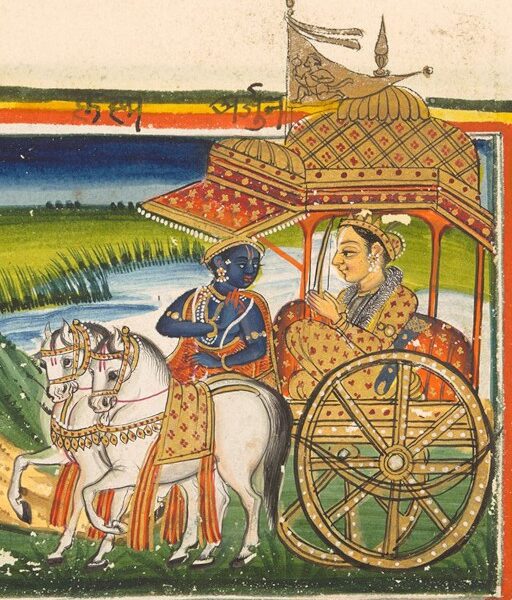
It’s a bit like when Durukha the chariot driver, he cursed the ecstasy that he was experiencing from driving Kṛṣṇa away. You don’t get beyond what you do.
The loss of consciousness.
Durukha the chariot here, in that case, was a stunt. You can’t move. So, all these would get in the way of his doing his particular service at the time. So, it’s not that you get more than. Kṛṣṇa is unlimited, so the amount of happiness there is unlimited. That’s just the way it works. That’s the scene. You know what I’m saying?
So, it’s not that there is some other element.
Does that make sense?
We have to get used to that Kṛṣṇa consciousness is happy. Because we have a tendency, the material world is not meant for happiness, though I think there is and I’m trying to get. So, then spiritual means I’m not trying to get and happiness means there is none. And I should be satisfied with that. But that’s just coming from, that’s how spirituality is defined on the material platform.
As if there is no personal endeavor.
Since you are part and parcel of the Supreme Lord, the results of His work must be enjoyed by the Supreme. This is actually Kṛṣṇa consciousness. So, that’s the point. Okay, we’ll give that up, we’ll accept that. But, we see after that, the person acting in Kṛṣṇa consciousness is a real sannyāsī, one in the real sort of life. So, this is sannyāsī.
But then he goes, by such a mentality one is satisfied because he is actually acting for the Supreme. So, there is satisfaction. So, satisfaction, it’s a lasting position of experience of happiness. Thus, he is not attached to anything material. He becomes accustomed to not taking pleasure in anything beyond the transcendental happiness derived from the service of the Lord. So, it’s supposed to be like this, therefore surrender. But, one will, by practice, get accustomed to being happy when one sees the Lord happy. So, that happiness is the transcendental happiness. So, that’s beyond the material. Because the material is not shared.
Right? The spiritual is.
It’s a negation of the misery, but it also means that the spiritual means we are not engaged in anything material. Which is true. But then they take that, that means you are not engaged in anything. Because they don’t know about spiritual activity. Right? So, by not knowing spiritual activity, then there is always, their idea is that there is no activity.
That’s the mistake. So, that’s why we are saying here, the performance of the occupational duties in connection with the Lord is real renunciation. So, that means performing the duties within the varnasrama system to please the Lord, that’s actual renunciation.
Right? Not that one has to be a sannyasa. So, whatever your duties are, you perform those. Right? But doing it for Krsna, the results of the Krsna, that’s sannyasa. You know? So, if you haven’t caught that before the end of your life, then the sannyasa asrama is supposed to give you practice in that, in the external. Right? But the idea is to appreciate that before you get to that stage.
1850. O son of Kunti, learn from me how one who has achieved this perfection can attain to the supreme perfectional stage.
Right? So, what is the change? This perfection can attain to the supreme perfectional stage.
Can attain to the supreme perfectional stage, Brahman, the highest, the stage of highest knowledge by acting in the way I shall now summarize.
Summary of the process of self-realization.
The Lord describes for Arjuna how one can achieve the highest perfectional stage simply by being engaged in his occupational duty. Performing that duty for the supreme personality of Godhead. One attains the supreme stage of Brahman simply by renouncing the result of his work for the satisfaction of the Supreme Lord. That is the process of self-realization. So that you’ve renounced it for the Lord, that gives you liberation. Right? Situational liberation. That you’ve done it to please Krishna, then that gets you prema.
Does that make sense? So, in other words, the activity of renunciation and having performed that renunciation for Krishna, pleasing Krishna.
In other words, the process is that renunciation, but the goal that you want is Krishna’s pleasure. Because if you do the activity for yourself, means you follow the same process, but you get the result for yourself. But here is that while you’re doing the process, there’s no desire for the result for yourself.
Does that make sense?
Less than twelve.
So that’s the process of self-realization.
Right? Simply by engaging his occupational duty. Right? Of that where the result is for the Lord.
Get it? Do you understand? We’re renouncing it, so it’s for the Lord, that will get us liberation. But doing it to please Krishna, that gets us liberation. That’s the devotion.
Less than twelve. Salvation is not obtained simply by dry speculative adventures, but only by the service of the Lord. Dry speculative adventures. Yeah.
Eighteen, no, fourteen, twenty-two to twenty-four. O son of Pandu, he who does not hate illumination, attachment and delusion, when they are present, or long for them when they disappear, who is unwavering and undisturbed through all these reactions of the material qualities, remaining neutral and transcendental, knowing that the modes alone are active, he who is situated in the Self and regards alike happiness and distress, who looks upon a lump of earth, a stone and a piece of gold with an equal eye, who is equal towards the desirable and the undesirable, such a person is said to have transcended the modes of nature.
Footnote. These verses describe the symptoms of a sthita prajna, one above the modes of nature. The characteristics to be recognized within oneself are described in verse twenty-two. The external characteristics visible by others are described in verses twenty-three and twenty-four.
So within oneself, does not hate illumination, attachment and delusion, when they come and they go.
One attains salvation by being conscious of Krsna. When a living entity stays in this material world, embodied by the material body, it is to be understood that he is under the control of one of the three modes of material nature. When he is actually out of the body, then he is out of the clutches of the material modes of nature. But as long as he is not out of the material body, he should be neutral.
He should engage himself in the devotional service to the Lord so that his identity with the material body will automatically be forgotten. When one is conscious of the material body, he acts only for sense gratification. But when one transfers the consciousness to Krsna, sense gratification automatically stops. One does not need this material body, and he does not need to accept the dictations of the material body. The qualities of the material bodies in the body will act. But as spirit soul, the self is aloof from such activities. That’s why Upadesa Murigo starts with the six pushings.
Because that’s what the body will do. The body gets hungry, the body gets tired, all these different things.
They come and go, you don’t worry about them.
It’s just a need of the gross and subtle bodies.
But because we identify with it, therefore we become happy or distressed depending upon it.
One does not need this material body, and he does not need to accept the dictations of the material body. The qualities of the material modes in the body will act. But as a spirit soul, the self is aloof from such activities. How does he become aloof? He does not desire to enjoy the body, nor does he desire to get out of it. Thus transcendentally situated, the devotee becomes automatically free. He need not try to become free from the influence of the modes of material nature. He doesn’t have to try to become free from the influence, he simply has to absorb himself in Krishna consciousness.
Then he’ll be free. Right?
The consequence is his freedom.
Yes, his freedom from the… But the body will still act according to the gunas, because the body is made of material energy, material energy is controlled by the three modes. So the body will still act, it’ll still get hungry, it’s not that pure devotee body doesn’t get hungry, or tired, or have to go to the bathroom. That’ll still go on. But he’s not disturbed by it. You know, if you’re hungry, if there’s something available, you eat. Not available, you don’t eat. You know, he’s not worried either way.
Nice. Hmm? Nice. Yes. So when the bucket is full, when the bucket is empty, one does not… one is not worried. Hmm?
Or you mean when the bucket’s full, whether you’re eating it, or whether you’re too full to eat it, you’re not disturbed? Yes, exactly.
Such devotee sees everything with an equal eye. He accepts everything… He accepts things that are favorable for his duty in Krishna consciousness. Otherwise he has no necessity of anything material, either a stone or gold. He accepts things that are favorable for his duty in Krishna consciousness. If it’s favorable, he accepts it. If it’s not favorable, he doesn’t need it. Right? In other words, he’s looking at it from the angle of his service. Right? The service is there, then it goes nicely. If it’s not there, he doesn’t worry about it.
He takes everyone as dear… as his dear friend, who helps him in his execution of Krishna consciousness.
And he does not hate his so-called enemy. He is equally disposed and sees everything on an equal level, because he knows perfectly well that he has nothing to do with material existence. Social and political issues do not affect him, because he knows the situation of temporary upheavals and disturbances.
He does not attempt anything for his own sake.
He can attempt anything for Krishna, but for his personal self, he does not attempt anything. By such behavior, one becomes actually transcendentally situated. And so again, it’s for Krishna, not for oneself. That endeavor, then he becomes transcendental.
Lesson 13.
Sri Krishna, the Supreme Personality of Godhead, is just like the sun. Therefore, one is at once liberated from the nescience of matter as soon as he surrenders to Sri Krishna. So as soon as you surrender, you’re liberated.
So one can take it that the devotee is on the liberated platform. Whoever surrendered is on the liberated platform. Now, when he is fully conscious of that surrender, then he’ll be fully conscious of what that liberation means.
Right.
Lesson 13.
10. To those who are constantly devoted to serving Me with love, I give the understanding by which they can come to Me. If one is sincere and devoted, he will attain the Lord. A person may have a bona fide spiritual master and may be attached to a spiritual organization, but if he is still not intelligent enough to make process, then Krishna from within gives him instructions, so he may ultimately come to Him without difficulty. The qualification is that a person without difficulty means he’ll progress spiritually. It doesn’t mean that there won’t be material difficulty, because that’s controlled by the modes of nature. Right. And that’s from the previous verse where he says he’s not going to be disturbed.
The qualification is that a person always engages himself in Krishna consciousness and with love and devotion render all kinds of service. He should perform some sort of work for Krishna, and that work should be with love. If a devotee is not intelligent enough to make progress on the path of self-realization, but is sincere and devoted to the activities of devotion and service, the Lord gives him a chance to make progress and ultimately attain to Him.
It means that they want to serve Krishna, want to do, but they don’t really know how to do it nicely. But Krishna will give the intelligence, the time.
So one should maintain that sincerity.
One may feel one doesn’t know, one may be unqualified, but still one continues because Krishna will give the results.
Ten to eleven. To show them special mercy, I, dwelling in their hearts, destroy with the shining lamp of knowledge the darkness born of ignorance.
The Lord helps His devotees to attain it. The Mayavadi philosophers think that without discriminating, one cannot have pure knowledge. For them, this answer is given by the Supreme Lord. Those who are engaged in pure devotional service, even though they may not have pure knowledge, even though they may be without sufficient education, and even without sufficient knowledge of the Vedic principles, are still helped by the Supreme God, as stated in this verse. So that means if any devotee is sincere, then whether he knows so many things or not, still Krishna will help him, he’ll advance. Difficulty comes as if the distraction is so great that the focus on Krishna is not so much.
Then that’ll be more difficult because you don’t want Krishna. See, it’s one thing you want, but aren’t very expert at following the process to get.
Because devotional service is based on the desire. But if one doesn’t have that desire, and is not very expert, then what’s going to carry things through?
Therefore, that safety net is the association of devotees. So hopefully in that association, one gets inspired.
So it’s very important to keep enthusiasm.
Keep enthusiasm, yes. But that’s also by the standard thing, would be by knowledge. You have that enthusiasm, because you know, enthusiasm comes after knowledge. You have that understanding, right? So therefore you’re enthusiastic. You see, here’s the field, this is the result, and this will be the method so you can understand, so you become inspired.
What role does the association of devotees play in enthusiasm?
Endeavor with intelligence. One, you see them making endeavor. And two, is by their association one gains knowledge, one gains intelligence. So by following their instructions, then that gives knowledge.
So it’s the devotion that’s most important, then things like knowledge and ability, those will come along with it.
But the focus is not, okay, yeah, you got to do this because you got to get knowledge, without knowledge you can’t know, it’s without devotion. These other things are just simply showing the hierarchy within. Okay, if you have the knowledge, this will happen, this will happen, this will happen. That’s just showing the progression there. But what drives that is the devotion.
You know what I’m saying? It’s just like you have the car, right? So what drives the car? The engine. Okay, like that. And so then one will focus this engine, and there’s all these different things, then the tires, so you have to get all that there, because from the engine then it gets to the ground, and then you have all the different whatever it is like this, okay? No? Right? We’re comfortable with that. But what happens if there’s no petrol?
Right, you know what I’m saying? Then the engine doesn’t work. So that’s the point, is without that devotional attitude, these whole processes of karma, jnana and yoga don’t work.
Right? They’re the mechanics.
Right? But the mechanics are only working because of the devotion to the Lord.
The Lord tells Arjuna that basically there is no possibility of understanding the Supreme Truth, the Absolute Truth, the Supreme Personality of Godhead, simply by speculating, for the Supreme Truth is so great that it is not possible to understand Him or to achieve Him simply by making a mental effort. He has to reveal Himself.
Man could go on speculating for several millions of years, and if he is not devoted, he is not a lover of the Supreme Truth. Oh, if he is not a lover of the Supreme Truth, he will never understand Krsna or the Supreme Truth.
Only by devotional service is the Supreme Truth, Krsna, pleased, and by His inconceivable energy, He can reveal Himself to the heart of the pure devotee. The pure devotee always has Krsna within his heart, and with the presence of Krsna, who is just like the sun, the darkness of ignorance is at once dissipated. This is the special mercy rendered to the pure devotee of Krsna.
So the Lord is in the heart, so He can easily dissipate the darkness of ignorance, but you have to want that. Otherwise, if you are attached to the darkness of ignorance, then He reciprocates with you through that medium of darkness of ignorance.
Does that make sense? Because you are covered, so you think you are the darkness of ignorance, and so you are attracted to the darkness of ignorance.
But the potency behind that darkness of ignorance is Krsna.
So when you want to have that relationship with Krsna, then it works very nicely, because then what is the occupation, what is the situation, that’s simply used as the medium.
Otherwise, then, you don’t see yourself as the soul, you see yourself as the body, and you don’t see that the Lord has entered everything, that’s why it has attraction. So you think the dead matter itself is what’s attractive. So your dead matter is the body, is interacting with the material energy, under the modes of nature. But if you don’t act in that way, then one is not under the modes, so the soul is interacting with God.
Sounds better. Yeah, sounds better. Definitely sounds better.
So this is specially rendered to the pure devotee by Krsna.
Hrti. Out of His causeless mercy, the Lord desires to award the soul the greatest boon in the form of pure devotional service. One should reciprocate with the Lord with the same pure intention, guided solely by the desire to please Him by rendering devotional service.
So the Lord gives pure devotional service, but then one should reciprocate by rendering that service.
One could say, oh, you’ve been given devotional service, but you have to use it. It’s like someone gives you money, you have to use it. You don’t say, I’m rich, but what are you doing with it?
Lesson 14. One should not desire to cooperate with Godhead conditionally for some material gain. Because before it says, human beings should cooperate with Godhead. So that means on any level you’re cooperating with the Lord, following His laws. But of all the cooperation, you shouldn’t be doing it for some material gain.
So in other words, you’ve accepted that connecting everything to the Lord is good. But you may be doing that because it’s His world, and so if He’s pleased, then you’ll get what you want. Does that make sense? Is that technically cooperating with Him? It means ultimately no, but the point is, at least you’re appreciating and following His laws. So that is a cooperation.
So that’s why human beings follow the Vedic system, because that’s a cooperation. But that’s what we see. Why does it end with those persons before? I was saying, do pious work, then you can’t do that, then knowledge is better than meditation, better than renunciation of work. But all of them are pious. It doesn’t drop out of that.
Right? Because pious means you’re following God’s laws. Impious means you’re not following God’s laws.
17. Charity given out of duty without expectation of return at the proper time and place and to a worthy person is considered to be in the mode of goodness.
Right? Charity should be given without any consideration of return. It means not that they’ll give you money back, but you’ll get something from it. Yeah, I’ve given them so much money, nobody cares, and this and that. So that’s not good. It means the culture is there. Someone’s given what’s great for all these… But the point is, is one expects something. So that’s for yourself, because you can’t control how the other person is going to feel. You can control what you feel. Right? And anyway, if they’re not grateful, why give to them in the first place?
So if it wasn’t obvious, now you know.
Yeah. But never expect anything in return.
In the Vedic literature, charity given to a person engaged in spiritual activities is recommended. There’s no recommendation for giving charity indiscriminately. Spiritual perfection is always a consideration. Therefore, charity is recommended to be given at a place of pilgrimage and at lunar or solar eclipses, or at the end of the month, or to a qualified Brahman or Vaishnava devotee, or in temples. Such charity should be given without any consideration of return. Right? So these are the recommendations, all of how it’s done.
But so, the more qualified the person, that’s the recommendation. Right? It’s not recommended to give to someone who’s not qualified.
You know, I’m saying you give something. People need it, they’re hungry, you give some food or like that. That’s okay, but that’s general welfare work. But the real charity should be what’s given to a qualified person. Because that you get. Lasting benefit. So what these other, then, how much benefit you get from feeding a starving person is how much you’ll get back.
Right? You gave once a pot, you’ll get back once a pot.
What’s that?
It’s slightly, I mean, it’s the same principle, but it’s different, it’s Dakshin, because something’s been done, so you’re reciprocating that. The other, generally charity, it’s not they’ve done something for you. Right? It’s just they’re qualified. It’s your duty to give part of your, you know, accumulated wealth to someone who’s qualified. Right? Is that what you’re saying?
So it’s slightly, I mean, same principle, but the details are different.
Here you’ve gained, so now you should, because it’s not done beforehand, because if it’s given beforehand, then there may be the consideration of, you know, I’ve given, so therefore they have to deal with me how I think.
Do you understand? Rather than what I deserve.
Yeah, yeah. It means it’s always, what activity, what activity, what service has been rendered, the qualification of the individual, all these have to be considered, you know. Someone does, you know, let’s say, an anaprasana. Okay, so that, you know, it’s something, but it’s not that big. But a marriage, that’s big. So the Dakshin you give for marriage should be more than you would for an anaprasana.
You know what I’m saying? And then if it’s just a devotee who knows how to do it, you know, then that’s, you know, they’re qualified, then that’s good, you give one level of charity. But if it’s someone who’s highly qualified, you know, or very spiritually developed or like that, then you would give more. Even though it’s the same activity. You know, it’s not that, oh, last time I gave this much, so this time I give… No, that’s on the individual.
You know, the individual’s circumstance, your circumstance, how much you have. You have a lot, you give more. You don’t have a lot, you give whatever, you know, whatever works. You understand what I’m saying?
So, when they’ve done some activity for you, that you’ve benefited from, then you’re giving Dakshin. Right? If you’re giving something so that they can do beneficial things, then that’s charity. If you give money, then they preach. If they come to your house and did a program, then what you give there, that’s Dakshin.
You know what I’m saying?
Your wife mentioned that you’re going to train the public as a performer, and if you appreciate their performance, then you’re obligated to give.
Some are singing bhajans.
I mean, on one level. I mean, if that’s what they’re doing it for, then, you know, you can always give them something. But that’s also according to their qualification. If they’re humble and properly behaved, you give more. If they’re not, you give less.
You know, if they come up and poke you and touch you, or something like that, then, you know, you’re not necessarily obligated to give them anything. You know, because that’s not their business. They have no right to come up and touch you. You know, they can’t invade your personal space.
Does that exist in India, personal space? Yeah, it’s just a little bit closer than…
They throw down more people, right? Yeah, probably the greatest I’ve seen is probably Sweden. That’s got the greatest personal space. Denmark is the same. Greece? One house here, and the ideal is one kilometre away is the next house. Ideal, yeah. Half a kilometre is okay. It can work. Yeah, but… And the corners of the house are white or red, or…? Not marked in Denmark, at least. Oh, in Sweden, then, the corners. You’ve got the carving in the corners, so that’s always painted. I can’t remember if it was red or white. Usually red. Red, okay. Sweden’s red. So Denmark is no specific country? No. So the main thing is just the space? Yeah, as big a hedge as possible around your… Whatever land you have.
Moats?
Yeah, we have toxic forest flows. Okay. Yeah.
Yeah, so you give something, but you give according to their qualification.
So what’s the main thing to remember? To be able to assess properly the situation and… What is the situation?
Well, something which is confusing. Unexpectedly you witness something which is generating this… But you still have to… The point is that it’s been generated, fine. You want to give something, fine. But then you have to use your intelligence as to what would be appropriate. Yeah.
Right? Because otherwise we’re coming up. We’re coming up to it. Just wait.
1721. But charity performed with the expectation of some return, or with a desire for fruitive results, or in a grudging move. It’s said to be charity in the mode of passion. You don’t really want to give it, but you know you’re supposed to give it, because there’s loss, right? You’re supposed to do it, but you’re looking at what gain you’ll get. You’re supposed to do it, but you’re looking at what loss. So that’s charity in the mode of passion.
Charity with desire for remuneration is not recommended. Charity is sometimes performed for elevation to the heavenly kingdom, and sometimes with great trouble and with repentance afterwards. Why have I spent so much in this way? Charity is also sometimes given under some obligation, at the request of a superior. These kinds of charity are said to be given in the mode of passion. There are many charitable foundations which offer their gifts to institutions where sense gratification goes on. Such charities are not recommended in the Vedic scripture. Only charity in the mode of goodness is recommended.
That’s why it says to a worthy person. So he’s saying here that they’re giving. It means the point is you want some return, or you’re giving only because you’re supposed to, but you really don’t want to. Not because they told you to give because you’re supposed to, and, oh, you’re happy to give. You may not have thought of it as where you don’t really want to give. So that’s all mode of passion, or afterwards you feel bad that I spent so much like that. And then these charitable foundations may give their money to people who are not actually qualified.
So then this is all passion.
1722. And charity performed at an impure place, at an improper time, to unworthy persons, or without proper attention and respect, is said to be in the mode of ignorance.
Contributions for indulgence in intoxication and gambling are not encouraged here. That sort of contribution is in the mode of ignorance. Such charity is not beneficial. Rather, sinful persons are encouraged. Similarly, if a person gives charity to a suitable person, but without respect and without attention, that sort of charity is also said to be in the mode of darkness.
So you may have a qualified person, it’s the right time, everything, but you do it without attention or respect. You’re either so distracted you just give and go off, or some other way, you don’t respect them and that, but you’re supposed to give, like that. So that’ll all be mode of ignorance. Riti. Even when one approaches the Lord for material gain, the Lord mercifully reciprocates with him by purifying his desires.
Okay, we’ll get it here.
And now, last page of this section. Maybe you can mention to Pandava Pandava that we’re probably not going to make it till Thursday.
Okay, Thursday we’ll have the next bit ready, but probably tomorrow we’ll have that ready. Unless some heavy issues come up. Yeah, yeah, I mean, this could be two days worth of discussion. Raj, what’s the promise right here?
We have until tomorrow to meditate on some political question. Oh, okay. Yeah, look at this and see if there’s an issue in mind.
Otherwise then he’ll have to come up with a few more pages. All right.