
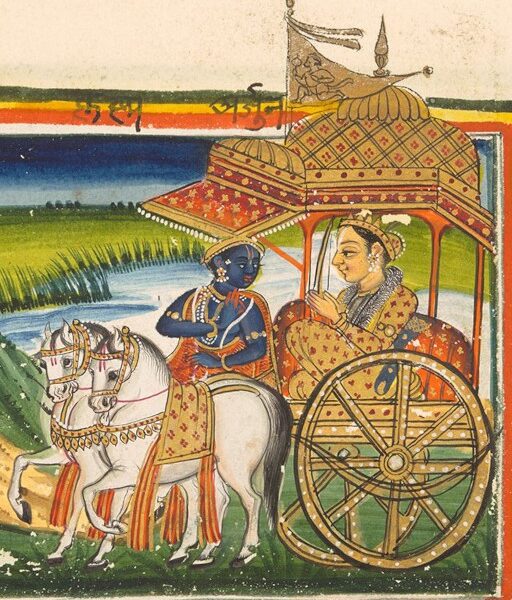
Every man should work for the purpose of yajña, or for Viṣṇu, the Supreme Personality of Godhead. Anything done for personal sense gratification is a cause of bondage. The conclusion is that everyone should be engaged according to the particular mode of nature he has acquired, and he should decide to work only to serve the supreme cause of the Supreme Lord. So, here again, it’s the particular mode of nature he has acquired, so that won’t change. And the best part is there’s no need for it to change. We have an idea it should change, because of social consideration. We’ll consider that, you know, socially we don’t like the particular nature that we’ve acquired. But it doesn’t matter. It’s whatever you can do connected to the Lord that’s important. Because if it’s done for yourself, no matter how elevated or not it is, it’s still sense gratification, it still binds one. So there’s sinful reaction. But if one is doing it to please Kṛṣṇa, then there’s no reaction. So here also sinful can have that double meaning. One is that an action done that’s not in connection with śāstra, it’s not your occupation, then that would be sinful. But also if we’re saying that if it’s done according to one’s occupation, so technically according to the Vedic, it wouldn’t be sinful, but it’s not being done for the Lord, then from the transcendental perspective it’s still sin. Because sin means doing something you shouldn’t do. So for the soul to not serve God, that’s sin, because that’s not what they’re supposed to do. They’re supposed to be engaged in the Lord’s service. That’s why it says the pious man surrenders. Yeah, pious man surrenders. So the point is that ultimate piety is devotional piety. So we should consider that whenever we are inattentive or not really meditating, contemplating things for the Lord, that we are sinful? One could do that, and it would definitely fit the particular cultural heritage.
But the point is that it would be more as that it’s just not pleasing to the Lord. So in other words, it’s what pleases the Lord, what doesn’t, rather than piety and sin. You know what I’m saying? Because piety and sin, we generally look at it, for piety means we gain, for sin we lose. So in other words, Kṛṣṇa is saying there’s no loss if one performs one’s own duty. But now even you perform your own duty, so technically there’s no sin, so there’s no specific loss as such. Still, if it’s not Kṛṣṇa conscious, then there’s loss of the opportunity to serve the Lord. And so gradually, gradually, consciousness will change, and you’re pious now, you’ll become impious. And if you’re impious, it just goes around and around. You know what I’m saying? So it’s just a matter of what words to use that bring out the proper connotation.
So we use piety and impiety. You know, they’re very valid and useful words. But in this case, the point is, is the result is to please Kṛṣṇa or not, rather than what result we’ll be getting from it. Because if you please Kṛṣṇa, we’ll be pleased. So that means it’s the best result. One doesn’t have to be in anxiety. But he’s pointing out here, work according to one’s nature is never affected by sin. So you don’t have to worry, I’m doing my work, and there’ll be a reaction. But if one’s doing someone else’s work, then there’ll be a reaction, because on one level, one won’t be able to completely please Kṛṣṇa, because you’re not fully absorbed. But on the other is that it’s not what your mentality is supposed to do, so therefore the quality of the service won’t come out right. Does that make sense?
Because the mentality goes with the skill, right? Because the first thing, prajumna means the mood, right? Then you apply the skill in abhidheya. Then you’ll get the result in pāyosana. So if the mood’s wrong, even the skill is applied, it’s still… Because when you perform an activity, you get two aspects. You get what is sensually perceivable, and you get what’s emotionally perceivable. So if the skill is correct, you’ll get the observable result, proper observable result. But if the mood’s not right, you won’t get the proper emotional result. Does that make sense? So if the mood’s not correct in performing the activity, even though it appears that it’s working nicely, it’s still wrong. So if you perform something that’s not your duty, the mood won’t be right. Otherwise, why are you doing something that’s not your duty? Even though the skill is very good. So it’ll be, I’m doing it because of my pride of the skill, or because I want that result of that other work rather than my own work. So it’s going to be something that’s dealing with myself, some aspect of saṅkarṣaṇa. But the problem is, it’ll be saṅkarṣaṇa where we’re not performing the proper duties. So even though we get the field, it’s based on false ego. So instead of saṅkarṣaṇa being dealt with, that I’m servant of the Lord. So that establishes the prajñāna, the proper mood, and therefore, aniruddha, you get the proper experience. It’s false ego, so therefore, then the element of prajñāna will be wrong, so therefore the element of aniruddha will be wrong. Though the skill, the abhidheya, will be fine.
Does that make sense?
Like that. So that’s the point. If we can discern these different things, then it works better. So we’re trying to get, that’s why I went through, is you have the knowledge of the field, you have the proper mood, you have the proper understanding of the goal, the proper understanding of what to do, and then that’s done in all that knowledge together, without the desire for the result for yourself. So you put that all together, and that is naiṣkārya.
Now that mood being to please Kṛṣṇa, then that’s devotional service. But that’s the form. So the Vedic form, that’s the proper Vedic form. Even if it’s not being done for Kṛṣṇa, that’s still the proper form. You’ll get the best possible result.
So the idea is that we’re doing something to please Kṛṣṇa, so you want to get the best possible result. So you can get the best possible result from the Vedic system. In the Vedic system, as defined, the naiṣkārya, that gives the best result.
So that way, then, the devotee is doing the best thing for Kṛṣṇa. Does that make sense? But it’s that, yeah.
And you mentioned that if you perform naiṣkārya, there is no sin. Yes. But there is still reaction. There’s still reaction. You always get reaction. Just not sinful. There’s not sinful reaction. It’s just like, you know, yeah. Yeah, there’s no sinful reaction, but it doesn’t mean that it won’t create a future situation. Right? Reaction is there. And along with whatever’s the good means, just like, let’s say, we’ve done our duty, and so then we’ll get a nice facility. But the point is this, we still have to be there to be in that facility. So if you want to wait around, great. But if you want to go back to Godhead, then why bother? You know what I’m saying? So, but we do our duty just to please Kṛṣṇa. We’re not doing it because it will give us a good result, or it will give us a result we’re not interested in. We’re doing it because that’s what makes Kṛṣṇa happy. You know what I’m saying? Like, you can cook something for somebody that you yourself aren’t specifically interested in. Right? But they like it a lot, so you’re happy to cook it, and happy to, and like that. So that’s the idea.
Dealing with the material condition means our acquired nature. Because here Prabhupāda uses this. According to the particular mode of nature he has acquired, rather than saying it’s the conditioned, because conditioned would also be like the term material. It means that we are under its control. We are an illusion. But here is that one is working with the modes according to what one has particularly acquired, but one is not bound by it. Right? There’s a difference. We have these two things, but we always put it together, because if we think I am the body or I am the mind, then the difficulty means is that then I’m going to be the actions and the results. So we have problems separating them.
You know what I’m saying? So good action, you know, if I’m action, then that means good action means I’m good, bad action means I’m bad. Right? And so in this way then, like we’re having the difficulty this morning, that means then the shooter, because of his action, is automatically bad. You know, just by nature is bad. Or the brāhmaṇa by nature is good. Right? But it’s not. It’s whether the activity is connected to the Lord or not. Because we can say, yes, the person who happens to be in the brahminical position by acquired nature, that’s a better acquired nature than a śūdra acquired nature. But the point is, is we’re in the material world.
You know what I’m saying? You know, it’s just like the guy’s in prison, right? But he’s in a, you know, he’s in a, you know, white collar prison.
You know what I’m saying? It’s not a high security. You know, everybody else in there is also a businessman like him. You know, who cheated on their taxes or something like that. You know, so they’re all, you know, basically gentlemen. Like that. But he’s in prison. You know, and then you have the man who’s in the, you know, high security prison because, you know, he’s a, you know, serial killer or something like that. Right? So then one could say, yes, this prisoner is better than that prisoner. But that’s what we’re discussing. Yes, the brāhmaṇa is better than śūdra. But the point is, is it’s just one’s bound with the gold chain to the wall and the other one’s bound with the iron chain to the wall.
You know what I’m saying?
So that’s it. It means, like, you have the guys in prison. They got a chain, right, and a ball. Right? Now, if it’s an iron ball, nobody even bothers with the ball. But if it was a solid gold ball, right, they’d probably be sitting down and polishing it. You know?
You know? And then he’s picking it up. You know, how’s your ring? Not bad. Yours seems a little heavier than mine. You know, like that. You know? You know what I’m saying? So the difficulty comes then is that we’re judging what’s better or worse on the principle of what’s already worse.
You know what I’m saying? So that’s the difficulty, rather than what is the actual standard, which is God-consciousness. So that’s what the Kumāras are talking about, is no other subject matter should be as important as God-consciousness. Yes? I heard one time somebody said, one of the Buddhists said that the living entities, they are endeavor department.
Endeavor department? Endeavor department. And Kṛṣṇa, He is results department. Yeah, you could say. So whenever we, whenever the… But He’s also fields department.
Whenever one tries to apply this, then it seems like it has to be quite mechanical. It’s like, I am Kṛṣṇa’s servant. And then I’m… No, you’re not saying it right. I would like to aspire one day… No, no, no. You have to use that. I am Kṛṣṇa’s servant. Yeah, yeah.
So then I am Kṛṣṇa’s servant. Because I’m doing His service for Him, and then the results are for Him also. Now let’s go, excuse me, do like a bit like that. Yeah, but what about your first day on the job?
You have a new job, never done it before. So wouldn’t you consider that a bit artificial?
Going to high school, that would be artificial. It is artificial. But you know what I’m saying is that…
You know what I’m saying? So it’s new. Nobody worries about it. You know, does that make sense? First day, you know, driving a car, that’s artificial. Right, because when you get in it, it’s always stupid. Riding a bicycle the first time, that’s also really artificial. So you know, you have two feet, you walk. Why you should be rolling, right? If we were meant to roll, the bottom of our feet would be round. Right, you know. Does that make sense? You know, so the difficulty is that we’re only saying that because it’s a matter of we think we shouldn’t be doing it.
You know what I’m saying? Artificial means it’s not your nature. But to say devotional service is not our nature, that’s artificial.
That’s the only real thing, is that the soul’s nature is to serve the Supreme Lord. That’s the only thing that’s real. Everything else is, you know, our particular acquired facilities in illusion.
And then at the end of the endeavor, then, when the mind goes, well, you know, that was useless, and you know, like materially it didn’t go well, then one can say, well, that’s Krishna’s result. Yeah, but He gives the results, but that doesn’t mean He has to give the result if you don’t do the work right.
You know what I’m saying? Because He makes the laws for what is proper endeavor.
You know, who, with what, at what time is doing what endeavor, and therefore give what result.
You know what I’m saying? So technically, Krishna’s all departments. We’re only an assistant in the endeavor department.
Okay.
You understand?
So we do our part right, then we’ll take part in that particular result. We don’t do it right, we won’t get the proper result. So if you follow that… That’s talking about, you’re talking about the external. But as far as devotional, you’re trying to do it to please Krishna, you’ll get result for that. But now, if you’re working at the best of your ability, even though it’s not very good, still you’ll get full results. But if you could do better and do not, then you won’t get full results. You’ll get how much is your endeavor. That’s why it’s full of body, mind, and words. That full endeavor, right? Then that gets the full results. Right? I think that’s why Krishna uses that word, you know, because His absorption is constantly… I mean, I forget what He uses. I mean, He’s all-consuming. He’s just completely absorbed. That’s why He gets the result. He’s completely absorbed. So if you do someone else’s occupation, you’re not fully absorbed, because how can you be fully absorbed in Krishna if you’re doing someone else’s occupation? Why would you be doing someone else’s occupation? There must be a reason for it. If it’s emergency, that’s another thing. But the point is, then it is your duty. But as soon as the emergency is over, it’s not. So then if one’s doing it, why would you be doing it, unless you have a particular motive? Right? And if you have that motive, then how is it for Krishna? It’s not complete. It’s not full.
Does that make sense? So it’s not that, yes, I can do the skill, because it’s not actually about skill. That’s the final manifestation of it, is the external. But it’s all about the mentality that’s there, and that’s all about the consciousness. So what we’re trying to do is get to the consciousness by going backwards. It’s supposed to be by consciousness, therefore there’s the how one thinks and all that, and body, and therefore the activity. So the consciousness is Krishna conscious. You think about Krishna using intelligence, therefore the senses are engaged in the mode of service. But because that’s not happening, then we’re engaging the body, the idea that the mind will kind of notice that, and then like that, and then notice Krishna, and so then it gets back to there.
So it only seems artificial because you’re having to run this process backwards.
But the first recommendation is to surrender to Krishna right now, this moment, and then it’s done. You don’t have to worry about any artificial flavorings.
But if you can’t do that, then you use this mechanical system.
You know what I’m saying? So if you can just get on the bike and ride it, great. If not, you put those little wheels on it.
Easier for the soul that’s in a female body. To do the mood part.
That’s not how it works.
I could be in trouble after, you know. Do the mood part.
He said about applying skill without mood. So does that mean that they’ve got like a different, like a remote or something that you didn’t get, so then they have the mood settings up in there or something? See, that’s how it works. That’s how it is for me.
Applying skill without mood gets sensually perceivable result, no emotionally perceivable result. It means there’s always going to be whether you get it from there. The person does it with no emotion, then it generates in the other person, you know, the emotion of being subjected to something that lacks emotion.
Does that make sense? So emotion is already there, but you’re not getting the emotional result you wanted.
Does that make sense? So that’s why if somebody just perfectly does the skill only, it doesn’t actually satisfy anybody. You know, unless it’s in a position where you don’t have to look at it as long as they get it done, right? You know what I’m saying? But anybody that’s in that, subjected to that environment, will not be satisfied.
But the female is like more in touch with that? They’re in touch with that, but the point is, what we were discussing yesterday, because they’re in touch with that, because of that need to be involved with it, which is the natural position, you know, the natural feminine nature. So that means the soul, being feminine, they have to be in touch with, you know, how you say, relationship, emotion, and like that. So, but the difficulty is where we say it’s a weakness on the material platform, not on the spiritual platform, but on the material platform, because then emotion’s emotion, right? Now it can be expressed spiritually or materially.
That’s where the distinction doesn’t come in. That will be said, that’s the point where you say it’s less intelligent.
You know what I’m saying? Because if you can’t get it on the spiritual platform, then it’ll be taken on the material.
Does that make sense? Well, the man, you know, training should be able to discriminate, so if it’s not there on the spiritual, then they’ll just sit there in a neutral state.
Right? Does that make sense? So, that means then one is able to distinguish and not get involved with spirituality.
But that option’s not there for the feminine nature, because it must be absorbed in, because that’s when we say prayojana, that means the result, the emotion. So that’s the platform.
You know what I’m saying? So the man can move from a sense -enjoyer to a person to devotee?
So I’m just trying to refresh what you’re saying. Yeah, you could say. What I’m just saying is that if it was properly situated, one would see everything in connection to the Lord. We’re just talking about the inherent fundamentals that we’re working with. We’re not specifically applying it to one position or another. It means, in other words, the feminine nature is tuned into the result and that experience of the result. Right? Does that make sense?
So… She’s gay. Huh? She’s gay. Gay? Yeah. Gay. Yeah. She’s gay and he’s supposed to be safety. Supposed to be.
You know what I’m saying? It means this is a whole other topic. So that’s why to see it in relationship here is that if you see that what you’re doing is in connection with Krishna, then it works perfectly. But if it’s not in connection with Krishna, there’ll still be the need to go after that. So that’s why if the environment is made that you’re in your own situation, where whatever you perform in that field is within your occupation, then it doesn’t matter. Then it becomes easier.
You know what I’m saying? If all experiences are going to be spiritual, no matter which one you choose in the need for variety, then it’ll always work out fine.
You know what I’m saying? Therefore the element of dependency.
You know what I’m saying? So it’s an advantage if the environment is correct. But if the environment is not correct, it’s not an advantage.
Does that make sense? I think more specifically what I’m trying to ask is like how there are some people in the Brahmacharya ashram. Is it like you change how you dress? Will that affect your, will you be more qualified in devotional service or something?
Something like, it’s close. Like the Brahmacharya ashram, they go through Brahmacharya ashram and then they’re able to get the devotional, the sensual, the emotional and the devotional results of their activities, because they’re doing it properly. Whereas some, because they’re used to doing things just to get the sensual result, without the emotional result, they go through even the Grihastha ashram and they’re reminded by their partner. Reminded meaning a euphemism there. I think it’s called being beaten with shoes.
And remember, they’re more pointy. There’s a stiletto that’s got a point there. It’s not like a good old boot or something. Unless you’re a goth, then it’s a big boot. And they’ve got the higher leverage because it goes up to here, so you can grab it at the top, you can lean in there. Shiny buckles as well. Shiny buckles, stiletto, hobnails.
So the partner then encourages the person to deal with them, not as stuff, but as a person. Yeah, but how well has it worked out for the three billion men on the planet?
Yeah, so it’s not about the situation. It’s about the understanding. So if you didn’t get the proper understanding as a brahmacari, you won’t be able to use it as a grihastha.
You know what I’m saying? The difference between the Upakurvana and the naisthikas, is the naisthika is realized, so he doesn’t require, but he understands the science. While the Upakurvana is one who understands the science, but he doesn’t have the realization about not requiring it, so he gets married.
But in both cases, that’s why Prabhupada says, first class brahmacari makes the first class grihastha. So first class doesn’t mean he doesn’t get married. What first class means is the level of training and understanding.
Yeah, because otherwise, why would there be for humans?
It’s just how much intensity of it you require. You know what I’m saying? The brahmacari goes like this, like that. The grihastha is like this.
You understand? It’s an electrical appliance, if you have a wave that goes like this, it doesn’t work right. Only when it goes like this, then it works.
So this idea that we’re only going to get what’s above the line is a urban myth.
Does that make sense?
No, have to be able to take both sides of the same thing.
You know what I’m saying?
You know what I’m saying? It’s a different topic, so to fit it into this, then the idea is if you have a particular acquired nature, you are engaged according to it. So if your acquired nature is that of being a grihastha, then one should act according to that. And if it’s not, then one shouldn’t. You know, why be a grihastha if you don’t need to be? But if you need to be, why wouldn’t you be a grihastha?
Does that make sense? You know, that’s the point. So you situate yourself according to what’s the need. But because you’re acting to satisfy the Lord, you have a skill. Right? It says he was hesitating to fight for the other party. Fighting is a skill. How did he learn that? He was trained. So in other words, one has training and skills, but along with the skill comes the proper mentality, the proper understanding, then that application and the proper Krishna consciousness, all that combined, then you get something very nice. Otherwise, then the difficulty comes is that it’s only a skill, or it’s only a feeling. You know what I’m saying? So you have, you know, both are a problem. You know, the guy who’s, you know, very expert in his skill and everything like that, but, you know, doesn’t really relate to the emotional platform. But at least all the facilities are there. It’s comfortable, but dry. Right? And the other guy, it’s emotional, so it’s not comfortable, and there’s no facility.
You know what I’m saying? You know, the other day, the question was, but what about lazy? You know, it’s like that. So it means that there’ll be no facility. So not only is it emotionally uncomfortable, that it’s also physically uncomfortable. So therefore, it’s worse situation.
Does that make sense? So that’s why it’s not an advantage.
Right?
So one’s always active. But the point is this, one can choose how much activity by how much room he wants to deal with. So if one doesn’t see the advantage of dealing with so much material facility, that’s fine, then don’t. But also don’t desire it, don’t need it.
You know what I’m saying? So then that’s intelligent, you know, that you’re dealing with a smaller amount of material energy. But that small amount you’re dealing with fully, you’re interacting fully.
Does that make sense? You know, if you’re too lazy to clean your big house, get a smaller one. You know, it’s like you can only clean three rooms out of the eight rooms. So get a three-room house. You know, if you’re going to clean one, get a studio. You know? And if you can’t do that, you’re dealing with your mother.
No?
Get a maid. Get a maid, yeah. Get a maid, yeah. It’s synonymous.
Yeah, it’s synonymous, but you could, you could, you could, you could, you might find out the particular, how you say, I don’t know what would be the proper mathematical term, but the, you know, how you say, the volume with, how you say, volume with movement.
You know, it’s one of those mathematical things. You know, like that of a rolling pin. Kinetic energy. Yeah, the kinetic, kinetic energetic element of a rolling pin.
The force times surface area. Yeah, yeah, like that. And if she’s Italian, she’s got one of those three-foot ones, rolling ravioli, so that was really dangerous.
Okay.
Eighteen forty-eight. Every endeavor is covered by some fault, just as fire is covered by smoke. Therefore, one should not give up the work born of his nature, O son of Kunti, even if such work is full of fault. Because the one or the other would say, no, but I do the other one so nicely, and this one I don’t do so well. But still, every endeavor is covered by fault. Because the other one, it only appears that it’s perfect. It means the skill is perfect, but it doesn’t mean that there’s not something in the equation that is imperfect. Because every endeavor is covered by fault. Krishna doesn’t say, endeavor is covered by fault. He says, every endeavor. Because it’s never perfect. That’s why the sastras will define what’s ideal, and then you, knowing that, you work towards that.
Can’t the words explain it? Somehow, I can’t remember.
So how, us being Kuntijas and Sankars, all these mixes of natures, and then it seems like everything is wrong, wrong. So how should we discern? It means, how to discern? It’s just like, can you tell the difference between, you know, one prison and the other?
No, according to what we are discussing.
Every endeavor is covered by fault. But it just might, there might be more fault included in these endeavors. So that’s the idea of training, is that then we will be able to perform the activity with less fault. But our only purpose of trying to perform something with less fault is because the results for Krsna. You know what I’m saying? There’s a fault that means that there’s something that’s not as ideal for Krsna. So we’re trying to remove all those faults, so that Krsna gets the best result. But the main best result is Krsna consciousness. That’s what Krsna is interested in. And being Krsna conscious, you want to get the result for Krsna. Therefore, your endeavor to give Him a perfect result is what’s important to Him. It’s not the perfect result that’s important to Him. It’s that you’ve endeavored to get it.
Does that make sense? So, therefore, it doesn’t matter what one’s position is. One’s endeavoring for the perfect result. Then that pleases Krsna. So even if, you know, from birth that there is certain conditionings that things may not be done so well or may be difficult, still the endeavor to try to do that is nice.
You know what I’m saying? You know, Krsna is, you know, very small, but He’s trying to carry Nanda Baba’s shoes. He’s not doing it perfectly, you’d say. The servant would do it much better. Right? But Krsna-carry gives much more pleasure than the perfect carrying of it by the servant. Right? Because the mood, that affection.
Does that make sense? So, if that mood is there, then that works. It doesn’t mean that the skill is not important, but one is endeavoring to make that skill proper. Whether one is perfected or not, that’s another thing. But because one is practicing it, then one perfects, generally, you know, as it develops, then one should be developing, the Krsna consciousness should be developing.
In conditioned life… In conditioned life, all work is contaminated by the material modes of nature. Even if one is a brahmana, he has to perform sacrifices in which animal killing is necessary. Similarly, a ksatriya, however pious he may be, has to fight enemies. He cannot avoid it. Similarly, a merchant, however pious he may be, must sometimes hide his profit to stay in business. Or he may sometimes have to do business on the black market. These things are necessary. One cannot avoid them. Similarly, even though a man is a sudra, serving a bad master, he has to carry out the order of the master, even though it should not be done. Despite these flaws, one should continue to carry out his prescribed duties, for they are born out of his own nature.
So here it’s even saying, not even just your skill in applying it has a fault, the work itself has a fault.
Like that. So then and that we can point out, oh no, this has a fault, so we shouldn’t. You know what I’m saying? But according to this, everything has a fault.
You know what I’m saying?
Because otherwise, if you go by the periphery, there’d be nothing to do, right? Because you’re trying to put on some clothes. So this is good for this, but then it has a problem over here, and it does that well, but then it has a… You know what I’m saying? So there’s always a fault. Whatever one does. You know what I’m saying?
You know what I’m saying? So there’ll always be that element. So one shouldn’t worry about that aspect either. So how well one… The activity itself, if that’s prescribed, that’s what’s nature, and then how well one does it. Like that. So one should just try to do… understand it and do one’s best. So he carries out his prescribed duties.
One should not give up his natural occupation because there are some disturbing elements. Rather, one should be determined to serve the Supreme Lord by his occupational duty in Kṛṣṇa consciousness. That is the perfectional point. He’s determined to please the Lord. When a particular type of occupation is performed for the satisfaction of the Supreme Lord, all the defects in that particular occupation are purified. When the results of work are purified, then when connected with devotional service, one becomes perfect in seeing the Self within, and that is Self-realization. Because then you become perfect in seeing oneself as serving for Kṛṣṇa. So by performing the work for Kṛṣṇa, that’s what will purify it. Otherwise, those flaws are inherent. One can’t get around it. To find that perfect situation where there’s no flaws, it doesn’t exist. You’re in the material world, so it’s not possible.
You have to cook, but it’s hot. So in the winter that’s great, but in the summer it’s not. So there’s always going to be some flaw. Taking a cold shower in the middle of summer, that would be great. But in the winter it’s not. So therefore, hot and cold water.
Not always.
No, but here we always have hot and cold water. You live in the pukka buildings, right? The brick buildings.
No, there’s always hot and cold water.
Huh? No, all of them, every last one of them. We’re the only ones that don’t have hot and cold water. It’s the hand pump, it’s always the same temperature. But in the middle of summer, you’ll see it, the water’s hot. In the middle of winter, it’s freezing cold. So you always get hot and cold running water. Like that. Well, our water’s always 23 degrees. It doesn’t matter if it’s summer or winter. So we miss out on all these, you know, modern luxuries.
See? So there’s always a fault.
Okay. Well, that’s the way it works.
One who is self-controlled and unattached, and who disregards all material enjoyments, can obtain, by practice of renunciation, the highest perfect stage of freedom from reaction. Right? So here’s this material enjoyment, disregards all material enjoyments. That doesn’t mean he disregards activities that generate material enjoyments. Those material enjoyments are for Kṛṣṇa. Right? We’ll take it as, oh, so nothing that gives any kind of enjoyment. Right? By practice of renunciation, means you give up the result, not the endeavor.
Renouncing the endeavor is not technically renunciation. It’s renouncing the result. Right? If it’s your occupation, because this has to be based on everything before us, saying that you’re going to perform your occupation according to the modes acquired. Does that make sense? So the renunciation doesn’t mean giving up the activity. It means whatever is the activity for your nature, that you’re performing.
Right? But the result of it, that’s what you’re giving up.
Right? Right? So the brahmacārī may renounce family life, because that’s his occupation. But the gṛhastha doesn’t renounce family life.
Right? So the point is, but he disregards all material enjoyments. That means all the facilities of the family life is there, but he’s seeing them connecting to Kṛṣṇa.
Right? Does that make sense?
Then one comes to the highest stage of freedom from all reaction. Right? Because the point is, performing an activity without designing the results, that’s what frees you from reaction. Not doing the activity. Because if not doing the activity, you’re doing inactivity.
You know what I’m saying? So there’s no such thing as doing nothing. You know, it may be a great ideal, but it doesn’t exist in reality.
You also say that it’s significant that it’s freedom from reaction, not absence of reaction. Yeah, freedom. Yeah. So things are still going on, but… Yeah, yeah, but you’re not involved.
Real renunciation means that one should always think himself part and parcel of the Supreme Lord, and therefore think he has no right to enjoy the results of his work. Because if you’re part and parcel of the Lord, then it’s all about the Lord. You’re just part of the Lord, so it’s not about you, it’s about the Lord.
Since he is part and parcel of the Supreme Lord, the results of his work must be enjoyed by the Supreme Lord. This is actually Kṛṣṇa consciousness. Again we see it comes back. Just that simple.
Just we’re part and parcel of the Lord, therefore whatever’s there is for His pleasure.
The person acting in Kṛṣṇa consciousness is a real sannyāsī, one in the renounced order of life.
So that’s actual renunciation, not that you didn’t do something that would generate a result. No, the result generated is for the Lord.
Does that make sense? That doesn’t mean, again, that we twist it and say, Did we miss out on one?
Did we miss out on a paragraph?
I think so.
Okay, now we’re ready.
Okay. Yes, so that means that it’s his duty not to be involved. So that’s his endeavor, is to not be involved. Right? Or the gṛhastha, he’s supposed to be involved, so he has to make the endeavor to be properly involved. In either case, the result for being involved and not involved is for the Lord. Because if you just renounce it because, Oh, then less trouble for me and all that, then that’s not proper. No, it’s renounced because that’s what you’re supposed to do. You understand? It’s not that enjoyment is for the Lord and renunciation is for me. No, it’s enjoyment and renunciation for Kṛṣṇa.
Does that make sense? Otherwise, the tendency is, Okay, beauty, influence, wealth, fame. Those, yes, that we shouldn’t be involved in. But knowledge and renunciation, those are fully for us. You know what I’m saying? We just take, Oh, they’re automatically, that’s good. No, even that, knowledge is for Kṛṣṇa, renunciation is for Kṛṣṇa. Otherwise, when we renounce something, then it’s not necessarily that Kṛṣṇa gets a good result from that. You know what I’m saying? It has to be that that’s the approved way of dealing. So then renunciation, then some Kṛṣṇa is getting something. Something is being offered. Does that make sense?
By such a mentality, one is satisfied because he is actually acting for the Supreme. Thus, he is not attached to anything material. He’s satisfied because of the spiritual platform. He becomes accustomed to not taking pleasure in anything beyond the transcendental happiness derived from the service of the Lord. He becomes accustomed. In other words, that’s the constitutional position. We become conditioned to try to be happy, enjoying things separately from the Lord. Prabhupāda is saying that by practice, then you become accustomed to acting in your natural position.
A sannyāsī is supposed to be free from the reactions of his past activities, but a person who is in Kṛṣṇa consciousness automatically attains this perfection without even accepting the so-called order of renunciation.
This state of mind is called yogyārūḍha, or the perfectional stage of… Oh, yogyārūḍha. Yeah, there’s… What was the other one? Yoga… That’s the practice. This is now the perfectional stage. Perfectional stage of yoga. As confirmed in the third chapter, one who is satisfied in himself has no fear of any kind of reaction from his activity. Because he’s satisfied in himself, so it doesn’t matter what the results are. It’s the results of the Kṛṣṇa. So if they’re nice, great, and if it’s not nice, then…
So here’s the so-called order of renunciation, because it’s the form for the mentality. It’s the full form for the mentality of renunciation. But it’s not that it itself is renunciation, because the person is renounced and is not involved in so many things, but what is the result of that renunciation? Who is it for? If it’s for themselves, it’s not actually renunciation.
You’re renouncing for yourself, so it’s not actually renunciation. Only when you renounce for Kṛṣṇa, then it’s renunciation. So that means then engaging one’s activities in the Lord’s service, not giving up activities. Does that make sense? So we say not giving up activities means according to one’s occupation. Right? If it’s the occupation to give up, then you don’t not give up. Right? That would be giving up to giving up. Do you know what I’m saying? And if you’re supposed to engage, you don’t give those up, because that would be, again, renouncing one’s occupation.
Does that make sense? Good.
How can we know what is pleasing Kṛṣṇa? How do we know what’s pleasing Kṛṣṇa? So it means do we flip a coin? Do we get a Ouija board? Have you ever tried fortune cookies?
Magic 8-ball. Magic 8-ball, yeah. Many businessmen always refer to that one.
It means following the duties prescribed, and then you see the response of the devotees.
So that combination. If you’re doing what you’re supposed to be doing, then it works out pretty good.
If you’re doing what you’re not supposed to be doing, then it can be a problem. Can we say to the specialists who are the paramparacists, any type, any association of duty? Yeah, any. The point is you cook lunch and everybody’s happy, then you know you’re doing something right. You know, if you cook lunch and they, in trying to be pleasant, say, yes, it was filling, and you know it wasn’t ideal. But at least it wasn’t so bad that they wouldn’t eat it, so at least they got full.
Quite interesting. Interesting, yeah. But it also indicates that it was different from what you expected, but still edible. So these are all still, you know, something to glean from this. Darling popcorn. Hmm? Darling popcorn. Yeah, it was filling. Unless the popcorn went in those black garbage sacks while it’s still hot, that it tastes like. Yeah, then that might not even be…
Yes.
Yes. Isn’t one being satisfied with himself as nature? Yes. That means that whatever state he’s in, according to Krishnamurti, is he satisfied with that?
Well, yes. I mean, it’s one satisfied that this is my nature, I’m doing the best I can, you know, in the circumstances to please Krsna. So one’s satisfied on that level. One is satisfied with his position that I’m servant, not master. So whatever I get, I make the endeavor, and whatever results come, you know, that Krsna’s pleased with them, then we’re happy with that. So is it like we should not endeavor for doing some more service? No, you can endeavor for more, because the point is you’re fully engaged. So if you can do more service, you do more service. But if that’s all the more you can do, then you don’t do more. You know what I’m saying? Not that, well, he does more, so why shouldn’t I do more? No, it’s a matter of I do how much I can, but I don’t do less than that.
1850. O son of Kunti, learn from me how one who has achieved this perfection can attain to the supreme perfectional stage, brahman, stage of highest knowledge, by acting in the way I shall now summarize.
The Lord describes for Arjuna how one can achieve the highest perfectional stage simply by being engaged in his occupational duty, performing that duty for the Supreme Personality of Godhead. One attains the supreme stage of brahman simply by renouncing the result of his work for the satisfaction of the Supreme Lord. That is the process of self-realization. The actual perfection of knowledge is in attaining pure Kṛṣṇa consciousness. That is described in the following verses. So he’s saying you attain perfection, or you attain brahman, the platform of brahman, simply by renouncing the results of your work. You’re already on the brahman platform, the liberated platform. But now, actual perfection is in pure Kṛṣṇa consciousness. In other words, that element is being done for Kṛṣṇa. Does that make sense? There’s nothing for oneself. So the act of giving it up, the results. In other words, you can see that you could perform an activity without desire for the result, and it’s still not for Kṛṣṇa. You understand? So the actual perfection is you’re giving it up for Kṛṣṇa.
Just imagine, the curtains open and the MC says, OK, let’s give it up for Kṛṣṇa.
OK, let’s give it up for Kṛṣṇa.
What are the problems in all these different meanings, the way words can be applied, right?
All right, so an example for application of this would be like, you know, I’m going to cook. And so I’m going to say, OK, Kṛṣṇa, you’re the Supreme Personality of Godhead. I’m a tiny teapot servant. I’m going to try to cook something nice for you.
And even if the mind says it’s stupid, then we should be like, here’s the real thing. And what is the mind’s basis of saying this is stupid? Well, because he has been my authority for a while. So why is he… Let me say, but why would he say it’s stupid, even though it’s been an authority for a while? What would be the basis that it’s stupid? Well, because there’s somebody else, there’s a function in there, known as the false ego, who’s trying to keep me in this world. OK, as long as it’s understood that that’s the basis of them saying it’s stupid.
You know, and then you just tell him, try it, you’ll like it.
Of course you have to say that with an appropriate Yiddish accent.
Yiddish, Yiddish, Yiddish? Yeah, like everything that you say, it all has the proper accent to go with it.
Sometimes German, sometimes Yiddish. Yeah, Yiddish, sometimes French. You know, like that, you have all different things going on. Yiddish steer, or Yiddish? Yiddish steer.
Yiddish, Yiddish, Yiddish steer.
Yes, why not?
Tutanadi used to say that, that the Jews were the burnt remnants of the Yadu dynasty.
OK, so here we get, so the process is that, In other words, he’s showing the technical along with the simplicity and pleasantness of Kṛṣṇa consciousness, right? Because in here, that means that high spiritual state simply by being engaged in his occupational duty, performing that duty for the Supreme Personality of Godhead, right? So the element of the detachment, that’s what gets you on the push or on the platform of perfection. But it’s doing that to please the Supreme Lord, that’s what then puts you into the transcendental realm.
So all these different aspects are there. So the science is all covered there. So we’ll think, oh, Prabhupāda’s just saying this over and over again, but he’s bringing out different technical aspects within it, but he’s wording it so nicely that only occasionally you get the technical. Like here he used the yoga anta, right? So that’s the yoga they’re talking about. So it doesn’t mean you have to do it through the staṅga yoga system. That’s why bhakti’s so much easier, you know, instead of tying yourself up like a pretzel and all that, you make a pretzel and offer it to Kṛṣṇa, it’s so much easier, right?
Does that make sense? Yeah. So like that. It works so much more perfectly.
Okay, lesson thirty-five.
So now here’s our reason, our thesis is that by performing your duty in connection with the Lord, you can attain the Lord, right? So now, how is this working?
Only under transcendental modes can the ordinary fluid of workers, salvationists and mystics also attain to Godhead, right? Because before we’re saying work, you know, deliberate knowledge and mystic perfection cannot attain devotional service, will not generate devotional service. So now he’s saying only under transcendental modes can the ordinary fluid of workers, salvationists and mystics also attain to Godhead. So it’s not necessarily here they’re saying the ordinary fluid of workers. It’s also be the ordinary fluid of workers, ordinary salvationists, ordinary mystics. But that doesn’t mean that there’s a, you know, you know, super wonderful fluid of workers, super, no, it means that fluid of workers, salvationists, mystics are ordinary, right? Devotional service makes it special.
Whatever you do, nine twenty-seven, whatever you do, whatever you eat, whatever you offer or give away, and whatever austerities you perform, do that, O son of Kuntī, as an offering to me. So now he’s giving, because he’s saying do everything for him, so now he’s giving points where you can apply it, right? Because everybody’s going to eat, right? So whatever you eat, offer that to Kṛṣṇa. Whatever you give away, right, because at some point, generally, unless you’re, you know, a pack rat or something like that, you give something away, right? And whatever austerities you perform, you know, does that make sense? So there’s always some kind of austerity being performed. Yes? In some of the accommodation in Māyāpurā, they say the water is quite cold in the morning, so… So you want to know if you can give that away, create it for some hot water. You can also eat it, it’s also cold. And if you bathe in it, that’s austere, so then, so you get the benefit of all of it. If you say, Kṛṣṇa, this water is brutal, I’m doing it for you, well, is there a chance that you don’t become hard-hearted?
Yes, always you… Keep it up? Yeah.
So you can do, you can do, like, austerity, but you’re like, if you can somehow or other… I think the building you’re in, you don’t have any other option.
You say you can do austerity. No, I mean, like, while you do, like, during the austerity, before, no, before, because you’re on poverty, before performing the austerity, you say, Kṛṣṇa, this is like this, and I… Anything that you remember Kṛṣṇa and connect it properly to Kṛṣṇa, it’ll always be effective. And so, by doing that with time, that will come naturally, right? And then your mind will quit telling you that it’s stupid.
This water is so cold, it helps me remember Kṛṣṇa, and therefore I like the… But it’s just that the cold water is better for the health in the morning. You know, during the day, then you might use warm water or something like that, and a scrub or things like that, but the cold water, it makes the skin work, it gets rid of rashes, it improves the intelligence, like that. Then there’s… I’m just saying there’s one that I… It was in the Pancharatra Pradip, and then I told Kṛṣṇa, and Kṛṣṇa would say, no, devotees aren’t going to worry about that. You know, that was back in 1980s, so it was quite an illusion. Taking a cold bath with cold water in the morning makes you more attractive to the opposite sex. So that one I removed from the thing, but actually I can see now I shouldn’t have removed it. Probably more people would be taking cold baths.
I’ve seen it, actually, it’s in some…
So that one thing is missing. It improves the intelligence, it does all kinds of things. A whole list of things. Yeah. It does all that. Because that’s just how the body reacts. It will say, oh, no, it’s not good to get cold and get sick. It doesn’t mean that you’re sick at all. The point of the cold shower is that that’s what’s required for rinsing off. You know, if you’re going to sit there and do a whole scrub and this and that, you’re supposed to use warm water.
You know what I’m saying? But the final bath is always in cold water.
I think even the modern people tell you to do that, but that’s what the Vedic thing is. So generally the morning bath is not where you have your whole scrub and that. You do that at another time of day. Because in the morning you’re just getting up, getting ready and involving yourself in spiritual activity. So that’s always a quick bath.
Some are so quick they turn it on and the water comes out of the tap. And before it gets to them, they’re already moving.
I’m not sure how they do it, but they’re pretty good.
Thus it is the duty of everyone to mold his life in such a way that he will not forget Kṛṣṇa in any circumstance. So whatever it is that you’re doing, try to arrange it so that Kṛṣṇa’s involved.
Everyone has to work for maintenance of his body and soul together.
And Kṛṣṇa recommends herein that one should work for Him, whatever you do.
Everyone has to eat something to live, therefore he should accept the remnants of foodstuffs offered to Kṛṣṇa.
Any civilized man has to perform some religious ritualistic ceremonies, therefore Kṛṣṇa recommends, do it for me. And this is called ārcana. Everyone has a tendency to give something in charity. Kṛṣṇa says, give it to me. And this means that all surplus money accumulated should be utilized in furthering the Kṛṣṇa consciousness movement. Nowadays people are very much inclined to the meditational process, which is not practical in this age. But if anyone practices meditating on Kṛṣṇa twenty -four hours a day, by chanting the Hare Kṛṣṇa mantra around his beads, he is surely the greatest meditator and the greatest yogi, as substantiated by the sixth chapter of Bhagavad-gītā. So now here is that, the occupational duty, so that it means all the duties, so all of them are connected to Him. Because the principle of the duty is established in the Veda and everybody has it. Now, whether you see it in relation to Him, then there’s what we would call higher duties. If you don’t see it in relation to Him, then there’s all the technical things that could be there. So in other words, rituals are going to be performed. But the highest would be, perform all those rituals for Kṛṣṇa. So that’s called theory worship.
Does that make sense? You know you’re going to eat, it’s offered to Kṛṣṇa, so it’s prasāda. The results of one’s work when it’s given to Kṛṣṇa.
Yes. So religious ritualistic ceremonies, self-proclaimed atheists, they would then use sports or music concerts or something else, ritualistic or religious ceremonies?
Yeah, when the guy comes, when he gets out of the car, he’s supposed to stand up and scream. And only when he gets back into the car after the performance and leaves, do you stop screaming. Yeah. I mean, there’s certain rituals that follow.
You know what I’m saying? Yeah, I know. You know, it’s like on the stage, only certain garments are thrown on the stage. So you don’t throw your shoes. Boots. Yeah, stuff like that. Yeah, so like that. There’s rituals. So now the highest ritual is theory worship.
This one’s not so high?
No. I mean, generally you don’t count, even though the gap may be very big, you don’t count under a rock, you know, very high.
So when you find something under a rock.
True.
Point is, is wherever you are, you start from there. But this is where it naturally comes, because it’s for Kṛṣṇa, then it comes up. So you like doing big programs, then hold a big program for Kṛṣṇa. Yeah, and it’s just any civilized man has to perform, so. Yeah. Yeah.
Is it true that fruits and milk don’t have to be offered to Kṛṣṇa? I’ve heard something like fruits and milk can be, I don’t know, said that it’s going off often?
No, I’ve never heard. It says whatever you eat. Yeah, no, I understand that, but I thought I, you know, I’m just generally told. No, see, there’s certain things that are there. And this is why Prabhupāda again and again makes it from all the different angles. We’ll say we’ve heard it. But the point is, is that there’s differences on the situations.
But the problem is, is because of not wanting, being, you know, laziness, and not wanting to do, you know, make that endeavor, then anytime there’s a situation that seems different from the ordinary, even though it applies just to that situation, will take and apply to every other situation.
You know, like, you know, we’re driving, you know, in our car, and, you know, we go into the stop at the petrol station, we go in and use the bathroom, so we don’t take off our shoes there and wash. So therefore, when we get back at home, we don’t have to wash either. Or when we’re at the temple, then it’s not, you know, it’s artificial to do that, because the natural thing is just to wear your shoes everywhere. You know what I’m saying? So it applies in one place, but it doesn’t apply in another. So the point is, is whatever is there is to be offered to Kṛṣṇa, right? But there’s the principle of what is in the tāṁ, that you’re getting something is by Kṛṣṇa’s grace. So in that way, it’s the Lord’s mercy, it’s like prasāda. But unless one’s seeing it in that attitude, one’s not going to get that benefit.
You know what I’m saying? So then something like the fruit may be seen in that way, but then it comes to, oh, fruit and milk you don’t have to offer. But then that means they won’t think of Kṛṣṇa either. So they’re not getting any benefit by that. So that’s the difficulty, is we always look for these loopholes, how to make it easier, and how you don’t have to… Well, if you see a tree full of fruit, sometimes I just feel like, you know, that’s Kṛṣṇa’s mercy to, you know, to help yourself, not to go and buy the fruit, that’s a whole different thing. No, but even if you help yourself to the fruit, it’s still by Kṛṣṇa’s grace that you have that fruit. Yes, yes. So that means it’s being offered. It’s just a matter of whether you’re going through the ritual of offering it. But unless you think of it in that way, but then the problem comes from that, then it’ll come down to the point of, you know, oh, fruit and milk doesn’t need to be offered, so every time you see fruit and milk, you just pick it up and eat it. You know what I’m saying? That’s what happens, because this was mentioned to, I think, a couple of sannyāsīs about something, and it was supposed to stay at that level, but then it just filters down where, you know, it just goes, and then it’s just, oh, you don’t have to offer all these things. And it’s not even, you’ve heard it, that only in the dāna. You’ve heard it where it’s anywhere. You know what I’m saying? So that’s what happens. The sannyāsīs, when they’re moving around, they come across some things like this, then because they’re engaged in that way, then they’ll naturally think of it in that way, so there’s no need of the ritualistic offering.
But Prabhupāda’s point was that this is not for general application.
Right? Then, you know, it must have been mentioned to somebody this, and then that brahmacārī then tells that, and then it gets around to, you know, fruit and milk nowhere on the planet, you have to bother. Now, how much do you count as milk? So milk means all dairy products. So, you know, you get yourself a chunk of cheese, you know, or cream cheese, you know, everything like that, you know, and like that.
Does that mean anything that goes with it? So now the chips go with it, with the cheese dip, you know, so therefore then it’s all, you know, it’s cool, you know, so only, you know what I’m saying, only if it’s grain, you know, then you have to, you know what I’m saying, this is the problem it comes down to. So in applying this, we lose the Kṛṣṇa conscious aspect, because the point here is being made over. If we notice there’s one thing that’s being made in every point here that Prabhupāda’s bringing, is how that in connection with Kṛṣṇa. So he says that, because this is the analysis of Gītā, so he’s bringing out what’s the essential points of Gītā, the essential points of Gītā. And the essential point is, it means this, whatever you do, whatever you eat, whatever you offer, you give away your austerities, perform that as an offering to me. That’s the essence. I even think, isn’t this one of the, those eleven verses or something? No, it’s not. But the principle is that everything is being done for Kṛṣṇa. And if it’s done for Kṛṣṇa, it’s perfect. If it’s not done for Kṛṣṇa, it’s not perfect. And if it’s done for Kṛṣṇa, it doesn’t matter what it is. All authorized things are perfect.
You don’t whimsically make up your own. It means this, you follow what is your occupational duty. Because then there’s a proper form, there’s a proper way for devotees to relate.
Is that okay? Yeah. Okay. You know, that would be a typical example of how, you know, the thing goes and then we drop the Kṛṣṇa. That was Nārada Muni’s point to Vyāsadeva, that in the Vedas, Mahābhārata has explained so many things, but people only see what you can get away with, not what you’re supposed to do. Right? And so because of that, then they’ll miss the point. You know, so he says, you have to make it more obvious. So he wrote Bhāgavatam. So it’s all about Kṛṣṇa.
Yes. Mahārāja can come to that litigation because you soon become a scholar, not offering.
Yeah.
Because nobody even knows what the reference is, or where it comes from.
Sorry? Yeah, yeah. No, because that happened back in the 70s. It was an issue that came up, I think, with some of the Swamis who were crossing the river or something, doing something, maybe on Parikrama or that, and it came up about something like that.
Across the Jalunda. Across the Jalunda.
The term across the river has another reference.
Wow, it is. I only saw the 11th part. My other hand was so small. Okay. So we got through two pages today. Yeah, two classes. Yeah, not bad.
Just so I think, wow, we can finish this this week.
Surely he just…
Oh, the rocks.
I was thinking, why is it this close? I’m taking the material. Om Hare Krsna, Hare Krsna, Krsna Krsna, Hare Hare, Hare Rama, Hare Rama, Rama Rama, Hare Hare. Jaya. Srinu Prabhupada. Jaya.