
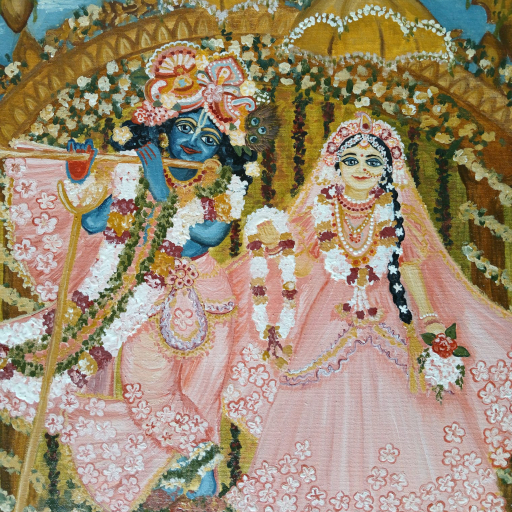
The purport is that svayam bhāgavān śrī-kṛṣṇa is the ultimate objective indicated by the term kevala-bhakti.
The word bhakti is also used for Nārāyaṇa and other expansions of Kṛṣṇa, but it is only Kṛṣṇa who can reciprocate with the complete sentiments of bhakti, because Kṛṣṇa has those four qualities that are not manifest in the personality of Nārāyaṇa. So when we say the complete sentiments of bhakti, it means that Nārāyaṇa is reciprocating with His devotees on the platform of devotion, and it is perfect and complete in itself, but the absolute end, or not, let’s say, the absolute extent that devotion can be manifested in all its very, very subtle and especially the sweet elements, that one won’t find in Nārāyaṇa, one will only find in Kṛṣṇa. Does that make sense?
Yes. I have like an area of doubt. An area of doubt. The topic will be also discussed in this chapter, I think.
Everybody has some inherent rasa. Everyone has an inherent rasa. Does it also contain the object of this rasa? That, for example, in other words, what will happen if a devotee who is inherently Viṣṇu -bhakta will approach our line, which is based on nectar of devotion and devotion to Kṛṣṇa?
The point is, is the information that’s there is not a problem for anyone. The science of devotion is just as valid in any of the four Sampradāyas, so that doesn’t make any difference. The point is, is that if the taste is there, then that is where one will remain, if that’s just in that one. Now, if inherently the devotee of Viṣṇu will either not come to this line or our teachings would just enhance his appreciation of his devotion to Viṣṇu. So there’s no problem.
Same question.
No question. So it says, the word bhakti is also used for Marāyaṇa and other expansions of Kṛṣṇa. Does this mean that bhakti in itself is considered like an expansion of Kṛṣṇa? Bhakti is an energy. Yes. So it will naturally, but the point is, is it will be matched with, just like when Kṛṣṇa is there because He is the surūpa, I mean the full manifestation of Godhead, therefore the surūpa-śakti is the full manifestation of energy. Then when He expands, you know, so there’s less qualities being manifest, whereas you were talking about less qualities and unlimited, so, you know, then that means the internal potency, when it expands to match that, also is manifesting those few less. So that means those areas that are not less aren’t part of the reciprocation. That doesn’t make it any less perfect, you know, or any less complete. It just means that Kṛṣṇa is most perfect. Like it says, Viṣṇu is perfect. You know, Dvaraka is perfect. Mathura is more perfect. Vṛndāvana is most perfect. So it just means those sentiments aren’t being exchanged or not being exchanged in that intimacy or elements like that. Does that make sense? Because the element of intimacy is not there. Because in Viṣṇu, the element of the on reverence, that servitorship, it will limit the haise. What it does is it limits the sense of possession.
It means we belong to Viṣṇu and He’s our Lord, but it’s formal. But a friend is my friend, you know, so I can do what I want with him. You know, he’s sleeping. I can wake him up because we’re going to go do something or like that. But you don’t do that with Viṣṇu. With someone who’s a master, you don’t do that. Does that make sense?
So it just becomes more and more intimate. Parental’s even more, conjugal’s even more, so you don’t see. So then one could say, but then, OK, but then Kṛṣṇa and Dvāraka, you have all those five rasas. But the conjugal there being the svākya, then it will also have some limitation like that. Because there’s the sense of ownership, but there’s a sense of rightful ownership.
So the tendency is you will deal with it. You’ll deal, there’s always time.
So if it doesn’t happen now, later. You know what I’m saying? So that sense of urgency is not there. But in parakīya, there’s urgency because you don’t know how long will be the interaction. Means you may plan it’ll be a long time, but at any time, somebody will walk in and then that’s it. You know, while a queen, if Rukmini is with Kṛṣṇa and someone walks in, what’s the problem? You understand? It may adjust the presentation, but it’s not going to. But the other one is just, it doesn’t exist. You know what I’m saying? So there’s always that greater amount of that intimacy in those things. So in that, you can manifest subtle things that you wouldn’t see otherwise. You know, just like the devotees were actually surprised. Not pleasantly surprised. Very surprised that Anharapanchami, Lakṣmī came out and so ferociously came and, you know, attacked Jagannātha’s place of stay in Vṛndāvana. You know, and harassed his pājarīs, and displayed so much anger, and then when he came back, locks them out for three days. Because she just doesn’t do that. So that’s a rare manifestation. You know, everyone appreciates, but it’s, you know, but in Vṛndāvana, that’s pretty standard.
You know, because for Lakṣmī, who’s the competition? There isn’t any. Right? But, you know, the gopīs, how many are there? Right? Does that make sense? Like that. Because in Dvaraka, there’s 16,108 queens, but Kṛṣṇa manifests with each one of them. So when he walks into the palace, they think they’re alone with Kṛṣṇa. Right? But with the gopīs, it’s not that. There’s one Kṛṣṇa, and then, you know, there’s, you know, 16,000 of them trying to get Him to come to their place. Does that make sense? So you have details, fine details.
The main points and, you know, sub-points are all there, but these finer, finer points that come up from that intimacy because of possession, that you won’t find in these other expansions. Does that make sense?
So, therefore, that’s why it says the complete sentiments. It doesn’t say the sentiments of bhakti. There’s no bhakti. No, there’s great bhakti, and there’s great… And it’ll be appreciated. We’ll even appreciate it, because devotion is devotion. It’s just that of devotion, and then the devotion in Vṛndāvana, we consider, you know, that’s where our taste is. Does that make sense? Yeah, like how many paramitas there are, or something like that. Yeah.
Yes? When you say Kailāna bhakti uses to indicate bhakti towards Kṛṣṇa, and especially Arjuna bhakti, how do you define Kailāna bhakti? Is it more general? Kailāna can be general, but here he’s made it clear that it’s kṛṣṇa-anusilinam. So in this definition, he’s talking about the pure, unalloyed devotion to Kṛṣṇa, right? But you will have, you know, in Viṣṇu bhakti, you’ll have Kailāna bhakti, but it’ll be in the context of Viṣṇu.
Does that make sense? So Kevala here means pure bhakti, right? It’s not mixed with anything. So that means there’s no karma, no jñāna, right? But for us, then it indicates pure, unalloyed, means there’s not even an interest in liberation or other aspects like that. So it’s just being brought to the level of Vibhāja bhakti, because there, then it’s 100 % only for Kṛṣṇa. In other realms, it’s transcendental, but there’s the pleasure of being involved in it, meaning that because you’re liberated, it’s your position to be happy, so it will be noticed. But in Vṛndāvana, they don’t bother noticing it, so technically they’re even more happy.
Does that make sense? So here in this definition, we’re talking about pure, unalloyed devotion to Kṛṣṇa. But he’s not saying that that doesn’t mean that there’s no devotion when you’re dealing with another form of Kṛṣṇa. It’s just that you can manifest the maximum amount of exchange, varieties of exchange, completeness of exchange with Kṛṣṇa only. Does that make sense? Yeah?
You had something? Yeah? I’m sorry, can I ask further on this? But this message, Krish, and I would say imposition, that like in this time everybody is thinking that I am worshipping Kṛṣṇa, and what if somebody… And we are. We are, yes, but what if somebody is inherently like connected to another form of the Lord? And you’re worried about that. You’re worried that it’ll be unjust that someone who is actually inherently a devotee of Viṣṇu is unnecessarily forced to worship the sweetest, most form of manifestation of the Personality of Godhead, and this will be some kind of transcendental abuse.
So we set up an office, you know, to give out forms. Do you feel that you’re being pressured into worshipping Kṛṣṇa when you’d actually rather be worshipping, you know, Kṛṣṇa-y Garbha?
At some point there will be a change of mentality.
The Vaikuṇṭha, the worshippers in Vaikuṇṭha, they… it’s not that they have a problem with Kṛṣṇa’s pastimes in Vṛndāvana and Kṛṣṇa. They just see it that Kṛṣṇa is an expansion of Viṣṇu. So they may even prefer His Vṛndāvana pastimes, so they always worship Viṣṇu in His Vṛndāvana pastimes.
Like in the Śrī Sampradāya, amongst the… means the alwāras, means their previous ācāryas, they all wrote songs.
And so these songs are a major aspect of their, you know, their study, their practice, all these different things. Does that make sense? So just as we have the songs in our vāra-ācāryas, then they have the songs of theirs. So of the three of those alwāras, three out of twelve wrote songs about Kṛṣṇa in Vṛndāvana. And one of them, Andal, exclusively only wrote about Kṛṣṇa in Vṛndāvana, didn’t write about anything else. So they don’t have a problem. The difference is, is they think, Kṛṣṇa… Viṣṇu is so wonderful that He has all these varieties of pastimes, that He also has these wonderful sweet pastimes in Vṛndāvana. Does that make sense? So they won’t have a problem.
Okay? So we can close the office.
Yes, yes.
Okay? That make sense? So therefore, because we don’t have any problem, you know, talking about Viṣṇu, so they have no problem talking about Kṛṣṇa. Just we understand Kṛṣṇa is the original. And they are, you know, feeling that Viṣṇu is the original. You have to feel Viṣṇu is the original to deal with awe and reverence. Right? Because otherwise, then that awe and reverence is based on what is the greatest. And if Kṛṣṇa is greater, then why would they be worshiping Viṣṇu? You understand? So it’s inherent that they have to think like that. You know, just like they say, every mother feels her child has descended from the heavenly planets. Please tell me on a good day.
That is there, but that’s not what’s important. The point is, is that you’re in the material world and drowning in the ocean. So it doesn’t matter who you are in the spiritual world. You’re still drowning. So it only has serious meaning when you’re out of the water and on the boat. And so when you’re on the boat, you’re liberated. And if you’re liberated, then it’s not an issue. It’s not a worry. What if this? What if that?
Yeah. That’s all. You know what I’m saying?
We’re standing across different levels, but towards, we may be at the bottom of the mountain. Okay.
So the point is, is developing this bhakti. So unless one has that, one won’t be going to Vaikuntha or Vrindavan. So we should focus on this aspect. Does that make sense? Because otherwise, all these what ifs, you know, that’s, it’s a problem. See, because one can naturally, if need be, there one can change rasa and move up. Generally, one won’t move down, but one will move up. Can. But it’s not required. Like Murari Gupta, he was quite happy worshipping Lord Caitanya and taking part in the Sankirtan pastimes, but he would see all this as connected to wrong. Like that. So when they tried to switch him to Radhan Krishna, he just couldn’t do it. He tried, but it just doesn’t work. So the point is, is don’t worry about it. It has its other side. Others will… It has, it has its other side. What is this other side? That others will profound, like the absoluteness of, that everybody should accept this and accept this as their Sarupa already. And who do you know sits around talking about Sarupa? There are some persons that are open about it. And so then one avoids them.
In other words, if they publicly talk about your Sarupa and this and that, then you can know for certain that is an assembly you absolutely don’t need to go to.
Give an example.
Married women. If they’re sitting around and there’s younger girls and all that there, will they talk about intimate relations with men?
Wouldn’t have a clue. Okay. No. Okay. So it’s just they don’t do it. Now, let’s say someone who’s, you know, older, they’re engaged. So I’m talking with others who are engaged. They may talk a little bit about, like this, or the married one, like this. But also, if there’s others there, it’s known maybe they’re engaged, but they won’t talk about it. Like if the little, you know, 12-year -old girl goes, wow, how is he like? You know, they’re not going to talk about it. You understand? It’s the teenagers who will talk about it because it’s new. It’s something they just think about. So they’ll talk about it. You understand? Because they don’t discriminate. They’ll talk anywhere and this and that. So that’s how you understand. Like you don’t see Prabhupada Bhakti Siddhanta Saraswati Thakur. You don’t see the Nitya Siddhas sitting around and talking and stuff. Why? Because it doesn’t matter. Does that make sense? It just absolutely doesn’t matter because it won’t mean anything anyway. So that’s why we’re saying, what if?
It’s not real. We’re not going, in this situation, this is there, so how do we deal with that? Because it’s totally and absolutely theoretical because we have no understanding of it and therefore these doubts can come up and it’s just mathematics.
You could do this. What if they come in and they’re actually, in the spiritual world, a bat and so they should be hanging upside down but we demand that they stand on their feet because otherwise socially it looks weird. Will they feel some problem? You know what I’m saying? So you get all these different… These what ifs are not important. They’re great for causing discussions and that, like we’ve been on this for the last 15 minutes but you understand that they’re not actually very important because, in other words, keep it to the relevance of where you’re at now and understanding the goal but this is like, unless you’re really worried that you’re really interested in the Vaikuntha-murti then it’s not relevant to you.
The point is that it’s understood that worship of Krishna will be the highest so even within the Vaikuntha realm they’ll consider it the sweetest. They don’t say it’s the highest but they say it’s the sweetest. The pastimes of majesty and all these different things they’ll say Krishna’s pastimes are the sweetest. That’s agreed. And they have no problem with it. They’ll always talk about them and sing songs so they don’t have any problem with us coming around because to them these are the Vrindavan guys. Does that make sense? So it’s not a problem.
Vaishnavas don’t have a problem.
In Tattva-viveka Bhaktivinoda Thakura makes the point that in the material world then there’s so many varieties of mentalities and perceptions but in the spiritual world there’s only one and that the Lord is the Supreme and we’re His servant and we worship Him through devotion. And so the variety of devotion that’s there everybody appreciates the other’s devotion.
Does that make sense? Narada Muni is a Vaikuntha man but he’s quite happy going to Dwaraka and Vrindavan all these things because it’s all about Krishna. Does that make sense?
If someone’s talking that you have a surupa and this and that that’s all right but if they’re talking about you have to act within it that’s where the sahaja comes in. Because unless you’re liberated there is no ifs no ands and no buts that you can function within your surupa other than surupa meaning I’m servant.
That’s the difference. Raganuga means you understand you have an idea that I want to serve in this way but you don’t meditate on you serving because you have to be there you have to do the service in the spiritual body. What are you going to meditate on? You don’t even know so therefore any meditation means you’re putting the material body in the spiritual pastimes. That’s called sahaja. You know it’s just easy.
Actual Raganuga is you are inspired thinking about what those who are in the pastimes are doing.
Does that make sense? So you remember the pastimes. It doesn’t change. So this idea is no we change our sadhana and we do things differently. No, it’s exactly the same because it’s sadhana bhakti.
So then you have vaidi and Raganuga. One is that you’re focusing more on the rules the other is the rules are natural for you and you’re focusing on the the exchanges or elements that are there in following the rules. This idea also that Raganuga means you don’t follow the rules that’s also a misnomer.
That’s also the sahaja element. So that’s the problem. The Prabhupada he constantly uses Raganuga bhakti. Spontaneous. He doesn’t have a problem with that. He has a problem with the materially conceived idea of Raganuga.
Does that make sense? That’s why there’s only one example given for Raganuga bhakti. That is the wife with the paramaha. You don’t hear of another example. So and the example is she does her duties even more nicely. What does that mean? It means she follows the rules better than a wife who doesn’t have a paramaha.
Right? Does that make sense? In other words the wife who doesn’t have a paramaha if she feels like it she does everything if she doesn’t feel like it she may drop a few things.
Right? Does that make sense? So the performance of sadhana bhakti may not be as exacting.
But the wife with the paramaha then to hide the fact that she has one she does all her duties so perfectly that no one would guess. That means a Raganuga sadhaka his vaidhi bhakti or his performance of what we call vaidhi bhakti will be better than the vaidhi sadhaka. So this idea is that oh we drop all that this is all sahaja. This is all misunderstanding.
Does that make sense?
Because if you think about what would you drop? You know making seven offerings a day at the temple or not changing his clothes or not being clean you know not being God conscious not singing songs not making nice offerings what would you drop that would enhance the rasa and therefore give Krishna more pleasure?
Does that make sense? So that’s the point. Is that they don’t know what they’re talking about. The rule doesn’t you’re not doing it because it’s the rule. That’s vaidhi. Because the rule says so they say well you know because you know the scriptures say that Raganuga bhakti is the highest so you know we should be involved in that and you know so therefore you know we have to approach you know an advanced person who knows this we have to hear from him about this we have to always absorb ourselves in those pastimes or that that’s vaidhi that’s all vaidhi every last word of that. And so what you generally hear in the name of Raganuga is vaidhi.
Because if it was Raganuga there’s a good chance you wouldn’t be hearing about it.
I see.
Yes.
Spontaneity. Does this make sense? In other words it means the principles of what Raganuga is that can be discussed openly but the practice of it one’s personal practice that’s not discussed openly.
It just doesn’t have so if you hear it being discussed openly in a broad assembly that means there’s something wrong.
You know what I’m saying? You know the wife of the paramour who would she talk about talk to with about her paramour? Basically nobody unless it’s someone else who’s very close or you know someone who has the same kind of situation or someone who’s a very dear friend they’re not going to talk about it openly.
It’s just not done. these examples are given because they match. They actually work. Because here if we’re dealing with Ra we’re not dealing with rules we’re dealing with moods. And so the mood is one doesn’t share these things.
Does that make sense?
Although the absolute truth is one it is manifest in three forms brahma-tattva paramatma-tattva and bhagavata-tattva.
Those who try to realize the absolute truth by the cultivation of jnana cannot advance beyond the concept of brahma-tattva.
The variegated aspect of transcendence which lies much deeper is not realized. One can be protected from the anarta of impersonalism only if he meets a self-realized Vaishnava guru.
So it means if you’re using only jnana you can’t get past Brahman because in the path of jnana you’re not dealing with emotions feelings relationships anything. You can see how it functions but that’s all the more it will be appreciated. So the Vaishnava guru he can show how that’s there and that’s non-different from Krishna but the aspects and the energies of that one seeing the perception of the varieties of Brahman that is coming from the person right and they’re the natural how do you say counterpart to the person they’re just the unmanifest element. Let’s say someone’s happy okay I say this devotee is happy okay so how how do we know?
He smiles so it’s a symptom so it’s a manifestation. So Brahman means it’s unmanifest doesn’t mean it doesn’t have qualities that’s why when they say it’s nirguna there’s no such thing because they’ll say it’s you know all one it’s you know all pervading all pervading is a quality eternal these are qualities but they only accept certain ones of them but there’s unlimited qualities but when they manifest that’s what they’re so here is manifest in the material phenomenon right then you have manifest in the spiritual phenomenon and then you have the original person himself so then what about Brahman can be realized by Jnana so I mean Jnana can only bring you up to Brahman yes and Bhakti is revealed by the devotee what about Paramatma? how can he be contacted? there’s the yogis because they’ll appreciate the personal aspect while the Jnana because there you’re using the the astanga yoga right because you’re using the mind because Jnana doesn’t use the mind it uses the intelligence of course they mentally speculate but they’ve already the intelligence establishes that this is what’s the value and so then the mind will choose from the various you know permutations that are there in trying to find you know an application to that knowledge to the situation but the emotions and the feelings about it right that’s not what’s important so Jnana will bring Paramatma? Jnana will bring but it’ll be limited there does that make sense? because then they’re only seeing that he’s controlling the world and doing those things but what he would rather see done and all that that takes it to Bhagavan right he means Paramatma you want to do something if you have the piety to do it you can do it even if it’s wrong you know what I’m saying? does that make sense? you have been you deal with money you’ve how do you say yeah it means like you want to do something right or wrong if you have the credits that will apply there then Paramatma will arrange it but it’s not his desire it’s your desire right so that’s why just with a spark of his energy he takes care of this it doesn’t take it doesn’t catch his interest but Bhagavan means what is his interest what he thinks is important but even you see the Lord it’s still because you just want to see the absolute truth or you want to get something from like that but if on seeing then you surrender then you take up bhakti but you know if you want to wait 60,000 years then hey we’re not going to complain those who pursue the path of yoga realize only the all-pervading Paramatma Vada thus they cannot attain the realization of Shuddha Bhagavat Tattva in this process there are few attributes in this process there are few attributes of bhakti but it is not Shuddha Bhakti generally religious principles in this world which pass for Bhagavat Dharma are all merely yoga processes which strive for realization of the Paramatma feature we cannot expect that in the end all of them will ultimately lead us to Bhagavat Dharma because the religious principles in this world then they’re dealing with the situations of the world and our situation in them we’re in that situation because of our our previous acts our karma so it’s our conditioning that places so we’re trying to take our conditioning and apply it into the elements of the world in a proper way in a religious way so even if it’s connected to the Lord it’s still the exchange is restricted by that particular dharma does this make sense? you know, say you’re being okay, you’re being honest in the situation so then you’re restricted to only exchange through that element of honesty and that means then you have to follow the rules that Krishna gives about honesty otherwise how are you dealing with the master of the rules and yourself as a servant of the rules you know what I’m saying so God defines as we were reading in Ishopanishad that the first thing is the Shastra right the the Pramana what is the evidence so the Shastra defines what God thinks is the proper way of doing things so whatever is your conditioning there’s some way that you can be involved in your interaction with the material nature that is based on its actually inherent nature according to God’s laws right means the situation has its own nature we think I’m in a situation I’ll do with the situation as I like but you can’t does that make sense you’re falling out of an airplane you can’t decide you’re going to walk over to you know the local store and pick something up for lunch you know you’re not going to you’re going to fall you’re not going to walk this way you know what I’m saying so the situation has its inherent nature due to illusion we don’t understand that or accept it so that situation is there because it the situation is defined by God’s laws we’re in that situation because of God’s laws because of our previous actions and the laws that apply to our actions therefore we’re in that situation but we’re so foolish we think I will control this situation no we can be assistant in that situation now if we see it in connection with the Lord then we’re dealing with the superior energy and so we’ll follow the laws and it’ll be devotional or we may be pious we accept the Shastra so we follow the laws according to that situation and therefore we’ll get piety and material benefit from it or we may decide I’m going to do whatever I like in this and try to force what I want out of it but you can even only force what you want out of it if there’s a little aspect of that in that situation but it will be temporary because that’s not the situation for it you know what I’m saying just like let’s say you’re at a funeral right now everybody is kind of in one mood but let’s say you’ve just come up with this great business idea you know and your friend’s there and you know unfortunately it is his mom in the casket there and so then you start you do have the opportunity there because you’re standing next to him and he’s not talking so you could start talking about wow this great idea you know we could do this and that and you know we could you know start these cruises and people can really enjoy themselves and we really go out you know he doesn’t want to hear it so you’ve said it and so I want to say this to him you’ve said it but it gets no real benefit does that make sense so you can force the issue you know when you want something you can do it illegally but it’s not going to give anything very satisfactory and it’ll tend to create situations in the future that have less and less of this opportunity right next time you know when his father dies he’ll make sure you’re in the back you know you know or he won’t even invite you right you know so does that make sense so you still need some pious benefits to be impious yeah of course I mean someone who’s who’s sincerely successfully impious they have a lot of piety there to do that but because they’re applying their piety in an impious way it will be lost so in the future then they won’t have any of that you know so what we call is you know one class of like western ideal you know the tycoon who flies around in every city and you know does all of whatever he does and stays in the hotels and goes out to the big disco whatever he does like this and everything’s nonsense that’s only because there’s previous piety but because he’s applying it like this in his next life you know he won’t be able to get you know a motel let alone a five star you know you know what I’m saying it just won’t happen he won’t get any facility does that make sense? so that’s the thing is when we’re looking at it no but they’re not following the Vedas and they’re successful no they’re only successful because of the leftover piety from previous lifetimes of following the Vedas there’s no question of getting any piety without following God’s laws there’s no question now with unknowingly you follow a law you get benefit you know what I’m saying you don’t know that it’s Vedic but you know you like let’s say there’s you’re walking down the street and there is a priest there and he gets attacked by some hoodlums and you chase them off then means in the Vedas it mentions that if you protect a Brahmin you know that’s the the you know the best thing that a shudra could ever do right and so even if he’s killed in the process he’ll be immediately elevated to the heavenly planets he’s done nothing else other than that so the person does that he’ll be elevated he doesn’t know all that but it’s there but he has some of that piety left over that he’s able to do but he’s unconscious doesn’t know what’s going on so his his application of his pious credits are unscientific so he can’t really make the best out of what he has does that make sense so this idea is that we either criticize oh they’re all just nonsense no the nonsense is they’re not Krishna conscious it’s not nonsense that they have facility that they’re Krishna conscious they use their facility differently and we’ll look at them they have facility and we’re doing this and so if we do what they do then we’ll get facility no that doesn’t work either because if you want to go for mundane unless you have the pious credits and if you really want to know just rewind back to the day before you joined what did you have so if you were the big tycoon yeah you can go back to that if you weren’t if you were the Arta or Artarti then good luck does that make sense or if you want to convert your devotional credits into material piety you can do that also but that’s kind of stupid yes no no if you know that you should protect and you step up and do it then you’re doing it in knowledge the other one is doing it because you know they’re nice or no one should bother anybody or they have that sentiment that’s our priest you’re not going to bother if anyone’s going to beat our priest I’m going to do it not you so it’s like you’re from the next block so you know what I’m saying of course if you’re thinking for about the result that’s less but that’s not based on knowledge that’s based on the mentality that I’m going to get the benefit but even if they think I’m going to get the benefit you still get the benefit you just won’t get maybe quite as much but you still get the benefit you know what I’m saying it’s just like the person comes along and knows that they smile and say certain things and they’ll get you in a certain mood and they can get something done and it’s really obvious that they’re doing it but it still works you know what I’m saying but if they did it without just naturally it would get more you know so it’s not that it won’t work the piety always works but the point is that’s being made is piety still keeps you in the material world so since we’re in the material world we use whatever facilities of this world to serve Krishna so using the facilities of the world according to Shastra is called piety right but we’re using those facilities to please Krishna but Krishna wrote the scriptures therefore we do it according to the scriptures so therefore the devotees get confused either we’re supposed to be pious and then they get distracted by that or we don’t care for all this piety and doing all this nice stuff is not necessary you know what I’m saying you know it’s like the leader doesn’t feel that he needs to be nice to anybody because we’re just trying to do Krishna service and why can’t people understand that why do they have to get so sentimental and absorbed in all that so I’m a practical person I don’t get distracted by this all these emotions I just you know see the work get it done but that’s against Shastra that he’s engaging himself in devotional service and trying to engage others that part is correct but that he’s not considering others as individuals and their feelings and the situations that they’re in that’s impious that’s why at some point he’s not the temple president anymore because after a while the whole yatra doesn’t like him I mean of course he has his few friends but you know he can sit with his few friends and complain how they kick me out I did so many years I gave so much you know like this they don’t appreciate so it’s like that and so they also get that reaction but the point is does that make sense is that where you’re doing something right you get the result there where you’re doing something wrong you get that result this idea this mundane idea that even if so much is right if there’s one fault it’s all bad that’s not real you know what I’m saying it’s where it’s wrong that’s where you get the bad result where you’re right that’s where you get the good result does that make sense unless it’s offensive and then that can cut down on pious results but if it’s just if it’s just yeah if it’s just central weakness central attachment then they’re two separate things you know what I’m saying so that’s why the person can will be so attached to all sinful things and so very attached to devotional things because they’re two separate things you know but if he offends devotees that will start to reduce the one you know does that make sense so that’s why sometimes that’s why these stories are always thrown in very rarely but they’re thrown in just to break this idea that you know if there’s one bad thing like let’s say the person is like the example before he’s a manager and he’s always doing really good management then he makes one big mistake now some people say oh he’s not a manager he never was a manager no he was always a manager he still is just he made a mistake now correct that mistake and go on managing does that make sense but this modern idea one thing’s wrong throw everything out at what point do you run out of people you know or at what point do you run out of you know some standard like that that’s why they don’t have any philosophy yeah it’s not philosophy you know you don’t have yeah you know like that you don’t have yeah so many things like that besides when after practicing either yoga or meditation for some time one imagines that I am Brahman aham graho pasana there is the maximum possibility of falling in the trap of impersonal spiritual jnan that’s what I said from the yoga see the the situation of Paramatma doesn’t have it’s not inherent in its own it means it’s a position but when it comes to the end you either have to choose moving forward to Bhagavat or moving back to Brahman it’s not that you stay there right Brahman you either move forward to the personal or fall back into the material is that does that make sense so these all in this process realization of the eternal eternal form of Bhagavan and the variegated characteristics of transcendence is not available right so here the variegated characteristics of transcendence so all this thing is Paramatma who’s the lord of controlling the material energy through his laws that’s what they’re seeing so that this what he’s controlling here is a reflection of the original transcendental you know culture and activities that the yogi doesn’t see right so the one just sees the energies and their their potential of interaction but the interaction isn’t what’s important it’s just the masculine feminine principles if they’re on the on the impersonal if they’re maya bodies then they don’t see anything so yeah but it’s not dynamic it being dynamic those interactions and you involved right in other words Brahman means you’re just an observer of it but when you’re involved you’re interacting with it that means you’re following the laws that’s controlled by Paramatma does that make sense now if you’re following those laws how they please the lord and then that that takes on bhakti that takes on then you’re dealing with Bhagavan right so all three aspects are the same thing because the situation has its potential has its laws that govern it but there’s the person in who you’re involved in that situation and trying to get a result for so therefore you can’t separate them but at the same time they’re three separate things does that make sense so Paramatma realization in its in essence it’s based on realization that even though it’s permanent you can take it forward to Bhagavan but then it’s lost at the moment and then it’s took back to Bhagavan so it’s tempering it’ll always yeah, it’ll be temporary yeah, it’s temporary but it’s like Brahman realization it’s also temporary you either have to move forward to Bhagavan or it will move the other way the thing is neutral is neutral is a point of passing through right it’s not an actual situation so as we see is that Jiva is either under the influence of the internal potency or the external there’s not a category of Jivas who are independently just not under either there’s no discussion of it at all there’s not one exemption or not one example you understand so that because the marginal potency means it’s by position the neutral state does that make sense but the neutral state is not some place you can stay you either have to go this way or that way in other words you may be in a state but you have to do something with it so that means they’re in the state of now seeing the Lord and then being there but now they either have to surrender the Lord or think they’re the Lord or I mean they can of course go back to material life so when the soul is liberated in Brahman he’s still technically under the external energy no he’s in one sense he’s potentially under the control because he sees Brahman but Brahman realization doesn’t get rid of that I am the controller and enjoyer but you’re inactive in controlling and enjoying therefore there’s no material reaction so you’re liberated does that make sense? but desire is inherent in the living entity so as soon as you desire then you have to control something and since you don’t know the spiritual you don’t know how to control within the spiritual environment then you’ll go back to the material environment so in that moment he’s just in his marginal position but yeah he’s in the marginal position but he would again yeah that’s why that’s why that’s why you’ll see there’s a difference in how we talk about the impersonal element as a process we say it’s not of interest does that make sense? you know especially Mayavad there’s nothing to gain there at all you know but when they’re discussing spiritual situation they’re not saying that being situated in Burma is bogus they’re just saying it’s not the ultimate situation because one can be temporarily situated there so one either should move forward or one will come back and since you made all that endeavor to get to there why not keep going does that make sense?
Maya’s always got some new tricks you know so you know so it means after flying from the lawn you come down as grass so you know then you’ll be happier as a blade of grass in the sun than one who’s not so I’m sure that you’re liberated you will be in the sun and get nice water and everything probably less people will step on you you know stuff like that yes I’m just thinking perhaps of the two posts in between one is eating the fruit and the super soul is just sitting there accompanying the little soul so I was thinking that if the bird turns around to face if the soul faces the super soul so that would be paramount for realization they either have to be interactive or they turn away and start eating the fruit again yeah basically it’s like okay I’m looking at you oh hi so it has to nice day yeah that would be good in this process realization of the eternal form of Bhagavan and the variegated characteristics of transcendence is not available the form which is imagined at the time of upasana whether virat or the forearm form situated in the heart is not eternal although this process is superior to the cultivation of impersonal jnan it is not the perfect and all pleasing process so virat means you’re seeing how paramatma is controlling everything like this or you’re just seeing the person paramatma but the point is is both of them are how you say they’re not an eternal situation because paramatma even though Vishnu is eternal but he’s expanded into your heart in this manifestation because you’re in the material world you leave the material world he doesn’t have to make that manifestation and virat is also only manifest when the material creation is there and it’s always the manifestations of it are constantly changing so they won’t that’s why it’s said that paramatma and Brahman realization are faculties of the material existence because in the spiritual world no one is absorbed in Brahman or paramatma everyone is absorbed in Bhagavan there is no so it’s only a concept that is practiced here it doesn’t mean that Brahman and paramatma is material it just means it’s a function that only happens here just like creation and destruction only happen here they don’t happen in the spiritual world it’s not perfect and pleasing so pleasing means there’s a person there’s interaction there’s relationship that will cause that pleasure that happiness the sadanta is that paramatma darshan cannot be called shuddha bhakti in this regard it is stated in bhakti-sandarbha after the creation of this universe the expansion of the supreme lord who enters it as the controller of the material nature and who is situated as the maintainer of the creation is known as jarad-ishvara or paramatma his function is related more to displaying the external potency rather than the internal potency therefore this tattva is naturally inferior to supreme and internal bhagavata tattva paramatma himself is bhagavan but our understanding of him and his therefore interaction with us is on an inferior position than when he’s acting as vishnu does that make sense so even though what’s happening is he’s interacting with his potencies and so it’s all going on through his yoga maya but what is perceived is through the external energy so the emphasis is on the control or displaying the material phenomena rather than the spiritual world does that make sense for the devotee in his heart there is all spiritual world how do you define devotee one who approaches bhagavan with bhakti ok is that ok you don’t have to worry you don’t have to get upset that there’s a whole spiritual world there you know like this why do I have to carry this around why can’t someone else do ok you’re not worried about that which spiritual world am I being forced to carry around Vrindavan when actually I’d rather carry around Vaikuntha Vaikuntha is a little smaller Goloka is 51% of the whole spiritual world so Vaikuntha is a lot smaller no problem absolute truth realized exclusively through the process of bhakti is called bhagavan ok in bhakti-sandarbha the characteristics of bhagavata-tattva are described as follows the complete absolute truth endowed with all transcendental potencies is called bhagavan right so when there is not all transcendental potencies manifest then you’re not dealing with bhagavan you’re dealing with brahman or paramatma right and also is here is if you’re dealing with paramatma or with brahman then bhakti is not exclusive right there’ll be something else there’ll be the bhakti and jnan bhakti and jnan but those jnan and jnan are there because of our conditioning we’re not discussing it as a tool of using right because pure devotion will use the same tools but it will be according to it will start with the devotion to krishna so it’s still exclusively bhakti does that make sense we have to be able to discern where bhakti is pure and but endeavor means you have to use facilities right the body the mind and words have to be engaged in certain situations to perform a to manifest a particular kind of devotion right does that make sense you know the service that goes with it someone who’s performing mixed devotional service maybe using the same situations doing the same service getting the same result but it’s mixed because of the consciousness so it’s not exclusive that devotion does that make sense there’s also some other mix that due to their conditioned nature they like the jnan or they like the meditation or does that make sense like the example you were using that somebody who comes along to inspire you but they’re attached they get less result than if they’re just doing it generally yeah that would work or you have the thing where where you know you have the person who likes to meditate and then you offer them to do some service to Krishna and don’t bother them they’re meditating you know but they’re supposed to be meditating on the lord too you know and then you know as an aspect of service so they’re attached to the meditation and that peacefulness it gives or all these different things like that so it is connected so therefore it’s nice but they’re still attached to that element that’s why it’s called mixed so bhagavan means it’s exclusive does that make sense like that so for the the devotees who are worshipping bhagavan then it may be mixed but their goal is exclusively Krishna and his pleasure like devotees will all say that’s my goal but I may not be there but the yogi his goal is actually some other things bhagavan brahman there’s some other goal so bhagavan the mix or the traces are subsiding yeah they’ll be subsiding I mean the other they’ll subside to a particular point but at some point you’ll be left with these elements because they’re not dealing with the lord on a platform that would require them to not be there they’re not really trying to get rid of it no up to a point they’re trying to get rid of whatever will get in the way of getting to the point they want to get to like that like to get to brahman there’s no discussion of getting rid of the concept that I’m the controller and enjoyer right because when they say brahmananda what’s the essence of that ananda ananda brahman brahman and what does that mean eternity eternity but in why are they inspired to get brahman you’re the greatest you’re brahman you’re god so you’re the supreme controller and therefore the supreme enjoyer so they don’t get rid of that that’s why they can never actually enter the spiritual world bhagavan appears as brahman and paramatman hence he is the original tattva and the supreme absolute truth his sarup vigraha is transcendental the complete spiritual bliss resides in him his potencies are inconceivable and beyond any reasoning he cannot be fathomed by any process fabricated by the knowledge of the infinitesimal jiva it’s interesting in here he just we’ll say these things but he just mentioned those three from the tattva sutras he knows the absolute truth he’s the master of all energies and he’s the lord of rasa so then here they’re saying is that he is complete spiritual bliss resides in him so that means the complete manifestation of rasa potencies are inconceivable beyond any reasoning right and he is the original tattva and the supreme absolute truth so they mention all of that so you see there’s always a consistency in presentation so here we’ll just read through it but why it means so much is because it’s according to those the process of jnana and karma are incapable of approaching bhagavan by combining bhagavata tattva with jnana the tattva appears as the formless and the effulgent impersonal brahman and if he is seen through the yoga process he appears as paramatma invested with this material creation bhakti is supremely pure it is very painful for bhakti devi to see the supreme personality godhead in his lesson manifestations if she sees this anywhere she cannot tolerate it so now we’re adding in another element that it’s not just us whimsically whenever we decide to you know what to do and this and that then bhakti devi herself is there as a personality and may appreciate or not our lack of seeing the importance of being sincere yes basically the result is one doesn’t get realization because when see when activity or chit is combined with ladhani the results that are that’s you know that are for the lord’s pleasure that’s called bhakti when that happens then the sundini potency then creates realization so one progresses so if bhakti devi is not pleased what means in that to that degree then one wouldn’t progress so in other words the aspects that are okay that one progresses the ones that aren’t then one wouldn’t progress yeah basically that’s why it’s said this year he cannot be fathomed by any process fabricated by the knowledge of the infinitesimal jiva processes of gyan and karma incapable of approaching bhagavan so if they’re there it just means it gets in the way of ones approaching the lord and understanding the lord but one has to understand is that it’s the jiva’s choice you know this idea that there’s somebody there who’s going to get angry and come and you know yeah sot sot him down with a thunderbolt or some you know in other words there’s no revenge so this idea that there’s a vengeful person that if you do something wrong no it’s your choice you just get the reaction it’s a science you don’t get involved she doesn’t get involved you get involved she reciprocates is that okay? so you don’t have to worry bhakti baby’s sitting there yeah smite yeah smite one of these three manifestations of the absolute truth is only the manifestation of bhagavan’s personal form that is the object of bhakti did i read that right? did i read yeah out of these three manifestations of the absolute truth it is only the manifestation of bhagavan’s personal form that is the object of bhakti so the other two aren’t objects of bhakti one is going through stages of realization but you’re doing them in connection with bhagavan so in the devotees understanding the brahman platform he’s doing it through his service to bhagavan right? or he understands that krishna’s controlling everything he does that as paramatma you know or the element of virat so then that’s also paramatma does that make sense? but the progress is there because of the desire for the devotion to bhagavan does that make sense? therefore one’s called a devotee a bhakta but the person who’s not seeing it like that they’re only following that process to get up to you know the yoga realization or brahman realization then they’re called impersonalists or yogis does that make sense? that’s the difference but even within bhagavan’s personal manifestation there’s one important distinction where the internal potency displays its complete opulence aishwarya there bhagavan appears as and where the internal potency displays its supreme sweetness madhurya there bhagavan appears as sri krsna in spite of being predominant almost everywhere aishwarya loses his charm in the presence of madhurya in the material world aishwarya is more influential than madhurya but in the spiritual world it is completely the opposite although from the viewpoint of siddhanta narayana and krsna are non-different krsna is superior due to possessing more rasa so we’ve established brahman paraman within bhagavan and now within bhagavan that based on aishwarya that based on madhurya so krsna is superior because of the element of the greater aspect of rasa tattva wise is non-different that’s why the example is given of a candle one candle lights many candles there’s no difference but still there’s the original candle so that manifests more rasa because of the sweetness yes krsna manifests his form according accordingly to his potency yes because it’s through it’s through potency that there’s manifestation he manifests through his yoga maya his qualities manifest through activities no his qualities manifest through I mean you can’t say that but the area that the qualities would be manifest is based on the mood of the devotee does that make sense so still the devotees are his potency so you can say he manifests through his potency but the point is what particular manifestation depends upon the devotee what devotee and the mood of the devotee yes so in the spiritual we’re seeing here the spiritual world the mood is more important here someone deals very nicely and everything like that then and you have a great relationship but you may not consider it as important as something else that could further your material facility does that make sense it doesn’t seem to be huh well here it says no battery yes hmm that one’s full and this one has no battery oh okay that one’s serious yeah so there may be the tendency to develop one’s opulence at the expense of the taste of relationships right especially the modern culture you know professes that as a great you know how you say noble deed right but unfortunately the spiritual world is the opposite yes because bhakti is a combination of chit and bhakti so in other words if activity is being done for Krishna’s pleasure that’s bhakti right but it won’t be manifest except through the activity that’s why it’s being said that the activity is the central point because that manifests the mood the mood has to be there but if the mood’s there and there’s no activity it’s useless of course if there’s activity no mood but we’ve already established the mood is proper but it manifests to just say I have the mood and that’s good enough you know it’s like I had one god brother in Vrindavan very famous when Prabhupada was there Prabhupada in the morning would walk around the deities you know walk around the temple in the morning so this devotee would walk in front he would walk in front of Prabhupada facing Prabhupada so he’s walking backwards you know his hands folded and you know always glorifying Prabhupada so in that way he was very unique very special because I don’t know that anybody else was so blatantly in any situation glorifying Prabhupada but he was bold enough to do it so he would be walking there and they’re walking oh Prabhupada you’re the greatest you’re this and that you know I only want to serve and this and that and so on like that so then clean up this water puddle you know and Prabhupada keeps on walking you know in other words there’s a limit to just saying everything’s wonderful and that you want to serve but not manifesting the service does that make sense? so to have that manubhava but not apply it through service that’s limited in its pleasure to Krishna right so that’s why bhakti is the combination of endeavor with that the desire to you know please Krishna otherwise it would just be shantarasma?
if you’re just appreciating then it’s shanta but there is no activity yeah and I’m saying the only activity is the appreciation that’s why neutrality is limited but what is it shantarasa like the animals it’s where they yeah but it’s do something right but what are they doing increasing the environment increasing the environment that’s the point it’s not the central point they’re they’re creating they’re enhancing the environment like that so in other words they appreciate the quality of Krishna so they enhance the environment in which that quality can manifest but they’re not actually involved in that process because we say they’re just predominant in shantarasa but it’s purely shantarasa in the spiritual world are they predominant it means what’s the percentage you want to use here what I’m just saying that you know what I’m saying everybody does something called Krishna in a spiritual way one way or another I mean there’s always another kind of pressure for someone who’s part of that so since everybody’s doing that what would you call someone who all they’re doing is only that in other words since there’s activity but the activity is not being done in servitorship it’s not being done in friendships it’s not being done in parental it’s not being done in conjugal what would you call that activity no it’s only a trick question because you’re trying to create a trick question you know what I’m saying in other words we’ll say this is a brick it’s made out of dirt but there’s a lot of air in here so you know what I’m saying but do we worry about the air no so the point is not the endeavor there it’s the nature of the result that they want right the endeavor has to be made to create a result for Krishna that’s what the endeavor is doing right what result do they want for Krishna they’re not trying to please him as a servant or a friend they’re just trying to create a nice atmosphere which that quality that they appreciate in Krishna they can appreciate right so in other words so that’s why when you’re dealing with the the tattva or the siddhanta of bhakti it’s counted as a rasa but when they’re dealing with actually Vrindavan it’s actually dropped as a rasa it’s not counted it’s just environment does that make sense I think you were mentioning that the jivas do not take this position these positions are manifested directly from the they could take but generally speaking they don’t I mean the four kamaras their service their service is neutral their neutrality so they appreciate and they’ll glorify and you know like that but the point is when you’re talking about unlimited then it’s not considered very much you know if I have a drop of water here and we’re standing next to the ocean and then I keep bringing it back to no but it’s a drop of water no but this is big and great and all that no but this is also ocean but it’s a very small ocean in fact if we brought along the hoos then you know it would be pretty big you know like that but you know no but this is you know what I’m saying it’s not does that make sense so in other words what’s happened in here is that we’ve taken the word that’s being used as a medium to define something else in other words we were discussing the hladini shakti and bhakti and so we’re showing that bhakti is manifest through the endeavor it wasn’t actually a discussion about endeavor does that make sense so now you’ve taken that word endeavor and now changed the presentation does that make sense so that’s why it looks confusing but it’s actually two different discussions let me say because the point is this hladini means the result and so it’s not a result of pleasing Krishna through the conjugal or the friendship or these other it’s a point of pleasing Krishna by appreciating his qualities that’s why it’s neutral because you’re appreciating the qualities but you’re not interacting specifically with those qualities you know what I’m saying your interaction is to appreciate the quality but because it’s an interaction with Krishna therefore it’s appreciated so it’s counted as bhakti so that’s why does that make sense like that so the point is it’s always on the goal what’s your situation what’s the goal those two are connected through activity that’s why activity is the central point but the activity is based on what is your identity and what is your goal yeah the four Kumaras walk around you know like that so the point does that make sense but they’re just appreciating the greatness of Vishnu or you know some aspect like that and that’s all so that is their service just appreciating that and the Lord reciprocates on that platform but it’s not dynamic right because there’s no technically service rendered meaning the senses are engaged in a way to bring about pleasure for Krishna’s senses here you with the mind which is in one sense a sense but you’re only appreciating so how is it bringing about specifically a pleasure to Krishna’s senses you know what I’m saying because if it was the mind itself just on its own was the best why would you go through all the trouble for the mind to engage the senses to get you know and adjust the whole situation so that you can get something so you can get a taste of it does that make sense like that so the mind doesn’t consider it enough to just think about something it wants the senses to engage in the activity to get the experience but thinking about it also is nice so that’s Shanta Ras is thinking about it so it’s nice but it’s not as nice as servitorship where the senses are engaged does that make sense alright so that’s why we need to develop a relationship with the senses instead of a service yes so it’s always active it’s always it’s always active so Shanta Ras is a temporary Ras no it’s a permanent Ras it would seem like you would you would develop the need to act if this no not necessarily by association one might see what more is there how more you could please and might take that up because I’m thinking feeling willing but the point is is what we were discussing before is that generally the Shanta Ras that we see is not necessarily Jiva’s you know what I’m saying there may be some there but it’s it’s not it’s not the category that’s generally seen as Jiva’s get involved like that yes some no it’s a some being the Jiva’s are some bit that’s why it’s not it’s not you know the general so they’ll get involved in the through the Ladini Shakti right so they’ll be under that in the fire of the Ladini Shakti and that way then being appreciating Krishna’s existence so this interaction will be there but one won’t one won’t generally put oneself under the existence potency because then it’s just your you know existence you know what I’m saying when two things are the same there’s not as much appreciation as when they’re different it’ll be more dynamic so then the the the the the the the the the the the eternity and the bliss then are connected it’s more dynamic connected through activity so we can assist in the activity you know we’re not Krishna and we’re not the internal potency but the activity brings the two together and we’re from that potency that generates activity so therefore that’s the natural place for us to assist so being active is more natural yes ma’am in Vrindavan those the incense like for example the the the the the the the they um they um in Vrindavan so I think the in English because they shanta that’s what we’ve been discussing shanta they enhance the environment because yoga maya she creates the environment You understand? Then the devotees do something with that environment.
So the environment means what you can perceive, what opportunities are there, where you fit into that environment, you know, the inspiration, all these different things. That’s all yoga means.
Thus it has been established that the favorable cultivation of activities meant to please Kṛṣṇa is the sole intrinsic characteristic, svarūpa-lakṣaṇa, of bhakti.
So that’s the point. He’s trying to establish this, that a favorable cultivation of activities, right, meant to please Kṛṣṇa, that’s the intrinsic characteristic of bhakti. That won’t change. Other characteristics you may manifest or not, but that one won’t change. Yes. Also we can connect, like, this process to Niyāt, from 18th chapter of Bhagavad-gītā, the object of knowledge, the process reveals the object.
Well, here is object of knowledge, but it’s not that Kṛṣṇa is the object, you know. It’s object of knowledge, because knowledge is the feminine aspect, so knowledge is actually the object. You know what I’m saying? So knowledge and Kṛṣṇa will interact, we can assist knowledge. There’s always that aspect. So we perceive things from the side of object. You know, as we were discussing, padartha, right, because we’re padartha, so we can see through padartha, like that, because we’re infinitesimal, how much we’ll see, but the internal potency is unlimited. That means that the unlimited qualities of Kṛṣṇa can be appreciated by the limited jīva if they connect themselves through the unlimited internal potency.
Does that make sense? So the actual what’s going on is Kṛṣṇa’s interacting with His internal potency, right? So, you know, He is tattva and His internal potency is the padartha. We can assist, right? So in this way we become padartha.
Does that make sense? But we’re always going to see it from this side, because that’s where we’re situated.
To remain both devoid of desires, separate from the desire to please Kṛṣṇa, anyābhilāṣita, and free from the coverings of karma, jñāna and karma, jñāna-karmā-vināvitam, is the tattva-sthalakṣaṇa, or secondary characteristic of bhakti. So the surupa is the cultivation of favorable activities, right? Not the avoiding any desire separate from pleasing Kṛṣṇa and karma and jñāna, right? Because if that was, if those were surupa -lakṣaṇas, the problem is how would we take up devotional service? We couldn’t. But that one’s favorably cultivating activities meant to please Kṛṣṇa, meant to please, whether we’re pleasing or not, that we can do. Therefore bhakti is there. But it’s impure because we may have desires that are separate from the desire to please Kṛṣṇa and there may be karma and jñāna mixed. Does that make sense? So that would be probably why also.
viṣṇu-bhaktiḥ pravakṣyāmi yayaḥ sarvaṁ avapyate.
In this half-verse from Bhakti-saṅdharva, the secondary characteristics of bhakti are reviewed. The word abhilāṣita means that that part from the desire, that apart from the desire to attain love of God.
All other types of desire should be rejected. There are two types of separate desires. The desire for sense gratification, bhakti, and the desire for liberation, mukti. In Bhakti-rasāmṛta-sindhu, 1.2.22, Śrīla Rūpa Gosvāmī writes that as long as the two witches of the desires for bhakti and mukti remain in the devotee’s heart, not even a fraction of pure happiness derived from siddha -bhakti will arise. So we’ll think, well, that means we’ll get nothing.
It means not even a fraction of what’s actually available. Remember, Taittiriya Upanishad, when it’s discussing ānanda, then it starts off just to quantify that if you have a king like Yudhiṣṭhira Mahārāja who is unrivaled rule emperorship of the world and everything’s running smoothly in his kingdom, that’s considered one unit of happiness.
So we’re not even dealing with a fraction of a unit of one happiness here. Does that make sense? And then that times a hundred is what your general Gandharvas, that times a hundred are your, excuse me, no, that’s the Pitrīs, a hundred times that are the Deva Gandharvas, a hundred times that are the Brahma Gandharvas. The Gandharvas that sing for Brahma. A hundred times that are your residents of the heavenly planets. A hundred times that are the authorities of the heavenly planets. A hundred times that is Indra. A hundred times that is Bhrigu. A hundred times that’s the Prajapatis. A hundred times that’s Brahma. And unlimitedly greater than that is the happiness of being liberated. And liberation is compared to a fraction of a portion of a drop, compared to the unlimited ocean of bhakti. So when I say here a fraction, yeah, so you’re getting some happiness from it, but what actually is there, because we’re comparing this happiness with something else I was doing. You know, we went on vacation, it was great, and we went to the temple and it was great, and kind of looking at it, and this one was a little more than that one. So it was only a little more, it should be like unlimitedly more. So what’s blocking it is these two witches, bhakti and mukti.
Yes. You want to know if therefore we have some connection from the Celts and all that, because they were into this and they accepted the witchers and all that. So you want to know if there’s some connection of the Wiccans here, and then therefore should we be going for the Stonehenge Festival and all that, because there is a connection here. They’re into witches and we’re also into not being into witches. Next week. Next week. Oh, yeah, that’s true. That’s true. Yeah. That’s at Glastonbury, right?
How can we get in here?
It’s burning.
Okay, that might work. I think there’s some Spanish blood here somewhere.
It has worked in the past, yes.
Basically, it’s just transferring the desire to serving Krishna, because when one tastes a higher taste, the lower taste is given up.
So, in other words, what’s being given up here is a direct endeavor within the material sphere. That’s bhukti. And being situated neutrally and not taking up service to Krishna, that’s mukti. So that’s why these two are discussed, because these are the two situations that the living entity tends to take up. The devotees will be distracted by that, or it’s like, I want to get out of the material world, it’s so painful, but that’s mukti.
You know what I’m saying? The point is, we want to serve Krishna, so whether we’re here or in the spiritual world doesn’t really matter.
Does that make sense? So that higher taste, by continually in the association of the devotees, those who have more taste than us, that’s why you associate with those more advanced, is that then we take on their mood or quality that removes these two. If someone’s willing to go through so much trouble for Krishna, then that breaks down our desire for mukti, or that they see that the devotional activity is so much nicer than other activities, that it breaks down the bhukti. So by association, by practice, and then by chanting, all these things wear it down. In other words, it comes to the point, we have to make that decision to be involved in that process, but it gets whittled down to the point that at one point it’s easy to step over. It’s like the ocean becomes reduced down to the size of a cat’s hoof print, so you can just step over, but you have to step over it. It’s not, wow, hey, check it out, it’s only the size of a cat’s hoof print, that’s neat. No, you have to step over it.
Is that okay?
Another question that arises from this discussion is, as devotees, can we get to that situation of thinking that, because there was trouble in the situation, so I’ll just stay out and not get really involved, because… Yeah, that’s the mode of goodness. The mode of goodness, the tendency is not to get involved in anything that’s a problem, which is favorable as long as one is, because of the situation of goodness, one is choosing a brahminical situation for oneself. In other words, not getting involved in your business or big administration or that. It means they’re not big trouble, but they’re also not your nature to do anyway. Right?
Does that make sense? But within the brahminical field, and specifically in the brahminical field of studying, teaching, and all these activities that we’re given, to not want to get involved in that because it’s trouble, then that’s where the mode of goodness loses its usefulness, because then you don’t want trouble, so then that’s the mukti, so then that’s not pure goodness, because pure goodness means you’re not worried about the bhukti and mukti. Right? Does that make sense? Like that. So it’s useful in that you’re not in passion and ignorance, but it’s still not good enough, because pure goodness is the ideal or the proper. Is that okay? The other question was contrasting disarmament, which you didn’t put to your field of work, with the yoga ladder presented in the book. Okay, yeah. So the focus now is, as you mentioned, right, to get into the light, to get away from the material attachment, appreciating the qualities of the spiritual qualities, so the spiritual activities. So this would be like getting lower, so you would be inspired to let them go? Yeah, one would let them go. In other words, the engagement of karma wouldn’t be so important because that would be reduced down to a minimal, or even if it’s not, one gets realization earlier, and one is still absorbed in the activities, but the results of those activities and then giving them to Krishna is what’s important. It’s doing that, doing your activities for Krishna, rather than doing them and then giving the result to Krishna. So in other words, the activity won’t change, but the mentality changes from renunciation to sannyasa.
Does that make sense?
Eighteenth chapter, I think it’s verse one? Eighteenth chapter. Krishna then opens the chapter defining that renunciation means giving up the results of your endeavor, and sannyasa means not doing an activity that will give you results. So the Mayavadis mean, I don’t do any activity at all, because what he means there is that you’re not doing an activity that will get you a result. You’re doing an activity that will only get Krishna a result. So that’s how then the devotee works even harder for Krishna than he would for himself. So Prabhupada is saying at least we should work equally. We should be working at least as hard as the karmis.
Ideally better, but at least as hard as the karmis. They have that conviction to please themselves, so we have that conviction to please Krishna. So that’s why then we’d be more expert at it. But the problem is, is we go to the karmis for becoming experts. And what is the main thing that, what are the main tools that they give for self-help?
Yeah, your goals, your mood, your identity. So they’re all material. So they’re not actually getting the essence of the workings of prosperity.
They’re having that, what’s getting in your way is you don’t have the right attitude to be prosperous. And you’re not contemplating your, your prosperity doesn’t mean enough to you, therefore you haven’t fixed a specific goal. You haven’t prioritized. You let it all just attack you at once. And so then, of course there’s the enjoyment of thinking about all these things, but if you actually want them, then you have to prioritize. But it’s still yourself, your mood, yourself, your results. So it’s not actually a very viable method. You know what I’m saying? Because sannyas, renunciation means, okay, you’re doing it, it’s yours, but that’s not pure bhakti. But sannyas means it’s Krishna’s. You’re just working for Krishna. So then, then it becomes, that would be your proper situation. Does that make sense?
Both bodily and mental enjoyments are considered bhakti. To make an extraneous effort to remain free of disease, to desire palatable foodstuffs, fame and power, wealth, followers, wife, sons and daughters, fame and victory are all considered bhakti. To desire to take one’s next birth in a Brahmin family or in a royal family, to attain residence on the heavenly planets or in Brahmaloka, or to attain any other type of happiness in one’s next life is also considered bhakti. Practice of the eightfold yoga system and to desire the eight or eighteen varieties of mystic perfections is also categorized as bhakti. To attain shrudha-bhakti, one has to remain completely aloof from the desire for bhakti. So in other words, anything outside of just wanting to please Krishna, is, you know, basically useless. Yes? What if one has not explicitly desired it, but still thinks there’s some value in it? Then you’re dealing with the, you’re dealing with, it’s still bhakti, it’s still a problem, but it’ll be in a more pure state. So it will give a higher situation. Does that make sense? So, it means the principle of it, so it’s still, it means it’s not strongly manifest as the secondary aspect of weakness of heart. Right? The primary being control and enjoy. Secondary meaning that there’s a specific area of controlling and enjoying that you are attached to. And that will naturally give rise to, what do you call it? Asat-Krishna, right? It means the taste for material enjoyment.
So, there’s one thing is that you have an attachment to, like endeavoring in a certain way because you’ll be happy, but it doesn’t mean that you have ever become happy, you just have the idea you will be. Asat-Krishna means you actually have a taste for that specific one, so you are able to accomplish it. You know what I’m saying? So, you move back from that, and it’s not specifically that you have a dynamic idea to endeavor for happiness in that way, but it still is seen as a nice way. So, in other words, the second level of that attachment is getting less, but it’s still there. You know, so it should be worked on. Generally, if it’s to that, then you would just intellectually deal with it through the philosophy. If it’s actually that there’s a need for it, then one would take it and connect it to Krishna so it gets purified. And by that purification, it reduces the attachment, the need to be involved, which will bring it then to that intellectual point that you have to get rid of it at some point.
Merely going to reside in the forest or accepting the dress of a sannyāsī will not free one from the desire for bhakti. If bhakti resides in the devotee’s heart, then even while living amidst the objects of the senses, he will be able to remain detached from them and will be capable of abandoning the desire for bhakti. When a jīva develops a taste for Kṛṣṇa -bhājana, his attachment for the sense objects starts fading. So this is just the answer to Mataji’s question. As you associate with the process and the devotees, then getting a taste for the devotional, you lose the taste for it. Because bhakti means you have a taste for the material. So when you get a taste for the spiritual, naturally then the material taste goes to reduce it. Yes?
Question inaudible No, but it means one is there and then the other. But the point is, while they’re absorbed in material facilities, then that bhakti is not manifest. Right? When they’re absorbed in bhakti, then there’s no bhukti manifest.
Question inaudible Yes, but then at that point, the bhakti is not the prominent element.
Is it?
Question inaudible But it’s by association.
By association you take it up.
You know what I’m saying? In other words, the others are there and they’re happy, so you want to become like that.
Question inaudible Yes, but not even a fraction of pure. So it’s smaller than a fraction.
Question inaudible Bhava is a fraction, yes. Question inaudible No, they’re talking here. It means otherwise they’re discussing for us. So we’re functioning a little bit below the platform of bhava. Right? Does that make sense? So bhava is that drop.
Prema is the unlimited ocean.
Question inaudible But you’re not seeing the chronology.
Dilvamangal Thakur is, you know, avidly engaged in his pursuits. But when it’s pointed out to him that if he made the same endeavor, you know, to realize God, he’d be very advanced. So being intelligent, then he took up the process. Right? So now he’s reduced less of that.
Question inaudible One could say yes, but… He didn’t follow, he just looked at it. It’s not even… That’s not even the point that matters. Whether one looks at an illusion or one’s interacting with an illusion, what’s the big deal? You know what I’m saying? We give illusion too much credit because for us illusion’s reality.
So that’s why when we have to know the person fell down, well, how much? So we know how bad. It doesn’t matter whether it’s a little or a lot. It’s the same illusion. But because we value that illusion, though we’re dealing with it in the opposite, in repulsion instead of in, you know, that attraction, so therefore we take it very seriously.
But, you know, in the, you know, Bhagavatam and like this, it’ll say, you know, he saw the girl and he became attracted and then he fell down. Right? It doesn’t say anything more. Right? But you go into some of these other literatures, Mahabharata, it’ll give you so much more detail.
You know what I’m saying? Because the audience is different. So the point is, is it doesn’t matter. So we’re not trying to protect him by saying, well, he only looked, you know. It means whether he looked or he went, it doesn’t matter. But the point is, is that before he was committed to associating with a prostitute.
You know what I’m saying? You know, we’re talking here, it’s a lifestyle.
We’re not talking about going out and they light a cigarette and say when the cigarette’s out, your time’s up. We’re talking about people where they live a lifestyle together. The cultural aspect of the masculine and femininity and all this interaction. So he’s committed to that as a lifestyle.
Does that make sense? So, therefore, if he looks at someone’s wife, one wouldn’t compare the two. It’s in the same category, but it’s not in the same intensity. Just say, oh, well, he fell down again.
It’s slightly different.
You understand? But the point is, is, it also establishes the point, is that when one comes to being fully absorbed in devotional service, that doesn’t come up again because do you hear of another time of Dilba Mangal getting distracted?
Is there another one?
Huh? You haven’t heard. But you’re leaving the door open that there’s a possibility.
Maybe.
So you’re taking it that this is a theorem, that it is, we haven’t come up with an evidence that it has happened, but the possibility’s there.
You know, there’s a lot of people in the Bhagavatam that wouldn’t make it in our society.
Okay? You understand? In other words, after that incident, and then he becomes more advanced and more committed, then you don’t hear of anything happening again. Ajamil. Now, he was, if you think Dilba Mangal was bad, then you have Ajamil.
Right? Now once he takes up very seriously again the devotional process, do we hear of another problem? No.
You haven’t heard.
I see.
So, then, and Bharat Maharaj, after he’s a deer, do we hear of any more problems in the Bhagavatam?
Yes? No? No. Okay. Solid, conclusive. So, therefore, it still proves what we’re talking about here. As the process goes, the more one is committed to it, the more taste one gets, and then that taste, it removes the material. It’s just like this. Let us say, we have something we do, and it gives us some pleasure. Now, if there’s something else we do, and it’s just a fraction more pleasure, which are we going to choose? The next one. Right? The one that gives that little bit more pleasure. So, it doesn’t take a lot. So, we’re talking in, you know, like, you know, probably, whatever’s beyond nanometers, right, you know, smaller than that, of, you know, happiness. And so, you know, we’re getting a few more in the devotional, but it’s real, it’s spiritual. It’s more than the material, so we’re taking it.
Does that make sense? Yeah. So, it’s not contradictory.
Okay? Okay. In the case of Bhairav Maharaj, he was free from this desire of bhukti because he became Baba, and also he didn’t have…
Nobody can hear. Sorry. In the case of Bhairav Maharaj, he was free from the desires of bhukti and mukti because he became Baba, and also he didn’t have a bad association. So, what was the nature of his attachment to this deer?
Didn’t we already discuss that? No, we didn’t. I thought we did. Maybe it was a few years ago.
See, now he’s going to be seeing… When he sees the deer, what does he see if we’re taking him on the transcendental platform? Okay. And the spirit soul is in what form? Or what conditioning?
Okay. Okay. And what kind of deer?
Yes, helpless baby deer. Now, a soul that is conditioned as a helpless baby deer, what’s it looking for? Shelter. Okay, so then naturally as a compassionate devotee because he sees the deer as a devotee of Krishna, but they don’t know they’re a devotee of Krishna. They just see themselves as this deer. So then he takes care. You know what I’m saying? He’s not going, oh, it’s so cute and fuzzy and, you know, can I have it by me? It’s not like that.
Does that make sense? So he’s still, when he’s going out looking for the deer, he knows that there’s a storm and the deer’s not that big, so he’ll get scared, so he’s trying to go and find him. So he’s still working on the transcendental platform, but at the time of his death, he’s thinking about that deer, even though he’s thinking about it transcendentally, but he’s still thinking about the deer. It’s not connected there so directly to Krishna. So therefore… That’s why he was born. Yeah, so he’s born as a deer, but because he’s on the transcendental platform, he still maintains his consciousness.
Because otherwise, if he was just attached to the deer, he’d be born as a deer with a deer consciousness.
Does that make sense? Yeah. And this idea that saving others, saving others is more important than self-realization, by this example, in this case it’s both.
The point is that you can’t help others if you’re not helping yourself. If you’re drowning in the ocean, how many people can you save?
Nearly one. Hmm? Nearly one. I said you’re drowning. No one. Right.
So this whole idea is that you’ll just perform your service in a jeopardy and then in this way it’ll go away, and like that. Or we deal with the brahmacharis, brahmacharis like cannon fodder, so okay, yeah, we lose a few, but we did this big festival.
That’s not the system.
But the point being made here with Bharat Maharaj is that the exclusivity of thinking, of being absorbed in Krishna, that has to be what it is. There can’t be these side distractions. It doesn’t mean that he just mentioned someone who’s situated like this can move in the world, right, and not be distracted. So they’re pointing out even on that level, if you’re distracted, you’ll still get it. It’ll still create the problem.
Right. Until you get to Prema, then there’ll be no problem.
Yes.
Yeah, that’s true. That’s true. Yeah, because he was alone. There was no one else there. Like we see as a deer, then he’d always go and stay around the ashrams. But there he wasn’t. You don’t hear at least much about it. So if there’s other association, then there’ll be.
Is that okay? Okay. Sorry. Thank you.