
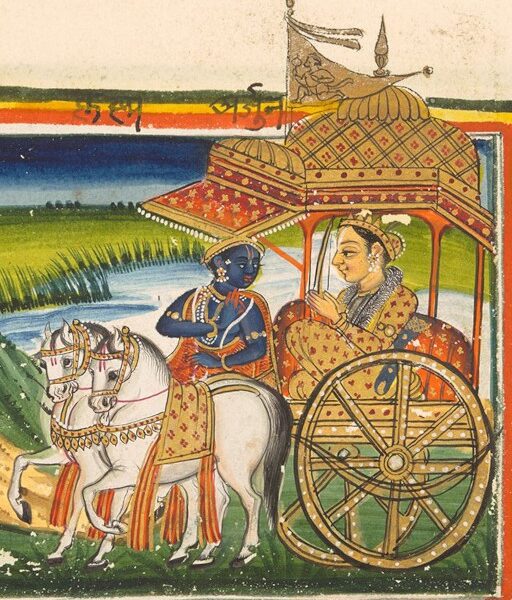
You understand? So it’s another… You don’t like to follow, but because you know you’re supposed to, you’re making the endeavor to. Then that will be progressive. Or he would like to, but he doesn’t have the strength. But if he doesn’t like to and it is determination he doesn’t, then that’s going to be a problem. Right?
So it’s very important to make those distinctions, right? Because Krishna does.
Krishna makes those distinctions. Yes. But I guess, when you find it’s mixed… Mixed. …tendency to be disobedient, tendency to try to follow and mix. What’ll be the difference? It’s mixed. It’ll be mixed, yes. But the point is, in other words, when the disobedience is the prominent, then it won’t work at all. But when it’s weakness, then it’ll work. But slowly. And if one is, you know, focused and determined, then it’ll work quickly.
So, see…
We’re going through… This is third chapter, so it’s going to be… It’s talking about karma. So that means karma is based on rules. Right? There’s rules to do. Because by karma you purify yourself, you’re elevated. So action will elevate you if it’s pious to the heavenly planets. If it’s spiritual, it’ll elevate you to Burma. And if it’s devotional, it will elevate you to relationship with the Lord. So the action… But the action has a form. Does that make sense? Jnan doesn’t have form. It’s an understanding. But karma has form. So form means that you’re dealing with different elements that will be interactive to create a result. So because you’re getting a specific result, there must be a specific activity. Therefore, there must be specific ingredients.
Right? Like that. So, you know, you take some cabbage, you put it in the pot, you cook it, you get a cabbage subji, right? But if you take the cabbage and throw it on a canvas or something, you won’t get any subji. You might get a Picasso, but you won’t get a subji. Does that make sense? So, the rules are therefore important. So someone who disobeys these rules, or disregards in this case, because generally speaking, someone’s already following their own made-up rules. So here, now, one’s coming in contact with the Lord’s rules, so one disregards.
You know what I’m saying? So, now, in dealing with karma, it’ll be pointed out how its rules are there, and therefore, they would be followed. So, jnan, there’s an understanding that has to be there, and because of that understanding, that will have some effect on your endeavor. Right? Does that make sense? Then there’s the devotional, you know, which is an understanding which uses the knowledge that is given, known as jnan, and the activities known as karma. Right? Because the devotion has to be expressed. Right? So, it’s action, but it’s also transcendental.
Right? So, karma has action. Jnan has transcendence. But bhakti is both. It’s action in the platform of transcendence. So one is, there’s karma, there’s action, but no transcendence. It’s mundane. Right? Transcendence then means one is spiritually situated, but no activity. But devotional means you’re situated spiritually and active.
Does that make sense? So you have to combine them. But, to discuss them, we discuss them one at a time. Does that make sense? So here, karma is being discussed.
And so then, it can be practiced basically as the prominence.
You know, it’ll be like karma yoga, that would be the prominence. So, but to understand it, it’s also discussed on its own. Does that make sense? Like, you’re cooking, so you discuss what pots to use, or how the pots have to be cleaned.
You know, how it sits on the fire, how much ghee to put, what kind of chants you’ll put, based on this. So, chants is how do they work. You can use dry spices, you can use powdered spices, whole spices, wet spices. You know, all these different things are ways, and what you’d put where, how much one would cook, what kind of effect you’d get. Right? Then there’s, you know, then frying things. Then boiling things. Right? Then the sauces. So, you learn those one at a time. But, when you’re making the preparation, it’s not that the preparation is only a chant. Right? You know? It’s all these things together, complete. So, therefore, in Gita you have karma yoga. Then you have jnana yoga. Then you combine the two. Then you have jnana yoga. Then that’s combined. Right? Then you add in that, then bhakti.
So, when you take karma, jnana, and bhakti, combine that together, that’s actually the devotional process. Right? So, in practice, that’ll be called buddhi-yoga.
But the center is because how are we knowing all this? It’s through intelligence. We’re analyzing it through intelligence. Right? You know, each one at a time, putting them together, looking at it from different angles. So, always these elements, you don’t have any one being the only exclusive platform.
Right? It means, to perform karma, there must be knowledge. Otherwise, because karma is done with the field, with the elements, there’s a goal. So, unless you know all those things, how will there be action? Right? So, that means some knowledge is there, but it’s not the prominence, so it’s called karma. We say that the jnani has no activities, but we know he does something. He gets out of bed in the morning, he brushes his teeth, right? He’s breathing, right? He’s eating, these things. But, comparatively speaking to karma, it’s very minimal.
Right? And the prominence is his contemplation on, you know, the soul, the material nature, the supreme, that combination. So, that would be the prominence of focus. Action is there. You know, but that’s not where the focus of consciousness is. Right? So, though knowledge is there in karma, the focus is on the karma. And though action is there in jnana, the focus is on the jnana. Right? And knowledge and jnana are there in, I mean, knowledge and activity are there in yoga. Right? But the focus is on, you know, meditation.
Right? And bhakti, the focus is on the Lord. But one will use knowledge, one will have all these different things. They’ll all be there.
Does that make sense? Jaya.
Yes. It’s a question of focus. Just where is the main element.
You know? So, all of them are there. But the tendency is that, that when we’re performing these, means you have to use all of them, but at any one particular circumstance, one may be more prominent than the other. Like when you’re deciding action, you’re using knowledge.
Right? Does that make sense? But when you’re performing knowledge, then the activity will be the prominent. But at the same time is, if that activity is well practiced, then meditation may be the prominence. Right? Does that make sense? So, if the personal element is there, meditation will be more prominent. Right? If the knowledge is there, it’ll be that. If the action and the result is there. You know what I’m saying? So, or even if it’s very practiced, but your interest is in the result, or in the activity, then the emphasis will be there. So, there’s all these different aspects are there. So, the subtle body is technically one element with three different aspects. It’s not that the mind is completely separate from the intelligence, completely separate from the ego. No, it’s what one values, what one accepts and rejects, that becomes one’s ego. Right? To evaluate that, you have to use intelligence.
Right? But the decision making of all this is made by the mind. What your ego, false ego is, is decided by the mind. What you do with what the intelligence is able to identify, that’s the mind. So, the mind is the bigger picture. And the intelligence and the false ego, those are aspects of the mind.
Yeah?
Confirmed.
Yes.
Due to a vacant heart. Due to a vacant heart.
So, you want to know if it’s up for rent or sale or… I wouldn’t buy it.
So, just a question about what vacant means. Because vacant means is that here is not being Krishna conscious, so that means the heart is vacant. Right? But, it’s not… It’s out of envy. So, when there’s envy… See, if you envy the Supreme Lord, you’re going to be envying yourself, you’re going to be envying everybody else. So, only because one has the idea that he’ll be happy through certain material activities. But the point is, he’s still envious of himself, because he’s the soul. So, spiritual activities is the platform.
And others will be involved in that process, but the other being involved will be only for getting his work done. Right? But now, unless you’re convincing, how do you get your work done? So, you have to be able to sincerely present that you care about the other person when you don’t. If you don’t care about yourself or God, why you’ll care about anybody else? So, basically speaking, then you could say is vacant. But if you add Krishna consciousness, then you add the personal aspect, something’s there, then you start adding these others. Or we see as a person is very absorbed in karma, if envy is not so prominent, then he has relationships with people, though temporary and dissatisfying, but at least something’s there to work with, and the concept of personal and relationship and acting within that will be appreciated by them. But they’ll always get distracted, and the result can be for Krishna, because anyway they’re working for someone else. You have good relationships with people, you’ll work for their benefit. So, you will be able to work for Krishna’s benefit. So, that’s why they’re on the platform of karma, they can apply that platform to Krishna. Difficulty is that it’s not necessarily pure, because in performing the activity for the pleasure of someone else, they’re having their own agenda in doing that. But they do want to make the other person happy. But making the other person happy is their identity. I’m the person that makes others happy.
So, I make God happy. So, at least that’s real, but it’s still mixed. So, it’s not what we define as pure devotion. Because it’s conscious of Krishna, it’s favorable to Krishna, but it’s not free from karma and yaga. Does that make sense? But then you have the main principle, the personal is prominent. So, for them, the Brahman and Paramahamsa platforms won’t be so important. Bhagavan will be.
But for the person who’s more distracted by karma, jnana or yoga, then Brahman and Paramahamsa will be more prominent and not Bhagavan. So, even though the platform is more, you could say, technically elevated in the way of that they’re less connected with material endeavor, they’re more detached from material endeavor in detail, but because the personal aspect has been reduced, their position for actually appreciating devotional service in its true context will be weaker than the person in karma.
But the knowledge will be solid, they may even be very regulated, very exact in their sadhana, and they’ll be very exemplary in that way. So, spiritually they’re very exemplary, but devotionally, not necessarily.
They’re performing their act, the jnana is being performed for Krishna, right? That’s why it says, pure devotion is free from karma and jnana, so you could do it from either platform. But the personal aspect, the relationship aspect will be weak.
But that won’t have the common mundanity to it. It’ll be spiritual, right? The other will have, its mix will be the common mundane, but it will be personal, right? Does that make sense? So, we see in the Bhagavatam many more examples of someone fully absorbed in karma that gives it all up and becomes a great devotee than those on the platform of jnana. Because the concept of Bhagavan-realization is much less. But in the Upanishads, then generally all your examples, there’s a few from karma, but mostly they’re all from jnana, right? You know, great gurus and sadhus and brahmacharis, you get much more example there. Because to be situated there, they’re better situated for Brahman-realization. But it’s weaker for Bhagavan-realization.
Does that make sense? It’s just like the example of someone knows, you know, it probably gives the example of that music school. If someone knows some violin, then when they come to apply to get into the school, they charge them more. And they have a different method to learn than someone who knows nothing, but has potential. Because you have to unlearn what they… So those, you know, sometimes you get it, it’s amusing that the devotees will come and they’ll be, you know, the discussion will come up about the four kinds of pious persons that will surrender, right? And they take pride. Well, I was a jnana, you know, I was out searching and I was this and that and all that. But you’ll generally notice that they’re not strong in personal relationships.
So that’s their weakness. So good on the other side, and they’re generally straight, good knowledge, everything like that, but as far as the personal dealings, they’re quite weak. Doesn’t mean that they can’t follow all the etiquettes. So everything will be proper, there’ll be no complaints.
But that relax, being able to associate, that’s weak. So it’s not necessarily in the devotional conception, the strongest position. Because they’re taking the jnani, actually they’re redefining jnani, I mean, excuse me, jijnasu is jnani. They just think, I was interested in knowledge, that makes me a jnani. No, jnani means I’m interested in knowing Krishna as a person. If I want knowledge and I’m looking for knowledge, I’m looking for answers, that’s a jijnasu.
Does that make sense? So generally speaking, someone who has no idea of spiritual life or Krishna consciousness, there’s a good chance that they’re going to be artha -artharti-jijnasu.
Someone who is from families of devotees or pious persons like this, because they’re exposed to the Krishna consciousness process, they’ll want to know who Krishna is as a person, generally speaking.
So the idea here is that envy, though it may have the element of being spiritually strong, ultimately their endeavor for perfection doesn’t work out. So mayavadis, they have great sadhana, sometimes do amazing things, in the way of sadhana and practices, but their actual attaining perfection doesn’t happen. As we get through all these different purports of Prabhupada’s saying, they will never be liberated from the bondage of fruitive action.
It just doesn’t happen. It’s just that they’re involved on a minor level, but they’ll never get free, like that. So it doesn’t happen, they don’t actually attain perfection, because they’re envious. If you’re envious of the person who gives liberation, how you’ll get it?
So it would be like going to the office, let’s say you need to have a paper signed, right? So you go to the particular office, you meet the officer, like that, or even you don’t even meet the officer, you just go to the office, you want your paper signed, and they say, well, you have to speak to this person, but you don’t speak to, why do I have to speak to the person? I just need a signature. What has that got to do with the person?
So I ignore the person, and then I’m very confident that I’m going to get the approval.
It’s not going to work.
So they’re dealing with the spiritual platform, but not understanding it’s God as a person is the source of that spiritual platform. Because what we know is only what is Kṛṣṇa’s potency.
We can only know Kṛṣṇa as He reveals Himself, because we’re not God. Or let’s say, we’re not puruṣa. We’re prakṛti. So we can know spiritual, and we can know material, but Kṛṣṇa’s beyond the two of them, because He’s the source of them.
He’s the source. It says, I’m the source of the spiritual and material worlds. So that means He’s beyond that. So that means He’s spiritual, but He’s actually beyond spiritual. He’s the source of spiritual.
So therefore, we’ll relate to the others very easily. So Brahman is His effulgence. So Jīva can relate to that quite easily.
Material phenomena, he can relate to quite easily.
He can even have the spiritual activities to be related to. But Him, that’s going to be only by His grace. So only through the internal potency can you know Kṛṣṇa.
So He’ll reveal Himself, but He does it through His energy, because we can only relate to energy. Our connection is energy.
Electricity is connected to the generator, but the electricity won’t know the generator.
But it doesn’t have to. In its activity, it’s just simply connected.
So that’s why, in devotional service, that unlimited knowledge about God is not important. How much knowledge is necessary to understand our connection and relationship with the Lord? That’s all that’s necessary.
Though it’s quite great.
So you take a drop out of unlimited. It’s quite big.
Sorry?
No, no. Because the service is study. I mean, service is energy. Knowledge is energy. What I’m saying is that it’s the devotion that makes the main element. So what we’re bringing out here is why this is coming up, because those who out of envy disregard these teachings, like that, their endeavors for perfection are ruined. So here is that it’s generic. It can mean either from karma or jnana. Like someone’s so proud of their material position and their abilities that they disregard.
Like that. But also then here the question went into the jnanas.
So it’s a matter of however you’re approaching the teachings, either through karma or jnana, it doesn’t matter. But one has to practice them. It says regularly.
You know? Like that. That’s who do not follow them regularly. So you just follow when you feel like that won’t work so good. Like that. It has to be regulated as recommended. And then you make your endeavor to do the best that you can at that.
Envy is the same as jealousy.
Close, but not exactly.
Jealousy means you see somebody with something you like. Let’s say they get a new sari. You know? And you think that’s a nice sari. Either that style or color. Something about it. So you decide, I’m going to get one. Right? But if you hadn’t seen it, you wouldn’t care about it. Only because they have it, you feel you should have. Right? So you go out and buy yourself one. Right? That’s jealousy. Right? Anybody else has something nice, you want it. And you make the endeavor, you go out and get it. That’s jealousy. Envy is, they have the sari, you see they have it. Then your point is, they should not have it. Only you should have it. That’s envy. So jealousy is basically a mode of passion.
Envy is a mode of ignorance. Because envy is destructive.
Is it due to bad relationships?
That can be conditioning.
But it’s not the actual reason. It means you can’t complain that your life is complicated and you can’t surrender and do this because when your mother was pregnant she ate too many pretzels. You can’t do that. There may be effect that how your family dealt with you, how people dealt with you, your experience with authorities and intimacy and other relationships or position and money and whatever it may be is the reason you can’t surrender. No, it’s not. The soul, it’s natural to surrender. That’s its position. So it’s just attachment to that conditioning that keeps us from surrendering. But it’s not the conditioning.
It’s in our hand at any moment to surrender. But by practice we generally don’t. So that’s why we take up the practice of sadhana where we practice in specific areas on a regulated basis surrendering. And then as we become purified it becomes easier and easier to surrender more and more and to broaden that.
But it’s not actually because of that. Oh, because they had problems with their father therefore they have authority issues so therefore surrendering to temple authorities or the spiritual master, Krishna’s instructions are difficult. Yes, on the conditioned platform it will be. But the point is in reality, the ultimate reality, no.
It will be considered.
So therefore it will have to be a point to be looked at or more attention given to. But it’s not actually can stop devotional service. Just like darkness can’t stop the sun from rising. There’s so much darkness the sun just can’t rise. You can’t light the candle because the darkness is just overflowing. As soon as you light it, it just flows over and puts it out. No. Is that a sense? One may have to be a bit determined.
Is that okay? Oh, yes. So if we know the energy in connection to the owner of energy does it mean that we already know the owner of energy? Does it mean or does not? Does it mean? Does it mean we already know? It means you know something. But it doesn’t… How much can you know? Right? How much can you know? It means the electricity, how much can it know about the generator?
Do you understand? In the generator, where is the electricity flowing?
Right? Just at one point.
Do you understand? But it’s not flowing, you know, in the… all the wiring and the magnets and the case, you know, all the different screws. It’s not there. It’s just at one point it touches.
Do you understand? So we’re… It means we’re touching the internal potency. The internal potency is fully absorbing.
So we can know that connection.
But if you’re 110,000 at the tip of the hair, it’s pretty big. You know, I mean, it’s plenty.
You know what I’m saying? In other words, it’s complete. Just because we don’t know everything about Krishna doesn’t mean that there’ll be some incompleteness, we’ll feel some incompleteness. It’s impossible.
You know what I’m saying? You have a cup, you can’t stick the ocean into your cup. All you need is the cup to be full. Right? The rest of the ocean is there, and you have someone in your cup, and you’re happy.
Is that what I’m saying? Oh, the example is being brought out simply to point out that jnana has its purpose, but it’s not an ultimate position.
Right? Just like karma, you’re making an endeavor, getting a result, but it’s not an ultimate position because you haven’t a result. Now what do you do with it? So when the knowledge is connected to Krishna, the result is connected to Krishna, then it becomes perfect.
Is that what I’m saying? So when that’s there, then it becomes perfect. So that’s what we have to do. So here is, disregard these teachings. So we’re not connecting our position to Krishna. That’s the weakness. That’s the only weakness. So if it’s connected, then it’s perfect. If it’s connected, it’s perfect. So that’s why their endeavors for perfection won’t happen because they’re envious of Krishna’s teachings. So that means, ultimately, they’ll be envious of Krishna. So, in other words, Krishna is not separating himself and his teachings very much.
You know, just like you don’t separate your breathing from yourself very much.
So if we know the tattva, so that means we already know Krishna. Can we say like that? Yeah. It means you know Krishna. It means, when we say you know Krishna, it means how much you can know.
Is that what you’re saying?
Yeah. I ask, would it be more like you can know everything about Krishna, although in a limited way, but it’s pretty much going down to how much have you realized about Krishna? Yes. Yeah. See, the thing is, if you appreciate the person, then you can say you know everything about them. At the same time, little technical details, you don’t know. In other words, the personal relationship, you know everything about. We’re attached to the idea that we can know everything.
Does that make sense? But how do you define everything?
Right? Like we know this book here, but do we know what size and quality of wire is in this binding and how they got the plastic on here and what kind of plastic and where did the ingredients for this plastic come and what kind of machine it was made in and how many parts are in that machine and what is it made out of? Who manufactured it? What was he eating for lunch when he manufactured it? Where did he get that loaf of bread? Who made that bread? Where were the caraway seeds in that bread from? Which farm was that from? What was the nature of that land that was there? What was the makeup of how much sand, how much clay and all those kinds of things and what kind of bacteria was there and other things that were growing nearby? You know, like that. And there was a dog over there. He was barking when the guy was doing that. Now, what kind of dog was that? You know, like that. And what was the pedigree of it? You know, so the thing was it wasn’t Germany, but was it a German dog? You know, like that. Because the owners, they’re Polish. You know, so like that. And then, you know, they’re Polish. Were they originally from Poland? But are they actually Ukrainian? You know, so that will make a difference of how they make their borscht. You know, like that. And so, you know, do they put more sour cream in their borscht or do they put less? You know, which is the thing like that. And then, with that, then what do they eat? You know, do they have pierogies or do they have blini? You know, like that. It would depend upon whether, you know, like this. And then how thin is the crepe that they make, that they put the cream, you know what I’m saying? Does that make sense? And this is from this book.
You know, so we’re not even going to get into this piece of paper. You know, who invented it and how he made the things and his sticks. He could stick it and stick it again and all that. And that came from the birds when he was walking through the forest and they stuck on his clothes and they don’t come off. And he thought, hey, this is great. And they made Velcro. And then they came up with this idea because it’s the same concept. You just do it with rubber instead of with plastic.
You understand? So you care about all that. You want to read the book. But no, I’m talking about all these other aspects about it. You know, how’s the book? Yeah, it’s a great book. But did you know that they made this out of, you know, organic paper that was from, you know, this place over here. It’s like, what do you care?
You understand? So that means, when we say God’s unlimited, well, he knows all that. He has all that. But for him, that’s not so important. What’s important is the relationship.
So if you know him in relationship, you know him completely.
It’s complete. But the point is, is that complete doesn’t mean that all the little details of knowledge are there. But what’s important is there. Like we say, you know, in Chinese philosophy, we say, Li is inside the Qi. So we cannot see the Li, but we can see the Qi. Yes. So if the Qi is here, we know that the Li is here. Yeah. Yeah. But how much is there in the Li that you, you know what I’m saying? Because the Li in the one thing is the same Li in the other thing. It’s the same Li.
You understand?
So, so, that’s the difficulty, is you get the, the, is, what is important to us is that’s what we can know.
You know what I’m saying?
Like Mother Yashoda, it’s not, it’s not important to her to know how many times the rocks skipped on the Jamuna River when, you know, Krishna and the cowherd boys threw them. If she hears about it, nice. But it’s not important. But what’s important to her is that Krishna will come back, she has these things ready to eat, she’s made some new clothes, some new ornaments. That’s important to her. And for the cowherd boys, they couldn’t, I mean, of course, lunch will be important to them, but, you know, that she just got some new pots to cook lunch, they couldn’t care less. So in other words, what’s important to the rasa, that much is, is necessary.
Right? And so, we get into technical elements because we are absorbed in material rasa, and we can’t tell the difference between material and spiritual. So in trying to convert our focus and rasa from the material to the transcendental, therefore the knowledge is important, because knowledge always takes the fun out of it. You know what I’m saying? Of course, unless you’re a nerd, but the point is, you know, so the, as soon as you start bringing knowledge into it, then it kind of loses interest.
Does that make sense? You know, so, that’s the whole point, is that the knowledge that we’re using is basically to break down our interest in the material world, and so, and that we can recognize the spiritual. Once that’s done, you know, properly, once situated, then the emphasis again is back on developing the spiritual rasa.
Does that make sense? You know, so, so, your platforms, your kinista and madhya platforms are to get you out of the material world. Platform of bhava, the focus is on developing a relationship to the degree that you can get yourself into the spiritual world.
You know what I’m saying? So if we try to take the rasa, or try to discover rasa, so, actually knowledge doesn’t help a lot. Knowledge doesn’t help a lot. Knowledge simply lets you understand the difference between them.
You know what I’m saying? But the actual experience of rasa has nothing to do with knowledge.
You know what I’m saying? It simply makes you aware. Let us say, I come out with something, you know, I bring something, you know, and so, you know, you look at, you don’t know so much about it. You know, you know, you know something of the field, but you don’t know that much. Right? So then, if I point out to you that, oh, this is that, you know, very special, rare thing from this place and it’s so hard to get, your appreciation of it goes up. Now you will pay attention in experiencing it. But before you just, you know, I give you something to, you know, eat, and you just, yeah, yeah, nice. But if I say, oh, this is from here, there, and that’s from here, oh, yeah, wow, this is great, you know. So the knowledge lets you appreciate what’s there.
Is that, does that make sense? That’s what it’s for. Because the point is, is where is knowledge?
Knowledge is in understanding the field. You know, being, you know, inspired that I can be involved in this and applying in the activity. But the result and experience of the result has nothing to do with knowledge.
Right.
So the experience related to the consciousness or the inner emotion.
Yeah. Yeah. But now it’s just a matter of the level of consciousness. So we’re experiencing things on a lower level of consciousness. We’re trying to get, become aware of higher level of consciousness.
Yeah.
You said that, no, you said that.
Knowledge allows us to appreciate, but at the same time it takes the fun out, so it’s the curiosity that’s converted into appreciation. It means it allows us to appreciate the spiritual while taking the fun out of the material.
Like that, yeah.
So…
Maharaj, sometimes in a practical way, Krishna knows everything, but a very specific event happens in our lives which only someone who knew exactly everything to the detail could have made that clear. Krishna, I mean, sitting in your heart, you know, he’s got nothing to do. And he’s, you know, fully conscious, so that means, you know, he’ll pick up a lot of things. Plus we have to remember the patterns we’re following in material life are patterns he set.
You know? So it’s just like, he already knows all the things. I remember once I was talking with, with the Balakrishna Maharaj, right? So, he’s super intelligent, excellent manager. You know, he could say, basically, him and one of the best, like that, because Prabhupada personally trained him, so… But at the same time, he would always consult.
He was so thoughtful, he’d think everything out, but he’d always consult with other, you know, who he thought were, you know, mature persons.
But I was sitting one day, I was sitting, and he had come up, he explained the situation and said, you know, so, what would you do?
And then he’d go, okay, well, you have this, so therefore that. And then he goes, oh, okay, D. You know? At the moment I didn’t catch it. You know? But later on when I was saying, because then it was, it was a very important thing, and then he was asking another person later, and I was listening. Then I understood is that D meant, he had already worked out so many scenarios you could do. You know, A, B, C, D, like this. I don’t know how many, but I had chosen D.
You know? So you say, and then it’s like, why? Why D? You know? You know, because he didn’t mention there’s A, B, and C. He just said, why D? And then you explain it, and oh, okay. You know, like that, and get someone else, and then he’ll work it out. You know, he’ll get more perspectives and everything like that. So point is, is, you know, Krishna’s worked this out to unlimited. So it’s just a matter of, okay, you know, he did this. Okay, now this and this, this, this, this is going to happen. So therefore, he’s going to like this, so we’ll just arrange over here that, you know, that’ll happen. You know? So you get up, wow!
Like that, yeah.
Mara? Hmm? Could you then please explain and elaborate a little on Krishna when he says, you know, past, present, and future. The future part is that our freedom is there, but we have, we have, we have a choice to surrender and not to surrender, but still, it’s as if Krishna is, when you get to the, when you get closer or you surrender more, then he’s already there and he’s kind of waiting and he’s, as if, yeah, he’s waiting for you there. He’s already, yeah, of course, I knew you would come here. So, and then you realize, oh, it’s stupid, I didn’t do this before.
But still, it takes our choice and surrender. It takes our wanting to come there. Maybe you could… The point is, is relationships based on the voluntary element. Right? You know, unless you’re, you know, Machiavellian, it’s your ideal, you know. But, so, therefore, without surrender, where’s the relationship?
Does that make sense? So, it’s a matter of surrender. Then he can reciprocate in that relationship. So, he wants to. It’s just a matter of we’re the one that’s reluctant, not him. Right? He’s always there. He is in everything. He is everything.
So, the point is, is when we say he, then Krishna’s there, he was always there. We just only now notice Do you know what I’m saying? But, as far as relationship goes, then he was there.
Because that’s when we started to act in that relationship.
But as far as knowledge, he was always there in everything. So, there was never, no time when he’s not there.
But the point is, as a living entity, it’s relationship that’s appreciated.
You see? The knowledge just makes things clear, because then you can act. You know what your position is. Everything becomes set. So, now, you know, you can move forward. But it’s relationship that’s dynamic. Knowledge is technically not dynamic. It can be applied in a dynamic way, but it itself is not dynamic. Action is dynamic.
Does that make sense? But knowledge is necessary. You can’t perform an action without knowledge.
Does that make sense? Yeah. But in this case, what we’re doing is distinction between the element of knowledge and the element of relationship. That’s where we started before. So, what we’re saying is that jnana has its purpose, but it has its limit. Right? Because the relationship that is based on the interaction, so it’s activity. So that’s why pastimes are the prominent. Like for us, we could say, you know, Gopinath is the prominent deity. No. Govinda is the prominent deity.
And our acarya is the acarya of Govinda, Avideha. So activity, pastime, is what’s important. Because the result is only experience.
Right? And so to continue that experience, there must be more activity. Here it’s that, unless there’s constant activity, there’ll be no experience.
So it’s not that we’re increasing, it’s just that by doing that, there always is an experience.
You stop activity, there’s no experience. In the spiritual platform, the experience doesn’t go away, it’s eternal. So you’re just increasing experience. It’s so nice. Here it was nice, you want more. Right here it was nice, it goes away, you want more, so you try to get it back. There it doesn’t go away, you just add more to it. What was that again?
Something over there?
Because it means the knowledge of the situation and all that is what’s prominent, important to them. Right? But applying that knowledge that’s where you get the experience.
I’m saying, you do have those who are very intelligent and very expert, but there’s a balance. Krishna’s like that. He’s the most knowledgeable, but the most… He is rasa.
But what we’re saying is, if you’re taking karmis and jnanis in the study of two areas, then you’ll generally see these differences. One is very personal, but doesn’t yet have much understanding. The other one has lots of understanding, but it’s not necessarily very personal.
So what we’re pointing out is that in getting out of the material phenomena, knowledge is necessary. Otherwise your work won’t be appropriate.
Right? But the difficulty is that someone on the platform of knowledge has a tendency not to work. And the person on the platform of karma, he works, but does not generally absorb himself much in knowledge. So devotional service explains that with the proper knowledge you act, that will liberate you.
Right? So that’s dynamic. Then you’ll get all perfection. But, it’s that you’re doing it to please Krishna that generates the devotion.
Right? Because getting out of the material world, that’s not actually the big deal. Right? It’s getting out of the material world and into the spiritual world. Right? Because otherwise, if you’re situated on Brahman, you’re out of the material world. Asuka Dev Goswami is running down the road. He’s not in the material world. Right? The body may be, but he, the soul, is not situated in the material sphere.
Is that, does that make sense? He’s transcendental and situated. But, unless, so the devotion is there, then, then it’s not within the spiritual, means the spiritual world.
Does that make sense?
Yes? Yes?
Does not use jnana anymore.
Who does not use?
Because it means you resolve. What do we define as karma?
How do we define karma? So, what does that mean? Fruitive means it’s about the fruit. So who’s the fruit for? In fruitive work.
Stick to the pattern. So, the fruitive work means it’s about the fruit. Right? You’ve done the work to get the fruit. Who’s the fruit for?
Okay, but for a karmi, who’s the fruit for? Krishna. Yes, okay. So a jnani, what does that mean the knowledge is for? Himself. Himself, yes. So if the fruit is for Krishna, it’s called devotional service. If the knowledge is for Krishna, it’s called devotional service. Right? If the meditation is on Krishna, it’s called devotional service. If the meditation is not on Krishna, we call it astanga yoga. The jnana is not on Krishna, it’s called jnani, you know, jnana. Right? If the activity is not on Krishna, we call it karma.
Does that make sense? It’s the same thing. If the senses are engaged not for Krishna, we call it sense gratification. If the senses are engaged in Krishna’s service, we call it devotional service.
Right? If the food’s for you, it’s called, you know, it’s called sin. If the food’s for Krishna, it’s called prasad. Do you understand? So, when we say, free from karma and jnana, means that the knowledge elements and the activity elements, the results, all that, the identity is not for us, it’s for Krishna.
Right? This is what we’re trying to get here is because we’re so used to form is the entity.
Right? Because we think we’re the body. So, all forms, then, therefore, you know, this rock is, you know, if it’s made of material elements, therefore, it is material.
Right? And spiritual means it has to be made out of spiritual elements. No, the point is, is this consciousness? Because this is one of Krishna’s energies. Does that mean Krishna’s material? No, it’s just his inferior energy. So, this is energy. Inferior energy, but energy. You look at it and look for opportunities for your benefit, it’s called material. You look at it, how to use it for Krishna, it’s called spiritual.
It’s just, it’s how you perceive it. Because material is a concept.
Right? And it happens to take place you know, within the external energy.
You know what I’m saying? That’s the place given for those who are not following God’s laws. Just like the prison. The prison is also part of the state. But that’s the part of the state given for the criminals.
Does that make sense? But it’s not that someone from, that’s not a criminal from the state can’t come into the prison.
Right? The warden and the guards, they’re law-abiding citizens. Right? Who are performing their activities. So, even though they’re within the boundary of the prison, they’re not in prison.
They’re on the, you know, the, how you say, the transcendental platform. You understand? But the prisoner, he’s in prison. And even if they take him out, and, you know, him and his friends, they take down to, you know, Highway 101, and they’re picking up garbage, they’re still in prison, even though they’re outside the prison walls. They’re still in prison. They’re still prisoners.
So, this concept we have to get used to.
Because otherwise we always say, no, this is material, no, that’s spiritual, based on the external, not on the consciousness.
You understand? So, the whole idea is, it’s consciousness that we’re trying to get to. But, we get to the consciousness through the activities, through the knowledge, through all the various qualities, because that’s where our values are. That’s where we’ll focus. Because our endeavor, our consciousness will be where our values are.
You know what I’m saying?
According to what is possible to distinguish someone else’s actions on those two platforms?
Basically, it’s a combination of knowledge and, as Prabhu pointed out, realization.
Because knowledge technically is not enough. Like, the jnanis, they have lots of knowledge, but they can’t tell. Like, when Lord Caitanya comes into the assembly of Prakrishnanda Saraswati, they can tell by symptoms that, you know, he’s situated in goodness, so he’ll be very advanced. But they can’t tell that he’s God, you know. You understand? So, it has its limits. So, realization, realization is also necessary. Knowledge is, knowledge is necessary for realization, but also activity. It’s only when you combine knowledge and activity you get realization. Otherwise, the person with activity gets experience and gets skill. And the person with knowledge gets more understanding. But neither of them get realization. Realization is only when you combine knowledge and endeavor.
So, that means the elements karma and jnana has to be combined. Then it works.
Does that make sense? So, that’s why you have the karmis and you have the armchair philosophers. Neither of them have realization.
They may have knowledge and skill, but no realization.
Mark, you were stressing the point that it has to be done for Krishna so that the action of knowledge is actually integrating us, helping us in devotion. So, this point for Krishna needs to be cultivated as a process of purification. However, then if we act and we acquire knowledge and don’t have such a pure relationship with Krishna yet, it can also carry us away in terms of improving it of our work and our knowledge like some anarchists are there on a steady platform. So, how can we guard ourselves when we do karma and jnana and we’re not able to do it before Krishna is lacking? The main emphasis is on, means you have two aspects. Always remember Krishna, never forget. So, always remember means that what elements are going to make you remember. So, His name, form, qualities, pastimes, associates, all this. Never forget means understanding technically what you’re dealing with and therefore the mechanics of what you’re dealing with. You know, and so, therefore, identifying where our attachments are in those mechanics and seeing that they don’t get in the way of our applying that endeavor on Krishna’s service.
Does that make sense? Because direct means it’s connected to Krishna, meaning you’re absorbed in Krishna. It’s directly Krishna. Indirect means where you’re dealing with the elements of our conditioning, the environment of our conditioning.
So, those aspects then we’re taking those and connecting them to Krishna. Means they’re already Krishna, but we don’t see them that way. That’s why it’s called Maya.
The money belongs to the bank, but the man doesn’t see it that way. So, what do we call him? A thief.
But his idea, it’s his money. He’s taken it, it’s his. But it’s still the bank’s money. Because as soon as he’s caught, the money goes back to the bank.
So, therefore, what we call the material phenomenon is still Krishna. But it’s called material because we don’t see it as Krishna. We see it separate from Krishna. So, what we’re trying to do is remove that. But that is there because of our conditioning.
So, the always remember Krishna is we’re always remembering the material world. So, we’re trying to switch it to that. But the reason we’re forgetting Krishna is because we’re remembering the material world. So, therefore, that activities of knowledge and contemplation are there to break down our attachment to the material. And so that we understand that what we’re looking for in the material is already there in the spiritual. It’s natural. Just like if you are so enamored by what’s going on in the mirror and want to get involved in the activities of the mirror, all you have to do is understand that you just have to turn around. It’s already going on.
You know what I’m saying? But that’s the thing. It’s this big, you know, mirror that takes up the whole wall, right? So, you’re there and you see yourself and all these other activities and you go over and try to interact with them by, you know, looking at the mirror. So, then you go and do, you know, like this. But it’s all about the mirror. But it’s not… The people that are not in that kind of mood are not very satisfied.
You know what I’m saying? So, that’s the point. So, you just have to turn. That’s the whole point, is that we’re looking at the tree. You turn and see the Lord. The tree already belongs to the Lord.
Is that okay?
Is proper consciousness quite enough for an action to be spiritual? Is proper consciousness enough for the action to be spiritual? Because I can try to do many wrong things for Krishna. I can try to do many wrong things for Krishna. But the point is, how do you define that that wrong thing is being done for Krishna? How is it for Krishna?
Because I can do… You can be in Krishna context. I will have more knowledge how to do… how Krishna wants for me to do. How Krishna wants for you. Now, you’re defining here is that just a not well-performed pious activity, or you’re talking about a sinful activity? For example, I will kiss Deity for… Kiss the Deity for Krishna.
Does Krishna want to be kissed by you?
Right? If he did, it would be one of the parts of the 64 items of devotional service. Right? And there’d be a whole page on this, you know, a slobbery kiss, or what kind of kiss would be the appropriate kiss.
Does that make sense? So the point is, we don’t make up our own process. We apply within what process is given. So kiss is not given, so therefore it doesn’t really work. It means proper consciousness, not enough… Proper consciousness, but the point is, we’re saying here, because we’re conscious of Krishna, in our mind we’re making it favorable to Krishna, but if we look at it more as we become more conscious of Krishna, then what would Krishna actually want? You know what I’m saying? In other words, we get things for someone, you know, according to what we do. But as we become more conscious of the person, then we start to see according to what they like.
Right?
Because in the direct activities, it’s very clearly stated what to do. The indirect, it’s also clearly stated, but we can apply that, you know, within karma and yama.
You know what I’m saying? Means deity worship is very clearly delineated what you should do. Family life, it also is clearly delineated, but you can properly follow, you can follow the shastra, have, you know, very pleasant family life, but it doesn’t necessarily mean it’s connected to Krishna.
You know what I’m saying? So the point is, the other, it is connected to Krishna, it’s just a matter of how much you’re connected.
You’re following the rules of deity worship, you’re connected to Krishna. Just now it’s a matter of the level of consciousness you’re dealing.
Is that what you’re saying?
I read now a book about Vamsi, that Babaji, and I don’t really understand what he did, the things that was not… What that means, you don’t understand how he didn’t do things according to the rules. That’s why, generally speaking, we don’t deal with Vamsi das Babaji.
Bhakti Siddhanta said, if it’ll make you feel any better, Bhakti Siddhanta Saraswati Thakur forbade all his disciples to go see him. Only one disciple is allowed to go and take him, you know, prasad or things he required. Because he said, just by seeing him, you’ll commit offense.
So therefore, don’t worry about it.
Right. Just by seeing him. Let alone interacting. So all these stories that we hear about him are from that one disciple.
So the point is, you know, he’s not functioning on this platform.
If you don’t understand, don’t read.
In other words, you read something… If you like reading things you don’t understand, try a medical journal, you know, that also… like that.
You know, talk to a lawyer, get one of the books on his shelf of, you know, previous cases. You know, I mean, there’s all kinds of things you can… you know, try to figure out, bend your head around derivatives. You know, there’s plenty of things to do to…
like that. But the point is, it’s here. You know, if you don’t understand, don’t read about it. Read about someone, you know, who… you’ll appreciate.
My Yudhisthira Maharaja has followed all the rules.
In the case of Yudhisthira Maharaja and the Pandavas, he quickly seems praying for more problems.
But these problems, they’re, as you were explaining, they’re… in the material world, it is here for devotees to… the problems in the material world is to teach us that what is Krishna and what is in the real world, that we should go away from Krishna. He would guide us like that. But in the case of them, the Pandavas and King Kunti, they were already seeing Krishna. They already had… Yeah, but they want to see more. Perfect relationship. Yeah, they want to see more.
Right. Hmm.
Everybody knows Seymour is a nice guy, right?
No?
Arjuna, he does not…
what I’ve heard, he does not have… does not exist in the spiritual world. Does not exist at all. Nothing.
Absolutely not. If he went there, he’d be thrown out.
Excuse me. But could you, like… I’ve heard something… So, I mean, but what’s the problem? What is the problem? Well, he’s… I mean, he’s an associate, very intimate associate with Krishna. Yeah, so the point is that… and where does he associate with Krishna? In the material world. So, Krishna’s in the material world.
He’s placed past himself. In the material world. So that means when the Shastra is very careful to point out that Krishna appears to his own internal potency, we’re supposed to understand that to be material.
No. Not exactly. See, the thing is, this is what we were talking about before. We take location as everything.
But location isn’t as important as consciousness.
You understand? The location is the bank. Right? And the one person needs the bank, and they get what they get from there, or they’re working there. And the thief, he’s also in the same location, but he sees it differently.
So it’s not location. So we take, well, material world is here. Why are you in Mayapur now? Why aren’t we, let’s say, in Timbuktu?
Why aren’t we in Mayapur?
Probably more Karmis refer to Timbuktu than to Mayapur. So, if we had a festival there, that would probably be on CNN. The Hare Krishna’s have their yearly festival in Timbuktu this year. They’ll be here. They’re on site here. So, why Timbuktu this year?
Why Mayapur?
It’s the spiritual world. No, but you’re saying it’s the material world.
Do you understand?
It’s the spiritual world. Therefore, Arjuna is interacting with Krishna in the spiritual world. But, he’s only in the pastimes of Krishna when he is within the Gokula, where he manifests his pastimes within the Mahatattva.
Does that make sense? Perfect. Okay.
It’s just that my limitation is that both the Pandavas’ day, as it’s explained, That means somebody has to hang out with them here. So, is that a problem? No.
Right? The Lord is always with His associates. So, what’s the problem if they’re the associates? Right? So, the Lord’s pastimes are always going on here. So, that means they’re always here. They’re busy. It’s just that it’s explained that Draupadi and the Pandavas, they have spiritual bodies. They came here in their bodies.
Yeah, but Krishna is here in His spiritual body. So, you confirmed it. Do you understand? There’s another step here. I don’t have a problem with that. Just like this. Okay.
How does…
Now, we say Krishna never leaves Vrndavana. Okay. But, Krishna’s in Dvaraka.
Krishna’s in Mathura. How does that work?
So, is Krishna in Dvaraka ever in Vrndavana?
Or He’s always in Dvaraka?
He’s Vasudeva Krishna. He is Vasudeva Krishna. So, He’s always in Dvaraka. He’s not in Vrndavana. Right? And Vrndavana Krishna’s not in Dvaraka. Both His spiritual realms.
Alright? Does that make sense? So, the manifestation of that particular potency of the Lord that we know as Arjuna, that’s only within the manifestations within the pastimes within the Mahabharata.
You know what I’m saying? In other aspects, it’s somewhere else. There’s that Krishna looks the same.
But otherwise, as you expand, let’s say, let us take Satyabhama.
Is Satyabhama in Vrndavana?
Is Radharani in Dvaraka? Are they the same person?
Yes. But, different moods for different pastimes. So, therefore, Satyabhama is not in Vrndavana.
It’s the same way as Arjuna is not within the the, you know, the three padabhuti. He’s only within the ekapadabhuti.
So, Dvaraka and Gokula, He’s there. But Dvaraka and Goloka, He’s not.
Does that work?
See, the difficulty always comes to our time and space. And what I mentioned before is that certain manifestations can only be material or only be spiritual. No, it’s a matter of how you see them.
Not necessarily. Like, we understand abhishmas in the, you know, it means, but that particular manifestation like that may be only manifest here. You know, just like Krishna killing demons is only manifest here. So, that mood of sankarsana, where he’s killing the demon and establishing dharma, you’ll only see that here. You won’t see that in the… Yeah, I mean, there’s no demons in Vaikuntha. So, there’s nobody, you don’t have to… It is just like Jaya and Vijaya were thinking that, you know, that they, the Lord being, you know, all perfect and having all these qualities. He’s the most powerful and, you know, be the best at fighting and all that. But it’s not done in Vaikuntha. So, they came to the material world to perform that service like that. Does that work?
Yes.
… … … … … … … … … … No, but making a garland, that anybody can do. You know, you have to then choose what things that they… Like, they can’t cook for the deity, dress the deity off in the Arctic, to the deity off in the boat, but, you know, they could cut vegetables for cooking, they could make garlands, they could groin sandalwood pegs, they could do those kind of things. Does that make sense? We make it… Oh, we have a very strict standard that only those who are, you know, Nitya Siddhas can, you know, you know, turn on the blender, stuff like that. You know, but those are our standards. They’re not pancharatric standards. But we like to do those. Those that are actually pancharatric, we avoid, and those that we’ve created ourselves, those are like… I know it’s like carved in stone. I mean, written would be… Wouldn’t be enough, you know, like, you know, chiseled in with a very large, you know, five-pound, you know, sledgehammer. You know, you can’t get rid of them. There’s something that is right there in Nectar of Devotion that’s talked about and everybody’s heard about and everybody knows it, no one practices it like that. So, you also have to see what’s there. If those things like that, why can’t they do it?
You know what I’m saying?
That’s the thing.
You know what I’m saying?
The main thing is your hands are clean.
So, if spiritual and material depends on consciousness, so does it mean, actually, like, consciousness creates spiritual world and material world? No, no, don’t go to Buddhism here. Like, from Ghana, you know… If you’re there and you’re conscious, then when the tree falls, it makes noise. But if you’re not there, it doesn’t make any noise. You know, like… No, don’t go there.
The point is, your situation is defined by your consciousness.
But those worlds are what they are whether you’re conscious of them or not. Like, Krishna’s in the heart, you’re conscious. Then you appreciate, you get the benefit. You’re not conscious, you don’t get… He’s still there. It’s not… It’s the elements that they’re made out of. In other words, the material phenomena is still made out of, you know, earth, water, fire, air, ether is still controlled by the modes of nature. Right? Now, if you’re not conscious of Krishna, the effect of that inferior energy is it binds you to material consciousness and it keeps you within the external energy. Right?
The spiritual world is made out of sac -cid-ananda. Right? Its reflection is goodness, passion and ignorance. So it’s made out of superior energy. And it has all the same things. This is a reflection of that. Right? So, it is what it is. Now, the point is, if someone who’s always God conscious, the best place for them is in the spiritual manifestation. Right? The superior manifestation. Those who are not God conscious, then their proper place is within the external phenomena.
But the effect you get from that, because it’s one energy, it’s just two different manifestations. So, you can be dealing with spiritual, we get material result, and deal with material, we get spiritual result. Right? Ravana is kidnapping Sita, she’s spiritual, but he’s getting material result.
Right? And the pure devotees within the material world are engaging in Krishna’s service, they’re getting a spiritual result.
But to be able to distinguish these two, that’s what’s important. Because once you’re distinguished, because while we’re here, we’re only going to be dealing with the external energy. Let’s say, here in Mayapur, you could be dealing with both. Or wherever you are, the name is the Lord, the deity is the Lord. So, there is that opportunity, but when you walk down Fifth Avenue, it’s, you know, external energy.
Another question?
There are still some people say that, I mean, if we don’t chant Hare Krishna in a proper mood, then we only chant, chant the Dekali. Chanting? If we don’t chant properly, then we… We don’t chant properly? If we only chant A, B, C, D, it’s not real mantra. It’s not real mantra. It is real mantra, you’re just not getting the benefit. Otherwise, if it’s not real mantra, why would there be an offense?
If I sit here and chant A, B, C, D, A, B, C, A, B, C, A, B, C, A, B, C all day, you know. Or if you’re in, you know, certain parts of Europe, A, B, C, A, B, C, A, B, C, A, B, C, right? Like that. So then, what’s the offense? I’m attentive or not attentive. What does it matter? If I’m attentive to this rock, then it’s good, but if I’m inattentive, then I’ll make great offense.
You understand? Why is it an offense? Because it is Krishna.
See, we’re too attached to the idea that we’re the supreme controller.
So even here in sadhana, we make the name. And if I chant impurity, then it’s the name and all these things and glorious and all that. But if I don’t chant, then it’s not the name.
But that makes us in control. No, the point is it’s an offense because it’s Krishna. It’s directly Krishna, and we’re not paying attention. That’s why it’s an offense. Otherwise, if it’s just letters, then what’s the big deal?
You understand? The point is, it’s Krishna sitting there and you’re not paying any attention. So, you know, Paramatma, that’s understood. He sits there.
Right? But the holy name is directly Bhagavan. It’s not a localized aspect. But, His manifestation to us is our realization.
Let’s take another example that would be probably a little bit more you know, obvious.
The deity in the temple. Right? So, the devotee is standing there and the Karmi walks in.
So, now that the Karmi’s walked in, now is the deity any less spiritual? Because he just sees a nice flower arrangement.
You understand? So, it’s just stone. There is no deity there anymore. It’s just stone. Right? He’s made it that way.
Deity’s still there, but he only sees stone. So, in other words, it’s Krishna, but you are only seeing letters.
Right? And so you’re getting whatever benefit you get from chanting a bunch of letters. And it won’t be an LLB.
Does that make sense?
You understand? So, it’s not that we make it. That’s why I was saying these things are a contamination.
Right? Because, in this case, in that aspect of the Buddhism, that you’re still the controller because you make it spiritual and you make it material. But no, it’s spiritual material despite you. It’s whether you get the benefit of the spiritual or not, depending upon how much you are conscious or not. But it is what it is.
Now, if someone doesn’t receive the name in the Parampara, it is just letters. But if you receive in Parampara, the chit potency is there. That’s what makes it spiritual. Not that, you know, now the letters are different or something.
Is that okay? Yeah?
Shila Prabhupada ki, Shama Vaitra Bhakti Vrindiki, Jai Nitai Govardhanam.