
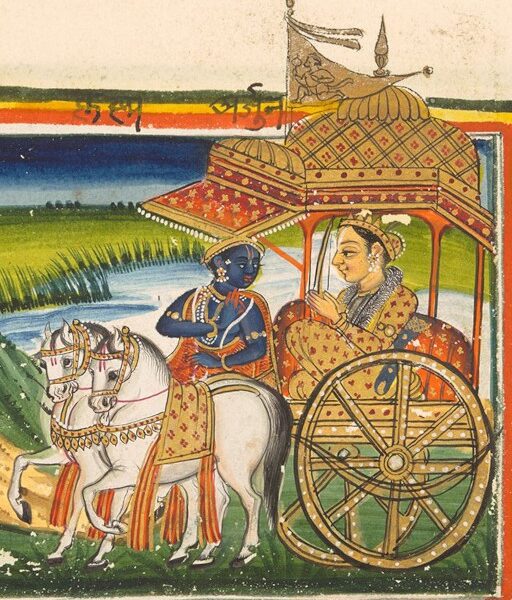
Then we understand that everything will be connected.
So this element of being connected then becomes very important, because whatever is there is Krsna. It’s an illusion to think it’s not Krsna. So we’re used to being in an environment where we don’t see it’s connected to Krsna. So we’ve gotten used to that and think that’s standard. Now we’re having to learn this new kind of, like for us, this new vision. So it is actually just a standard vision. In the spiritual world, that’s how everybody sees, is everything’s connected to Krsna. So that means that all situations that they’re in, then they’re always aware of Krsna, and it’s inspired by the environment. So that in rasa is called the vibhava.
Vibhava means that that which inspires you in, that which makes you, the rasa, what makes or reminds you of Krsna. So that means everything around, so anything, it says anything connected to Krsna. But for devotees, everything’s connected to Krsna. So there’s that which is directly, personally connected to Krsna, and then there’s everything that you can use to please Krsna. Does that make sense?
And so the idea that everything is for Krsna. So here we learn, okay, Krsna’s God, He’s the greatest, He owns everything. So then we’re going to think, okay, this belongs to God. So that’s the first step. What’s the second step?
Should be used for God. Should be used for God, right? So that’s the whole point, is that if it belongs to God, it’s to be used for God, okay? So now the resident spiritual world, then they don’t have to worry necessarily about, it belongs to God. That’s already been accepted. So when they see something, it’s just how to engage it in Krsna’s service, right? So whatever situation you’re in, it’s how can this situation be connected to Krsna? How can it be used for Krsna?
Does that make sense? So all it is, is we’re going through the step, you know, I’m not the body, so that means the field here is not mine, right? Because how are we perceiving this, right? We’re perceiving all this that since the field is the body, right? We’ll say, no, no, there’s me, and then there’s the field. No, no. The field, you’re perceiving it only because of your body, because you can only perceive the field through the senses.
And you’re going to interpret that field according to your own desires.
It’s not going to be something else, and that’s going to be what’s good for your body.
Does that make sense? That’s the whole idea, it always comes back to the body. So the whole field is the body. So we say we’re not the body, that means we aren’t anything here, right? So we’re not it, so we’re not the controller and enjoyer, it’s not ours, because if I’m the controller and mine, you know, it belongs to me, then whose is it? Who is the controller and enjoyer, right? And then that’s God. So then if it’s, and so, because I think I’m the controller and enjoyer, and it’s mine, therefore it’s for me. But if I’m not the controller and enjoyer, and God is, so then that means whatever’s there in that field is for the service to the Lord. You understand? So this is the process we’re going through, right? So that’s why they said there’s a difference between the upaya-bhakti and the phala-bhakti, right? The phala-bhakti means you’ve gotten the results, you’re on the platform of prema, therefore the steps that you go through in upaya-bhakti to get to the point that it’s to be used for Kṛṣṇa, you don’t have to go through. You don’t have to think, oh, I’m not this body, I’m not the mind, you know, don’t be attached, you know, it all belongs to Kṛṣṇa. Kṛṣṇa’s the controller and enjoyer, so therefore I should engage everything in His service, right? And then, okay, so what can I do? Does that make sense? And we’ll look according to our values, and what that part of the field will pick up on, and then that part of the field will engage in Kṛṣṇa’s service, right? Spiritual world, then they’re going to look at, it’s automatically for Kṛṣṇa, they only want to please Kṛṣṇa. So naturally, according to their nature, they’ll look at the field and what their nature means, what way they’ll serve Kṛṣṇa. Here in the material world, nature means how you’re going to serve yourself. Right? It’s your own pleasure that we have the specific nature we have today. But in the spiritual world, the nature is how they want to please Kṛṣṇa. Yes. When you’re in, like, vijñāna-māyā, are you still actually acting on your own behalf? Vijñāna-māyā means you’re on the Brahman platform. So then, technically you see everything in connection with Brahman. So it’s not so much, but there’s still the element of working with your own conditioning. But it’s not a matter of that that is the motive behind. The motive behind is this being spiritually situated.
Does that make sense? That endeavor for liberation.
Is that what you’re saying? Yeah. But it’s, yeah. But it’s, yeah, still, from my point of view, because of the conditioning. Yes. Yeah. I mean, you can be working on it, that, you know. The point is, for Vaiṣṇavas, you’re trying to switch it. But until it becomes prominent, we don’t call it by that category. You know what I’m saying? It’s not that in Māramāya there’s not an understanding of we’re not the body. Right? And that we’re acting according to that. But the prominence is the performance of one’s duty. Right? Vijñāna-māyā will be, then we’re not, it’s not karma-yoga, it’s jñāna-yoga. Right? So then we’re going to be performing the activities.
Does that make sense? Yeah. So it’s your, your vijñāna-māyā will be jñāna-yoga.
Right? Your māra-māyā, that will be karma-yoga, as niṣkaṁ karma-yoga. Right? In its proper standing. We’re talking about the consciousness being there. Right? We’re not talking about someone who’s on that platform doing their duties but for sense gratification or for other, you know what I’m saying? So there’s where you’re situated, and then there’s where your consciousness is. Right? So ideally they both match. Right? And then your artha and kāma, right, your anamo and prāṇamo, those will be sākhaṁ. Right? But one will be obviously, you know, grossly selfish, you know, the anamo. And prāṇamo will mean you’ll be worried about others’ sense gratification. So it appears like niṣkaṁ, but it’s not actually, because the extent of sense gratification is still for our benefit. It makes us feel, you know, good, and like that. So it’s, the inspiration is what we’re going to get from it, the benefit of it, rather than, it’s our duty. Seems like this is where materialists often get it wrong, where they think, this is why there is no real good, because when you do good, you feel good, and therefore it’s ultimately selfish. Yeah. The devotees will also think like that. The point is, is if you feel good about anything, it can’t be spiritual. So it’s got to be, you’re completely, you know, just, you know, how you say, complete, completely unsheltered, you know. Then you are that spiritual.
No, it’s connected to Kṛṣṇa. It’s good. Is that the point? So this whole point of this process, right, and then anandamaya, then that is your un -deliberated platform, but it can either be only on the liberated platform of having developed prema, or you’ve developed prema, right? So someone on bhava-bhakti, that is anandamaya, but they haven’t necessarily developed that prema. It also includes the impersonalists that make it to the Brahman platform, but because they’re only there temporarily, we don’t, they don’t figure so prominently in the equation, but they’re there, right?
So it’s prominent, so the liberation element is the prominent. Therefore, it’s anandamaya.
But when it’s there, but not the prominent, it’s vijnanamaya. You know, when there’s just a touch of it, then it’s the monamaya, right? And generally, anandamaya, pranamaya, there’s no concept of liberation. Even duties are hard to, you know, understand, except for what is good for, you know, the general group, you know, the extended sense gratification. Right? That’s the dharma. Would it also be like very short-term? Dharma could be like what can, what could see the result within a short- Yes, yes. It means you’re doing it to get a result, rather than get it, doing it because you’re supposed to do it, right?
So he’ll be pious because the person is situated in, in performing his duties, right? He’s situated in monamaya, but his consciousness is not. His consciousness is in anandamaya, pranamaya, right? Just like the person in vijnanamaya is situated, he’s performing the duties of a monamaya, of dharma, but he’s, his consciousness is in, right? So in other words, the solid situation of the material platform is performing the activities recommended in the Vedas, right? Is that what you’re saying? Though someone may be doing more towards karma and someone more towards yoga, but that’s the recommended position, because then it’s fruitful, because from dharma comes artha, therefore karma, right? Does that make sense? But otherwise, without dharma, there won’t be those things. Without dharma, then how are you going to get the moksha, right? Because if it’s a whimsical lifestyle, how that will result in spiritual understanding.
Is that what you’re saying?
Right? Yes. So in other words, everything’s connected to the Lord, and so this concept that there is something different, that’s only our conditioning. We think there’s something different, but there isn’t actually something different, right? It doesn’t exist. It’s only a concept that it’s there, but in reality it’s not.
The living entity cannot be separated from Krsna. For want of sufficient knowledge in the absolute science, we are now covered with illusion, and therefore we think that we are separate from Krsna. Although we are… We are… Ha.
Yeah, no, I’m just used to single pages.
Ha. We are…
Although, although we are separate parts of Krsna, we are nevertheless non-different from Him. The bodily difference of the living entities is maya, or not actual fact. Right? It means we’re thinking that this living entity is, you know, tall, this one’s short, this one’s fat, this one’s thin, this one’s old, this one, you know. Those… Those aren’t the real… aren’t actual differences. The souls are all the same. Those are the… Those are the condition. That’s the cover. That’s what he’s covered by. You know what I’m saying? Just like, let’s say, you have a bunch of people, and they’ve all fallen into the mud. Right? So, now depending on what mud they’ve fall… fallen to, we… we categorize them. You know, his more clayey mud, and his is more old, funky mud, you know, stinky mud, you know, like that. And he’s just kind of splattered with mud, so that’s different than the guy that’s completely covered with mud. So they have all different names, and so they’re identified with that, and because of that it changes how you deal with them, all the social position, depending upon what mud they’re covered with. You see what I’m saying? So that’s not real. The point is the souls are all the same. They’re all servants of Kṛṣṇa. So you can deal with everybody as servant of Kṛṣṇa. Right? So that doesn’t change.
The bodily difference of the living entities is māyā, or not, actually fact. We are all meant to satisfy Kṛṣṇa. By māyā alone, Arjuna thought that the temporary bodily relationship with his kinsmen was more important than his eternal spiritual relationship with Kṛṣṇa.
The whole teaching of the Gītā is targeted towards this end, that a living being, as Kṛṣṇa’s eternal serva… servitor, cannot be separated from Kṛṣṇa, and his sense of being… being and identity apart from Kṛṣṇa is called māyā. So here, again, the whole teaching of the Gītā. Right? Again, Prabhupāda’s bringing these out. The whole teaching is this, is we’re not separated from Kṛṣṇa. Right? That we’re meant to serve Kṛṣṇa. Right? That the result of all our activities is meant to please Kṛṣṇa. So this is… this is the whole teaching.
So you can’t be separated. So it’s more than just, okay, we’re here, we can’t… we think. The point is, is it’s an illusion to think anything’s different. Right? We’re sitting on the floor. We’re held up. But that potency is Kṛṣṇa. So by Kṛṣṇa’s mercy, there’s a floor. So it’s Him. Right? He’s the columns. He’s holding up the, you know, the ceiling. He’s the ceiling, you know. Which is nice right now. Yes. Yes, yes. It’s quite nice. So it’s all His mercy. So we’re surrounded by Him. You see something. How can you see something unless… where does the power of seeing come from? That’s Kṛṣṇa. So that means it’s Kṛṣṇa who’s seeing. Right? We think, I’m seeing, but we’re being seen. Only because we’re being seen can we see.
Right? And then how we see Kṛṣṇa who is seeing us, that’s how He relates to us. You understand? Because He sees, we can see. And then with that, our own power of seeing, how we identify what we see with that power of seeing, which is Kṛṣṇa, that’s how Kṛṣṇa relates with us.
Right? Does that make sense? So we only see, you know, a column. Therefore, He appears to us just as a column. So if we understand, no, it’s Kṛṣṇa who’s doing it by His mercy, then He reciprocates as being able to perceive Him there.
Does that, does that make sense? So one can see Kṛṣṇa everywhere in everything. So that means one’s always surrounded by Kṛṣṇa. Right? It may be the manifestation is through the Brahman, but the Brahman, as I said, His personal effulgence. So it’s still Him.
Right? We have this idea that this Brahman is an impersonal. So therefore if Kṛṣṇa’s entered everything and all this and that, it’s impersonal.
Does that make sense? But no, it’s personal.
So that means everything that’s important, we’re surrounded by Kṛṣṇa.
Yes. So that way we’re just seeing that elements. Now, that’s the first step. The next step would be, well, what are we supposed to do for Kṛṣṇa? Right? What are our duties in this and that? You know, since it’s all Kṛṣṇa, then the third step is that, you know, how to please Kṛṣṇa with this environment. So it’s not a matter of that it is Kṛṣṇa or that, you know, I have duties to perform in connection to Kṛṣṇa. No, it’s just automatically what’s there, how to use that for Kṛṣṇa.
I know some devotees, they see things and it appears it doesn’t exist, and they just kind of, you know, trying to preach to, you know, to other people that they are those who see all subtle things and energies and not who manifest through them. Yeah, but that’s not what we’re talking about. You know what I’m saying? Yes. That’s their own mind. Here we’re talking about, that’s why Kṛṣṇa goes through and for three chapters explains where you can see Him. Right? So, in other words, that all those different, He’s the strength of the strong. All right? Why do you build a column? Should it be weak or should it be strong? Right. So, therefore, He is the strength of the column. Right? But we’ll generally think He’s the strength of the strong. We’ll just see some, you know, big seven foot, five hundred, you know, kilo guy there, you know, like that, and then we’ll say, OK, He’s strong, so Kṛṣṇa’s that strength. But the point is, is anything that’s strong is Kṛṣṇa. Right? You have a stick, right? Why do you get a walking stick? Because it’s weak? No, because it’s strong. So that strength in that walking stick is Kṛṣṇa.
Does that make sense? So, the point is, is that element of strength. So, there’s so many places to manage, but at least we find it in one place.
Does that make sense? You know, so one place is there. So, the point is, is that when they make it up and they see Mahāprabhu, is that great? But the point is, is now what are you going to do about it? So, is the point, is the point that I am absorbed in experiencing how Kṛṣṇa’s in everything, or I am going to serve Kṛṣṇa, who’s in everything? So, if I’m, if I’m experiencing it, it’s nice, but it’s still about myself.
So, the point is, is even, if, even, even we’re just taking it that there’s some substance to what they see. But the point is, is, is that, that’s the end? Now that’s, you’re, you’re, you’re the advanced person? No, now you’re, now you’re the, the, the smaller of the, you know what I’m saying? Just like, let’s say, you have a 15 -year-old. They’re the biggest kid. The 15-year-olds look back. So, they look at the 14, 13, 12 on down, and they’re the biggest guy. Right? So, you know, so therefore you can do that. But when you’re 16, you’re an adult, they don’t look back. They look forward.
Right? So, they’re looking at others. So, anyway, from 16 up to, you know, 29, they basically see the same kind of age group. You know, okay, you’re a little bit, you know, old, but it’s, you’re kind of like the same, equals. But they’re the youngest of the adults.
You know what I’m saying? So, the point is, is, means, if they’re putting themselves in a more advanced category, but the point is, is, that’s only the beginning, because you’re only appreciating the Brahman element. But you’re thinking, you’re acting as if that’s it. You’re perfect.
So, that’s, that’s, you know, that’s a, that’s, that’s a neophyte on the adult platform, if it’s in substance. But the way of application is they’re showing that they’re bigger than everybody, but that’s what the, that’s what the adolescent does. You know what I’m saying? That’s what the punk kid does.
Does that make sense? Yeah. So, that’s the difficulty with it, is that they should actually be looking the other way, but they’re looking back this way. Right? If there’s some substance. Same time as by the sounds, generally when they do those things, that’s, there may have been some experience, but then they’re trying to ride on that and get whatever they can out of it. So, whether it’s actually being experienced, they’re remembering an experience.
It’s not a constant experience. Yeah, I wouldn’t think so. Otherwise, if it’s a constant experience, then why would they be dealing, why would they be, how can you get benefit from it, if you’re experiencing it? Right? Just like if you’re asleep, you can’t get the benefit of thinking, I’m sleeping so nicely, that you’re either asleep or you’re awake. If you’re in a kirtan, and it’s a great kirtan, that when you stop and talk to others, hey, wow, isn’t this a great kirtan? Are you enjoying the kirtan? No. No, it’s stopped. This is the, this is the meaning of, of aparoksha.
Aparoksha, it’s experienced, but you can’t observe it. So, if they’re able to observe it, they’re not experiencing it.
Does that make sense? It’s already past experience. It’s already past experience. Because if it’s present experience, it’s continuous, they won’t talk about it that way. They won’t get into this, like, oh, yeah. Because that means then you’re, you’re, you’re concentrating on what you’re feeling.
So, that’s how you tell the difference. If, if they’re explaining what’s, what’s there, and putting the subtle into, it means into observable definition, that means it’s a present experience.
But if they’re talking about the experience, their experience of it, it’s a past experience, past.
Does that make sense? So, that’s how one can, you know, tell the difference on whether these kind of things are real or not, you know.
You know, so, if they’re excited about, that they’re on that platform of experience, that’s one thing. But if they’re excited about the experience and explaining to you the experience so that you can experience it, that’s a different thing.
Does that make sense? You know, Prabhupada’s experiencing Krishna consciously, and he’s explaining it so you can also experience it.
He’s not talking about how he was experiencing it, you know, or it’s not about his experience.
He’s experiencing it, he’s explaining it so you can experience it. If they’re explaining their experience, that means then they can’t be experiencing it.
You know what I’m saying? Means if you’re, means you’re experiencing something, you can explain that experience, not what you’re, what you’re experiencing.
Does that make sense? Because as soon as you’re explaining what you’re feeling, then it moves into the past.
You know what I’m saying? Does that make any sense? Yeah? You catch that?
Can I explain what I’m feeling? Means like you’re seeing something, it’s a very nice scenery. You can say, okay, the trees are very, you know, green and beautiful, the birds are chirping and all that, it’s very bright and, you know, happy day. But when you start saying, you know, but I’m feeling so good in this kind of thing, now you’re not explaining what actually is the thing. You’ve moved to what you’re doing. So you can maybe explain what I’m experiencing, but the whole point is, is the devotees never explain what they’re experiencing. The ācāryas, nobody does that. Because what they’re experiencing is your own emotions, not the scenery. Yeah, it’s, you know, so your own emotions, but it’s not dynamic anymore because it’s just your side of it. So you see, the ācāryas don’t explain that.
Yes?
So the whole point is, it’s not about our experience. You’ll experience something, but it’s the experience in the dynamic of its continuance.
Right? Because Kṛṣṇa consciousness is continuance.
Right? It’s not in the future, it’s not in the past. It’s in the present. So it’s continuance.
Does that make sense?
Is this sahaja style? We would generally categorize it as these are symptoms of sahaja. Because they make something advanced, make it into something easy, something cheap. So that’s the whole point. That’s why one avoids a certain mentality. Because the point is, is this dynamic. As we said, even if one is experiencing that, that’s just preliminary levels. That’s the understanding of Brahman. And we said that the experience of the person is unlimitedly times greater than that. So therefore, it’s nice, it’s a good foundation, but it’s not actually what you’re looking for. So one shouldn’t consider, I’m advanced because of that.
Right? You’re advanced because of the personal aspect. But in any case, at no time does the devotee think he’s advanced anyway, because that will block one from developing Kṛṇa.
Right? Because as we said, it means here I’m the controller and enjoyer. Right? When you’re getting rid of that, the puruṣa -bhāva, then there’s the element that I am advanced and I’m the guru of devotees.
Does that make sense? So these are the subtle forms of that, that will block Bhāva moving to Kṛṇa.
Right? It means I’m the controller and enjoyer keeps you from moving from the conditioned stage to the liberated stage. Right? Because there is no I’m the controller and enjoyer on the path of Bhāva. But one can still have these subtle things.
Right?
No, no, it’s not a matter of that. We were talking this in specific, that somebody’s talking about, you know, wherever they look they see Mahāprabhu and this kind of experience and, you know, leaves Russell and Odysseus and, you know, all this kind of so-called, you know, ecstasy. They read something, you know, in the past times and then they feel that that’s what’s happening to them. But that’s sahajiya, because even if it is happening to them, you don’t explain it like that. That’s what we’re saying, the ācāryas never explain it like that. So if you’re explaining it like that, there’s something wrong.
Okay. The whole teaching of the Gītā is targeted towards this end, that a living being as Kṛṣṇa’s eternal servitor cannot be separated from Kṛṣṇa and his sense of being an identity apart from Kṛṣṇa is called māyā. So here it’s not complete because we may understand that we’re not the material world, but we haven’t, we’re not seeing ourselves as Kṛṣṇa’s eternal servitor, because otherwise we may see I’m not the body, I’m the soul, but it’s still separate from Kṛṣṇa, because unless we see I’m servitor. So that’s why the impersonalist is not complete, because they’re Brahman realized, but they don’t see themselves as an eternal servitor, because the reality is Kṛṣṇa is a person, and we’re a person. That’s the reality. That the nature of the people is spiritual and eternal and Brahman, that’s another thing.
You know what I’m saying? It’s just like you relate to the other person because he’s a person. It’s not that, hey, I got skin and you got skin, so therefore, hey. You know what I’m saying? That’s not the point, or you’re in the house, so it’s not because of the house that’s why you’re relating. You’re relating to the person in the house.
You understand? Otherwise, if you’re relating to the house, you’re relating to a third party. So the relationship isn’t direct, so it’s a direct relationship. We mean with the person, because the relationship with Brahman is not technically direct, right? You can directly perceive, but the relationship is not direct. Because what is the relationship? There’s no manifestation.
There’s only yourself. Paramāma is there, but it’s specifically localized. It’s still, he’s just organizing that Brahman experience.
You know what I’m saying? In other words, there’s Brahman, means the platform of the spiritual existence. Then there’s the activities of spiritual existence. But then there’s the mood of affection and exchange in spiritual existence, right? That’s expressed through the activities, the spiritual activities. You understand? So being spiritually situated, you, with that spiritual situation, perform spiritual activities. And in that spiritual situation with those spiritual activities, you express your love for Kṛṣṇa. Or to reverse it, to express our love for Kṛṣṇa, then we engage in spiritual activities in a spiritual environment.
Does that make sense? But the focus is on Kṛṣṇa, the person. So it’s not complete until it’s Bhagavān realization. Because the other two are real, they exist, they’re non-different.
You know what I’m saying? So you’re having a nice time with somebody, it’s because of the place and the activities you’re doing. But it’s the experience of that interaction that’s important. It’s not actually the place or the activity.
You know what I’m saying? You have some friends, you could be standing on a corner, sitting on a bench, you know, in your house, driving in the car. It doesn’t matter the situation. The relationship of friendship is what’s important. Right? You could be laughing and joking, you could be serious, you could be studying something, you know, you could be, you know, cooking lunch. It doesn’t matter the activity. It’s the experience of interacting as friends. Does that make sense? But that interaction of friends is the sthāi bhāva, the foundational rasa. But then all the differences in situations and experiences and all that, that adds flavor to it. So that’s why all the other four aspects of rasa are there. They create all the variety and everything in which that is expressed.
Is that clear?
So that’s therefore, you know, as a Kṛṣṇa’s eternal servitor, so it’s more than just, okay, that’s a fact. No, it’s how you think.
That’s the difference. You say, oh, we’ve heard all this. But we have heard all this. But then the next thing is contemplating it and applying it, and then realizing it.
Right? And it’s this symbol. The whole teaching of the Gītā is targeted towards this end, that a living being as Kṛṣṇa’s eternal servitor cannot be separated from Kṛṣṇa. This sense of being and His sense of being and identity apart from Kṛṣṇa is called māyā.
Right? And so if he identifies his being as separate from Kṛṣṇa, that’s māyā. He sees it in connection with Kṛṣṇa. So that would mean even he sees himself as Brahman, if it’s not connected to Kṛṣṇa, it’s still māyā.
Because that’s why the impersonalist, he can only be on the spiritual platform temporarily, because it is māyā. It’s an illusion to think that the soul is separate from the Personality of Godhead. Right? But, as we said, the situation and the activities.
Right? Spiritual world, the dhāma is nondifferent from Kṛṣṇa. The activities going on in the dhāma are nondifferent from Kṛṣṇa. But still, those two aren’t the focus. The focus is the interaction with Kṛṣṇa. Right? So everything is explained in relationship to Kṛṣṇa.
Does that make sense? So this being a reflection of there, you have the situations and you have the activities. Right? And you have the mood. Right? So the mood is, I am the controller and enjoyer. We change that to, no, I am the servant of Kṛṣṇa. Right? Then we see the situation. It’s also Kṛṣṇa. So just as it’s Kṛṣṇa’s potency there, it’s Kṛṣṇa’s potency here. Just there is very special. So that’s a full manifestation of potency. Here it’s nothing special. It’s just a spark.
So just a spark runs the situations and the activities. So nothing special.
Does that make sense? Yes. So when we say that we engage in spiritual activities, and at the same time we say that a bunch of friends can do whatever, and it’s not important where they are and what they are doing. Is this because we have a tendency to forget Kṛṣṇa? No, I was showing the reflection. Is that, that it’s Kṛṣṇa’s potency that makes the spiritual world work. So that’s why they can see Kṛṣṇa in anything. But they’re going to immediately remember the person. So the situation will remind them of the person. The activity will remind them of the person.
Right? But here we start off understanding we’re not the material nature. Right? So we’ve negated that. And that we are Brahman. So we start with, okay, the situation. And it connected to Kṛṣṇa. Then the activities connected to Kṛṣṇa. Then, you know, Kṛṣṇa is a person. I don’t mean Kṛṣṇa is a person by fact. I mean Kṛṣṇa is a person in realization.
You know, by experience. Does that make sense? So, in other words, we’re going through that whole process. So we’re showing the difference between fala-bhakti and upāya-bhakti.
The upāya, we’re having to go through these stages. We’re not the material world. We’re spiritual. And then, but there’s spiritual activity and those activities are meant to please Kṛṣṇa. So basically we have to go through four stages.
Right? But those on the platform of prema, there’s only one. That’s the situation. Because it includes the other. The person includes the activities of the situation.
Just like we said, the body is the field. Because the field is the situation and the activities.
So Kṛṣṇa is the field. Kṛṣṇa is the activity.
Right? He is the situation. He is existence. He is knowledge and activity. He is, you know, ananda.
But the point is, it’s Him as the person and interacting with the person that’s important.
Right? So therefore the situations, the activities of the situation, those are secondary.
Does that make sense? They’re only in support of interacting with the person.
You know what I’m saying? That’s what I’m saying. That’s the example of the friends. The important thing is interacting with your friends. So, okay, so what situation or what activities are we going to experience today? Oh, we could do this. Oh, we did that last week. Okay, then something else. But what are they talking about? Situations and activities.
Right? But if they miss the point of the friendship, then it’s not satisfying.
You understand? Because the relationships maintain because you’re getting the proper experience in the relationship.
Right? And the situation and activities is secondary.
Right? But if all that they have is that secondary consideration, those are called shallow relationships.
You know, that group of, you know, that gang of boys and they hang out and do all this and that. Generally all they talk about is third party stuff. It’s nothing about each other.
So that’s shallow because all they have is the situation. The situations and activities of friends, though they don’t actually experience friendship, relationship.
You know what I’m saying? So for them, it’s very important that only certain situations and only certain activities they will consider good.
But if it’s bad, then it wasn’t good. It means they won’t consider it as a relationship. If someone actually has a relationship, whether the situations are nice or not, it works. You know what I’m saying? You know, you want to eat something like this and you end up in some crazy little place, every place else is closed and you only get some, you know, some weirdo like chili pecoras or something like that. The friends will sit down and laugh about it. Right? But the punk kids, yeah, forget this, I’m not eating that. You know. So there’s nothing to base their relationship on because the situation and the activity isn’t what they would call as the common ground.
So it’s shallow.
You know? You know, like the cheerleader, she sees some nice boy and then, you know, they go out together and then she notices, you know, while they’re sitting there eating their burger that he has a wart on his thumb. That’s it. Bang. There’s no relationship anymore. She drops him like that.
Hmm? I didn’t catch what he has on his thumb. Thumb. Thumb. A wart.
A wart? Like a big spot. There’s funny little things. They grow out of the skin and they look a little kind of bumpy like that, you know. Witches always have them on the end of their nose, you know, with their hair growing out of it. Yeah. Yeah, yeah.
So that’s the point is that there’s only certain things. It’s not that those certain situations that are favorable for the rasa.
You know what I’m saying? No, it’s a matter of that those situations are there. There is no rasa. That’s the difference.
And then some would have a tendency to go into this sahajiya mood with explaining the rasa when it’s not really there as a kind of… It’s another thing if you’re sharing past experiences. Oh, you know, they’re sitting there, you know, stuck in the train station. The train didn’t show up. It’s going to come after three hours. So what they’re going to talk about, either they’re going to get into something now, find something now. They’ll talk about, hey, remember when we did this and that, you know, like that. So it’s something there, but it means there’s a fine point there. It’s not that you can’t explain experiences. We’re talking about when people are talking about spiritual experiences, you know, and they’re not just talking about it as facts, but, you know, the voice changes.
That kind of thing like that, that’s where you start knowing something’s not going right.
You know what I’m saying?
Because if they don’t use that all the time, if they always talk nice and gentle, that’s fine.
You know, but they only use it for here, then you know there’s something.
Yes. Maharaj, from your explanation, it looks like for a devotee on the Brahma-Bhuta platform, there’s no karma sharira, but that little contamination is still there, like the ink in the pot. Yes, so that’s why the association of the nitya-siddhas is important. So the principle is the association of Vaisnavas and learning about Krishna from them is an eternal principle. It works on all levels.
Right? It means the person on the platform of Prema, then that is their eternal situation of being with devotees and discussing about Krishna. Right? So it just nourishes the Prema. But before that, in Bhava, without that association, you won’t get the Prema. And in the conditioned state, without that association, you won’t get free from conditioning.
Right? And what does Krishna do all day? Associate with Vaisnavas. If you don’t like to associate with Vaisnavas, what do you have in common with Krishna? What’s the common ground? Because as we’re explaining, it’s the persons who are important, not the situation. It doesn’t say, it says, approach a bona fide spiritual master. Associate with Vaisnavas. It doesn’t say, you know, make sure on a nice sunny day out in a nice meadow with wildflowers and birds chirping and butterflies, you know, flitting and, you know, sun rays, you know, how you say, doing whatever they do and all this, and creeks babbling and all that. Then, you know, associate with devotees.
It doesn’t talk situations.
Right? And if it talks activities, it’s talking eternal activities. Hear from the Vaisnavas.
Associate with Vaisnavas. It means, in other words, the activities of someone who’s Krishna conscious. Right? And the perspective that they, how they see the situation. So they teach you how to see the situation. They teach you what are the appropriate activities. And they teach you what is the resultant goal of those activities.
Does that make sense? So the point is, it always comes back to association with devotees. But unless you see yourself as a servitor, how are you going to associate with devotees? Because that’s how they see themselves.
Right? If I’m just Vermont, nice, but, you know.
Here? Okay.
436.
Right? And so this is fourth chapter. Right? This is Jnana Yoga. Right? So there’s all this depth to it. So it’s not that there’s going to be different knowledge as we progress through the different books. It’s just going deeper and deeper into what’s already there. Does that make sense? It doesn’t change, because it says this is the whole teaching. So it’s not that when you get to the Bhagavatam, then, well, actually, some think that was the whole teaching. And for neophytes, that is. But now it’s actually this. And then Caitanya Charita Mrita, and then it’s another. No. That is the whole teaching. But what it means to be Krishna’s eternal servitor, who is Krishna. Right? That we’re not separated from Krishna. What does that mean?
What does that say?
Yeah.
It means our desire to be connected to Krishna. That’s what we have. It means that’s what we’re in control of. But the point is, it’s just like now. That’s all we’re in control of now. But we don’t mind that, you know, the modes of nature have arranged, you know, the body, and how the body functions, and the situations, and the activities, and managing those activities, and managing the results. We’re not complaining. Because as what we’re desiring is what we’re able to be involved in. So it doesn’t change in the spiritual world. Then it’s the same thing, but it’s being conducted by saṃdhini, saṃvit, and hladini potencies.
Right? That’s the original. The reflection is goodness, passion, ignorance.
So everything works by… Yeah. But no one minds. But at the same time, you don’t need to see it like that. Here we have to see it because we’re controlled by the modes. We identify with them. So we’re not that. But we are serving the Kṛṣṇa. So once we identify there, there’s no need to separate these energies and see them separately. Right? Up to the platform of liberation, it’s necessary to see that way. But once one’s liberated, there’s no need to see that way anymore. Right? That’s the example of the wood, fire burning up wood. So wood is material conditioning and fire is the knowledge. Like that, then when the wood’s burnt up, there’s no fire. So that knowledge burns up the material existence and after that it’s not necessary.
Because the result that you want to get is there.
You know what I’m saying? You have a can. You have a can opener. You’ve opened the can. Do you need the can opener? No, the can’s open.
You understand?
You know, it’s like you want to go to sleep, so you make the bed ready. And then you get in bed. Now do you need to make the bed while you’re in bed? No, it’s already there.
So that’s the point. Once one comes to prema, these preliminary things aren’t necessary. Because the result of it’s already there.
Yes.
Doesn’t mean you can’t if the situation’s there. The point is, if you know Krishna, you know everything. So it’s not that they can’t. But that’s not what’s of interest.
You know what I’m saying? The guy who’s racing the car, for him it’s the handling of the car. It’s not the decals on the outside. But for the kids, wow, check out the decals. Because that’s all they can get is the externals.
The experiences. But it’s not that they can’t explain.
Yeah, so this company, they’re giving us money, and then we’re able to do what we’re doing, and therefore we have the decal on the car. They can explain that. But that’s not what’s of interest to them.
Hmm. No, dualities is more looking at it from the neophyte platform.
No, any situation, there’s something there. The point is, you can remember Krishna in any situation.
Is that a sense? Yeah, so that’s that. It’s not a matter of it’s hot, so then I can’t serve Krishna. It’s cold, I can’t serve Krishna. It’s hot, you can serve. When it’s cold, you can serve.
That’s the thing, you’re not affected by the dualities. So that’s why the neophyte would be the most affected by that. The madhyama is not so affected. But he will act through his conditioned nature. But that’s expected. Arjuna is not asked to not function as a ksatriya.
So there’s no need to act outside of one’s nature.
The point is the nature being engaged in Krishna’s service. Like, do we expect mother Dashoda to act outside of her nature, as mother of Krishna? You know, we’re not going, Wow, he’s so attached to that. You know, it’s like that.
Spiritual, be free. Why do you have to be caught up in all these restrictions?
There’s no need.
It’s perfect because it’s connected to Krishna. The point is, if your nature is fully connected to Krishna, then it will be okay.
So it’s not a problem that the conditioned nature is fully connected to Krishna.
It means you’re going to have to have some situation and some activity. So part of the situation is the particular body you have. And so we happen to have one made out of the, you know, the modes of nature. So therefore, that’s what we use. So it’s not a problem that that’s used. So you can only do certain things. So that’s what we do. It’s not a need of doing something else.
436. Even if you are considered to be the most sinful of all sinners, when you are situated in the boat of transcendental knowledge, you’ll be able to cross over the ocean of miseries. So even you’re sinful of all sinners, right? So it means you have to be really sinful. You know, like the man’s man. So the sinful of all sinners. It doesn’t say you’re the most sinful. No, but you’re the most sinful of all sinners.
Just to make it very clear. But when you’re situated in the boat of transcendental knowledge, you actually understand who you are. Then you can cross over. It doesn’t matter. There are no other qualifications than the association of the devotees and understanding and practicing that instruction that they give. It doesn’t matter what it is. All that can be removed.
We’re the one that thinks it’s very great.
Yeah, because we think a hundred years is a long time or because we think that we’re the control and enjoyer, so what’s against that is bad, you know, like that. You know, that the body is the real thing, so something done with the body, then the body is sinful. You know, I don’t know. So the whole problem is consciousness.
The Lord saves those who associate with saintly persons. Proper understanding of one’s constitutional position in relationship to Kṛṣṇa is so nice that it can at once lift one from the struggle for existence which goes on in the ocean of nescience.
This material world, so here, knowledge means constitutional position because that’s transcendental.
This material world is sometimes regarded as an ocean of nescience and sometimes as a blazing forest.
So here, you know, an ocean of nescience or a blazing forest. Either one is dangerous. If you’re in the middle of it, you know, it’s not going to be auspicious. However, in the ocean, however expert a swimmer one may be, the struggle for existence is very severe. If someone comes forward and lifts the struggling swimmer from the ocean, he is the greatest savior.
Perfect knowledge received from the Supreme Personality of Godhead is the path of liberation.
The boat of Kṛṣṇa consciousness is very simple, but at the same time the most sublime. So again here, Prabhupāda, how simple it is. Right? It is that simple. We like to make it complicated.
Like that. So here, now sometimes there’s an ocean of nescience and a blazing fire, but here we’re talking knowledge. So what’s the opposite of knowledge? Right? Ignorance. So therefore the ocean will be the most appropriate example. Blazing fire, because there’s struggle. But the blazing fire will be connected with what? What will that represent?
Means one is the ignorance. What’s the other side?
Lust, right? So I’m the controller, that’s the ocean. I’m the enjoyer, that’s the forest fire.
Right? Is that what you’re saying? So then that forest fire… So then being there, one is overwhelmed by lust, and so everything is, you know, burns one at once, and desires and needs, and so there’s no relief when suffering. And the other is because of ignorance. You don’t know who you are, therefore you’re just washed around, and your experience is you don’t establish where you’re going. If you’re out in the middle of the ocean, you do not establish where you’re going next. Right? The ocean just washes you this way, and that one that way, and the wind blows, so you go this way, and then the wave throws you that way. Right? And then there’s the fish.
Yes? I’m surprised that… What do you have to add on those… What one’s duty is, but there isn’t a statement about duty? Well, then analyze why you should be doing it, and then what’s the problem with the… In other words, take… Okay, what position you’re in. Follow the path of doing the duty. What will it get you? How will that be? What will the result be? Follow the path of not doing the duty. And then where will that end up? And then, with your intelligence, compare the two. Like that. And after a while, then the mind’s going to have to kind of agree.
Right? Because you have to understand, just because we’ve had a bad experience doesn’t mean that the principle is bad. In other words, we’ve had problems with parents, and so therefore we think, you know, all authority… But other people have fine experience with their parents.
So in other words, know that the misgiving is due to your specific conditioning, due to your specific material desire. Which will change. What’s the misgiving today? Tomorrow will be, you know, what you’re fanatic about.
It’s on the material platform.
You understand?
So here’s… The boat of Krishna consciousness is very simple, but at the same time the most sublime. So we have this element. It’s the whole teaching. It’s simple, but at the same time it’s the depth of it is unlimited.
It’s the most simple, but it’s the most sublime.
437. As blazing fire turns firewood to ashes, O Arjuna, so does the fire of knowledge burn to ashes all reactions to material activities. So it will burn everything, and so it’s not left. So then one is liberated.
That’s the point of the knowledge. It burns up because it is the opposite. The fire is the lust. So that’s controlled by knowledge.
Because we thought, I’m the controller and enjoyer, therefore the love is converted into lust. Now if we understand I’m not the body, I’m servant of Krishna, then that transforms the lust back into love.
Is there anything?
Knowledge is the key point. Knowledge is the key point, yes. But that comes from the association of the boat.
So we say, when you are situated in the boat of transcendental knowledge means you’re in that boat because that’s where the spiritual master is. That’s where the Vaisnavas are. They’re on the boat. We’re the ones in the ocean. So they pick us up from the ocean onto the boat. So therefore when we’re situated in the boat of transcendental knowledge it’s not just where we have knowledge. No, where we have knowledge by the association of the boat. So that’s the association is the important thing.
It’s very simple. It’s like we get caught up in terms of confidential, more confidential, most confidential. But those are, at the start of those three different categories, it’s very simple. I’m not the body, you’re the spirit, or relationship. It’s just deeper, deeper understandings of the same thing.
That’s it. Because when Krishna says, I need all the most confidential knowledge, then he says the most, 18th chapter. So he’s already said that before. But it’s taking it to another level, another depth. It’s adding some more appreciation to it.
He says the same thing, but it’s just you add more elements.
No, no, that’s the point. It’s not mystical. So that’s why when he was talking that devotees tend to try to make it mystical. It’s not mystical. It’s generally, you know, he’s mentioning something there. So that, I would get an idea that that comes from that specific circle. Because just as you see in, let’s say like Christianity.
Like Western Christianity.
You know, in Western Europe. Then, you know, it’s the religion, and then there’s so much of the authority, those elements are what’s prominent. You know, the hierarchy, the structure, you know, like that. When you move to the East Block, then it’s the emotions of it. Like in Poland you have the Black Madonna, and things like that. So they’re much more in the pictures of Jesus as a baby with his mother.
So Mother Mary is much more prominent to them. So the sentiment of it, the emotion of it, meaning that kind of personal element, not the sentiment meaning in faith, the sentiment meaning in relationship.
Does that make sense? Right? And then when you go farther east, you go into Russia, then it’s all about mystical. The mystical elements of Christianity.
So the mystique of it is very much. So that would be what he would be talking about.
Yeah, then it’s just faith and guitars.
Faith and guitars.
Because there it’s not about authority, it’s not about that, it’s just having the feeling, being in that feeling. So it’s sentimental, but it doesn’t have any structure. You know what I’m saying? Like the Polish, they’ll go to church every day.
The other places will go once a week, and if they’re really fired up, they’ll go again on Wednesday. They go every day, sometimes twice a day.
So structure is there, authority is there, but the mood is more important.
So it just has the mystical. So we get distracted by these elements. The point is while you’re experiencing the mystical, where’s the interaction with Krishna?
That’s the point, is that it’s nice, but what’s the service to Krishna? That’s why the example is given in the Nectar of Devotion, that the raktak is fanning Krishna, and because of fanning the ecstasy is coming, which is not a problem, but the ecstasy is creating tears, and so he can’t see Krishna, so he can’t see how to fan properly. So therefore then it’s an impediment to his service.
So that’s the point, is that it’s the service, not the experience, that’s important to the devotee. The service is important. It generates the experience.
It’s not that, well that’s giving, so therefore they just get off into their ecstasy, but then the service isn’t going on.
You understand? If they’re sitting alone and thinking of Krishna, and then ecstatic symptoms are there, they don’t have a problem with that, because the service is remembering.
You know what I’m saying? But if the service is Arjuna, then it gets in the way.
Samandhi-jnana received in the association of devotees destroys all karmic reactions.
Perfect knowledge of self and super-self, and of their relationship, is compared herein to fire. This fire not only burns up all reactions to impious activities, but also all reactions to pious activities, turning them to ashes. Because piety also, material piety is going to get in the way, because then you just have to do what’s good and nice, because all material piety is geared at what aspect of someone’s existence. You have consciousness, you have the subtle body, you have the gross body. What is it aimed at? Subtle body? Subtle body? Feeding kids a Viapara. Gross body? Gross body. You know, seeing that the kids have a loving environment. Subtle body. Does it ever get to consciousness? Never. So all piety is dealing, material piety, since it’s material, it can only deal with the gross and subtle bodies. It can’t deal with the soul.
Spiritual understanding deals with the soul. So therefore, sinful activity is activity that’s not recommended. It’s not recommended to use in Krishna’s service. Pious activity is activities that are recommended to use in Krishna’s service. But the attachment to piety and impiety, both of them are not useful in Krishna’s service, because then the activity is more important.
Right? Just like we have an element, we want to broadcast Krishna consciousness, right? So people should know about Krishna.
Right? But now, if we’re attached to the point of, no, we can’t broadcast like this, we have to put it into very pleasant language and not step on anybody’s toes and apologize for everything that they think we’re doing wrong, though technically, according to the Vedas, we’re not doing wrong. They’re wrong. In the mode of ignorance, you think religion is your religion and your religion is religion. So we’re apologizing for that. That kind of communication, right, is not spiritual.
One is looking at material piety.
So it’s not spiritual.
Right? Does that make sense? Time, place and circumstance, you’re talking to a particular person, you talk in a way that they’ll appreciate, but we never have to apologize for Krishna consciousness. We never have to adjust Krishna consciousness.
Does that make sense? Then they’ll say, no, but it is time, place. No, it’s not.
Because if it was, it would be pure Vedanta.
But what they’re trying to present is Krishna consciousness through the eyes of a pious person.
Oh, we’re feeding people, we’re doing this, it’s education, it’s charity, it’s all that. That’s why we’re great people. That’s why you want to join our movement.
But if that’s the thing, they already have their charities, they already have their church.
And they’re not satisfied because they’re already doing charity, they’re already going to church. They’re not satisfied. So what’s wrong? Because they don’t have sambandha-jnana.
That’s what we have to do. Do you understand? So the point is, is it goes beyond. So this perfect knowledge of sambandha-jnana, of the Self, Super-Self and their relation, because that’s what it meant. If you just know the Self and Super -Self, it’s not enough. Because these other philosophies, you know, we’ll get into next year, they teach about the Self and God, but they don’t teach the relationship.
Right? And most of all the Vedic philosophies, right, then they… What is it?
The word Gnostic? Is that the word for it? They’re all Gnostic. Gnostic. Gnostic. They’re all Gnostic. They all believe in the Veda. And so on all of them, you’re the soul. Right? And there’s activities based on the authority of the Veda. And there’s the Supreme.
All of them. Right? But the difference is, is none of them teach, you know, except for Vyasa, none of them teach the relationship between the soul and God.
They don’t teach that. Right? It means that you’re the soul, you’re Brahman, so you don’t belong here. So by, you know, or you do belong here. Right? So if you belong here, then by good pious activities, you’ll enjoy eternally. Because the result of good acts is good results. So if you do that, then if you do everything perfectly, then eternally you’ll be happy. Right? And God, you know, gives the results of your activities. So you’ve mentioned the living entity, you’ve mentioned the activities, you mentioned God. But the relationship between the living entity and God has been missed. Or, the other is, is that, you know, we’re not the body, we’re the soul. And we’re suffering in the material world. And so therefore, through logic, through knowledge of, you know, atomic theory, right, through analyzation of the material phenomena, or, you know, or through yoga, or through Vedanta, right, you’ll liberate yourself from the material existence. And God is the one who grants that.
But still, no relationship with God is explained.
Is that what you’re saying? You know, or in the, you know, your world philosophies, you know, there’s the soul, whatever they think it is, and there’s God, and you do good work, and you’ll go to heaven.
Where’s the relationship with God? Not explained.
You know what I’m saying? Or the other, you may, there’s you, you know, there is no soul. It’s an illusion that you think there is one. There’s the supreme. And by following a path of negation, then you’ll elevate yourself to that supreme platform. But what’s the relationship? There is no.
You understand? So, they talk about useful elements in the way of dealing with the situation and activities.
But they don’t talk about the relationship with God. So that’s what’s unique to the Vaishnava philosophy, is actually discuss relationship with God. You know, what it looks like.
Okay. So that knowledge is, is like a, is, is compared to a fire, which will burn to ashes the wood of material existence.
There are many stages of reaction.
Reaction in the making, reaction fructifying, reaction already achieved, and reaction a priori. What’s a priori?
Just now coming. Just now coming. Okay, so already achieved. Okay. So they put the achieved in just before.
So reaction in the making. Very dynamic here. Reaction in the making. So these four stages are there. So you have the bij, kutaj, phulanmukta, and prarabdha. You know, because prarabdha is already achieved, then that would mean phulanmukta would be the a priori, kutaj would be fructifying, and bija would be in the making.
Like the body is prarabdha. It’s the already achieved from previous.
It’s already there. There’s nothing you can do much about it. There’s, oh, here. Footnote three. Srila Baladeva Dibhushan comments on this verse as follows, Just as blazing fire turns fuel wood to ashes, the fire of knowledge, the fire of relation of one’s own atma and paramama turns to ashes all reactions, including those arising from pious acts, but not the prarabdha reactions.
Because if it burns to ashes, your body and mind and intelligence, you don’t have anything to work with. Right? So it leaves that until you get to the, you know, platform of, you know, until you get to the liberated platform. Right? Then you’ll get, you’ll have your spiritual form. So then the other one doesn’t, isn’t so important.
That knowledge burns up all accumulated past karmas, which are like reeds, except the prarabdha karmas. And that knowledge transforms also the actions performed in the present life, making them like drops of water rolling off a lotus leaf, having no reactions. In other words, even though you’re dealing with the body, what’s there from prarabdha karma, the activities you perform now don’t create further.
So this is what all these, these, these Vedic philosophies are explaining.
You know, like that. But the problem is, is they don’t really know that it’s devotional service that is actually successful at this. Their systems don’t really work so well.
Though the prarabdha karmas are extremely weakened by the influence of this knowledge, they are still situated in the person with realization of atma, by the will of the Lord, in order to preach the proper path of conduct. Because if the prarabdha karmas were completely destroyed, the body of the devotee, which is the result of prarabdha karma, would disappear, and thus there would be no one to preach the Lord’s message. Right? You know. Otherwise, you’re sitting there giving lecture, and people are thinking about it, asking questions, and that, the atmosphere, you know, develops, and they’re right into it, and then, the guy just disappears. Prarabdha karma, everything’s gone. You know, like that. So, you know, so that’s how you know you’re successful at preaching. When the whole room is empty, there’s no one left, then that was like, you know, that was good. Yeah, a little pile of ashes on the floor, yeah. So then, then you know, it’s like that. Then the question comes, do you sweep the ashes up, or, you know, now do you take those all and put them in samana? You know, what do you do with the ashes?
Yes.
Krishna’s pots, right?
There, okay. Ah. 438.
In this world, there is nothing so sublime as pure transcendental knowledge. Such knowledge is the mature fruit of all mysticism.
And one who, who has become accomplished in the practice of devotional service enjoys this knowledge within himself in due course of time.
Knowledge culminates in Krishna consciousness. When we speak of transcendental knowledge, we do so in terms of spiritual understanding.
As such, there’s nothing so sublime and pure as transcendental knowledge, right? So he says, when we speak of transcendental knowledge, we do so in terms of spiritual understanding. Understanding, we’re not devoting, we’re not talking about transcendental knowledge, we’re talking about the pastimes. We know pastimes are there how they were. Like that. But we’re talking about sambandhiyan, of understanding, you know, the nature of the living entity, the Lord and their relationship. When that’s there and that’s appreciated, then the pastimes have a meaning. Otherwise, they don’t really have meaning.
As such, there is nothing so sublime and pure as transcendental knowledge. Ignorance is the cause of our bondage. And knowledge is the cause of our liberation. This knowledge is the mature fruit of devotional service. And when one is situated in transcendental knowledge, he need not search for peace elsewhere, for he enjoys peace within himself. In other words, this knowledge and peace culminate in Kṛṣṇa consciousness. That is the last word in the Bhagavad -gītā. So all this knowledge is given, like that, then they result in peace, they result in Kṛṣṇa consciousness. So the knowledge will bring one to the liberated platform. So that’s the peaceful platform. So that knowledge that brings us to that platform, that peace experienced in Brahma-bhūta, that culminates in Kṛṣṇa consciousness.
There’s nothing higher than that. So it all comes to prema. So that’s the last word.
So it’s 439.
A faithful man who’s dedicated to transcendental knowledge and who subdues the senses is eligible to receive such knowledge. And having achieved it, he quickly attains the supreme spiritual peace.
So, if you’re dedicated to the knowledge, you control the senses. So that means, subdue the senses means, means they’re not engaged in māyā, but they’re engaged in practicing that knowledge. Because we’ll look at it, renunciation means just stopping the senses from engaging in activities connected with the material, with māyā. But it also means, subduing the senses means engaging them in what’s connected to the Supreme Lord. Right? So you have to have both. Because the actual point of controlling the senses and there’s no māyā, is that you can engage them in Kṛṣṇa service. Right? Because if you just control it without engaging in Kṛṣṇa service, that’s very difficult. Because we said, for the impersonalist, the path is very difficult because there’s no positive activity. But for the devotee, then it’s not. It’s not difficult. Because it’s positive, because it’s connected to the Lord. There’s positive engagement. So that’s control of the senses. Or here, subduing the senses.
Only a faithful attain the Lord. Such knowledge in Kṛṣṇa consciousness can be achieved. And then having achieved it, he quickly, so he is eligible to receive the knowledge. He’s dedicated the knowledge, so then he can receive. Because, one, you have the element of receiving, meaning you’re worthy now to hear. Because you’re committed to it. The other is that you’ve heard, but now to understand it. Right? And because you practice it, then you realize it. So it keeps on going. And having achieved it, he quickly attains the supreme spiritual peace. So having achieved it means he’s realized that that will bring him to the Brahma-bhūta platform.
Does that make sense? So that’s the supreme spiritual peace. Or you could say, that’s spiritual peace. But that will then bring him to prema. So that’s, you could say, the supreme spiritual peace. Such knowledge in Kṛṣṇa consciousness can be achieved by a faithful person who believes firmly in Kṛṣṇa. Right? So faithful, and that faith is firm. Then it can be achieved, this knowledge. One is called a faithful man who thinks that simply by acting in Kṛṣṇa consciousness he can attain the highest perfection. Right? If you’re thinking that, no, I require other things to attain that highest perfection, then it’s a distraction. But Kṛṣṇa consciousness will take care of everything. Because we said, everything is connected to Kṛṣṇa. So, therefore, if there’s anything of value, it’s connected to Kṛṣṇa.
Right? Like Bhaktivinoda, now he was a district magistrate. So socially, would you consider that a good situation? You know? You know, on the district level, the district magistrate would be like in the cities, you know, the high court judge. Right? Because the district magistrate, he deals with all the legalities in the district.
You know? Like that. So he is the, he is the, the judicial authority in a district. So it’s a respectable position. Right? He was a family man. Right? So that’s more respectable than someone who’s not. Who’s just, who’s unmarried. Right? Not only that, he has, he has children. Right? He has a decent place to live. He’s not living on the road somewhere. So, does he have anything, would we say, would he by any, by all definition, be materially well situated? Right? There are no one in any culture would complain. Right? He would be respected. Okay. So, the thing is, is why is he doing that?
And how, but how is that specifics of serving Krishna?
Show example. And, but what is he, how is he showing example?
Reusing the situation. Yes. And? Performing his duties. He’s performing his duties. But, what we’re trying to get at here is that what is the position of Vaishnavism at that time? How do people in the, in the, in the greater society look upon the Vaishnavs?
Yeah, degraded bunch of beggars. Right? Because in their, their so-called renunciation, they have nothing. But they also have no philosophy, they have no practices, they have no nothing. Right? So, then you’re getting rid of the two elements. Here’s a respectable, sophisticated, educated man. And he’s fully into Krishna consciousness. So therefore, you know, someone who is cultured could feel comfortable taking it up. So therefore, his sophistication is not separate from Krishna. And being in that separate, that situation, he’s able to chant his rounds, study, write books, and take care of his family. Right? Therefore, he has, you know, 12 children.
You know what I’m saying? If he didn’t have any children, then someone else could say, oh, well, you don’t know because, you know, you don’t have any children. If there’s children there, then there’s no time for japa and this and that. Like I remember one, one mother was, was going around. They were traveling around the world with their whole family. They had three kids, like that. They were traveling around. And I remember sitting there and somebody came up and discussing something about Grihastha life. And there was someone saying, you know, there’s no time to chant and all that. And the lady looks at him and says, I’ve had three kids. There’s never been a time I didn’t chant 16 rounds.
You know? So, so, they’re pointing out. And now, if he had two or three, okay, then that’ll cover most people. But there’s the guys that have four, five, six kids. Right? Then you say, that’s a big family. So when you have that big a family, then you can’t do it. He’s got 12 kids. Nobody does, you know, who do you know, you know, anywhere in your family and your friends that had 10, 12 kids? Huh? You know. Okay. But like that. So it’s rare. You know what I’m saying? It’s very rare. Bach had 20. Bach. He had 20 kids. Okay. Two wives. He had 20 kids. I think the one wife died, you know, 70 kids, whatever it was. But he had 20 kids. So the point is, is then, you know, because once you get past that, I don’t think they’re going to make a difference if someone has 12 and someone has 15. They’re not going to really make a big deal out of it. You know? But, you know, they make a big deal if you have one. No, but we have two. No, but we have three. No, but we have five. You know, so it’s always a thing. So no one can say, he’s not a successful family man, he’s not a successful socially, he’s not successful occupationally, and at the same time, he’s fully Krishna conscious. Right? So therefore, there’s no difference in what he’s doing. The devotee’s just trying to situate himself socially so that people don’t bother him and don’t look down upon him. What’s the use if it doesn’t do some preaching?
Does that make sense? That’s the point. It does preaching. You have to recognize, you know, that he was what? In this case, kind of, I don’t know, this kind of hat, this big hat. It’s a western hat. I don’t know if somebody gave him or not. It’s a big hat, big brimmed hat, you know, for like out in the sun, like in Vrindavan and stuff like that. But it’s a good quality hat, so he was wearing that. You know, it’s dhoti and everything and that hat. And he’s walking through the airport and one gentleman saw and he mentioned to who he’s with and says, wow, look at that, it’s an up-to-date Hare Krishna. You know, because they’re used to slobs as Hare Krishnas. So you hear, wow, an up-to-date, you know, like that. So he’s a gentleman and he’s up-to -date. Wow, okay, cool, you know, like that. So the point is if that’s the motive then people can appreciate.
The purpose is to establish Krishna consciousness. So you have to preach at all levels. Like that. So it has use. But this idea that I have to get money but it doesn’t have anything to do with Krishna or get social position or a family or a facility but it’s not connected to Krishna. So the point is this, there isn’t something different. So that’s why he says what is called faithful man when he thinks that simply by acting in Krishna consciousness he can attain the highest perfection. So it’s within Krishna consciousness. If you’re saying that, no, I have to do a separate endeavor, that is maya. Because if the Brahmavadi is technically in maya because he thinks he’s separate from the Lord or has no relationship with the Lord, then why wouldn’t just some normal ordinary mundane social position and facilities be maya? No, I’m a devotee. But that doesn’t mean devotees can’t be in maya. It’s like maya is very broad, maya. It’s just not, you know, he’s a devotee, we’re not dealing with that guy. No, he says he’ll deal with anybody. He’s very liberal.
This faith is attained by the discharge of devotional service and by chanting Hare Krishna, Hare Krishna, Krishna Krishna, Hare Hare, Hare Rama, Hare Rama, Rama Rama, Hare Hare, which cleanses one’s heart of all material dirt. Over and above this one should control the senses, right? So now, over and above this, so one is, has the faith, he’s discharging devotional service, he’s chanting, then there should be the control of the senses because that will keep one from getting distracted, right? What will distract you from Krishna consciousness? Right? The senses. So that’s why the senses need to be controlled. That’s the only reason. It’s not that controlling the senses has a goodness or badness on its own. It’s good because it insists in Krishna consciousness. It’s bad because it goes against Krishna consciousness. Why? Because the senses were engaged, devotional service means to engage the senses in the Lord of the senses. So now if we’re engaging the senses not in the Lord of the senses, then that’s not devotional service. That’s why it’s not useful. And not only that, is generally, generally if we don’t control the senses, what we engage the senses in is far more attractive to us as conditioned living entities than the engagement of the senses in Krishna service.
Does that make sense? You know, so, in other words, the sinful activity will create more attraction to the mind than a pious one. Right? Unless one is inherently pious. Right? You know, born with the divine qualities, like Arjuna. He’s not attracted by sinful activities, but he’s attracted by pious ones. So that’ll also get in the way. Right? But in any case, you control the senses, so then it makes it favorable for Krishna consciousness. That’s the reason for it. Right? Because otherwise, simply by acting Krishna conscious, no, we have to be moral, we have to be upstanding, we have to be socially acceptable. No, we don’t. We simply have to be Krishna conscious.
And then Krishna consciousness can include those other things. But if those other things don’t include Krishna consciousness, basically useless.
A person who is faithful to Krishna, and he controls his senses, can easily attain perfection in the knowledge of Krishna consciousness without delay. So perfection means you’re realizing it. Right? You can get the knowledge, but to realize it, that then will come. Because otherwise, you’re doing service, but not controlling the senses. You’re controlling the senses, not doing service. You won’t get the perfection of knowledge.
Right? Which is Krishna consciousness. Well, it gets something. Means what degree you’re following, that degree you’ll get.
You know what I’m saying?
Yes. So chanting and controlling the senses, they are inseparable? They’re inseparable. Because one is that the senses are, as we mentioned, two aspects control the senses. One is they’re not doing any nonsense. And two, they’re engaged in Krishna service. So both are controlling the senses. So because here is that, you could also say, that this faith… Okay, a person who is faithful to Krishna and controls the senses can easily attain… So he’s faithful, he controls the senses, means they’re not being engaged badly, and they’re being engaged, you know, in service.
Without delay. Vritti. Having described those who are qualified to receive transcendental knowledge, the Lord next describes the unqualified and the result they receive. So again, we see as Krishna starts with what’s actual, the principle, and then gives the, you know, what’s not right. This is always the way to, the best way to explain. What is the standard and everything, and then what’s not. Because if you explain the other, then people get so much into that and understand that, and then they don’t understand when you’re dealing with what’s correct. So you explain what is the standard first. Then you deal with exceptions, right? So that’s why also in explanation, in logic, that you’re explaining what is the thesis, what is the standard, and what are all these other things. But, that will therefore bring up the doubt. But you have to have established your point. Then you work with the doubts. And then clearing the doubts, then again, it brings it naturally back to your point. Right? So that you conclude, therefore, with your point. But you don’t start with the doubt. You know, sometimes devotees, on issues, they want to start with the exception. No, you have to start with, just like let’s say we want to discuss what’s re -initiation. What’s the first thing you have to discuss? What is initiation? You don’t know what initiation is. How do you know what re-initiation is? Right? If you can’t cook the beans, how do you make re-fried beans?
You understand? It doesn’t happen. if you don’t know, because devotees will discuss re-initiation, but if you ask them, what’s initiation? They won’t know.
Because it’s not discussed.
So, unless we actually know what’s the standards of philosophy, culture, unless we know what’s food, how do we know what’s an exception to that?
You know what I’m saying? We have food. If someone’s sick, there’s an exception. Right? The person who’s, you know, has, let’s say liver problems, he avoids rich food. You know what I’m saying? A person who has slow digestion avoids eating later in the day. You know what I’m saying? So all these different things are there as exceptions. But what real food is, that’s not known.
You know what I’m saying? Somebody’s into food. You know, he’s discussing food. They’re food freak. They can’t explain what’s real food.
Right? Because, Krishna explains in the Gita, food in the mode of goodness. Right? You know, it’s juicy, it’s sweet, it’s rich. Right? Huh? Fatty. You know, all these things. But as soon as you say fatty, someone who’s into hell will say, no, no, it can’t be fatty. But then, but if it’s not fatty, it means it’s in the mode of ignorance.
Right? Raw food.
If you’re a cow, yes.
You know what I’m saying? So, you understand? So, the point is, is these things come up, is that they’re not connected to the Lord. They’re exceptions. And so we have to take the exception after understanding the principle. Then, of course, exceptions are always valid, because material world means it’s full of exceptions. But unless you know the standard to compare it to, how do you know what to deal with?
You know what I’m saying? So, people are so used to exceptions that they think that’s the standard. That if someone’s doing something that’s actually normal, they’ll think it’s weird.
Can it also have something to do with problems with authority? That the principle generally is left out because it restricts us? Yeah, because principle means the authority. Yeah, yes. That’s a very good point. I never thought of that. Because I was thinking of the form of authority. I never took it that the principle is the underlying, the basis of authority.
Yeah, because if somebody is authority but doesn’t speak on the principle, then what they’re describing won’t efficiently work, though you have to follow them, though it’s not efficient. Like the manager, let’s say, doesn’t understand something, so what he’s telling you to do actually technically is not right, but you have to follow because he’s the authority. But you expect that the authority will actually understand the principle.
That’s a very good point. So that’s why principles aren’t understood because people don’t have faith in authority.
Good, very good.
Does that mean that I’m uncultured, I’m exceptional?
Well, there’s a difference between exceptional and exception.
So they’re an exception when it comes to what is actual culture. When it’s how uncultured they are, then they are exceptional.
They exceptionally lack culture, yes.
Okay, so now we’re getting into now we’ve described what is the faithful man and what’s proper and all that within knowledge. Now, then the opposite, 440. But ignorant and faithless persons who doubt the revealed scriptures do not attain God consciousness. They fall down. For the doubting soul, there is happiness neither in this world nor in the next.
Does that make sense? So if they doubt the revealed scriptures, they’ll fall back to wherever they were. Now, if they fall back to sinful life, they basically disappear, you don’t hear about them. But if they fall back to a pious life, then you still hear from them because they will consider piety and Krishna consciousness to be the same. So not being able to discriminate, they’ll be able to present themselves as still quite Krishna consciously situated. Though all they’re describing is material piety. Their whole platform is pranamoy, justice, morality and economics.
But there’s actually no necessarily Krishna consciousness. So they’ve fallen down to pranamoy. You should be on anandamoy. So that’s a fall down. The consciousness is lower. Though they’re not doing sinful activities. Because when we say that someone bloops, I just saw it the other day. It’s something, it’s just a karmic thing. And it was talking about something bloops.
So even the karmis use the term. I wanted to look it up and see what was exactly how they’re defining it. It’s probably not a birdie. No, no, no. This was some other thing. No, no, no. It was talking about different situations. It wasn’t meaning bloop. It just means that, you know. I think it was, oh yeah, even in like the end of movies. I mean, the end of movies, they show the bloopers. Oh, man. It means what scene didn’t work. You know, the person went to do something and he laughed when it was serious. Or he went to do something and dropped it. Like that. They call them bloopers. I think that was the thing. So the principle is there. So it’s not a politically incorrect term.
Just to let everyone know. Yeah, so. How do we get to that? Because we’re going to say something about the bloop.
Oh, okay. Yeah, fall down. So when the living entity bloops from the spiritual platform, he falls in the material world. But he starts off as Brahma, great sages, Prajapatis. So you can’t say that’s in a pious position. That’s quite a good position. Materially. So here is that the point. The fall down can mean anything that’s not God conscious.
So even fall, but we’ll consider falling down to a pious situation isn’t bad. Does that make sense? But it’s still a fall down. It’s not Krishna conscious.
You know, like Prabhupada said, like Bhakti Chumar was saying, saying, but he’s so young. I think he had only been in the movement maybe nine months or something.
Prabhupada was giving him sannyas. And he said, but he’s so new, so young. You know, like that. And you know, what if he falls down? You know, like that. And then Prabhupada looked at it and said, yeah, if he falls down, he’ll fall down with a load of goodness.
So like that. But it’s, you know, still in this, we’re looking at the absolute. It’s still a fall down. You’re still, it’s still. So therefore, we have to be very, very careful about this. We don’t, we understand that we can’t doubt the revealed scriptures. You can have questions and not understand how to apply it. You can’t doubt the authority of scripture. Otherwise, but it says, but ignorant and faithless. Ignorant and faithless persons who doubt the revealed scriptures do not attain God consciousness. They fall down. For the doubting soul, there’s happiness neither in this world or in the next, right? Because if you doubt, you can’t, means the gross materialist has full faith in the material world.
Right? But the person who is a skeptic, he doesn’t enjoy here. Skeptics do not enjoy materially. And they don’t enjoy spiritually.
Yes, someone has to be faithful.
But the point is transferring that faith from materialism to Krishna.
The faithless fall down. Persons who are almost like animals have no faith in or knowledge of the standard, of the standard revealed scriptures. Right? We also have to point here. Animals can mean either very gross, which is how we’ll take it, or animals means from Prabhupada’s platform. You know, it means, you know, you’re sophisticated western gentleman. He’s an animal. Very nice animal, right? You know, puppies are cute and they’re nice, right? You know, like that. But they’re still an animal. Does that make sense?
Even though they have knowledge of or can cite passages from the revealed scriptures, have actually no faith in these words. So that person is an animal.
And even though others may have faith in scriptures like Bhagavad Gita, they do not believe in or worship the personality of Godhead, Sri Krishna. Footnote. According to Srila Baladeva Vidyabhusana, this last category of faithless persons are, quote, those who, in spite of having faith, doubt if they can attain the perfection. Right? Because you have the duality, no, I’m so fallen, I can’t. And you’re not going to get there. The point is, the soul, that’s your natural position. So it’s not a matter of getting there. It’s a matter of removing the dirt that’s there. It’s not that you have to get there. You have to remove the dirt.
Such persons cannot have any standing in Krishna consciousness, right? Because that’s taken as humility. Oh, I’m so fallen, I can’t do it, so therefore I’ll just go on being a nonsense.
Such persons cannot have any standing in Krishna consciousness. They fall down. Out of all the above-mentioned persons, those who have no faith and are always doubtful make no progress at all.
So, no faith and doubtful. So they may have knowledge or not. You know, they may be ignorant or not. They may be more animalistic or not. But the ones who have no faith and are always doubtful, they’ll never make progress.
You can, but the point is, but one wants to clear that doubt. If he actually is convinced of his own doubt, then he’ll have a problem. But if he may have a doubt, but by discussing it, then in the association of devotees, then by his own explanation, by others’ questions, that doubt will be removed. Like that. Because our processes, we may not be fully qualified, but we sit down and start to speak. And then by speaking, then, you know, we have to associate, hear, explain. So, you know, if we just read it, that’s one thing. We catch what we want or not. But if we have to explain it to others, you have to go into detail. Then they’ll ask a question. You have to go into more detail. So you convince yourself. That’s why it says, Sukadeva Goswami became perfect by speaking. Parikhit, by hearing. Is that all right? So it’s not a problem that one has not realized. No, one starts speaking. That’s why from the beginning, the new devotees, they speak Krishna consciousness. And that will give them understanding.
So we can doubt our own ability to understand, but not doubt what’s in the service. No, but even there it says, those who, in spite of having faith, doubt if they can attain the perfection.
Because the point is, who are you to not be affected by Krishna’s process?
You know, it’s like saying, well, if I jump in the pool, what if I don’t become wet?
My skin is so dry, even if I went in the pool, I would not become wet. The whole pool would get sucked up into my skin, and I’d still be dry.
Different levels of faith.
No, there’s different understandings.
But faith basically means, you accept that what the Shastra says is correct, whether we understand it or not. But this is the principle, they have faith in scripture. The detail that the scripture describes, we may be able to appreciate or not, but the point is, the scripture has to be correct. So what that means, so that would be a doubt or a misgiving, right? A doubt is I don’t understand how it applies. Misgiving means I don’t like it. I may understand how it applies, but I don’t want to apply it.
I’m not practicing, I’m not a devotee. Once they get that faith, then everything will be revealed. So what’s the turning point between no faith, not reading, and faith, reading? It’s association of devotees. But the point is, one has to have that faith that the scriptures are correct. Like I said before, before it was like two devotees would be, two brahmacharis are arguing over some point, and one is saying this, and one is saying that, you know, going on and on and on, right? And then a third devotee, a little more mature comes by, and then says, no, but Prabhupada says this. In that nanosecond, the argument’s over. Both sides accept that point, drop it, walk off. Right? And now you can hold the whole thing, well, you know, even Prabhupada here, well, I don’t know, that’s not politically correct, we can’t say, they can go on talking about doubting Prabhupada, and present it as it’s a perfectly normal, you know, we’re in an intellectual democratic society, you know, of enlightened persons, and so it’s our right to be able to do that.
That’s lack of faith.
Because the point is, is no, it’s correct. We may not understand how to apply it. You know, what does it mean?
You know what I’m saying? Because like, let’s take something, you know, you know, juicy, like, you know, a woman is always under, under the, you know, authority of the father, the husband, or the son. Right? So, woman has no freedom. Right? So your modern democratic society will not appreciate that one. Right? So one could doubt that. No? Yes? Okay. So, but the point is, is, what does protection mean?
Right? So, by the, the, you know, Western kind of machismo understanding of that, I wonder if you could do a, what do you call it, you know, when you take two words and you put them together? Is there a name for that? If you could take, huh? No, no, no. It’s a thing where you make a new word out of it. There’s a name for it. It’s not, it’s like a synthesis, but it’s got a specific name. Okay. Then, if you could take machismo and, and, let’s see.
It starts with an M also. It means hates women.
Misogynist. If you could take misogynist and machismo and make it into one word, that would be the perfect. Machisisimist. Huh? Machisisimist.
Machisi, machisisimistic.
Yeah, maybe, maybe. Okay. So, then that means is that you just control the woman, tell her everything what to do, and she can’t make any decisions or have any say in anything. Right? That would be the standard interpretation. No? Yeah. Okay. And, um, but, and so, therefore, then we’ll say, but that doesn’t fit into the modern thing and this and that. The women are intelligent. They’re doing so many things and so qualified. But that’s not what the Vedas meant at all. That’s what the modern, uh, uh, misogynist, uh, uh, you know, machisimo says.
Right? Does that make sense? So, then, but the, the Vedic thing is that the support, protection means all the facility they require for anything on the body, mind, and words level is provided for them. They don’t have to run around and get it themselves. That’s what it means. So you don’t see practically any of those modern machisimo, misogynist doing that.
And, therefore, the women are complaining that the point’s not right because it’s being used in the opposite of what it’s supposed to be used. Because of ignorance.
Right? Because it’s based on I’m the body, they’re the body, they’re the woman, I’m the man. So, therefore, I’m the man. Right? So, you know, I say what happens. But that’s not how it works.
Does that make sense? That’s, so, so, it becomes misapplied. So you have to have faith that, okay, the scriptures say this, I don’t understand how it works.
So then you’ll perform service, it’ll be revealed, your associated devotees find from them, that’s what you do. But you have faith it’s correct. You may not know how to apply it, but you have faith it’s correct. Is it possible, Mahesh, to put some faith in the scriptures and then doubt, like, for example, you know, when Prophet’s time, one devotee, when he, when Prophet said they didn’t go to the moon. Yeah, but what happened to it?
They fall down.
Does that mean he didn’t really have faith? He had it up to a point. But the point is, is that you want it to be complete. It doesn’t mean your understanding is complete, your faith is complete.
Like, just how much does the modern man understand science?
Right? Not much, unless you’re a scientist. I mean, a non-scientist, how much does he understand of science? But how much faith does he have in science and technology?
Total faith.
Right? In other words, you’re using a gizmo of modern technology, and it has some glitches in it, some bugs. But you have full faith that there’s somebody who’s going to work that all out. And then the next model will be perfect.
You don’t go, yeah, hey, this is this, and this has this problem. These things are useless. And then go back to, you know, your tin cans or whatever it is. You know, they don’t do that. No, you have faith, it will happen. So the same point is theirs. I don’t understand it, but I have faith that by performing devotional service, right, then one will get, so it says, a faithful man is dedicated to transcendental knowledge and who subdues his senses is eligible to receive such knowledge. So the point is this, he wasn’t faithful and not dedicated to transcendental knowledge. Therefore, why would he receive that knowledge? Even though maybe his senses were controlled.
So, sorry, that’s why I made the point is that there’s two kinds of these faithless persons. Those whose senses are controlled, those who are not. So the one who’s not controlled, they disappear and you never hear of them again. And then they resurface something later. But the ones who control their senses, they go to the side. They’re actually in a fallen position, but they don’t go away. They present themselves as still in Krishna consciousness because God is good, so what’s good is God. So morality is good, so therefore it’s devotional. I’m moral and I make all my points on morality. I argue morality. I point out everyone else’s faults in morality. Therefore, I’m Krishna conscious. But it has nothing to do. One’s in a fallen position, just as not so far, like here, right, because it said, you know, Lord Caitanya first saved the most fallen, so He starts with it. You know, I say, you know, you got to get right down there and really, you know, scrape to get them off the bottom of the gutter, right? You know, then after that somebody just fell in, right? Easier to pull out. Does that make sense?
Does this work or? Yeah. Also, there’s a verse that says if you have implicit faith in the revealed scriptures on the spiritual master… everything will be revealed. That’s right. They’re eligible to achieve such knowledge.
So you have to have that faith. Then it comes. So devotees don’t understand certain areas, can understand certain areas, even though it’s explained to them, and they have sufficient intelligence. It’s not like they’re, you know, you know, somebody who’s seriously intellectually handicapped. It means they lack faith. Otherwise, why? Why can’t it be understood? Right? There’s an attachment to something else. But the point is, as long as that’s predominantly their faith in Krishna consciousness, then that will carry them through something, through there. But if they make it into an issue, they’ll have more problems. Right? So that boy you mentioned, he made it into an issue about not going to the moon. Just he didn’t understand that point, but he can keep going back to the point. It’s one thing you didn’t understand and this and that and moved on and didn’t think about it. Then other things, he’ll get purified, convinced, and then eventually he’ll get them. But he takes it as a thing and then discusses that and tries to make it… So someone who takes that and that’s all they discuss, they’ll have more problems.
It’s not a matter of they take it and they’re discussing with everybody so they can explain it so he does understand it.
You understand? So these differences, they’re important.
Yes? Maharaja says, Sri Avalokiteshvara says that you don’t know how to take things out to take in the pain of action. Yes. Maharaja says to take in the pain of action but not in one life. Then it’ll take more than one life. Yes. What’s the problem? It means Maharaja Katvanga did it in a moment, which means one eleventh of a second.
So… What are we waiting for? A lifetime is quite a while.
Just multiply.
Eleven, right? Moments in a second, right? Times 60, you get a minute. Times 60, you get an hour. Times 24, right? You get a day. Times 365, right? And then times whatever you think is… another 50, 60, 70 years. How many moments are there? So that means that many opportunities to fully surrender. So that’s a lot. So we’re not saying, okay, you get one shot, two shots, three shots. We’re saying you get billions of shots like that.
And then you can do that all in one lifetime.
Why waste? Why put it off for another lifetime? You want to be born again, sit around in the maternity ward with all these other crying materials and all that, and then have everybody come and go, like this and do that to you for a few years, dress you up in all crazy stuff you want to be dressed up. You know what I’m saying? Go through this whole thing again, and then whether to get married or not, and all that whole thing. You want to go through all that again? And then you can get situated and start your serious Krishna consciousness.
You know what I’m saying? That’s a waste of time. So in other words, if you don’t do it this lifetime, you’re going to have to go through as much stuff basically up to now to get serious that you can apply yourself again.
That’s a waste of time.
Have you ever heard of a parabolic curve?
I’ve heard the name.
Right, a curve has a certain curve and it just stays like that. So eventually it turns into a circle. You know, how big the circle is. Parabolic means it starts off very flat and goes up until it, so it makes a 90 degrees.
So that means it starts off slow and it gets faster as it goes.
Just like this course.
Starts out going very, very slow and it gets quicker at the end.
Is that what you’re saying?
Okay.
Better to stay on board.
Yes, yes, yes. Better to stay on board because you never know what’s going to happen. Especially if you go to the heavenly planets and then come back, right? Because, you know, the minimum standard on a heavenly planet is 10,000 years. You know, like the moon or these lower ones. Right? And then the golden age of Lord Caitanya is 10,000 years. You don’t want to come back after, you know, the golden age. So, you know, better get it together now. Yeah. You know, you have to go to a new universe, you know, like that.
You know, these souls here, they’ve been around a while. You know, like that. You’ve got a new universe, a whole new setting.