
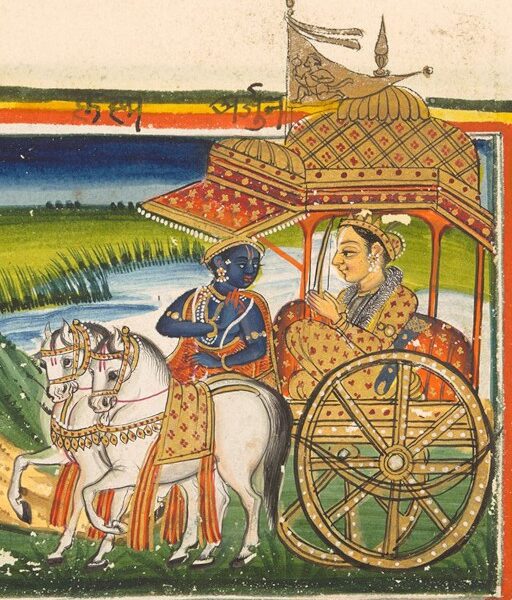
A devotee is transcendental amidst all circumstances.
A pure devotee is neither happy nor distressed over material gain and loss, nor is he very much anxious to get a son or disciple, nor is he distressed by not getting one. If he loses anything which is very dear to him, he does not lament. Similarly, if he does not get what he desires, he is not distressed. He is transcendental in the face of all kinds of auspicious and inauspicious and sinful activities. The situation may be auspicious, nice. He is not going overly ecstatic about it. And if it’s an inauspicious situation, it’s not a distress, it’s not a distraction. Hmm.
What’s the trouble?
I’m not sure how to get into it.
So he’s not worried about these things. One might say, well, Bhaktivedanta Sarasvati Thakur used to, you know, when it was time to travel and that, look, you know, see if it was the proper time or not. But that was specifically by the regular daily things. Each day has particular times of the day. So he would look at that aspect. But it’s just because then the service would go better. Right? In other words, devotional service is meant to be all auspicious because it’s about Krishna. So therefore, if the time that you would leave would be a proper time, then he wouldn’t worry about it. If the time would be not so proper, then he would make an adjustment and would leave earlier. So it was within a proper time. That’s all. But it was so that the service would go nicely. But he wasn’t worried about auspicious or inauspicious in the way of results as been before, gain and loss, you know, different things that one would be comfortable with. It was not to do with that. He’s prepared to accept all kinds of risks for the satisfaction of the Supreme Lord. So therefore, things may not be as secure as, you know, one would necessarily like. You know, they have a proper place to stay. You have this, you have that, good food or not. So you’ll take all these different risks.
Nothing is an impediment in this discharge of his devotional service. Such a devotee is very dear to Krishna. So nothing gets in the way of the service. If everything is very nice, great. If it’s not nice, still the service goes on. So such a person, because they’re always focused on Krishna and always trying to do good for Krishna, that person is very dear to Krishna.
Without good qualities, one cannot be a pure devotee.
We may find some repetition in the descriptions of the qualifications of a devotee. But this is just to emphasize the fact that a devotee must acquire all these qualifications.
So the whole point is anything repeated is important, right? Anything emphasized is important. So, like here, Krishna, not only is he repeating it, but he goes, after each one, this person is dear to me. And then against him, this person is dear to me. So he’s, not only is there the repetition, but he’s also emphasizing, you know, or he’s glorifying. Like when he says such a devotee is very rare, that’s glorification. So we see he’s using all of these elements when it comes to the qualities of a devotee. Without good qualifications, one cannot be a pure devotee.
One who is not a devotee has no good qualifications. One who wants to be recognized as a devotee should develop the good qualifications. Of course, he does not extraneously endeavor to acquire these qualifications. But engagement in Kṛṣṇa consciousness and devotional service automatically helps him develop them. So we’ve discussed before. Devotional service automatically gives knowledge and detachment, right? So there’s purification. So good qualities, which are the nature of the soul, then start to become manifest. It’s not that they’re not there, it’s that they’re covered.
And then, outside of one’s endeavor in devotional service, one does not have to try to arrange for these things. They will come automatically with devotional service. Because devotional service, being performed within the material world, is in the environment of obstacles. So there’s always going to be an opportunity to test your good qualities. You don’t have to worry that unless you make a side endeavor, you won’t be able to practice these things. No, they’ll always be there. One will always have to be humble, tolerant, respectful, unattached, like that. It’ll always come.
The next lesson describes the demoniac qualities. These qualities are already discussed in Lesson 4, as part of the intrinsic nature of a demon. Lesson 25 emphasizes that the same qualities may act as impediments for the progress of a devotee. The demoniac qualities were there. They were being discussed because someone with the divine qualities are naturally engageable in the Lord’s service, right? So there was just about what’s useful in service, what’s not, right? So then, here it’s being described, yeah, and then it was described that even someone who has those qualities, by association with the devotees, they can advance in devotional service. So now, here again they’re being described, but now how the qualities themselves are an impediment, right?
Does that make sense? So it’s two different aspects, that you understand that something can be an impediment, right? So the point is devotional service is so much more powerful, so even if one is engaged in these activities, it won’t be a…
Yeah, so you’re making the difference between that Krishna consciousness is so powerful, even if one has demoniac qualities, by association he can overcome them. But we’re not saying that these qualities themselves are not impediments. So one should be very careful to not cultivate them. Does that make sense?
Lesson twenty-five. In order to attain to the stage of devotional service, one should guard against such destructive habits as are described in Bhagavad-gita.
So here is destructive habits. That’s the point. So what’s destructive is called demoniac, and what’s aggressive, that’s divine.
So this is sixteen, four through six, nine, ten, twelve through fifteen, eighteen, twenty-one through twenty-two.
Full description.
Pride, arrogance, conceit, anger, harshness and ignorance. These qualities belong to those of demoniac nature, O son of Pītā. The transcendental qualities are conducive to liberation, whereas the demoniac qualities make for bondage. Do not worry, O son of Pāṇḍava, for you are born with the divine qualities. O son of Pītā, in this world there are two kinds of created beings. One is called the divine and the other the demoniac.
I have already explained to you at length the divine qualities. Now hear from me of the demoniac.
What is conceit?
Conceit.
I like to think it would sound very special or something. Like arrogance? It’s like arrogance, but because it’s given here as two words, there must be some difference. I would think arrogance is more of a general mood, one’s just proud, yes? I think it’s hiding your true motivation or something. Conceit. Like instead of deceit.
Conceit, that’s how it’s defined later. Because in the verse it’s called imāna, so it means I am this body. Oh, I am this body, okay. So arrogance would just be, it means your pride, it means these are all like subtleties of the same thing. Like pride, arrogance and conceit.
Pride is that you have that sense of, you know, self-worth that may be a little bit more than others. You would compare it. Arrogance would mean that you express it. You know, the conceit, as it was mentioned here, that it’s based on the bodily identity. You’re conceited because of the particular, you know, I say family, one’s from or one’s education, or something that is connected with the body. There’s something special there. That work?
So we notice that they’re all out of the…
and ignorance, all the demoniac, because they’re all elements connected with improperly understanding the position as the soul.
In other words, the controlling and enjoying tendencies that one identifies with the body instead of as the soul, and one is very comfortable with that, or even very proud of that. So that makes for the whole attitude. The identity is material, and the attitude is therefore based on that identity.
I have already explained to you at length the divine qualities. Now hear from me of the demoniac. Following such conclusions, the demoniac, who are lost to themselves and who have no intelligence, engage themselves in unbeneficial, horrible works meant to destroy the world. Taking shelter of insatiable lust and absorb the conceit of pride and false prestige.
The demoniac, thus illusioned, are always sworn to unclean work, attracted by the impermanent, bound by a network of hundreds of thousands of desires, and absorbed in lust and anger. They secure money by illegal means for sense gratification. The demoniac person thinks, so much wealth do I have today, and I will gain more according to my schemes.
He has, he’s proud, but he’s going to gain more by his schemes, not by the Lord’s grace, not by others helping. There’s no sense of gratefulness or cooperation. Even if others help him, it’s because he arranged that, it was part of a scheme.
So much is mine now, and it will increase in the future more and more. He is my enemy, and I have killed him. And my other enemies will also be killed. I am the Lord of everything.
I am the enjoyer. I am perfect, powerful, and happy. I am the richest man, surrounded by aristocratic relatives. There is none so powerful and happy as I am. I shall perform sacrifices, I shall give some charity, and thus I shall rejoice. In this way, such persons are deluded by ignorance. This element that I am powerful and happy, right? Because one is powerful means one’s in control. One’s happy means one is the enjoyer. Right? So those two must be. So if someone else is controlling or someone else is enjoying, it’s a problem, right? Unless it’s your aristocratic relatives. And of course they’re submissive to you, so therefore it’s okay.
Bewildered by false ego, strength, pride, lust, and anger, the demons become envious of the Supreme Personality of Godhead, who is situated in their own bodies, in the bodies of others, and blasphemy against the real religion. Those who are envious, right? So it means surrender to the Lord. It’s a real religion. Those who are envious and mischievous, who are the lowest among men, are perpetually cast in the ocean of material existence, into various demoniac species of life. Right? So here’s also an element. Envious and mischievous, who are the lowest among men. Also there’s that connection there, is that when we think of the mudha, we think of the lowest among men, but he’s not the one that’s powerful and successful, surrounded by aristocratic relatives. Right? Does that make sense? He’s just the duffer that’s completely absorbed in his work.
Right? So here is that element, where there is the concept that there is religion. For the mudha, he doesn’t even think of anything beyond his basic work and his day -to-day maintenance. But here is that. They’re thinking they’re doing charity, they’re doing religious acts and all that, but they’re going to do it the way they want to do it. They’re not going to do it the way they’re supposed to do it. They’re envious of the Lord because they want to be the Lord. But they’re willing to do seemingly pious activities to present themselves as something special, but they do it whimsically. You catch this? So this is lowest among men. More detail.
There are three gates leading to this hell. Lust, anger and greed.
So lust will be your attachment, your prayojana.
Anger will be your sambandha. And greed will be your endeavor. In other words, you’ve endeavored and got the result, but you just want more and more, so you just keep working. So on all three platforms.
It’s a complete program for going to hell. These are three gates. You can use either one of them, any one or any combination, but all three of them together, that’s the perfection, as Prabhu was saying here, for gliding. The other ones might be more rough. Every sane man should give these up, for they lead to the degradation of the soul. The man who has escaped these three gates of hell, O son of Kunti, performs acts conducive to self-realization and thus gradually attains the supreme destination. So then we can also understand here that these three give rise to all the other qualities. All the other qualities are simply details of these, manifestations of these.
It seems that the description of the demoniac mentality is mainly about passion, and less about… Passion? No, no, it’s a lot of ignorance, because it means anger is ignorance.
He’s whimsically doing activities, so that makes it ignorance. He’s doing a religious activity whimsically, so that aspect is ignorance. That he wants a result from it for his enjoyment, that’ll be the passion. Because passion and endeavor means you’re following the rules. When you follow the rules but for your own purpose, that’s passion. When you follow the rules because you’re supposed to follow them, that’s goodness. But ignorance will mean you don’t know what’s what and you whimsically do whatever you like. So even though it’s within endeavor, it’s still within ignorance.
So that means you’re samanda, abhidheyan, prayojana. Each of them can be within goodness, passion, and ignorance.
Even though we’ll take goodness, passion, and ignorance and identify as samanda, abhidheyan, prayojana. But still within themselves you have these, like that, you know, finer details. So it’s ignorance of ignorance or passion of ignorance or goodness of ignorance or, you know, like that.
Naturally everything would have its origin there because the normal position is love of God. So that one’s inspiration, everything… It means you become inspired because you see the goal. You need the goal that makes you endeavor. It actually brings you to the point of endeavor. So the element of the goal is always that aspect. But how you’re going… What kind of goals you’re looking for, how you’ll endeavor for them will depend upon how you see the field. Because you have to work with the field to get a result. So how you identify the field is then what will be your endeavor. So if you see yourself as servant of the Lord, that will change how the other things work.
You know what I’m saying? So if that lust is there, naturally there, or I’m the controller, that will be there. So it comes with both. The I in mind is there. Because you want mind, then therefore you have to focus on I. Or because this I is there, therefore you’re going to focus on mind. You know what I’m saying? Either one will give rise to the other. But the point is, most likely it starts with the enjoyment. But that means you become envious, which is in your situation.
So they’re kind of like simultaneously. They go together. You can’t separate. The masculine means the feminine is there. The feminine means the masculine. It’s just which one’s the prominent. But the other one will always be there. That’s what I was saying before, that arrogance, pride, conceit, basically the same thing. But which angle it’s coming from and what aspect is emphasized, then it makes a difference.
Devotee must give up lust, anger and greed. The beginning of demoniac life is described herein. One tries to satisfy his lust, and when he cannot, anger and greed arise. A sane man who does not want to glide down to the species of demoniac life must try to give up these three enemies, which can kill the self to such an extent that there will be no possibility of liberation from this material entanglement. Footnote. Sri Ramanujacharya writes in his commentary to 1621, Lord Krishna confirms that the demoniac nature is in itself a hellish condition of life, perpetuating more and more degrading hellish existence. The three portals to hellish existence are lust, greed and anger, which completely destroy and ruin all opportunity for advancing in spiritual consciousness. Lust, greed and anger are the foundations of all other vices described previously, which run rampant among the demoniac. The word dvaram means portal and gate, inferring cause.
Okay, portal and gate, inferring cause, means these are what will cause, you know, the, how do you say, the progression towards hell, right? So they’re the gates, but these gates are dynamic in that they are the cause of it.
The words nasanam atmana mean destructive and even suicidal, denoting how utterly negative lust, greed and anger are in evolving the consciousness to commune with the immortal soul.
Therefore, Lord Krishna emphasized that lust, greed and anger must be permanently abandoned, fully relinquished and completely neutralized, since these three voracious vices comprise the cause that leads the jiva directly to dreaded nāraka.
So, the soul associates with these, right? So that has to be given up, right? They’re not inherent in the soul. The soul takes up the association. So if you adjust the consciousness, then naturally you’re going to adjust the association.
When it says, kill the self to an extent that there will be no possibility, it sounds kind of final. No possibility means someone gets life imprisonment, okay? It has that sense of finale, but it’s over at some point. You know what I’m saying? So, all it is means that this will be a lot longer than other problems you go through. You know what I’m saying? Like whatever else one would consider hellish in this world, it has a sooner end. You know what I’m saying? But this kind of thing, it’s a lot longer. So because of that length of time, therefore, it basically uses that definition.
Yeah. Because it ruins all opportunities. Because whatever opportunity is there, means what’s present. You can’t take advantage of. So you’d have to wait for a long time for all that, and again, to have the opportunity. But we’re not talking here, we’re talking, can be thousands, tens of thousands, millions. We’re talking, can talk a long time.
You know what I’m saying?
One devotee approached Prabhupada that he wanted to accept another guru outside, you know, some bogus guru.
Not even a bona fide guru in another line, just somebody else that he was more attracted to their presentation.
So he’s leaving bona fide guru for bogus. And Prabhupada said he wanted blessings. So Prabhupada said, I give you a blessing that for one million lifetimes you will not meet the bona fide guru again.
So we have to understand, now that’s a long time. That’s what Ramanujacharya is talking about. You know, that’s what Krishna is talking about. The time is so long. You know, I mean, we think this one lifetime is so long. A million of those.
Right?
Sometimes a Kadasi comes along. Yeah.
But that’s worse. Especially the part between getting up and lunch.
How did you know that was worse?
I mean, after you go to sleep till the next morning, it’s generally not so bad.
The Vedic process of purification is based on giving up a lust, anger and greed. One should be very careful of these three enemies to human life. Lust, anger and greed. The more a person is freed from lust, anger and greed, the more his existence becomes pure. When he can follow the rules and regulations enjoined, oh, then he can follow the rules and regulations enjoined by the Vedic literature. By following the regular principles of human life, one gradually raises himself to the platform of spiritual realization. If one is so fortunate by such practice to rise to the platform of Krishna consciousness, then such success is guaranteed for him.
In the Vedic literature, the ways of action and reaction are prescribed to enable one to come to the stage of purification. The whole method is based on giving up lust, greed and anger. By cultivating knowledge of this process, one can be elevated to the highest position of self -realization. This self-realization is perfected in devotional service. So the Vedic culture is designed to give up lust, anger and greed. So anything that will cultivate lust, anger and greed, it’s always regulated or avoided.
So that’s the whole point. That’s why we’ll consider it to be getting in the way of things. That’s the difficulty. But it won’t get in the way. It only gets in the way of lust, anger and greed.
That’s the problem. One will generally find that the points of contention of the Vedic culture aren’t…
The piety isn’t the problem. It’s that it actually contradicts some demoniac quality, like sworn to unclean acts. So the standards of cleanliness of the Vedic culture are automatically a point of contention. One must respect authority. That’s immediately a point of contention.
Does that make sense? You have to follow rules and not be whimsical. Immediately, no, we’re devotees, we can do whatever we like. No, no, we’re devotees, we follow Guru Sabha Shastra.
Does that make sense? So then it’s always… Our difficulty with Vedic culture are the points of demoniac qualities that we have particular affinity for.
That’s where it’s going to be a problem. It’s not going to be some place that we’re comfortable with. We like regulated life, everything orderly and neat and that, hierarchy, the whole thing like that. A person like that has no problem with the Vedic culture.
Does that make sense? The problem is that if anything lacks, that’s where we’re going to find the fault.
Does that make sense? Yes. About the lust, anger, greed, in the Charya, whenever the sex desire came in his mind, he spit at the thought.
He’s a Charya, he’s one of the twelve hallwars. Okay.
So, the Jiva isn’t supposed to associate with lust, anger, greed, and not inherit in the soul? Yes. No, but the thing is, lust is a transformation of the natural love.
You know what I’m saying? So, it’s going to be applied, it’s just where you’re going to apply it.
So, Prabhupada says when there’s frustration of lust, then you get anger and greed.
So, they’re all connected there.
The point is that you’re dealing within the material world with the material mind, so it’s used to acting in a particular way. So, it comes up with… The point is, a situation is there. So, therefore, in that situation, there’s the Krishna conscious application, and there’s the application for sense gratification.
Does that make sense? So, you could take either one, right? So, the mind, you know, will bring that up.
They’re saying intelligence will identify, the mind will bring it up, but when it’s brought up, you’re not interested.
Does that make sense? Because we take it, oh, it can never come up. Yeah, that’s the neophyte’s concept. But the point is, because… Why is that? Because the neophyte thinks he’s the mind. So, if I’m the pure devotee, the mind will never think of that. No, I’m not the body.
You know what I’m saying?
So, that’s the point.
There’s a pure devotee of rebirth.
Could it happen?
Okay. Why would it happen? He’s a pure devotee, so he’s cultured, he has all the good qualities of demigods. The body does that. So, the whole point is, is the mind does that. The mind is looking for enjoyment. So, we take that opportunity for enjoyment and engage that in Krishna service.
So, it’s just the way it works. Because we identify with the body and mind, therefore, if anybody does anything with the body or thinks anything with the mind, that’s them. So, therefore, that’s the demoniac quality. Rather, the soul is pure. They’re endeavoring. Body and mind come up with all kinds of stuff.
It’s not useful. It says here, all these qualities are not useful. So, they’re avoided. But that’s why they’re avoided, because they’re not useful in devotional service. Not because they’re not good, or everybody knows they’re not good, or things like that. That’s just the social qualities that simply make things go on. If somebody is greedy, what does that mean? Less for others. And we are one of the others there. He’s greedy, so then we’re one of the ones that could get less. That’s why people don’t like greed. Arrogance. Why isn’t it socially acceptable for arrogance? We’re talking in the contemporary environment.
Because everybody wants to be special, so if someone’s making themselves more special, it reduces everybody else’s specialness.
If somebody’s angry, then it’s destructive, so it can destroy the facility you have, or someone else has, to enjoy themselves.
Does that make sense? Someone’s too controlling means you can’t control, and if you can’t control, you can’t enjoy.
Does that make sense? Someone else has more money. What does that mean? You think because he has the money, therefore I don’t have the money. You know what I’m saying? But if it actually works like that… Now the communists came in. They took over. They kicked out all the farmers. Like that. Took all their land, took all their facilities. They go into ridiculous houses, take all their stuff. Like that. So many regimes do this. And so then they give it to the people. So now, according to their philosophy, now everything should be right and orderly. Now everything should be prosperous for everybody, go on nicely and everything like this, but unfortunately communism collapsed because there was no economy. You can’t run a country when there’s no money.
Does that make sense?
Seeing that, the Chinese were very clever. They introduced economics. Kept their communism, introduced economics. So they’re running fine.
You understand? So the point is that if you gave it to everybody, now everything should be fine. They went in during the French Revolution. They sacked all the whatever Louis had. Gave it out to the people. All 23 of them. Like that. Like that. So it goes on. But why is it then there’s not prosperity?
Because it’s not about if just everybody has the same amount of money, everything will be prosperous. No, it’s the people who know how to make money then have to share it.
So the problem is if they keep more beyond what they should do. They should be giving their tax and they should be giving in charity.
And then the rest that they have, you can’t complain because they’re the ones making the money. You know what I’m saying? Okay, he needs to have millions of dollars, but he’s giving away millions of dollars. Right? If he doesn’t have millions of dollars, he doesn’t give away millions. You know what I’m saying? Normal thing is that, standard is that if I have a million dollars, then I may give 10,000. So it’s really maybe 100,000, but generally not. You know what I’m saying?
Does that make sense? So if you see opulence, unless it’s a nouveau riche, but if it’s somebody who, it’s more standard traditional families that do business. If you see money, that means they’re making so much way more than that.
You know what I’m saying? They’re not going to spend it all. Does that make sense? So that’s the point. They’re comfortable. They feel, I’m safe. I’ve got so many millions, therefore I can give away a few hundred thousand. Or I have so many hundreds of millions, so I can give away a few millions. Or I have a few billions, so I can give away a few hundred million.
Does that make sense? So that’s how it works. So the point is, the charity goes up the more they have, if the consciousness is proper.
Does that make sense? So this idea of all these different elements, then don’t work. They’re simply based on our own lust, anger and greed.
Why he has and why I don’t have. The point is, he knows how to make it and you don’t. That’s why he has and you don’t have. So why don’t acknowledge that? That won’t be acknowledged. It’ll simply be presented as some very lofty, you know, kind of human ideal. When it’s not, all it is is, I’m envious because he has and I don’t have.
Do you know what I’m saying?
So it’s the intelligence being controlled by the mind. Yes. Intelligence being controlled by the mind. One will notice, who arranges these big charity dinners?
Wives. Wives, okay. But wives with money or wives without money? Wives with money. Yeah. Wives with money invite other wives with money and then they bring their husbands along with a checkbook. Right?
Does that make sense? So the people with money, they’re cultivating other people with money to give money in charity. Right? It’s not organized by some poor people.
Do you understand? So the normal thing is, is those with money will give in charity if they’re properly trained.
Right? So this person without money to complain that why he has money doesn’t match.
Is it that if they don’t give in charity, they lack identity? Lack? Identity. That just means their greed or their attachments and stuff are hard. In other words, there’s lack of training, so there’s not enough good quality. No, no, what I’m saying is the motivation to arrange all these benefits and dinners and stuff is part of identity. Identity, yes, because we’re religious, we’re charitable, we’re good people, like that. So you don’t want to be the only one doing it. Because you want to do it, you want to make sure everybody else is doing it. You know? You know the same kind of thing. I like wearing like what I wear, so therefore I’m comfortable if only everybody else is wearing that. So then I’ll try to create that. Does that make sense?
In that devotional service, the liberation of the conditioned soul is guaranteed. Therefore, according to the Vedic system, there are instituted the four orders of life and the four statuses of life called the caste system and the spiritual order system. There are different rules and regulations or different castes or divisions of society. And if a person is able to follow them, he will be automatically raised to the highest platform of spiritual realization. Then he can have liberation without a doubt. So they’re meant for… The Varanasi system is meant to elevate yourself to the platform of liberation.
Just by following it, whether one’s a devotee or not, it will elevate one to that platform.
But for the devotee, then the same activities, those are the activities of devotional service. Does that make sense? Yes, no? It means if this is a reflection, then the activities of the spiritual world are the activities of the Vedic system.
Right? You follow that system to please Krishna, it’s devotional. Right? So it gets you to the planets of interaction where they’re following that culture. If you don’t do it for Krishna, he will get you out of the material world because they’re not activities of the material world. Right? The demoniac world, these are the activities of the material world. He’ll get you out to the spiritual platform, but not to the devotional.
Does that make sense?
Okay. Footnote. Srila Sridhar Swami writes in his commentary to 1622, the special result of renouncing lust, anger and greed is being stated by Lord Krishna in that such a person is able to acquire the mental understanding that develops the consciousness to the point where spiritual pursuits become attractive and desirable. For example, vegetarianism, the practice of yoga, meditation, fasting and celibacy.
Thereby one gains the process of purifying himself enough to gain the association of the Vaisnavas who are Lord Krishna’s exclusive devotees and will guide one to embark upon the path of devotion for the ultimate benefit.
Okay. So Sridhar Maharaj is pointing out here that by renouncing lust, anger and greed, through practice of the Vedic culture, then it cultivates the mental understanding and the consciousness to a point where these good divine qualities become attractive.
In other words, if lust, anger and greed are too much, one is not attracted by the divine qualities. And the divine qualities are very useful in devotional service. So the Vedic culture is designed to cultivate the divine qualities by controlling the mind.
So in other words, the Vedic culture creates an ideal situation for one to perform devotional service within. It’s not devotional service, but it provides an ideal environment, an ideal atmosphere. That’s why it’s recommended.
Vrti. Lessons 21 to 25 can be taken as describing the qualifications of the bona fide spiritual master. The spiritual master is purged of all vices as a result of the transcendental training he has received. He has strong faith and realized knowledge and can therefore accept and apply Sri Krsna’s last words.
Lessons 21 to 22. Such a spiritual master is rare and very dear to Krsna because he is freed of destructive habits. Oh, that’s… Okay. Oh, those were… No.
Such a spiritual master is rare and very dear to Krsna because he is freed of destructive habits and possesses attractive qualities.
Okay, that’s Lessons 20. Does that mean that what was said before is less… What’s in the brackets?
Okay, so he actually probably didn’t move the period on the other side because otherwise you’d think it’s the next. Okay. Next, Lessons 26 to 35 describe the process of devotional service from the stage of bhajana -kriya onwards. That is to be followed under such a bona fide spiritual master. Okay? So the spiritual master has the good qualities that are mentioned. He lacks the bad qualities, right? And so we also have to come to that stage. So now these next things, 26 to 35, describe how by following the instructions of the spiritual master we can develop those qualities and come to that divine platform. Does that make sense? Yes. Maharaj, is it for a disciple?
Before becoming a disciple, if a devotee wants to check, for example, the spiritual master, he can check according to these three qualities. Yes, like that, but best is… It means yes, by that, those are the bases, but one can look at all the others because one also has to know how that’s defined.
Does that make sense?
Defined means, what do you mean by lust? He likes taking prasad, so is he lustful? Because some devotees will say taking prasad is sense gratification. It’s not devotional service, it’s sense gratification. Therefore, you should be eating prasad you don’t like.
Yeah, yeah. You know what I’m saying? Then it’s devotional service. Then it’s spiritual, otherwise it’s material. So you get many kinds of misunderstandings of what is sense gratification. What is mental speculation?
Does that make sense?
So one has to be careful in looking at this. In other words, there has to be maturity. At the same time, the spiritual master is also checking the disciple. If the disciple lacks the maturity to appreciate the qualification of a spiritual master, he may also seem to be unfit. So it goes both ways. How you evaluate also would have an influence on what are your qualifications, or be indicative of your qualifications.
Does that make sense? Like that. Same with the spiritual master. His evaluation of your qualification is you’re rich. Then there may be a lacking in his standards.
Like that. Does that make sense?
Yeah. So like that, then.
It both has. So your qualification is determined by what standards you’re judging others by. Like that. Does that make sense? You know, so like we see here, one is a friend to all living entities. So that means he sees everyone as servant of the Lord, whether they recognize it or not. So that he uses that as a standard to judge other living entities, that’s his qualification.
You know what I’m saying?
Like someone has authority issues, so he likes a guru that doesn’t exercise any authority. Right?
So then he’ll consider that good, but that’s also his disqualification. You know, someone else appreciates the authority, so that’s his qualification.
Does that make sense? So another thing is on culture, but just the authority is established or not. They let you do whatever you want or not.
Does that make sense? So that can be our qualification or disqualification.
Right? In other words, our own values, we’re using that to judge others with.
But now the point is, are our values divine?
You know, if they are, great. But if they’re not, it might not work out so good.
Yes?
Question regarding mental stipulation and philosophical stipulation.
So previously I heard from some devotees that we should not do mental speculation, but we can do philosophical speculation. But in yesterday’s class, page number 9, it is mentioned that it is subject matter for the devotee only, not for the philosophical speculators. Yeah. Now see, what they’re trying to do is that they’re not… Mental speculation means the mind is accepting various ways to apply something that didn’t work. Right? It means, in other words, the intelligence… Why don’t we call it intellectual speculation? Because the intelligence just observes what’s available, but makes no choice. Right? The mind is what makes the choice. Does that make sense? So the point is, the mind is speculating, because there’s ten options. So this one looks the best. You try that. It didn’t work. Okay, let’s try the next option. Let’s try the next option. The next option will make us happy. No, no, that was wrong. The next one will make us happy. So that’s mental speculation. Right? So the point is, that mental speculation can be based on Shastra or not. You know, it can be for the purpose of pleasing Krishna or not.
Right? So if it’s based on Shastra to please Krishna, it’s not called mental speculation. It’s called contemplation. Right? But if it’s not based on Shastra, not for devotional service, then it’s called mental speculation.
Okay, lesson twenty-six. One can begin to practice such devotional service under a bona fide spiritual master. And by doing so, one can gradually revive this God-consciousness, even in this mundane world. So in other words, what was described before, but just to contrast so you know, then the demoniac is given. So that’s to be avoided. There’s always yama and niyama. Right? What shouldn’t be done, what should be done. Right? So now, having described them both, now it’s like such devotional service means what was described that should be done. Now that can be practiced under the bona fide spiritual master. So it’s still that same point, by associating with Krishna and His instructions, one can advance. Right? But that’s done by the association with the spiritual master.
Right? Does that make sense? So it always comes back to that. So then, that practice, practicing like that, the devotees have these qualities. You should appreciate those and try to practice your devotional service according to that.
Right? So even in the mundane world this can be done. 7.16 Best among the Bharatas, four kinds of pious men begin to render devotional service unto Me. The distressed, the desire of wealth, the inquisitive and he who is searching for knowledge of the Absolute.
Right? So beginning devotional service, so one can start from these points. By the mercy of the pure devotees, the pious also become pure devotees. Unlike the miscreants, these are adherents of regulated principles of the scriptures and they are called Supatina, or those who obey the rules and regulations of the scriptures, the moral and social laws, and are more or less devoted to the Supreme Lord. So that’s the thing. But they, you know, may or may not know so much. Right? They may or may not have material desire, but the point is, is they’re willing to follow scripture. You know, they have a devotion to the Lord. Right? So that makes the common, the foundation.
These are not pure devotees because they have some aspiration to fulfill in exchange for devotional service. Pure devotional service is without aspiration and without desire for material profit. When these four kinds of persons come to the Supreme Lord for devotional service and are completely purified by the association of a pure devotee, they also become pure devotees. On the whole, when the distressed, the inquisitive, the seekers of knowledge, and those who are in need of money are free from all material desires, and when they fully understand that material remuneration has nothing to do with spiritual improvement, they become pure devotees.
As long as such a purified stage is not attained, devotees in transcendental service to the Lord are tainted with fruitive activities, the search for mundane knowledge, etc. So one has to transcend all this before one can come to the stage of pure devotional service. So, as a starting place, it’s fine, but it has to be transcended at some point to come to the pure platform. Right? So the idea of Mr. Bhakti is all right as a stage to pass through. It’s not all right as a standard.
Right? But, trying to obtain the standard, one may be applying…
How do you say?
…mixed devotional service. Right? Does that make sense? So it’s not that, oh, it’s mixed devotional… bogus and not a devotee, this, that, blah. Does that make sense?
7.17 Of these, the one who is in full knowledge and who is always engaged in pure devotional service is the best. For I am very dear to him, and he is very dear to me. The jnani is the best amongst the pious. Right? So the jnani is different from the inquisitive. The inquisitive, you know, we would consider to be more on the jnana, you know, the path of jnan, like that, because they’re attached to knowledge, while the jnani, defined here, is attached to Krishna. Right? So that’s what makes the difference.
For I am very dear to him, and he is dear to me.
Free from all contaminations of material desires, the distressed, the inquisitive, the penniless, and the seeker after supreme knowledge can all become pure devotees. But out of them, he who is in knowledge of the Absolute Truth and free from all material desires becomes a really pure devotee of the Lord. So now we have pure devotees and really pure devotees.
And of the four orders, the devotee who is in full knowledge and is at the same time engaged in devotional service is, the Lord says, the best.
Right? So you have proper knowledge and engage that in Krishna’s service, that’s the best. Because he may be engaged in service, but not have proper knowledge, or have proper knowledge but not engage in devotional service. Someone who has both, right, is the best.
By searching after knowledge, one realizes that his self is different from his material body. And when further advanced, he comes to the knowledge of impersonal Brahman and Paramatma.
When one is fully purified, he realizes that his conscious constitutional position is to be the eternal servant of God. So by association with pure devotees, the inquisitive, the distressed, the seeker after material amelioration, and the man in knowledge all become themselves pure. But in the preparatory stage, the man who is in full knowledge of the Supreme Lord and is at the same time executing devotional service is very dear to the Lord. He who is situated in pure knowledge of the transcendence of the Supreme Personality of Godhead is so protected in devotional service that material contamination cannot touch him. Eight. Footnote eight. In his commentary to this verse, Srila Baladeva Vidyabhusan describes the special position of the jnani as follows. The Lord says, Among the four, the jnani is considered the best because he is nitya -yukta and eka-bhakti.
Nitya-yukta will be… Okay, he’s going to define it. Having given up desires such as getting relief from suffering, getting wealth or gaining knowledge of atma, he is serving me constantly. Nitya-yukta. Because we can say, I’m doing service. But the point is, there’s the element that what we’re doing for ourselves, at that point we’re not serving Krsna. Right? Maybe Krsna is included, but it’s not nitya. Right? Because sometimes you think what you’re going to get out of it. It’s not always. So always means you only want to please Krsna.
Does that make sense? So he’s given up all these other motives. Relieving of suffering, getting wealth or getting knowledge of atma. Right? Then he becomes… Then that’s nitya-yukta. Right? Eternally yukta, connected.
The others engage in service as long as they attain their desires. Right? As long as the situation is prosperous or peaceful or like that, then they’ll consider. But as soon as then, you know, some disturbing situation comes up and it’s not comfortable emotionally or facility-wise or knowledge-wise, then they may leave. Yes. Maharaj, what is desire for getting knowledge of atma? Desire for getting… It means it’s interesting, knowing about the soul, knowing about all these different things. You just like, you know, hearing newer and newer knowledge. So it’s not about applying the knowledge. It’s about learning the knowledge. That’s why it’s said it’s not nitya-yukta. Because you’re engaged in those activities, not as service to Krsna. It’s just your interest. But the point is, on the material platform, you may not get these answers. So you turn to the Lord for these answers. And so those… One, by associating with the pure devotees, then one comes to that stage of pure devotion. Right? But it’s also said within that, the one who knows the Lord and is engaged, that’s even better. You know what I’m saying? Because the person who’s interested in money or, you know, that peaceful situation, that emotional, you know, what they’re comfortable in, then they may perform devotional service. They come to the pure devotional platform. And they’re performing service. Right? But they don’t have that knowledge. So that may continue nicely or may not. Right? Or the yajnas… He has knowledge about the Absolute Truth as going on and studying. But his engagement in the devotional service may not be as ideal.
Right? But when both are there, then that’s the really pure devotee.
What does it mean when Krishna says that nor long for… Like when he says about illumination, nor long for them when they disappear? What disappears? When the illumination… When the lights go out.
Or when the sun goes down on Venice Beach.
Are you sure you’re quoting it properly? Well, I don’t know the full verse, but he says three things. Something… Something and something. Something, something and illumination. And illumination. But the point is, what about the illumination? Maybe it has to be attached to it when it’s there, or long for it whenever they disappear. But are you sure illumination is one of the ones that disappears? Yeah. You’re sure? Yeah. Positive? Yeah. Definitely. No doubt. No doubt. The point is, illumination means that you understand something. Oh, wow. It becomes very clear. But when things aren’t clear, you still depend upon Krishna. Right. So if things are clear or not clear, still you depend upon the Lord. Because, you know, He is all knowledge and that. So, therefore, whatever you need to know and understand that Krishna will arrange. But it’s not that that’s what’s comfortable for you, because for some people having a comfortable physical situation, someone else is comfortable emotional, someone else is comfortable intellectual.
You know what I’m saying? So, in other words, whether the situation is comfortable or not, then you’re still doing your service. Yeah, that’s right.
I mean, if that goes away, if that, oh, I don’t know, then it’s like I can’t proceed, you know, I can’t see how it’s… Yeah, but devotional service still works, because it’s not by our intellectual prowess that we’ll understand everything. Does that make sense? Because we have to understand the knowledge of Krishna, you know, it’s vast, right?
But the problem is, is that we’re thinking that by our own intelligence we’ll understand this vastness. No, it’s by what Krishna reveals.
You know what I’m saying?
So, if one’s enamored by vastness, then it’s a problem. The point is, what’s useful knowledge and understanding, you know, who I am, who’s Krishna, what’s my relationship, and how do I engage in service, that aspect of this vast knowledge is useful. Otherwise, just, you know, vastness just means the opportunity for mental speculation.
The others engage in service as long as they attain their desires. The jnani has unmotivated devotion only to Me. The others engage in devotion to Me because I fulfill their desires. Therefore, the jnani is the best.
I am the object of love for the jnani. He, immersed in the nectar ocean of love for Me, does not seek anything else. He limits himself only to love of Me. Since I am endowed with qualities such as omniscience and unlimited powers, which no one can completely describe, and this jnani is the object of affection for Me, according to the rule, ye yata mam prapadyante, as they surrender to Me, I respond accordingly. I am also limited to loving only Him.
6.3. For one who is a neophyte in the Eightfold Yoga system, work is said to be the means. And for one who is already elevated in yoga, cessation of all material activities is said to be the means.
A devotee is more advanced than the mystic yogi.
Concerning the Eightfold Yoga system, attempts in the beginning to enter into meditation through regulated principles of life and practice of different sitting postures, which are more or less bodily exercises, are considered fruitive mental activities. It’s fruitive activities, but on the mental platform.
That’s why you can take yoga and connect it to karma.
All such activities lead to the achieving perfect mental equilibrium to control the senses. When one is accomplished in the practice of meditation, he ceases all disturbing mental activities.
A Krishna conscious person, however, is situated from the beginning on the platform of meditation because he always thinks of Krishna. And being thus constantly engaged in the service of Krishna, he is considered to have ceased all material activities. So the yogi, he’s starting off with material, performing all these bodily exercises, breathing exercises, all the different things. That’s his focus. And then when he becomes good at that, then he stops all that and just engages in meditation.
But the devotee is already meditating from the beginning. He’s already doing things for Krishna. His meditation may not be, how do you say, samadhi. But the point is he’s meditating on Krishna. So he’s already doing what the yogi can only do once they get to that advanced platform right from the beginning.
Is that so? Yes? When the yogis, so-called yogis, sometimes they say that the devotees, they’re not really meditating because they’re not peaceful. Sometimes they’re walking and talking. Yes, but the difference is this. One could say that, but one could also then look at it, no, the devotee’s in a higher position of meditation because they can only meditate if the situation they’re in is ideal and perfect. Out of the way, quiet, no one disturbing, no other activity, nothing. But the devotees can still do meditation while all these activities are going on because they take the symptom if the body is peaceful, then the meditation is right. But the point is this. No, it means you can meditate on all this. The businessman, though, involved in so many meetings and discussions and seems very passionate, but he’s meditating on one thing. He’s going to get his profit. Like that, the army general’s out there and he’s meditating. He’s going to win this war. So the point is this. The idea is meditation is supposed to be on the supreme. That’s why it’s called yoga. It’s connected with the supreme. But here, they have to do it in a peaceful environment. For devotional services, you can do it in an active environment.
Does that make sense? They can’t understand because they’re looking for certain symptoms. What they don’t understand is, no, this yoga system is more advanced because it can engage activities where the other one can’t. If they’re doing activities, they don’t meditate. If they’re meditating, they don’t do activities. But devotional service, you can do both at once. Then, of course, how much meditation is there? Then one would say, no, but we’re getting more meditation. Is it? Because you can only meditate when you’re not doing anything. So how many hours are you meditating? Right? So, depending on what they are, then if they’re at a yoga ashram and that, then a few hours a day. So what do they do the rest of the time? Because according to their system, they’re not meditating. You know what I’m saying? So that means, then, like that. But the devotee, you take his meditation and spread it out throughout the whole day, it’ll come up to be the same, if not more. And as he matures, it becomes more and more and more. Because otherwise, in their system, according to what they’re practicing, they’re not going to get past a few hours anyway.
That’s why, you know, in some of these ashrams, then they, you know, they talk karma yoga. Because they can’t meditate all day. You know, the Zen guys can handle, I think, seven hours of staring at a wall. That’s all the more they do. Right? Because even you hear about them doing that, that’s not all they do. They also do martial arts, or, you know, arranging flowers, or, you know, farming, or they do something else. Because that’s the maximum they can do. So they can still, it’s less than a third.
Does that make sense? So, that’s the maximum. But we can get up to 24 hours a day. In all activities, all anything. So our system is much more efficient. So right from the beginning, anybody can start the process of meditation. Because you’re doing it for Krishna.
Does that make sense? Right? So it’s automatic. You can understand it’s a superior system. It gets more. It gets 24 hours a day. They can say, no, but our system gets 24 hours a day. Who do they know that’s ever gotten to that platform?
You know what I’m saying? So, the thing is, it’s nice, but no one they know is on that platform.
Because when the sangha yoga talks about it, the guy is, you know, the picture that we have, of that guy that’s just all skin and bones covered by creepers and all that. That’s the guy that’s 24 hours a day meditating. Right? You know, nobody else is. So unless they know a guy like that, then it doesn’t happen.
Maybe more Shiva. No, but then he’s talking with his brothers, Kumaras, Narada Muni, you know, so like that. So, he’s not doing that.
So he’s engaged in devotional service.
Because he’s talking about the Lord, you know, or being engaged in activities connected to the Lord. So actually he’s following the yoga, but devotional yoga.
He’s not, you know, a sangha yogi.
Yes. Kumaras? Yes. I’m just about this business man, an army general, meditating on one goal. So that’s because they are interested in certain things. Yeah, but my point is, is meditation is possible while you’re doing activity. You know what I’m saying? Because here, the yoga system is, is you can’t meditate when you’re doing activity.
But here we’re pointing out is that, though the principle, it can be done. So if it can be done there, why can’t it be done in the Lord? Point is, is they have great, great desire for that activity, or the results of that activity. So if you have great desire to please the Lord, why one wouldn’t be able to meditate upon the Lord all day? So, so for, for, because that’s their, that’s their area of interest, their, you said their interest. Yeah, so if God’s your area of interest, then you can be absorbed all day. But for the neophyte devotee… But the neophyte devotee, how much is he materially absorbed? You bring me that, that army general, and we teach him samsara, and you, you watch how he does it.
He’s not going to be spacing out.
You know what I’m saying? Regulated. Huh? Regulated. Yes. Right? He will be like that.
Because that’s why they’re successful. They’re regulated. They accept authority. They understand the science that they’re dealing with. They understand without endeavor you get no results.
You know what I’m saying? They don’t ask a question about laziness. It doesn’t even cross their mind. You know, it’s just not part of it. It’s like, you know, to them, you know, it’s not, it’s not something you would consider, you know, like, you know, eating a bicycle or something. It’s just that you wouldn’t consider it. You know?
So, so according to what? That was no, we were not inferring any insult to Guinness and his friends like that. Because I think they’re from your part of the world, right? You mean the world backwards? Yeah, yeah.
Bicycle eating? Yeah. And I’m talking about the army general. The businessman won’t be interested in that. Yeah.
And according to one’s level in Krishna consciousness, then one can, like, meditate, you know, I’m going to distribute a lot of books because I, you know, I want a lot of money or I want prestige and then later one can offer to… Yeah, but what is he meditating on? So therefore, it’s as pointed out here, it’s not, it’s not ekabhakti.
Right? Because it’s about other things. And it’s not nityayukta.
So, but the point is, if there’s connection to Krishna, he’s sometimes meditating on Krishna, even though he has these other distractions. And I’m saying you take all of his time that he does think of Krishna, then, you know, it will be as much if not more than that yogi who sits down and does his meditation.
Because the guy sitting down and doing his meditation is not exactly focusing on his omkara there, you know, he’s thinking about so many things.
So even if it’s not one goal exactly, but many goals… But as long as Krishna is one of them, it’s progressive. But if Krishna is not one of them, then it’s basically useless. Yeah.
Thanks. Okay.
Okay, 6.4. A person is said to be elevated in yoga when, having renounced all material desires, neither acts for sense gratification nor engages in fruitive activities.
Only a devotee is perfectly detached from sense gratification. When a person is fully engaged in transcendental loving service to the Lord, he is pleased in himself. Thus he is no longer engaged in sense gratification or in fruitive activities. Otherwise, one must be engaged in sense gratification since one cannot live without engagement.
Without Krishna consciousness, one must be always seeking self-centered or extended selfish activities. But a Krishna conscious person can do everything for the satisfaction of Krishna and therefore be perfectly detached from sense gratification. One who has no such realization must mechanically try to escape material desires before being elevated to the top rung of the yoga ladder.
So by association to devotees, one gets that realization. So one can practice devotional service. But if not, then this yoga ladder, then they have to, the karmas, the jnanas, the yogas, then they’re going to have to mechanically try to get rid of the material desires. And then having gotten rid of them, then they’ll be able to qualify themselves for taking up the devotional service. Not that their lack of it is what generates devotional service. No, by their lack of it, then they’re able to appreciate the qualities of the devotees and their instructions that, applying, will make them advance in devotional service.
Yoga ladder, is that basically Shraddha Tukam? No, yoga ladder means karma yoga, jnana yoga, jnana yoga, bhakti yoga. It would seem that a devotee wouldn’t naturally take those steps like that. No, because he goes to bhakti yoga. But bhakti yoga includes karma, jnana, jnana, yogas. So that’s why they’re studied separately. So that you know how to combine them. So it’s not a ladder in the way that we take one step, then another step. It means if you’re talking a very long process over thousands of lifetimes, then you may be talking that he’s a karma yogi and then he goes and takes a jnana and yoga and then is able to surrender to the Lord. But at the same time, we would rather deal with a karmi than a jnani? No, in this case, we’re talking about jnanis, we’re meaning mayavadis. You’d rather, you know, deal with the gross materials than a mayavadi. Right, because the gross materials is only going to influence on temporary sinful desires, right? But the mayavadi, you know, it destroys one’s identity, one’s opportunity to surrender to the Lord. And the karmi is engaged, so we just have to engage Shankara Krishna instead of him. But what about the jnani then? Who is he in this context?
It means it depends upon how you’re defining it. But the jnani would be one who is through the Upanishads, and there’s the Vedanta, he is trying to detach himself from material energy, but his focus is on applying the knowledge to detach himself, rather than the karmic, who’s engaging the activities, you know, and giving it the fruits of the activities.
My doubt, I think, is that it seems to me that the closer you get to the actual top step, the bhakti step, the more difficult it would be to change. I mean, if you’re a yogi sitting in a malaise doing all this meditation, and a devotee comes along, you wouldn’t necessarily find… It’s rare. I mean, I’ve met one devotee, I have one godbrother, he was a yogi, like we talked about, you know, the matted hair, this much, you know, walking around, the gopins and all that, and he was in… He used to live in the forest for like, I think, 10 or 12 years. He built himself a little thing there, you know, from local stuff there, and he had a trap door. It’s on the bottom, you don’t put it anywhere else, you put it on the bottom. It opens only inwards, not outwards, and you sit on it. That way then the tigers and other things can’t open the door, you know. And he used to have… The monkeys used to bring him fruit and stuff, so he seemed to have quite a rapport there. And he may have had a geetha or something like this, but somehow or another, at some point, he ran across a BTG. How, I don’t know, but somebody must have been walking through and left it in the forest. He found that, he read that, he was convinced, and wanted to meet Prabhupada, so the address was there in Vrindavan. So then he, you know, left his forest and walked up to there, you know, so he came into the temple and, you know, was asked where Prabhupada was. And so taking one look at him, then they decided, well, I don’t know if Prabhupada wants to meet this guy. So, you know, he had to go shave up and everything like that. So he did, and then he met Prabhupada and he joined.
That’s the only one I’ve heard of on that level. So the point is, if one is meditating on the Supersoul, you know, therefore a worshipper of Krishna, then it won’t be a difficulty. But if one is interested in merging into the Supersoul, then they would have a lot of problems. So forgive me if this is a stupid question, but what’s the use of the term the yoga ladder then?
Because from karma you’re going to get tired of fruitive activities, so you’re going to take up renunciation.
Right? And the renunciation, I guess your point, then you can take up meditation. So it’s a natural progression. You know, just like you’re here in the samsara, it just goes around and around, it just works in a way. You’re impious, then you get tired of being harassed by material energy, so you start to become pious. Then when you become very pious it gets better and you get more inspired, then you have so much facility, you get proud of that, so you start developing all the demoniac qualities. So then you come down again.
Isn’t it easier to remain like Karmi and then hopefully run into the devotees? But the point is, is you don’t know where hopefully you’re going to run into. No, no. But the other process, we’re talking millions of lifetimes possibly. Yeah, but it says karma is also a lot of lifetimes. The point is, is the living entity’s been here for a long time, so where they are in this. But the point is, is you have to know what is higher than what. Yeah. You know what I’m saying?
It’s a matter of just like, is algebra higher than arithmetic? No. But you have to work out your groceries and how much you have to pay, what you’re going to use.
But algebra is higher. Why would you settle for something lower? Right. Yeah. So the point is, is that acceptance of that, it’s whatever is applicable for the devotee then whatever is applicable, karma, jnana, dhyana, is what is used.
But you have to know is there’s a hierarchy to get up to that point.
Does that make sense?
Right. Can you do arithmetic? I mean algebra if you don’t know arithmetic. No. Right. So that’s the whole point, is it means the bhakti means you understand karma, jnana, and yoga.
Yeah, but you don’t have to go through jnana, dhyana. Yes, you do. The devotee who first comes to the temple, as you sit down, and gets right into the things, and philosophically, he washes pots. Right? And then after a while, the philosopher needs something he does like that. So he goes through it anyway. But it’s just where the emphasis is. The other one, the emphasis is complete. So he’s only doing karma, only doing jnana, only doing like that. I think I got it now. Okay? So we don’t emphasize this yoga lab in our study. But the Gita goes through and explains it. The Prophet explains it. But it’s not a major principle of our study. I was speaking with one devotee who teaches, and we agreed that many who use this term maybe don’t really realize what it means. No, they don’t. They agree that neither did we. Yeah.
No, but it’s… Some of you emphasize it a lot, because it is a point being made. Prabhupada uses it. He uses this top run of the yoga ladder, so he’s making this point. Like that. Because these first… Your third through sixth chapter are talking about the yoga systems. You know, so third chapter is karma yoga. Right? Then fourth chapter is jnana. Then fifth chapter is combination of karma and jnana. Right? Sixth chapter is jnana. Right? So there is a ladder.
Right? And so you’re meditating on Supreme Lord. Then, who is this Supreme Lord? Then seven through twelve describes bhakti. So there’s a natural ladder.
Sixth five. One must deliver himself with the help of his mind and not degrade himself. The mind is the friend of the conditioned soul and his enemy as well. One should be trained to focus the mind on Krsna.
The purpose of the yoga system is to control the mind and to draw it away from the attachment to sense objects. So that means the yoga system means all the… you know, all the different parts. So here it’s being taken as that there’s one yoga system and that it has all these different levels. Right? It is stressed herein that the mind must be so trained that it can deliver the conditioned soul from the mire of nescience. In material existence, one is subjected to the influence of the mind and the senses. In fact, the pure soul is entangled in the material world because the mind is involved with the false ego which desires to lord it over material nature. Right? The soul is associating with the contaminated mind. Right? Because he wants to be the lord of material nature. So the mind will come up with all the different ways that you can consider that I am the lord of material nature.
So the yoga system controls it. You want facility. Yes, you can get the facility, but through this regulation. And so many other people have to benefit from it. You have to worship the Supreme Lord. So the jnana yoga… Also, you like knowledge. You like that. So you must study. But you have to apply that into your life so you become detached from everything and you have to start understanding the connection with the Supreme. The jnana, you have to meditate upon the Lord. So they’re all controlling the mind so that it’s not engaged in useless activities.
Right?
Therefore, the mind should be trained so it will not be attached by the glitter of material nature. And in this way, the conditioned soul may be saved. There’s a glitter. Because that’s the Lord’s, how He’s entered us. It’s a glitter. Like that. The Bhagavatam mentions that glitter, though in the darkness. So material energy is ignorance, it’s darkness. But there’s this little kind of glitter to it. Like that. Does that make sense?
One should not degrade oneself by attraction to sense objects. The more one is attracted by sense objects, the more one becomes entangled in material existence. The best way to disentangle oneself is to always engage the mind in Kṛṣṇa consciousness. The word he is used for emphasizing this point, i.e., that one must do this. I wasn’t sure if it was a typo or if that was accurate. The word he.
Yeah. So one must do this, one must engage the mind. You do that, everything works nice. Because the mind is what makes the choice. So if the mind is making the choice in Kṛṣṇa consciousness, then it’s beneficial. But if the mind is making the choice not in Kṛṣṇa consciousness, not beneficial.
6.6. For him who has conquered the mind, the mind is the best of friends. But for one who has failed to do so, his mind will remain the greatest enemy.
Because the best of friends, it will always be attached to Kṛṣṇa. But if it’s not attached to Kṛṣṇa, it will be its greatest enemy, because that will be what gets in the way. We’ll say this one was the cause of that, that was the cause. No, it’s the mind that’s the cause.
By performing devotional service, one automatically controls the mind. The constitutional position of the living entity is to carry out the order of the superior. As long as one’s mind remains an unconquered enemy, one has to serve the dictations of lust, anger, avarice, illusion, etc. But when the mind is conquered, one voluntarily agrees to abide by the dictation of the Personality of Godhead, who is situated within the heart of everyone as Paramātmā.
Real yoga practice entails meeting the Paramātmā within the heart, then following His dictation.
For one who takes to Kṛṣṇa consciousness directly, perfect surrender to the dictation of the Lord follows automatically.
In other words, someone who means these other processes will be slow to get to that point, for one who takes up devotional service, who surrenders to Kṛṣṇa as his yoga practice, then automatically it comes that he has surrendered to the Lord’s direction, what the Lord says to do.
6-7 For one who has conquered the mind, the Supersoul is already reached, for he has attained tranquility. To such a man, happiness and distress, heat and cold, honor and dishonor are all the same, because the Supersoul is giving direction. It says He directs the wanderings of all living entities. So, if you are surrendered, if the mind is conquered, then you can follow the direction of the Supersoul, so He is reached.
Otherwise, then the mind has other things to think about, and so it will not be the direction of the Supersoul.
A devotee attains the state of practical samādhi, absorption in the Supreme. One has to abide by superior dictation. Once one’s mind is fixed on the superior nature, he has no alternative but to follow the dictation of the Supreme.
The mind must admit some superior dictation and follow it. The effect of controlling the mind is that one automatically follows the dictation of the Paramātmā, or Supersoul, because this transcendental position is at once achieved by one who is in Kṛṣṇa consciousness.
The devotee of the Lord is unaffected by the dualities of material existence, namely distress and happiness, cold and heat, etc. This state is practical samādhi, or absorption in the Supreme. Practical meaning that one can do it, engage in practical activities. The other is practical, means you actually get there, it actually works. So superior dictation is there, so that’s why one’s trying to get to the Supersoul. So it’s his dictation, and that dictation then comes to us through the spiritual master. So accepting that, one has already attained the Supersoul.
One’s attained the direction of the Lord, if one’s accepted the direction of the Lord. Can we say that the mind stands in between the soul and the Supersoul?
Practically, yes. In reality, no, because the soul and the Supersoul, they’re what’s next to each other. The mind is the foreign element, but because the living entity identifies with the mind, then yes, the mind is what’s in between.
So now if the mind becomes purified, then we are able to appreciate the Lord in a certain mode of transcendental senses. But otherwise, then the mind will engage the senses in something else.
So it’s a problem. So he’s actually not in between, but we’re putting him in between. We’re putting him in between. Because the point is, the soul naturally has a purified mind, purified intelligence and senses, but we accept these coverings. So the coverings come in between.
Because otherwise, the soul and the Lord, that’s a direct relationship. But we’re covered, so that comes in between. So then accordingly, as we surrender, depending upon that covering, that’s how Krishna reciprocates. So when we deal with him without coverings, then he reciprocates directly. When we deal with him through coverings, he reciprocates through these coverings. Like we want money, that’s a covering, right? So he reciprocates through that.
Does that make sense? So we put it there, it doesn’t have to be there. That’s why it’s mentioning the direct process, and just surrendering that, because then you don’t have to work through that intermediary.
That work?
Well, when it’s hot, you don’t wear chudders in that, and when it’s cold, you do. So why are you doing that?
So? Why protect the body?
Service for? Okay, Lord. Because in India, when you say you do service, it means you have a job.
Okay?
So therefore, then, he’s unaffected. Because he’s only involved in that because it’s connected to the Lord. It’s a nice situation, he serves the Lord. It’s not nice, he serves the Lord. He’s in an honored position, he does that. He still serves.
He’s always absorbed and consistent in his service to the Lord.
Okay.
Sixth Eighth. A person is said to be established in self-realization and is called a yogi or mystic when he is fully satisfied by virtue of acquired knowledge and realization.
Such a person is situated in transcendence and is self-controlled. He sees everything, whether it be pebbles, stones or gold, as the same.
One should follow the instructions of a person who is in Kṛṣṇa consciousness. Person or person? A person. A person, okay.
This Bhagavad-gītā is the science of Kṛṣṇa consciousness. No one can become Kṛṣṇa conscious simply by mundane scholarship. One must be fortunate enough to associate with a person who is in pure consciousness. A Kṛṣṇa conscious person has realized knowledge by the grace of Kṛṣṇa because he is satisfied with pure devotional service. By realized knowledge he becomes perfect. By transcendental knowledge one can remain steady in his convictions, but by mere academic knowledge one can be easily deluded and confused by apparent contradictions.
Because it has to make sense to you, not that we are intelligent enough to actually understand. In other words, let us say you have a third grader, right? And he comes home one day and looks at one of his siblings’ seventh grade math book. Does he understand it? No. So he could either think, I don’t have that much intelligence. I need more training to be able to appreciate this knowledge. Or he can think that it’s not important. I don’t understand it, so it can’t be real.
So this is the thing is that by their scholarship, if they don’t understand it, they figure it’s not real, because they are very puffed up. If the whole world was made up of third graders, then they could have that status, and say that yes, all this other knowledge is not important. But the difficulty is, if the whole world is not, then it’s only amongst themselves.
But they have a tendency to only talk amongst themselves and then convince themselves. Because the point is, the academy itself establishes the standards of what’s within it. So some within it, then they are recognized. But they are establishing it, not the common person, not somebody else. Which is fine, that’s fine. But the point is, they are acknowledging themselves to be intelligent.
But it’s not necessarily that the standards have been set by someone else, and they are implementing it. So God sets the standard, you implement that standard, then you are educated. But here they make up their own concept of what is educated. What they learn in the university today, not much of that would be considered educated in the medieval university, and vice versa.
So one would say, oh, we are much more developed in science. Yes, but you are less developed as a human being.
So it’s just a matter of how they define it. So therefore he can become easily bewildered, easily deluded and confused by apparent contradictions. Right, I can’t understand the contradiction, it’s wrong. No, you are not intelligent enough to understand the contradictions.
What does that make sense? It is a realized soul who is actually self-controlled, because he has surrendered to Kṛṣṇa.
He is transcendental because he has nothing to do with mundane scholarship. So he is self-controlled because he has surrendered, and he is transcendental, he has nothing to do with mundane scholarship.
For him, mundane scholarship and mental speculation, which may be as good as gold to others, are of no greater value than pebbles or stones.
So it doesn’t have any real meaning at all.
So on the mundane platform, whether it’s pebbles, stones or gold, it’s still all the same. It doesn’t mean that it’s all gold. No, it’s all pebbles and stones.
You know, pebble and stone, pebble just means a smaller stone, right? So, you know, some guy has a little bit of money, some guy has a lot of money, but it’s still the same thing.
6.1. The Supreme Personality of Godhead said, One who is unattached to the fruits of his work, and who works as he is obliged, is in the renounced order of life. And he is the true mystic, not he who lights no fire and performs no duty.
Bhakti-yoga is better than astanga-yoga.
In this chapter, the Lord explains that the process of the eightfold yoga system is a means to control the mind and senses. However, this is very difficult for people in general to perform, especially in the age of Kali. Although the eightfold yoga system is recommended, in this chapter, the Lord emphasizes that the process of karma-yoga, or acting in Kṛṣṇa consciousness, is better. Everyone acts in this world to maintain his family and their paraphernalia, but no one is working without some self-interest, some personal gratification, be it concentrated or extended. So this is, again, Prabhupāda’s message, concentrated or selfish or extended. It means for yourself or for what’s important to you, your family, community, nation. The criterion of perfection is to act in Kṛṣṇa consciousness and not with a view to enjoying the fruits of work.
So here is that the process of karma -yoga, or acting to please the Lord, that’s better. Because we can say karma-yoga and it means devotional service, because your activities are all engaged in Lord’s service. We can say jñāna-yoga and it can be devotional service, because all your intelligence is used in the Lord’s service. We can say jñāna-yoga because it’s devotional service, because one is always meditating upon Kṛṣṇa. Is this a different definition?
Can we say that when we have a spiritual master, he helps us to connect with bhakti-yoga? And if we don’t have a spiritual master, how can we make karma-yoga and bhakti -yoga? It won’t happen. Because the Lord can only be understood by His grace, and He only gives His grace when we follow the direction of the devotees.
So they may have some information about bhakti, but it’s only information, they can’t practice it.
I think Rabindra Swarupa was talking about that sometimes down in Boston, there’s a university town, there’s ten universities in the one town, so like half a million students amongst all the universities. So sometimes the professors, they sit around down at the pub, drinking beer and all that, and discussing Jiva Goswami Sundarvas.
It’s a little fine point. No, but the word there, but in grammar it means like this, it’ll just go on and on and on. So it’s not that they don’t have knowledge about it, but they can’t use it, they can’t apply it. Sundarvas aren’t a conversation for drinking, like that. The Irish have it, right? Guinness Book of World Records. You have your Guinness, and then you have your book. Those go together, not your Guinness and such Sundarva.
Otherwise it would have been Guinness commentary on such Sundarva. That then would be, but it’s not. There’s no commentary.
Yes. Is that it? Yes. You said about engaging the intelligence in Krishna consciousness. So what if somebody has intelligence, but they’re… Don’t use it. There’s some difficulty in applying the… So they wash pots. Right?
Because then the body’s engaged. And by doing devotional service, karma automatically gives yama. So bhakti automatically will give knowledge and detachment. So as he becomes purified, then he’ll be able to use that intelligence in Krishna service. So is it the attachment that makes the mind disrupt the… Yes, attachment’s always what gets in the way, because it’s covered, right? It’s supposed to be love for Krishna, but it’s covered by lust.
That’s eminence. That natural love is transformed into lust. That’s because of the covering over the soul.
Remove the covering, the natural nature is there.
Okay. The devotee is the perfect sannyasi and the perfect yogi. The sannyasis sometimes artificially think that they have become liberated from all material duties, and therefore they cease to perform Agnihotra yajnas. But actually they are self-interested because their goal is to become one with the impersonal Brahman. Such a desire is greater than any material desire. In other words, the karma is approaching God for material facility. So we’ll consider that’s not so ideal. But how less ideal is you approach God to become God.
You know, so that’s like really… You know, so he’s thinking, I am better because I’ve given up these lower desires, right? But yes, he’s given up those lower desires, and he accepts some other lower desire that’s even worse.
You know, does that make sense? You know, the guy has given up, yeah, no cigarettes and stuff like that, you know, but now he’s a drunkard, right? So somehow or another that’s better. You know, it doesn’t work like that.
Similarly, the mystic yogi who practices the yoga system with half-open eyes, ceasing all material activities, desires some satisfaction for his personal self. But a person acting in Kṛṣṇa consciousness works for the satisfaction of the whole without self -interest. A Kṛṣṇa conscious person has no desire for self-satisfaction. His criterion of success is the satisfaction of Kṛṣṇa, and thus he is the perfect sannyāsī, or perfect yogi.
So because they’ve given up these material endeavors, they think that they’ve come to the spiritual platform, but they still have the same amount of material desires. And so the devotee is the perfect sannyāsī because whatever he does, the result of it is for Kṛṣṇa. So that’s why it looks like karma, but it’s not. It’s karma yoga.
5.21.22 Such a liberated person is not attached to material sense pleasure, but is always in trance, enjoying the pleasure within. In this way, the self-realized person enjoys unlimited happiness, for he concentrates on the Supreme. He’s concentrating on the Supreme, that’s why he’s happy.
An intelligent person does not take part in the sources of misery. So lust, anger, and greed, they cause the misery, which are due to contact with the material senses.
O son of Kuntī, would such pleasures have a beginning and an end? And so the wise man does not delight in them. There’s a beginning and end, so therefore you don’t delight in them. They may be pleasant, nice, but you don’t delight in them.
The test for spiritual realization. A person in brahma-yoga, or Kṛṣṇa consciousness, is so absorbed in the loving service of the Lord that he loses his taste for material sense pleasure altogether. The highest pleasure in terms of matter is sex pleasure. The whole world is moving under its spell, and a materialist cannot work at all times without this motivation. But a person engaged in Kṛṣṇa consciousness can work with greater vigor without sex pleasure, which he avoids. That is the test in spiritual realization. Spiritual realization and sex pleasure go ill together. A Kṛṣṇa conscious person is not attached to any kind of sense pleasure, due to his being a liberated soul. So this is the primary, because everything else goes along with it. You know, nice food, clothes, position, power, influence, it all goes along with this. So for the devotee, then giving up that drive for sex pleasure, then that makes it so much easier to be Kṛṣṇa conscious. Because all the distraction in the world comes because of this basis.
So there, the liberated person is not attracted to material sense pleasure. Because what does it have to offer? So he sees opportunities, he engages the senses in the Lord’s service.
So we have more of this? We have. Okay. For the next… Yes. I have a question regarding the yoga ladder. What is the relationship between the yoga ladder and the progression that is described in 12th chapter, the verses relating to 12th, starting with just surrendering to Me, and then follow the rules and regulations and work for Me, because it seems there’s also a yoga ladder. No, but there it’s going backwards, and just surrender to Kṛṣṇa, that would be… Generally, I would take that as within devotional service, that you’re taking it that… You know, that uttama-bhakti, just immediately surrender. If you can’t do that, then follow the rules and regulations. If you can’t do that, then work for Kṛṣṇa. Because you’re going to do your own work anyway, at least give the result. Not then do work and give the result to Kṛṣṇa. You can’t do that. Now it’s talking about… Now it gets down to outside the devotional service of yoga ladder. Then perform nice work as karma or jñāna, jñāna, like that. But better than the others is renouncing the fruits of action. So it immediately brings it back to… The stage above that’s higher than any of this. So to be pious, to be a jñāna, to be a yogi, that’s better than nothing. But better than that is giving up the results of your work, even though you think it’s your results.
So that renunciation is better than these other levels. It means renunciation, the result given to Kṛṣṇa. Then if you can work for Kṛṣṇa, that’s better for that than that. If you can completely dedicate your whole time for Kṛṣṇa, that’s better than that. And then that full surrender, that’s the best.
This seems that the last verse, it says, if you cannot take this practice, then engage yourself in the conservation of knowledge. So it starts with jñāna and then progresses to… No, but it’s already started there. If you can’t do this, it means be a pious guy. Then these other things are options. But it immediately takes it back up to the renunciation, giving up the fruits of one’s work as better than those.
Does that make sense? Go on.