
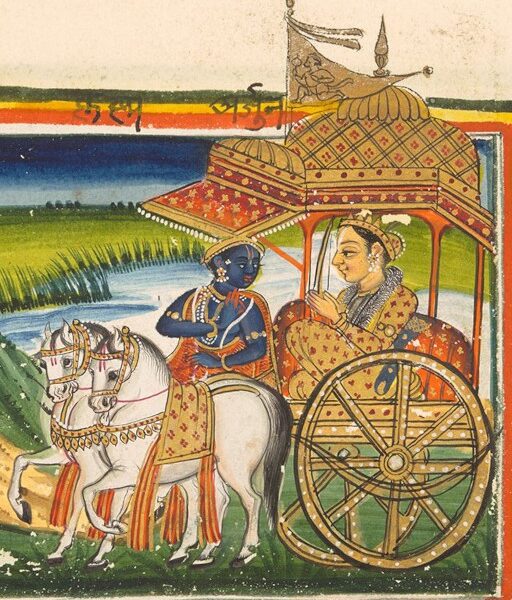
But what their worship of Rādhā and Kṛṣṇa isn’t vraja. It’s a different form of Vṛndāvana.
Do you understand? It means you have Vṛndāvana, which means the pastimes of Rādhā and Kṛṣṇa. But vraja-vṛndāvana, because that’s why we use the term vraja-vṛndāvana, is that it is unique in that the level of affection or that surrender is so much greater than any of the other realms.
Does that make sense? Just like in the Śrī line, than the previous ācāryas to Rāmānuja. Then you have twelve alwars, like Kulaśekhara.
I don’t know if it’s Kulaśekhara. We quote his prayers. He’s one of them. So they have three of them write prayers about Rādhā and Kṛṣṇa, their pastimes. Because they write songs, like Nārottama dāsa Ṭhākura and Bhaktivinoda Ṭhākura have written songs, so they’ve written songs.
So they’re called the Divya-prabhaṇḍas. So in their line, this is very important. So Pañcarātra, Vedānta and the Divya-prabhaṇḍas, these are their main study.
So, Andal, she wrote exclusively, all her songs are about Rādhā and Kṛṣṇa.
Does that make sense? Now, they worship Vaikuṇṭha-pāti.
So they are going to Vaikuṇṭha.
Yes, but in the form of Rādhā and Kṛṣṇa. You understand? So their mood still has the elements of service and done formally through rules, but the pastimes are that of Rādhā and Kṛṣṇa.
You understand?
What doesn’t make sense?
Yes, so who are they worshipping? Lakṣmī-Narayana. So where do they go? Vaikuṇṭha. You know what I’m saying? In other words, Kṛṣṇa is with His cows and the cow herd like this, but it’s still, the mood is different. So the idea is that Kṛṣṇa does all these sweet pastimes.
You know what I’m saying? So for them, they see that Narayana is so wonderful that He performs these nice pastimes, these sweet pastimes. It’s still the same person, but He performs these pastimes. You know what I’m saying? So they still go to Vaikuṇṭha. You know what I’m saying? It’s like Narayana, He does so many things, but the point is that you go where Narayana is. Does that make sense?
Basically, yes.
So that’s how they look at it. The point is that the pastimes are very nice, so everybody likes them.
You know what I’m saying? Does that make sense?
Then you also have the elements of Vṛndāvana where it’s done in opulence. Not on reverence, but opulence.
Does that make sense? So Radharani goes to the rasa dance on a swan airplane. She doesn’t walk. She goes with ten million maidservants.
So that’s opulence.
We won’t even discuss the management.
Does that make sense? So that’s opulence.
I forget what that’s called. They call it lower Goloka. Is it called Ananda Vṛndāvana? No, that’s a different one. I’m not sure exactly, but that’s what we’re getting to. See, for the Nimbārakas, there’s no separation.
There’s only sambho. There’s no vipralambha. So Radha and Kṛṣṇa are always together. They’re never separated. So does that sound like brunch? No. So the point is, it’s the same pastimes, but only those pastimes where Radha and Kṛṣṇa are always together.
Yes. Why? It means they have that closeness, that intimacy. That lack of worrying about rules, doing things from the spontaneous platform. But for them, the element of vipralambha, they don’t consider important.
So that means it will always be ecstatic.
It’s always increasing. But it’s stable, it’s steady.
You know what I’m saying? So the level of surrender, the specialness of the vraja pastimes is this element of vipralambha.
It’s not so much they don’t accept Lord Caitanya, they’re not following in that line. You know what I’m saying? But how they see Him, I’m not sure. I know the śrīs, Madhavas count Him as the greatest sannyāsī.
Because He went through there. So then…
But it’s not that they specifically follow that line.
But it’s not that they couldn’t worship Lord Caitanya and appreciate His Navadvīpa pastimes. But just in the Vṛndāvana pastimes, they would see it from their perspective.
Does that make sense? So it’s not vraja. That’s what generally returns as ānanda-vṛndāvana, because it’s always just happiness. You have the ānanda-rāmāyaṇa.
It doesn’t have any of the bad parts of it. It always just has all the happy moments. So therefore we coin the phrase ānanda-vṛndāvana.
Vṛndāvana is always ecstatic, it’s always ānanda. But the point is that they only accept that part of it. They don’t think vipralambha is also a kind of ānanda. But the point is that the separation creates how intense the saṃbhoga is, and how the saṃbhoga creates how intense the vipralambha is. So therefore it keeps getting more, but the intensity of it is so much greater than if it’s always nice.
Does that make sense? Yeah, so that’s what we’re talking about. I have one more question. You were saying that Pralabhāni, Yashoda, they cook a hundred stoves. Where are these informations?
That’s not so important.
No, but you know there must be something to get the information about the spiritual food. Yeah, but I’m just saying we have such information. That kind of detail is only important to bring out that they’re willing to go to a lot of effort to please Kṛṣṇa. So it’s not just what’s easy they do, but they make that effort.
Yeah, I’m not concerned about the hundred stoves. I want to know where I can find this kind of information. That kind of information is in the Kṛṣṇa book. No, Kṛṣṇa book, Bhāgavatam, you just have to know what you’re looking for.
You know what I’m saying? You have to appreciate what is going on.
You know what I’m saying? You have a bunch of cowherd boys, right? And they’re playing.
And they steal Madhu Mangal’s lunch.
And when he goes to get it, then they toss it from each boy to another.
Who are they? Cowherd boys are of which bone?
Vicious. Madhu Mangal is Brahman. So, do they care much about these things? No, so you can catch that. But it’s not done to harass them. It’s done, and the fun, you know, of course, amongst boys harassing each other is part of the fun. Right, you know? Does that make sense? So, these kind of things are just the, you can catch that specialness of what’s the mood.
You know what I’m saying? It’s right there. We just look at, oh, that’s a nice pattern, what’s another one? But it’s what’s within that one, and there’s so much.
Does that make sense?
Okay, yes. If we appreciate, for example, one, pastime like Madhu Mangal, does it mean we can increase our consciousness towards Krishna Consciousness? If we have an appreciation, we can. Yes, yes, yes. The point is that rasa is rasa. It’s just a matter of where you appreciate it.
You understand? Just like cooking is cooking. Now, whether it’s Krishna Conscious or not, you know, that’s another thing. So, the point is, and then it’s a matter of, yeah. So, rasa is there. It has the transcendental aspect, which includes all things, because it’s all connected to Krishna. Or you’re just focusing on the emotional aspect. Right? So, that’s parthiva. No, that’s svargi. Or you’re just looking at the sensual aspect. That’s parthiva. But the nature of rasa is the same, whether it’s on Vaikuntha rasa, the transcendental platform, or on the emotional or on the sensual. You know what I’m saying? Because the emotional and sensual will be of this world.
But how it works, it’s the same. You know what I’m saying? Mother showed her when she cooks, she’ll take a pot, put it on a fire. Right? Put something in the pot. Right? If need put a lid on the pot, she uses things to stir it with. Right? The pot’s hot, so she uses something to pick it up with. You know what I’m saying? So, it’s not changed. It’s not a different system. It’s not that, you know, over there is that you don’t have to stir it, you know, it just stirs itself, or, you know, the pot knows, or it’s like that, makes the adjustments, or the fire moves over. You know, it’s not like that. It’s not mystical.
You know what I’m saying? It’s just that everything’s perfect.
You know what I’m saying? Everybody knows what to do, so everything comes out perfect.
Does that make sense?
Is that okay?
Yes. All right. As we mentioned in the previous class about the Chatur Shloki Bhagavad Gita that Krishna says, I give the understanding, that He does it personally instead of, as a feature of Paramatma providing for the conditioned souls through the material energy. If I understand it properly, is it that Krishna is acting directly through His internal potency and then as a Paramatma to His external potency? No, Paramatma also works as internal potency. But the point is, is that the internal potency is the external potency. You know what I’m saying? So she carries it out as the external potency. He only deals with the internal potency.
Lesson 18. So if one develops the sense of associating with saintly devotees, he is blessed by Krishna. So the sense of associating means he likes to do that, he appreciates it. You know, he can identify it. Right? You know, here’s something of value and then take advantage of that. Does that make sense? So, yeah. So then he’s blessed by Krishna. Because for Krishna, what’s the most important thing? Relationships. Yeah, relationships with devotees. So therefore if you want to move with Krishna, you have to be comfortable with… The devotees are the most important thing.
Does that make sense? Otherwise, where’s the common ground?
A. Twenty-Eight. A person who accepts the path of devotional service is not bereft of the results derived from studying the Vedas, performing sacrifices, undergoing austerities, giving charity, or pursuing philosophical and fruitive activities. Simply by performing devotional service, he attains all these, and at the end, he reaches the supreme eternal abode.
Means all these different elements, they’re already contained within devotional service. So they’re not a separate endeavor. Right? So devotional service automatically awards the benefit of all of these. Right? But one may think, oh, unless I do this separately, I won’t get the benefit. Point is, it’s already included in devotional service. Right? Charity means you’re giving… When you give charity, what are you doing? What is the charity for?
Benefiting someone else, okay? So, you may benefit them by getting them food, or a mosquito net, or medicine, right? Some clothes, like that. Does that make sense? Or, you know, do something to… Do some entertainment, or… Something, you know, for them. Like that. But the point is, that is for the body, for the subtle body, the body and mind, senses. But there’s nothing being done for the consciousness, for the soul. So if you do welfare work, we do some benefit for the soul. It’s also welfare work. Right? We won’t count it as welfare work. Well, they know you have to do this as welfare work. It’s when someone asks the devotees, you know, okay, you’re doing so many things, you know, you’re very religious, and we appreciate that. But you’re not doing welfare work, like all these other religious groups are. You know, and then the devotees will think, oh, we’ve got to do something. But we’re already doing something. We’re already doing the best welfare, but it’s not explained. He says, yes, you know, others are doing, you know, which is important, for doing, taking care of the body and mind, but the taking care is temporary, and the body and mind is temporary. But the soul is eternal. So therefore, if you do something for the benefit of the soul, that’s eternal.
Right? So if you have lots of facilities, okay, then you do that. If you don’t have lots of facilities, stick to the main point. So the problem with doing welfare work for the body and the subtle body is actually that you’re feeding the attachment of the consciousness to the material. Yes, unless you’re spiritual. If you’re giving them prasadam, then you’re feeding, then it’s spiritual. That was the complaint where you have, some devotees are emphasizing the need to get really involved in all these kind of things like charity and that, and all the others will be impressed. And some are highly opposed to that. So the point is not distributing prasadam as a problem. Prabhupada started that. That’s what we do. The point is, is that you’re distributing prasadam and just presenting it as food.
Right? And one may say, no, but they won’t accept prasadam. But the point is, is how are you looking at it? You know, in other words, if you bought into the thing, no, the charity is actually a value, then what’s the meaning?
You understand what I mean? Yes, they will get a jnata-sukrti, but not due to you distributing it to them. By the ones who cooked it in faith, you know, for Krishna and offered it to Krishna. It’s going to be through their blessings that those people will get benefit, not through yours, because you think it’s actually real charity work that you’re feeding people. No, it’s because they’re getting prasad, they’re benefited. Otherwise, yes, they’re benefited. For how many hours? Right? You feed them. Feed them nicely. But after six or eight hours, they’re hungry again. Not starving, that may take 24 hours, but, you know. You understand? So that’s all you’re doing. So that’s why we don’t present it as charity, as such. We present it that, you know, so they have to understand it’s spiritual food. Now, if somebody won’t accept that, then, of course, we know, okay, we just say it’s, you know, it’s, you know, blessed food, something, you know, something that they’ll, whatever level they’ll accept, as long as they’re eating it. But we know in ourselves that they’re taking prasad, and that’s determination. It’s not because we’re doing this and feeding them, that that’s the good PR. It’s kind of like, who cares for the good PR? Today they can be good, tomorrow it can be bad. You know what I’m saying? The same people can switch on you, it doesn’t matter. You know, it’s just like there. In Russia we’ve been going along, distilling books, we have a hundred senators, all this and that. And then suddenly there’s a court case that they banned the Bhagavad Gita.
You know what I’m saying? So, therefore, this whole point of the mundane is very, very temporary.
So one should be functioning on the transcendental platform.
You know what I’m saying? One may use the, you know, the modern mediums, but you don’t look at them as modern. You look at them as just tools to serve Krishna.
You know, it’s not because that’s what’s accepted by most people, that that makes it good. Who cares? You know, most people on the planet think illicit sex is good. Actually, all the ones on the planet accept that intoxication is fine, as long as it’s controlled. Right? Social drinking is considered, you know, proper, sophisticated, adult. Like that. Smoking’s kind of getting a bad name, but still, a lot of the planet smokes and is fine with it. So does that make it okay? So we can’t take the public’s opinion as standard. We take it and consider the public’s opinion on what medium you’ll use for preaching. But ultimately, it doesn’t matter. It doesn’t matter that they think we’re crazy for going down the street in bedsheets and singing. It doesn’t matter at all. Because by hearing that, they’re eternally benefited. And by not going out there in your bedsheets and not doing the kirtan, nobody’s benefited. But you feel good that you’re not offending the finer sentiments of a very, very small fraction of the population.
Right? How many, you know, university intellectuals, you know, who are liberals, who hate the Vedic culture, are out on that street? You know what I’m saying? So that means thousands and thousands are benefited, and we’re not doing it because of one or two.
That’s not PR. PR is what is the mass thing. In the mass things, religion is fine. There is a God and they don’t mind it.
That’s the reality.
Does that make sense? One thing I’ve experienced really sort of flies where I come from is when I explain to people that we’re doing the food for life and we’re serving meals for five rupees a meal, and children in Bombay are going to school and getting these meals. And they’re really impressed, you know, because our simple lifestyle makes us able to do these things.
So is this necessarily… I mean, is this good? It depends where you’re going to take it. It means, is that the end of the discussion? Or is that to get in the door for something else? Yeah, then I can take it to the philosophy. Yeah, but the point is you’re trying to get at the philosophy. But for some, they just feel that they’re satisfied to leave it at that. And now they have a good impression of Iskander. Great! But then the point is if that’s all you’ve done, know it that those who are going to take it further are what you’re trying to support. So don’t take it that what you’re doing is the main thing. Take it as it is a supportive element. So therefore, don’t tell the ones who are doing the main thing that what they’re doing is not right.
Does that make sense?
It’s like the guy who’s cleaning the bathroom. And so he doesn’t want anyone to use it because they’ll mess it up. Because keeping the bathroom clean, that’s the most important thing. Not that the bathroom has actually a purpose.
So the point is they think that PR is the purpose. No, it’s a tool. And the point is it doesn’t matter. PR means that you’re heard. It doesn’t matter if it’s good or bad. People who know this, they become popular. You know what I’m saying? It’s like Lady Gaga. Whoever heard of her a few years ago? Right? There’s so many others in the same line of music. There was so much more known. But she just comes out and does the most outrageous things. So everyone talks and they all think she’s crazy. But she’s not. And then who is this lady? Then they’ll listen to her music.
You understand? Prabhupada said this. There’s no good or bad PR. It’s all good. As long as they hear about it, then they’re going to want to know who are these Hare Krishnas? You know what I’m saying? So then we’re out there doing good work and so then they’ll come to see. Oh, okay.
That’s the whole point. But those who are courageous understand this. Those who are weak and cowardly don’t because of their own personal social position. They can’t tolerate when someone goes, Oh, you Hare Krishnas, you do this. It’s like, oh, it felt so bad. I went out there and they said this. Like that. That’s called weak. No, you just tell them. No, that’s this. That’s that.
There’s misinformation. There’s yellow journalism. So stand up to it. And if you can’t, fine. Let someone who can stand up to it, let them do it. But then you stay out of the way and don’t tell them what to do.
Yeah.
There’s no backseat Santa Catarina. Yeah. I was going to say the same.
Does that make sense?
Okay. Those who learn Bhagavad Gita from a devotee will attain Krishna’s mercy. One who has a little faith in Bhagavad Gita should learn Bhagavad Gita from a devotee. Because in the beginning of the fourth chapter it is stated clearly that Bhagavad Gita can be understood only by devotees.
Because Krishna is a person. You approach Him as a person, you’ll understand. You don’t approach Him as a person, you won’t understand. So only devotees can understand. No one else can perfectly understand the purpose of Bhagavad Gita.
Right here.
That is… Okay, that beginning verse. That very ancient science of the relationship with the Supreme is today told by me to you because you are my devotee as well as my friend. And can therefore understand the transcendental mystery of the science. Krishna is very directly saying that’s your qualification.
It’s not because you’re very intellectual, it’s not because you’re religious, it’s not because you’re into all the mystical and new agey. You only understand because you’re a devotee.
One should therefore learn Bhagavad Gita from a devotee of Krishna, not from mental speculators. This is a sign of faith. We also have to remember that if you have philosophy without religion, then it’s mental speculation. So one also has to be careful there. Even within… in the line.
When one reaches… searches for a devotee and fortunately gets a devotee’s association, one actually begins to study and understand Bhagavad Gita. By advancement in the association of the devotee, one is placed in devotional service. And this service dispels all one’s misgivings about Krishna or God. And Krishna’s activities, forms, pastimes, names and other features. Right? So past… Samkirtan is also pastimes. So it dispels your misgivings about those pastimes.
Right? Now his Laksa Tanya had some problem. Government didn’t always appreciate what he did. The local intellectual… intelligentsia didn’t appreciate what he did. Right? You know, they just happened to be, you know, Vedic smarters rather than, you know, modern academic professors. It’s the same thing. Same principle. So what they don’t like? Who cares?
After these misgivings have perfect… have been perfectly cleared away, one becomes fixed in one’s study. Right? Then one relishes the study of Bhagavad Gita and attains a state of feeling always Krishna conscious. In advanced stage, one falls completely in love with Krishna. This highest perfectional stage of life enables the devotee to be transferred to Krishna’s abode in the spiritual sky, Goloka Vrndavana, where the devotee becomes eternally happy. Do we notice anything in this?
Yeah, from Shraddha to Prema. The whole process is here. Right? This sign of faith, right? Hearing from his faith. When one searches for a devotee, first he gets a devotee’s association. Right? Saru-sanga. He… One actually begins to study and understand Gita. Right? Bhajana-kriya. By advancement of the association of devotees, one is placed in devotional service. Right? So that means bhajana-kriya is solid. That’s coming by the grace of the devotees. And service dispels all one’s misgivings about Krishna, and Artha-nivrtti, or God. And Krishna’s activities form pastimes, names, and other features. Right? So here, he’s talking about misgivings about Krishna and that. He didn’t say about giving up sinful activities or attachment. No. This is where the misgivings are. Because the misgiving is you think this is more important than Krishna. No, this is more valuable than something in Krishna consciousness.
Does that make sense? So again, it’s the same process. Artha-nivrtti is seen as connection with appreciating Krishna’s name, form, qualities, and pastimes. As opposed to… you know, becoming more austere, more humble, more this, more that. Those will come automatically. Those are symptoms. You can appreciate. He’s advancing because these symptoms are there. Right? But the advancement happens because of focusing on Krishna’s name, form, qualities, and pastimes. Right? And other features. Right? About Krishna or God. So that means all the philosophical points. Everything. Right? After these misgivings have been perfectly cleared away, one becomes fixed in one’s study. Right? So nishta. Right? Then one relishes the study of Bhagavad-gita, ruchi, and attains the state of feeling always Krishna conscious, asakti. In the advanced stage, right, so into bhava, one falls completely in love with Krishna. Right? So that means you come to prema. The highest perfectional stage of life, right, coming to prema, enables the devotee to be transferred to Krishna’s abode in the spiritual sky, Goloka Vrndava. Right? But you had to have done bhava here. Right? Unless you did it already within this body. But in any case, bhava goes on here, whether you do it physically or mentally. Does that make sense? And then once you come to prema, then you go to Goloka. But there’s no difference between, you know, upper Goloka and Goloka in manifest and material world. Where the devotee becomes eternally happy. So Prabhupada so nicely says all these things. He’s worked it into the study of Gita.
While we wouldn’t, when we say Shraddha, we would apply it in one way that we got it. Okay, Madhurika, somebody said it like this, and we’ll go through all these things. Like that. But here Prabhupada’s taken it and applied it in connection with Gita. The study of Gita. Right? So this is, when Prabhupada says it’s all in his books, it’s there. One just has to know what one’s looking for. In other words, if you appreciate what’s there, and feel there’s no lack, then everything is revealed.
And as one then studies so many things, then you see, oh, it is all there. Just Prabhupada is so expert, that he can say it within languages so pleasant and so accessible to everyone. Right? In other words, it’s simple that someone who’s not very academic would appreciate it. But it’s so poetic that someone who’s academic will appreciate it for its, it’s that direct simplicity and exactness. You know what I’m saying? So everyone will like it. It’s not that, okay, you know, it’s like reading Dr. Seuss or something. The kids will like it, but the adults will think, well, it doesn’t, you know, needs a little bit more action here.
Does that make sense?
Lesson 19. Without association with the saintly devotees, no one can develop God-consciousness.
13.8. Humility, pridelessness, non-violence, tolerance, simplicity, approaching a bona fide spiritual master, cleanliness, steadiness, self-control, all these I declare to be knowledge, and besides this, whatever they may be, is ignorance.
Spiritual life begins with accepting the bona fide spiritual master. The principle of accepting a spiritual master as mentioned in verse 8 is essential. Even for one who takes to devotional service, it is most important.
Transcendental life begins when one accepts a bona fide spiritual master. Right? So that means we can say the śraddha -sādhu-saṅga, then when one accepts the spiritual master in bhajana-kriya, that’s when it becomes serious. Right? But before that, of course, you’re following the direction of the spiritual master, so it’s connected, you know, it’s bona fide, it’s uplifting, but it becomes serious at that point because then Kṛṣṇa accepts that you are willing to submit and work under, you know, an authority. Right? Otherwise then one may be tending to stick to one’s own ideas, you know, take Kṛṣṇa consciousness how much you want, when you want, as opposed to, you know, direction of others.
The Supreme Personality of Godhead, Śrī Kṛṣṇa, clearly states here that this process of knowledge is the actual path. Anything speculated beyond this is nonsense. So these qualities mentioned here, these are the only qualities that are necessary. Right? This is knowledge. Right? When we say, one performs, Kṛṣṇa says, in knowledge, that you perform your devotional, in knowledge, it means these.
Right? It doesn’t mean something else. So knowledge means this. Knowledge doesn’t mean you know, you know, how the clouds work, and what’s a, you know, what’s a cumulus nimbus, what’s the serious cloud, and all those kind of things. Like, whoa, you didn’t teach that? You’re uneducated. Like, you know, it’s like that. Who cares? Who remembers? Right? How many windows in the empire they put up? Yes, basically like that. How many windows in the mirage? Yeah, like that, yeah. So, that’s the whole point. Vṛtti. By the mercy of the pure devotees, one can understand that all types of cheating religion should be abandoned, and one should approach the Lord with pure intention to render selfless loving service. Still, in order to successfully perform such service, one should accept an initiation from a bona fide spiritual master who can guide him to the ultimate goal. Hence, the following adhikāra. Right? So this, that ends this, that adhikāra, which was, well, three goes way back. We have to look at the beginning here. Okay, three. Such pure devotional service of Godhead is attainable by the association of saints. Right? So, we’ve established that the living entity is part and parcel of the Lord, so it’s everyone’s duty to cooperate with him by performing devotional service. Adhikāra, the two good works, salvation by knowledge and perfection of mystic powers, are all subordinate to the transcendental loving service to the Lord. Right? So, we’re supposed to cooperate, but in cooperation, that means the means of cooperation, means good work, knowledge, and perfection, and mystic, perfection by mystic power. All that’s engaged in the Lord’s service. So, they’ve mentioned all three, so that’s making sure that you don’t just engage the knowledge you have and the good work you can do, but also your mystic cities. You should make sure that those are also engaged. Don’t keep those for yourself.
And then, adhikāra, such pure devotional service where you see what’s primary, is the service, and secondary, the medium, that is only attainable by the association of devotees. Right? Otherwise, it’s not by good work or by knowledge or by mystic power. Those won’t generate. It’s only by association. You engage good work, salvation by knowledge and perfection by mystic power. Like that. So, now that brings us to four. Śrī Kṛṣṇa is the ideal saint. Where is it? Oh, okay, yes.
So, adhikāraṇa, four. Right? But it says, still in order to successfully perform such service, one should accept initiation from bona fide spiritual master and guide him to the ultimate goal, hence the following adhikāraṇa. Right? So, now we’ve gone from you must cooperate, then all the activities, anything you know and have ever done, all that’s secondary or supportive of devotional service, to gain that understanding and gain that practice, that is gained from devotees.
And now, the next one. Śrī Kṛṣṇa is the ideal saint. No one should approach Śrī Kṛṣṇa. So, one should approach Śrī Kṛṣṇa through His transparent medium, spiritual master. And thus, Śrī Kṛṣṇa will reveal Himself. Right? So, now we’ve brought it down to association of devotees and that is by approaching the spiritual master.
Lesson twenty. Twenty to thirty-five. Fifteen lessons. This is a serious adhikāraṇa.
Śrī Kṛṣṇa is the ideal saint. Okay. So, now this is going to be in this lesson. Twenty.
Okay.
Hritya. The sambandha part of the Bhagavad-gītā analysis established that the perfect transcendental knowledge of the connection between the Lord, the living entities and the material nature is the beginning of devotional service. The first three adhikāraṇas, the Abhidheya part, lessons one through nineteen, describe the natural result of this perfect knowledge. The dynamic process of devotional service which starts with śrādhana and continues through the stage of sadhu-saṅga. Now, adhikāraṇa four will emphasize that sadhu-saṅga should lead to bhajana-kriya or performing devotional service under the guidance of a bona fide spiritual master. Right? So, in other words, you’ve got, sambandha is establishing that perfect knowledge. Having that knowledge, you have that faith. Then you take up the association, right? Because the sambandha-jñāna is to establish faith. Right? So all that technical is to establish faith. Having that faith, then you take up sadhu -saṅga. Right? And in sadhu-saṅga, then bhajana-kriya, you work under the spiritual master. Okay.
So, two, six through.
Six and seven. Interesting. Nor do we know which is better, conquering them or being conquered by them. If we kill the sons of Dhritarashtra, we should not care to live, yet they are now standing before us on the battlefield.
Here it is, he’s saying this. We’ll just take it. Okay, yeah, he’s saying. But the point is this. We don’t know which is better. Why?
Because it means we kill the sons of Dhritarashtra, we wouldn’t care to live.
And so, but the point is that they’re here.
You understand? You get that? There’s a mood there. Does that make sense? Yes, no? Mataji? Yes. You see, that’s what you’re looking for. Right? You’re looking for those elements because that’s where you find those finer points. Otherwise, why mention it all? So, it being mentioned that it’s like he doesn’t care to live if we killed them, but they’re standing here. So, what does that mean? Then we would have to kill them, but we wouldn’t want to live if we killed them. So, whether we kill them or they kill us, it doesn’t really matter.
You understand? So, therefore, the material attachment is coming out. You can see that that mood. But, it’s a very pious attachment.
You know, it’s not like that verse that you’re reading before, you know, I have killed my enemies and tomorrow I’ll kill more of them. You know, that’s Dhrtarastra. I mean, that’s Duryodhana’s verse. Like that.
One cannot solve the problems of life without the help of a bona fide spiritual master.
Arjuna did not know whether he should fight and risk unnecessary violence, although fighting is the duty of ksatriyas, or whether he should refrain and live by begging. If he did not conquer the enemy, begging would be his only means of subsistence. Nor was there certainty of victory, because either side might emerge victorious. That’s just the nature of war. Even if victory awaited them and their cause was justified, still, if the sons of Dhrtarastra died in battle, it would be very difficult to live in their absence. Under the circumstances, what would be, that would be another kind of defeat for them. So, in either way, you’re defeated on the material platform.
So, here’s the point. Arjuna did not know whether he should fight or not. Right? He couldn’t distinguish, because on the material platform, then it’s not going to work out good.
So, so, so, so, how you say?
Yeah. So, now the next verse, two-seven. Now I am confused about my duty and have lost all composure because of miserly weakness. Right? Because miserly means you keep it for yourself. You don’t use it. Right? So, he’s not using his abilities as a ksatriya, because there’s miserly weakness. He’s afraid we’ll lose this and that. So, he’s not using it. So, it’s miserly. In this condition, I’m asking, but see he’s so smart, he could see it. That’s one thing I noticed. I mean, you don’t see as much now. You still do. But I noticed when he came to India, it was much more common being amongst the gentlemen of India, is that they could directly see what the problems were. They could see their attachments. They could see all these different things. Just that they’re attached, so they do it. And we could say, well, if you could see it, you wouldn’t stop. No, but devotees still do it. They know they’re attached to it, so they still do it. So, it’s the same position, but they’re able to see it, recognize it, even admit to it. You know?
So, here we see how clearly he’s thinking. He’s emotional. How clear is his thought still? So, the clouding is in the results, not in what’s going on. Right? So, how qualified the level is here. You know, they can see, I’m confused, lost all composure because of miserly weakness. He’s not going to, he’s just not going, you know, I don’t feel right, I can’t do this. You know, he doesn’t just use that kind of terminology. Right? You know, he’s going on about, you know, what exactly is happening. In the previous verse, he mentions that. Yet, they’re standing here. You know, he could have just said, you know, if we kill them, they kill us, you know, but then, like that, and so he’s just saying it’s all that, but they’re standing here. You know, that’s very clear. You only see that, you know, at a certain level of depth of culture. You know what I’m saying? This is not something that is generally seen nowadays. Western culture, you’d have to go back quite some time to see it. You know, the writers in the 1800s and stuff like that, or, you know, 16th, they would say stuff like this. You know? Or, you know, how you say in Asia, they still talk like this. You know what I’m saying? So it’s a matter of that depth of relationship and culture. So you can just, even from here, see how qualified. Because that’s the point. Krishna’s speaking this to Arjuna because he’s qualified.
I mean, that’s why he’s turning, that’s why the point of this verse is one should approach a bona fide… Because this whole idea is you have to approach Krishna through approaching… Krishna is the ideal sadhu. So that means you have to approach him through a sadhu who represents him. Right? So now we’re giving that process, right? Here, he’s bewildered. Right? Because you just say, now I’m confused about my duty. Oh, what’s the confusion? So, therefore, 2.6, he doesn’t know which is better, conquering them being conquered.
Right? So whether to fight or not fight. If he fights, it’s going to be bad. If he doesn’t fight, it’s going to be bad. And even if they fight and win, I mean, if they fight and lose, it’s going to be bad. And even if they fight and win, it’s going to be bad.
So he’s not seeing any silver lining.
It’s not happening.
So that is confusion. Now he’s pointed that out.
So here it says, in this condition, I’m asking you to tell me for certain what is best for me. Right? So that doesn’t mean you kind of beat around or just kind of give some moral support. You tell exactly what’s the thing. Now I am your disciple and the soul surrendered unto you. Please instruct me. So that’s the point is that we’re confused in the material world. We don’t know what’s right, what’s wrong. So we surrender the spiritual master to be directed how to know what to do and what not to do. Right? That’s the whole point. Then bhajanakriya starts seriously. Right? Otherwise you’re chanting, you’re doing all these things but technically they’re called purusharyavidhi. Right? It means preliminary activities to initiation. So they’re very purifying and the better it’s done, initiation will go so much better. You know what I’m saying? So if someone performs the basic, takes initiation, then that further will go on in initiation. What hasn’t, you know, what’s been not initiated for 10, 12 years like that, still that means the purusharyavidhi is very strong. So when one does take initiation then it will move very quickly.
Unless the reason you haven’t taken is not circumstances but doubts. Then it’s just you’ve done, you know, in 12 years what others did in six months or one year. But of course being more educated, more intellectual, you’ll have to find another reason for that. You couldn’t be something less than just the you know, ordinary sentimental guy who got initiation 12 years before you or 11 months, you know, 11 years, you know, six months.
By nature’s own way the complete system of material activities is a source of perplexity for everyone. Right? By nature’s own way. Right? You know? You could have that you know, over the door of, you know, Maya’s office. Nature’s own way laid out just like, you know, like what was that famous one, you know, you know, I say, work is freedom. Ah, yeah. Work will, yeah, work will set you free. Work will set you free, yes. Like that. You know? A shower might help, but work will set you free.
But, so, so, you know, you have all these nice little things there so you can have that over Maya’s. Nature’s own way.
By nature’s own way, the complete system of material activities, right? Complete system. It’s complete in itself. No one’s, no one’s wanting out of it. No one’s gotten out of it. Right? You know? So it’s, it’s a source of perplexity for everyone. Right? Because even Haranyakasipu, who was the biggest demon there ever was, we have to remember is that, you know, he’s, so he’s the biggest. Ravana was number two. Right? Ravana was impressed with Haranyakasipu because of Haranyakasipu’s earring. It was bigger than he could pick up.
You know? So he went to visit Bali Maharaj. You know, it’s also in the family, you know, demon to demon. And he’s there hosting and he notices this huge, like, mountain of jewels and that. He says, what’s that? He says, that’s Haranyakasipu’s earring. And he says, you can have it if you want. He says, and then, you know, he goes, he can’t lift it. It’s so big. Like that. You know, he moves Kailash and, you know, stuff like that. so then, then, you know, Bali tells him, he says, and that person who killed Haranyakasipu is, is there, you know, is sitting outside your, your place with all those monkeys.
And so he killed the guy who, this is his earring that you can’t lift. What about you? You know? So his point is, is why don’t you just surrender? But unfortunately, Ravana could not accept a spiritual master. He was, so, he was unable to solve the perplexities of nature’s own way.
In every step there’s perplexity and therefore it behooves one to approach a bona fide spiritual master who can give one proper guidance for executing the purpose of life. So behooves means it’s mandatory.
You know? It means if, if you want to solve this you can only do that by approaching a spiritual master. There isn’t another way. It has to be done. So it’s not, well if you like, and, no, it has to be done. Of course. When you want to do, that’s another thing, but it has to be done.
Like that. And you can give proper guidance for executing. So that guidance means it’s coming in parampara. Right? So as you see here, we can discuss this and we get that beneficial, that benefit. It means when we read these, one, you’re associating, what these instructions Krishna gives, you’re directly associating with Krishna. You know? Does that make sense? So Krishna and Arjuna, you’re directly associating through the scripture, but it’s coming down through parampara. Right? And then the purports, you’re directly associating with the problem. Like that. So, one is able to do. So, one’s connection to this is through the spiritual master. Does that make sense? So, that’s why it has to be in parampara.
Otherwise, you don’t get that benefit.
But you do get some benefit, purification and so on. I mean, so if you approach someone who’s not in the parampara, it would be pious to follow all these things, it would be purifying, but it wouldn’t necessarily develop any devotional point. Because the point is, you really sincerely wanted to, why not someone in parampara? So, if they’re not in one of the four sampradayas, then there’s some, there must be some lack of sincerity there. Piety, yes, but sincerity of devotional service, no. So, someone from the West with a pure heart and honest desires, Krishna would present a bona fide parampara. Yeah. I mean, it’s otherwise, you know, that’s why we go out and preach.
Is that, you know, you’re just walking down the street minding your own business and then suddenly a devotee walks into your life and, you know, like that. Before you know it, you have a proof in your hand. Yes. Wait a minute. Yeah. So, that’s how it goes.
So, that’s why devotees do that because Krishna doesn’t. He sits in the heart and he waits. He’s made the facility, but you still have to take the first step. But the devotee is just like, who cares about the first step?
Like that. They just go in and get the work done.
All Vedic literatures advise us to approach a bona fide spiritual master to get free from the perplexities of life, which happen without our desire. Right? So, it gets complicated without our desire. You know, it’s not that, like we said, it doesn’t stay there. You know, it’s complicated, you know, and then underneath in the brackets, because that’s the way I want it. You know. No, it’s just, it just happens and you don’t know how it happens, so all you can say is it’s complicated because you have no solution.
Right? If you had a solution, you wouldn’t, you wouldn’t check it’s complicated.
Right?
They are like a forest fire that somehow blazes without being set by anyone. Right? It’s not just the modes of nature, you know, their movement against each other just creates that fire.
Similarly, the world situation is such that perplexities of life automatically appear. Right? Without our wanting such confusion. That means, you’re sitting on that beach there, you know, enjoying the sun, but you didn’t, you didn’t plan for there to be an ozone hole there. You know, it wasn’t there when you visited that beach as a kid. Right? So now, instead of going the whole day comfortably, you get burned in ten minutes. Right? That’s just the way it works.
No one wants fire and yet it takes place and we become perplexed. The Vedic wisdom therefore advises that in order to solve the perplexities of life and to understand the science of the solution, one must approach a bona fide spiritual master who is in the disciplic succession. A person with a bona fide spiritual master is supposed to know everything. One should not therefore remain in material perplexities, but should approach a spiritual master. This is the purport of this verse. So now this is the thing. He’s perplexed. Right? And we’re giving, we’re giving it just, oh, perplexed, so you understand what’s going on. Right? The depth of it. So you won’t think, okay, well, you know, but his perplexity is nothing like mine. You know. I don’t know whether to, you know, wear these shoes or those shoes out to dinner tonight. You know, stuff like that. You know, it’s not that kind of perplexity.
So this is more serious. You’re losing your whole family here.
Vritti. When the Lord is pleased, he imparts the most confidential knowledge through his representative, the spiritual master. So, because we have to remember, ultimately it’s Krishna who’s the guru. Right?
You know what I’m saying? And the guru’s representing Krishna. Right? So that’s the whole point. So if you follow the bona fide line, then it’s connected. You get that connection to Krishna. Like you’re saying here, Krishna’s giving these instructions. Right? But by connection to the bona fide spiritual master, we’re able to receive them in the parampara. So it has the potency. That potency is there. Therefore it changes the heart. Does that make sense?
Yes.
And so he’s approaching the bona fide spiritual master which happens to Krishna.
As our role. Yes. I mean, that’s the idea. He’s the role model. there was how he was perplexed, but how he surrendered. And then how he was able to apply those instructions in his life. That’s what we should aspire for. So that’s the advantage of the Puranas. Is that they give those role models. They give those stories so that one can see how to properly apply it. Because it covers all areas. I remember once I mentioned to a devotee, they asked, where do you get all this cultural stuff from? I said, from Bhagavatam. They said, no, Bhagavatam is all philosophy.
The point is, like we were discussing this morning, Kardama Muni is a brahmachari. But he wants to get married. He approaches the Lord. So is that not a practical, down to earth cultural phenomenon that happens within our community? Right? Something like that. Then, there’s children. That doesn’t happen in our community. Then, the child grows up and he leaves for the forest.
So, these things are going on.
Do we not have problems where one mataji gets envious or jealous of another because she’s had a child and she wants one but she doesn’t have one? That doesn’t come up? Right. So, these things are happening. Those are the story lines that the philosophy is all explained through.
You know what I’m saying? Indra’s in a position of power. He puts more focus on his ability than on Krishna’s mercy. Right? And then he gets chastised by a senior devotee.
Does this not happen? Right? We try to use our material prowess and it backfires. I’ve heard story after story of persons who are professionals before they join, they come into the movement. They can’t use any of it even though they try. So, it’s only by Krishna’s grace. You’re using it on the material platform but if you want to use it on the spiritual platform then you have to have the right attitude. You can’t think it’s me. Right? The doctor can think he’s the big doctor but he can’t think he’s the big doctor as a devotee. Because thinking like that is material. Therefore, it will function in the material sphere but not in the spiritual.
1864 Because you are my very dear friend I am speaking to you my supreme instruction. The most confidential knowledge of all. Hear this from me for it is for your benefit. Right? So before he said he’s given confidential knowledge. Right? More confidential knowledge. So this is the most confidential knowledge. The most confidential knowledge is to surrender to the Supreme Personality of Godhead. The Lord has given Arjuna knowledge that is confidential knowledge of Brahman and still more confidential knowledge of the Supersoul within everyone’s heart. And now he is giving the most confidential part of knowledge just surrendering to the Supreme Personality of Godhead. Right? So Brahman, Paramatma and now Bhagavan. Right? Because before we see before there’s this this it’s hinted at but now it’s very clearly being given. Before that was all the technicalities of how you deal in the Brahman and Paramatma platform to free yourself from material entanglement. Right? The most essential point is to surrender to the person then that makes all that other thing easy. Then you can use those tools.
Could you say Brahman, Paramatma and Bhagavan as a framework on which you know, false beliefs Um when we’re talking about philosophy about the personality of Godhead yes because these three features are hints when we talk about that’s why we say that was being used before you know, about Krishna being this morning Now see if you can find it Krishna’s mystic pose He is knowledge so unless he allows you can’t find original and inexhaustible Yes, original and inexhaustible Ok, yes original and inexhaustible So, why would he be using these? Because it means this is all this is all him Right? So, one would say no, no but it’s just we’re only interested in, you know, Krishna and Braj That’s nice but the point is is Krishna and Braj is worshipped on the platform of spontaneous devotional service not whimsical devotional service that’s distracted by material desire That means to do that you have to follow the rules because either you surrender immediately or you follow the rules and regulations Krishna also did that At the end of the ninth chapter he said man-mana just always think of me The same instruction is repeated here to stress the essence of the teachings of Gita Right? So, it being the conclusion So, those are there So, this is he’s bringing this out that this is the most essential point Right? Because otherwise now he wants to receive all three confidential, more confidential so most confidential so he’s just making sure emphasizing anything repeated is always taken as more important That’s just the rule within Mimamsa it’s just what’s repeated you know, what’s repeated what’s glorified you know these things are to be taken as important Right here he says most confidential so he’s glorifying Right? and at the same time it’s a repetition The same instruction repeated here to stress the essence of the teachings of Bhagavad Gita This essence is not understood by a common man but by one who is actually very dear to Krishna a pure devotee of Krishna This is the most important instruction in all Vedic literature So, it means here also it’s understood it may be understood that this is it Right? Because otherwise say, you know devotional oh, it’s doing this it’s doing the point is it’s just surrendering to Krishna That’s why that’s why we’re chanting that’s why we take prasad that’s why we do all these things because we’re surrendering to Krishna Right? So, understanding that then that is what he’s talking about here that’s a pure devotee Right? Otherwise we will generally focus on all the secondary elements that are engaged in devotional service Right? So, that means that we’re dealing with more of the elements of Brahman and Paramatma on a good day But we know ultimately it’s Krishna but we’re not appreciating In other words we understand yes, Krishna is the supreme person and he’s the ultimate goal but it’s not understood in that that is the motivation why one’s doing something You know what I’m saying?
Right? We’re going to Mangalarthi because we’re supposed to not because Krishna is a person and we’re his devotee and we want to see him when we first get up in the morning You know what I’m saying?
Does that make sense? So, that’s that’s the point that will come though that’s the nice thing about the process If you start anywhere then that will come Confirmed Good Discourt And Lars whenever one’s focusing on the process on Krishna and if one is told that one’s going to leave the body in a very short time you know giving some giving some date or something like that some serious illness or something then that will tend to focus the mind more on Krishna consciousness So you want a date?
One would appreciate a lot more but whenever there’s not a specific date in mind then one takes takes it for granted takes the uniform life for granted and Krishna consciousness for granted Okay Have you ever seen a lotus leaf? an actual lotus leaf? Yeah Have you ever seen water on it?
Okay When water the leaf top the leaf top is very astringent so when water sits on the top it doesn’t sit normally like this it sits in a ball any movement it’ll roll you know the other one it has to kind of move no, this just rolls it’s like mercury you know mercury’s in a ball just like right? Does that make sense? So if you took some mercury and put it on this paper here you know it’s like any movement it could go So do I need to give you a date when it’s falling off?
Or just the condition of it is at any moment it could go You understand? So you don’t need an exact date Does that make sense?
Okay Let us say like this Someone is captured by some very nasty people Right? And they say We’re going to kill you You know So sit down here We’ll be back So do you need an exact time to start worrying?
You know you just sit there and everybody else is freaking out How come you’re not freaking out? Well they didn’t say what time they were So hey until they come back what’s the big deal? You know Enjoy life You know We got all this space You know We got our own private, you know handcuffs Hey cool You know How many people got handcuffs? Right?
Does that make sense? So the point is is one is going to die We don’t mind saying it No one else will say it You know what I’m saying? Occasionally you know Old people will will I’ve heard one or two that say You know They won’t say I could die any time That’s only if it’s really serious Occasionally they’ll say it You know There’s another one You know He got one one foot on a banana peel and the other foot in a coffin Right? You know So then he’s trying to get slipped and then fall in Right? You know So You know what I’m saying? It’s like if you go to these What do you call it? These old people’s homes What do you call them? Retirement homes Yeah Retirement homes What’s the point of being in a retirement home? What is the obvious point? Everybody’s going to die there Right? You go there because no one will take care of you So you go there because these people take care of you Right? Because you’re going to die But do they talk about it? No So the point is is it’s obvious You know what I’m saying?
So it’s just a matter of Let me think Like Chanakya says you should make money as if you’re going to make money and study as if you’re going to live forever and he said you should practice spiritual life like you’re going to die at any moment You can try it Just think about it You could die at any moment See how your nouns go They go pretty good The problem is it’s remembering to remember So this is the most important instruction in all Vedic literature So he’s not even just saying in Bhagavad Gita but in all Vedic literature is surrender to the Supreme Personality of Godhead And all these other aspects are how in whatever position you’re in or whatever situation you’re in that you can relate yourself to that Supreme Personality of Godhead That’s what all the different literatures are for But the essence is this 1865 Always think of me Become my devotee Worship me and offer your homage unto me Thus you will come to me without fail I promise you this because you are my very dear friend Here’s also an element of repetition This is at least what, the second if not third time we’ve come across these verses in this study So how important it must be for Prabhupada to bring it out in so many different ways Thus you will come to me without fail I promise you this because you are my very dear friend Right here Because you are my very dear friend I’m speaking to you by my supreme instruction Thus you will come I promise you this because you are my very dear friend So that’s the point So this is the meaning Sakyam In the nine processes You’re a friend of Krishna because you’re trying to do work for Krishna This nice karma means you’re working for Krishna That situates one as Sakyam Friend of Krishna Because friend means you’re always favorable towards you’re always working for the benefit Yes It’s also some indication that the relation between Krishna and Arjuna is very clear Yes Different rings Different rings That one we can take out in ten minutes It’s not a matter of less chance It just means It’s just a matter of by that cultivation that chance will develop So it’s not a matter if he doesn’t have this then his chance is less because then it makes us look like we are that impurity You know I am the dust on the mirror You know what I’m saying No It’s that we can’t see who we are because of the dust So it’s just a matter of you continue the process in the association of devotees that dust will go away Does that make sense?
Yes You have to be patient Yes, you have to be patient That’s why it gives the examples One doesn’t expect that just because now we’ve taken the process immediately it’s going to have the result It takes time Does that make sense? The fruit is on the tree It will take time to ripen Yes But the point is now Krishna is the ultimate goal We may not think so focused on it but eventually that will come The point is the relationship is with Krishna Not that we’re turning to God just to get rid of our problems in the material world In the beginning we may do that We want answers We’re confused You know, we’re in anxiety So as that gets removed then we can start to think about that, well, who’s removed that? You know, Krishna’s done that So therefore we would naturally have some feelings towards that person And getting rid of material anxiety that’s not the big deal You know what I’m saying?
The big deal is developing love for him and being eternally within his pastimes That’s the big deal You know what I’m saying? And it’s just like you’re at a program there’s so many nice people there you want to interact but there’s a mosquito bothering you So, you know the mosquito takes up your attention but that’s not the big deal So you get rid of the mosquito then you can, you know So you get rid of that material attachment So that’s it’s important but it’s very minor compared to the happiness of devotion of service So thus you’ll come to me without fail I promise you this because you’re my very dear friend So when one comes to that point where he’s always thinking of him worshipping him offers homage to him surrendering as a devotee then he will without fail And remember this is also in connection with the one that says Krishna will carry to preserve what he has carry what he lacks So whatever’s lacking in here Krishna will take care of that and preserve whatever’s there Does that make sense?
The most confidential anyone who falls everyone who follows the path of Arjuna can become a dear friend to Krishna The most confidential part of knowledge is that one should become a pure devotee of Krishna and always think of him and act for him One should not become an official meditator Life should be so molded that one will always have the chance to think of Krishna One should always act in such a way that all his daily activities are in connection with Krishna He should arrange his life in such a way that throughout the 24 hours he cannot but think of Krishna And the Lord’s promise is that anyone who is in such a pure Krishna consciousness will certainly return to be born in Krishna where he will be engaged in the association of Krishna face to face The most confidential part of knowledge is spoken to Arjuna because he is the dear friend of Krishna Everyone who follows the path of Arjuna can become a dear friend to Krishna and obtain the same perfection as Arjuna So now in this section what is this path?
What is the pertinent point?
What does that mean following the path of Arjuna in connection with this Adhikara?
Surrender to the spiritual master Take those instructions from the spiritual master Then one will get this So this is the whole process Because one is getting that relationship with Krishna but that is represented through the spiritual master Then the whole thing works very well There are some other I saw a thing the other day about Islam and how it is not how it is supposed to be one they may not be happy and throw us in one world and the Islamic law Shia law something like that you know, the cross law Yes, but my question will come is that Shunni or Shiite? I am not sure Neither are they and they kill each other So it is not going to happen Yes and in the opening of most every chapter of the Koran it says Blessed be Abraham Blessed be Moses Blessed be Jacob and Isaac Right? So those who worship those personalities also somehow or another are not good either You know what I am saying?
The point is one is looking at the external The point is the bona fide spiritual master will show that actual transcendental connection rather than simply the religious connection Right? And in most cases sub-religious connection You know, just ethics you know ethics economics justice that is generally what they deal with But if you deal with actually the nature of, you know, the mind the body you know, the whole social system and all that They are just trying to make people that are by nature unethical make them ethical Because then you have something to work with Om Hare Krishna Hare Krishna Krishna Krishna Hare Hare Hare Rama Hare Rama Rama Rama Hare Hare