
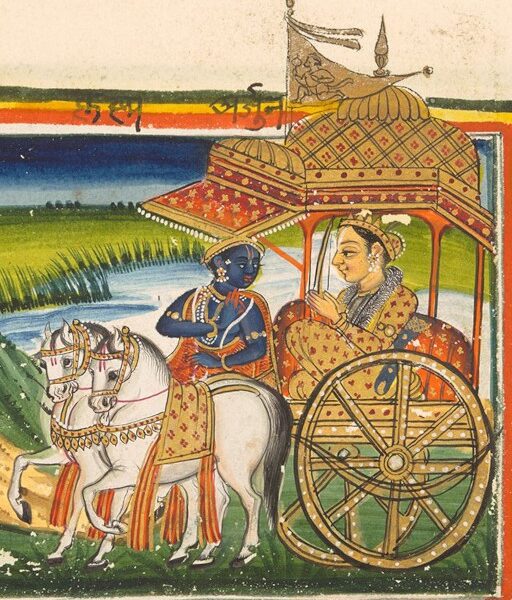
In the material concept, concept of life, when one works for sense gratification there is misery, but in the absolute world when one is engaged in pure devotional service there is no misery.
So the point is that the devotee means that in the material concept of life you are engaging the senses, so there is misery, right? In the spiritual platform one is engaging the senses, but there is no misery, right, because it is in cooperation with the Lord, right? This whole section is on the cooperating with the Lord.
The devotee in Kṛṣṇa consciousness has nothing for which to lament or desire, right, because whatever is your desire is what you engage in, right? You desire something so the senses are engaged. You don’t desire anything, you don’t, there is no engagement of the senses, right, means in sense gratification. So that means they have no desire except to please Kṛṣṇa, so there is no material desire. So their engagement in the Lord’s service then gives no misery either. Since God is full, a living entity who is engaged in God’s service, in Kṛṣṇa consciousness, becomes also full in Himself, right, says, full in Himself, not full of Himself, right? That’s the material concept, right, like that, full meaning complete. He is just like a river cleansed of all dirty water. Because a pure devotee has no thought other than Kṛṣṇa, he is naturally always joyful. He does not lament for any material loss or aspire for gain because he is full in the service of the Lord, right, so he has nothing to fulfill for himself. His only interest is how to please Kṛṣṇa, right?
He has no desire for material enjoyment because he knows that every living entity is a fragmental part and parcel of the Supreme Lord and therefore eternally a servant. The world is miserable for the materially infected person, but for a devotee the entire world is as good as Vaikuṇṭha, or the spirit of God. Such a stage can be achieved by the mercy of Lord Caitanya, who preached pure devotional service in this age. So what we see is that the world is as good as Vaikuṇṭha because there is no desire, there is nothing to lament, there is nothing that there is any gain or any loss, right? Because on the material platform, the idea is that we look at the situation and what we are going to get from the situation as what is important, right? Engagement is the same, but the situation is what we are going to enjoy by the endeavor. So from the situation I am going to generate a result I want. So you have to perform an activity to do that, right? But the focus is on the situation of what you can get from the situation, right? So that’s why for the devotee he doesn’t have the concept that if I take up Kṛṣṇa consciousness that therefore materially as the situation everything will be perfect, right? Because why do we want a perfect situation?
To be happy on the material platform.
Does that make sense? So therefore that the material world isn’t wonderful, that doesn’t bother the devotee because the situation is not what he is interested in, right? And the result for himself is not what he is interested in. He is simply interested is that the result is good for Kṛṣṇa, right? So you do that by making the endeavor. It doesn’t work out the first time, you keep endeavoring until it works out. Does that make sense?
Because otherwise you make the mistake that religion, because it gives good results, therefore if I take up Kṛṣṇa consciousness there will be no bad results materially, right? So as long as it means when things are good materially and good spiritually then we’ll say that’s great. If it’s only good spiritually and not materially we’ll say we may feel there’s a problem, right? Does that make sense? So this is the mistake is that religion in our mind means that it will give all good results. But the problem is that it does give all good results but the soul is spiritual and the results are spiritual. That’s real for the soul. But because we identify with the body we expect the religion to give us good material results because we identify with them because of the identifying with the body.
Does this make sense? Yes. It’s like the quality of sannyāsa’s indifference. The quality of sannyāsa’s indifference. Do we have to develop that?
It’s not that we have to develop it, it will come. You know what I’m saying? In other words, the problem with something is not what is its situation but it’s the mentality behind it. Let us say someone gives us something quite nice, you know, a very nice thing and we like it very much, we put it in a prominent place in the house, you know? And now let us say after some time, you know, not so much that we’ve forgotten about the thing but, you know, it’s still there that this person does something that we really, it annoys us so much we want to have nothing to do with this person.
Okay? So what happens with that item? Yeah, it goes.
You understand? But look at it. It’s a really good thing. Right? Very nice, very expensive, very useful but we’ll get rid of it because it carries the wrong mood. You understand? So getting rid of things isn’t our problem.
It’s based on the mood. So the point is when the mood’s Kṛṣṇa conscious…
Oh, it’s in this pocket.
So all these other qualities, they come about because of one’s attraction to Kṛṣṇa.
Does that make sense?
So we notice here is that the focus in Prabhupāda’s, what he’s talking about is simply that the living entity in cooperation with the Lord doesn’t endeavor for sense gratification which means engaging the senses separate from the Lord. He’s always engaged in all his activities in connection with the Lord. Does that make sense?
Yes. Sometimes it appears that there is a situation where materially it is bad and spiritually it’s not good as well. But that just means things aren’t going well. Because the point is this, spiritual, that can be constant. So it’s not the situation that’s creating the good or bad consciousness. The consciousness is bad, therefore the situation is not good. You know what I’m saying? Does that make sense? In other words, if one is… the consciousness is material, it’ll always create a situation that’s not nice. Meaning the situation itself may be physically not nice or maybe nice but it’s not comfortable for you.
You know what I’m saying? Like that. So, those two go together very naturally, right? But if one is Kṛṣṇa conscious, then one doesn’t become disturbed by the world because the nature of the world is if it’s nice, it will become not nice. And if it’s not nice, it will become nice. Just the way it is. It just happens to be that those two happen to be together. You know what I’m saying? So the material world going from nice to not nice and nice to not nice, that’s what it does. That’s its job, right? But us being spiritually situated, that’s our job. And so one can be spiritually situated throughout.
Does that make sense?
So, if one is spiritually situated, but, yeah, if one is spiritually situated, but materially it’s not nice, then that’s normal because it’s the material world. Right? If it’s spiritually well-situated and the situation is nice, that’s also fine. But it’s not that the devotional activity, it’s because I’m doing devotional activity, therefore the situation is nice. This material world will go back and forth between nice and not nice. They’re two different things. Does that make sense? If one looks at it in this perspective, then one does not try to connect the two. Right? But if one sees that one has facility and one is not distracted by it, that same facility before one might get comfortable with the material arrangements or might even be distracted or absorbed in those material arrangements, then you can understand, OK, that’s coming from spiritual development because now we have facility and we’re not being distracted.
Right? But if it’s just the normal just coming and going of that, that just comes and goes as it would anyway. Right? It’s just like today the weather is going to be what it is whether you’re Krishna conscious or not. Do you know what I’m saying? And then tomorrow it may be different.
Does that make sense? So material world just does what it does. What we’re so used to is that religion is connected to that. So on the material platform, yes, the reason you’re getting good and bad is from following or not following religion in the past.
You understand? But the present, what you’re doing is what’s going to give you in the future. Right? So therefore, you’re doing nice things for Krishna, so it will create an auspicious situation. But it doesn’t mean that because the situation is auspicious, you’re going to have a particular fondness for it.
You know what I’m saying? Because as one advances in Krishna consciousness, one is not so much interested in nice situations.
Does that make sense? Like that. The difficulty comes is because we connect the two on the platform of karma, which is true. Good karma gets good results. Bad karma gets bad results. But this is Krishna consciousness. So this is the nature of the soul. So you’re using good work for Krishna, but getting a good result materially is not what one’s looking for. If one’s looking for that, then the devotional service is mixed. And because it’s mixed, then any material desire will bring misery, even if it’s a good result. Right? You know, King Midas. It’s not bad. Everything turns into gold. You know what I’m saying? But, you know, it lacks a bit in relationship. You know what I’m saying?
You know what I’m saying? So we’d say, wow, this guy’s, you know, it’s a good situation. But at the same time is that it’s not. You know what I’m saying? So even Indra on the heavenly planet, still there’s suffering. There’s misery. Right? Because there are demigods that are higher than him. There’s demons who, you know, want his position. You know, there’s all kinds of things going on. Does that make sense? So it’s always miserable. So the point is, is if one has, how you tell is that whether you have nice material facility or not, and you’re still Krishna conscious, that’s the symptom of advancement. Not whether there’s good material facility or not. Because that can come and that can go. Right? Does that make sense? So we shouldn’t base it that only if good things come, then the religion is working properly. No, that means, you know, you’ve done nice work in the past. You’re doing nice work now.
If we see our lives and even before they go to deliver, and Krishna’s in some bad situations. Before. Oh, now. No, no, I’m just saying there’s a difference between even now and before.
Why would you want to put them together?
He is always taking care. But he takes the care according to how you reciprocate. So that means before, then you’re dealing with him. If you’re interacting with God, then you’re dealing with him as simply the order supplier for material facility. You’ve done the good work. You get good facility. You haven’t done the good work. You won’t get good facility. Now turning to God, that’s generally the way you get good facility. But still, depending upon what you have, you know, in your good karmic bank account, he can give or not. Just like we said, you go to the bank teller, you have money in your account, let him give you. If you don’t have, they can’t give you. No matter how nice you are now, and how much you say, and this and that, you know what I’m saying, you still have to have the good facility. But by that work now, that will give in the future, but not now. Right? But when you’re dealing with Krishna, then it’s according to what he will see will be good for your development. So by giving you facility, if that will be good, he’ll give it. By not giving it, if that will be good, he won’t give. You know what I’m saying? You know, the child’s behaving nicely, but they have a cold, so they don’t get any ice cream. You know, even though they’re so nice.
Do you understand? So in their mind, you know, why mommy’s not giving me ice cream? Because I’m being so nice. Yeah, but you have a cold. Does that make sense?
So like that. Does that work? Always better to separate. God’s always there, but the point is, you’re dealing differently with him now. You’re recognizing him as a person before we were.
Okay, so we see in the beginning of this, these first three, the process of realizing Atma. But it’s based on the principle of just engaging the senses in the Lord’s service. So being purified by his intelligence and controlling the mind with determination. He knows I’m the servant of the Lord. I’m not this body. Krishna is the controller and the joy. I’m not. Therefore, he’s purified by his intelligence because he sees this is the correct position.
And he makes that endeavor to act in that way. Opportunity for sense gratification is there. He thinks, no, this is not the way that it works. It should be used for Krishna. Giving up objects and sense gratification. So through that intelligence, he gives it up. With practice, then he becomes, it happens the mind also avoids. But in the beginning, that’s why it’s purified by his intelligence and controlling the mind. So that means the intelligence is giving proper direction, but you still have to control the mind.
So therefore, he gives up objects of sense gratification. Giving up an object of sense gratification means you saw it in sense gratification as an object of sense gratification. But through intelligence, you give that up. Does that make sense? So it’s not that, oh, I’m seeing it as sense gratification. No, that’s normal.
When one begins the process, one is used to seeing the objects as the senses as sense gratification. So then the first part of Buddha Yoga is seeing that this is not the position. So by intelligence, then you see this is not right, so you give it up. Right? Does that make sense? That doesn’t mean you don’t engage it. It just means it’s not for you. Right? So if one can’t work with those things, then one gives them up and doesn’t work with those objects of the senses. Right? And as one becomes purified, then they can be engaged. That’s what we were meaning before, is that you can engage with the objects of the senses that before were a problem, but now they’re not a problem. That means that that’s through advancement.
Being freed from attachment and hatred, because attachment will give you the enjoyment you want. Hatred is because whatever got in the way of that, or the object itself, because you couldn’t get it, so therefore you hate it.
One who lives in a secluded place. Secluded means away from the activities of sense gratification. Right? It doesn’t mean you go out and… It doesn’t mean you move to Perth. Right?
So that might do it, but, you know, like that. Who eats little means who eats how much is required. He’s not eating for sense gratification, so he eats only what’s required. So much of the time we make fine, that’s less than what we are used to eating. Or, if we totally think we’re the body, it might even… who eats little is actually more than what you’re used to eating.
Means like someone who’s really worried about their figure, like a model, or, you know, like that. Then they might be eating less than they actually require to keep body and soul together. You know? But the point is, it’s just how much is actually required.
Who controls his body, mind, and power of speech, so he’s aware of it. It’s not just the modes of nature, he goes through the movements of this world, but he is aware of it. So he’s aware of the field, and then what are the opportunities? So therefore he’s aware of what are the sense objects, and through intelligence he controls that. Right? So that means he’s aware, he’s conscious. Who is always in trance, and who is detached, free from false ego, false strength, false pride, lust, anger, and acceptance of material things. So here he’s always in trance, so therefore being in trance he’s always absorbed in Krishna. Therefore there is no material things. Everything is being used in Krishna’s service. There’s no false proprietorship, because if it’s not material, it’s not yours, it belongs to Krishna, so there’s no proprietorship.
But he’s peaceful, therefore if nothing’s yours, you’re peaceful. Right? Does that make sense? If you’re in your house, you’re not so relaxed, so what do you do for a vacation? You go to somewhere that’s not yours, that’s not your hotel room, it’s not your spa. Right? Like that. So you’re peaceful. Why? Because nothing’s yours. You know, you don’t have to worry about it. You know, there’s other guys, they have to worry about it. Right? You’re sitting there in the hotel, and you’re happy, looking around at all the people that work there. Are they happy? No, they’re in anxiety. Why? Because, you know, if something goes wrong, then they have trouble. Right? Right? So that’s the point, peaceful, because if it’s not yours, then, well, there’s peace. That doesn’t mean you don’t take care of it. It’s Krishna’s. You take care of it for Krishna. So it’s not only you’re peaceful because you have nothing, so that’s how some deal with it. Okay, nothing’s mine, I don’t work with anything. So that gives peace, yes, but more than that is, I’m doing this for Krishna. You know what I’m saying? So you have taking care of something for yourself gives you anxiety. Taking care of nothing, that gives you that neutral state of peace. But when you take care of something for someone else you have great affection for, then that gives a positive, dynamic peace. Right? So peace is simply the situation that one’s in. But the experience is not that of peace. The experience is that, the dynamic relationship with the Lord. Right? Does that make sense? There’s always, there’s the situation and there’s the experience.
Does that make sense? We always have to be able to, because we put the two together.
You know? But they’re actually two different things. That’s why one is spiritually situated, but one is getting transcendental experience. Right?
The impersonalists and the yogis, they’re spiritually situated also, but they’re not getting transcendental experience. Right? And for a fleeting moment they’re getting the spiritual experience. And then very soon they’re back to the material experience. So then they come back to the material situation. Right? Does that make sense? Because you can be materially situated, but be in Krishna consciousness. Right? So that’s what’s happening here. So on the material platform, they’re peaceful. But it doesn’t mean that they’re not worrying about doing nice things for Krishna. But that doesn’t give anxiety. That doesn’t give misery.
Right? Okay. It’s free from less anger. Acceptance of material. Free from fault. Okay. Such a person is certainly elevated to the position of self-realization. Right? So one who is thus transcendentally situated once realizes the Supreme Brahman, which means the person, and becomes fully joyful. Otherwise, before that, just realizing Brahman, he’s joyful. But the Supreme Brahman, then he’s fully joyful.
Right? Because joyful, you know, just from Brahman, you’re peaceful. It’s nice. But it’s neutral. It’s not dynamic. It’s simply a nice situation.
Does that make sense? You’re in a nice situation. It’s nice. But what’s the next stage?
You’re in a very nice situation. What’s the next stage? You go in, you know, fabulous beds, nice places like this, great, you know, it’s all nice. What’s the next stage? Activity. You’re going to do something. You know, you go sit on the bed or go, you know, check out this and that, use the shower. You’re going to do something. Right?
No? So that’s the point, is that just being in the situation, that’s pleasant, that’s nice, but it’s not as nice as interacting with it. So that’s the point. The spiritual situation is nice, but interacting with the Lord in that spiritual situation, that’s what’s dynamic.
We see the difference?
See, the difficulty is that we just, we just, it all gets mashed together. Right? Does that make sense?
Right? Yes. So some devotees, they’re in this situation, not interacting very much. Does this mean they’re just in a, some kind of neutral state and just, you know, in the future they will? Yes. It’s just, in other words, if they are determined that serving the personality of Godhead, Krishna, is what their goal is, and they are in the association of persons like, who have had that mood, then it’s just a matter of time. They’ve just gotten from the materially active state to the spiritually neutral state. But then the idea is you get to the dynamic transcendental state. That’s what we’re trying to do. So it’s not bad. See, it’s like here is that you go all this, and becomes fully joyful. So that previous situation, he’s there, that’s what he’s gotten to by his purified intelligence controlling the mind, the senses, and all that. So he’s come to that state. But now he’ll come to, he becomes fully joyful by being in contact with serving the Lord. Right? Because before he’s serving the Lord, but now he’s really actually aware of it. You know, before you’re doing it because intellectually you know it’s right. Now he’s doing it because that’s what he wants to do. He has that feeling. Like before, you have material feelings, but you know intelligently it’s not right. So therefore you’re trying to avoid them and trying to engage in the Lord’s service. But one comes to the position when spiritually situated, and then one comes to the platform or one wants to, one likes doing that service to Krishna. Does that make sense? It just comes, right? Then he is equally dispoised to, he never laments or desires to have anything. So therefore there is no bad situation. As we said. Because if you don’t, if it doesn’t matter to you, you know, you’re not lamenting or, or, how do you say it? Or desiring, right? You know, it’s just like let’s say, you know, you sit down for breakfast and you have, you know, what generally, you know, something cooked and this and that. You know, but the kids, they like their cereals, you know, these out of the box, right? So now if I bring in, you know, 20 boxes of different cereal and show them all to you, you neither desire or nor lament. Because you don’t care. You know, but for the kid, wow, this one’s great. No, you don’t get that one. You get this one. Oh, you know, like that. I want it like that. You understand? So that’s the point. It doesn’t, it doesn’t matter.
Does that make sense? So that’s the thing. It’s not that, it’s not that they’re this kind of zombie, you know, like that. Non-scary zombie, right? But it’s, it’s a, yeah, so that’s probably why these, these advanced personalities, they never make, they make, you know, how you say, zombie movies. Because they’re not scary, right? You know, you have to get the scary zombies, right? So they never lament or desire because they are always absorbed in devotional service. Right? So that’s where their activity is. But for the other, their activity of their desire and hatred is all on the material platform. And here, it’s that their desires, their attachments, their interests, their endeavors are on the transcendental platform.
He’s equally disposed towards every living entity because everyone’s part and parcel of Krishna. So you see, it’s just a covering.
Right? It’s not that because there’s a covering, then there’s something else. That’s the mode of passion. Right? We see different kinds of souls. If you look at the history of, you know, yeah, your world religion, it’s because of this mode of passion. Right? They will be thinking that they’re situated, you know, in goodness, but actually in impassion because there’s different kinds of souls. Right? If you’re one religion, you’re a soul of that religion. And if you’re not of that religion, you’re a different soul. Right? Does that make sense? But here, it’s no. Everybody is servant of God. So one is equal poised. And in that state, he attains pure devotional service unto Me. So here it would attain, meaning then he becomes situated. Then that taste, that position of that. So you can see it in the beginning stages, in the middle, or in the end. So in any case, someone who would have this then would nicely move through the devotional process.
Yes. So to get to pure devotional service, it seems that first we need to get the intelligence purified. Yes. And this indicates, what is the relation between intelligence and knowledge and desire?
It means, it’s all what your point is of doing it. If one is learning about, you know, the Shastra and all that, because one simply wants knowledge, then that’s not going to necessarily be purified intelligence. He may learn, okay, through this, he has material purpose and knowledge, you know, so by nature he’s more controlled by the mode of goodness. So then learning about certain activities in the mode of, that are impassioned ignorance as opposed to goodness, he may, by his intelligence, not do them. Right? But it doesn’t mean that he gives up attachment and hatred, because he’ll be attached to the mode of goodness and have hatred towards those in passion and ignorance. Right? Does that make sense? So you’ll have some elements that are common with goodness, he’ll have. But what’s common with devotional service, he won’t have. Does that make sense? So, for the devotee, is that he is gaining knowledge so that he knows better how to situate himself as a servant of the Lord. Right? So he can see is that I’m servant of the Lord, but in this situation, if I act in this way, then that won’t be serving the Lord. And if I act in another way, then that will be serving the Lord. Right? Or it may be the action will be the same, but the consciousness. I’m seeing relationship to myself or not. Does that make sense?
Being here, yeah. That’s what we’re meaning here, because this is 18th chapter, so we’ve given up long ago about talking about just someone situated in goodness who’s situated in goodness. Right? You know the pious person, that’s all 4th chapter stuff. You know? So this is a matter of he’s intelligent because he understands the difference between matter and spirit. Right? So therefore, the senses and the sense objects, that’s matter. He’s spirit, Krishna’s spirit. So therefore, but at the same time, the material energy is also the Lord’s energy, so it’s also spirit. That means then the senses and the sense objects can be engaged in the service of the Supreme Spirit.
Yeah, it’s like we’re seeming, we’re controlling the matter, so we put material energy as less than us. In one sense it is, yes, because Gita will say that the soul and the super -soul are in the spiritual platform, while the material energy is not. But there is the element that the living entity being Purusha, he wants to enjoy, so he’s actually under the control of the modes of nature. Right? So now, Maya controls the world, he means the matter, the dead matter that we’re involved with through the modes of nature. Does that make sense? So that means we’re controlled by the modes of nature and the energy is controlled by the modes of nature. So there’s no question that we are superior to matter. If we act like matter, we’re actually junior, because what we’re not realizing is, yes, Maya controls the material energy through the modes of nature, but how does it actually operate? She controls us and uses us as an instrument to control the matter.
So we’re thinking, I’m the controller of matter, but we’re being only used as an instrument by Maya to control the matter.
So we’re always an instrument, we’re always a servant. But in illusion, being controlled that way, we think, I’m doing this.
Right? You know, like you pick up the kid and all that, and he has his hands, you know, like this, and you go up to someone else and he’s flying and, you know, he’ll be saying, I’m flying, he goes up to, you know, someone else in the house and you start hitting them, yeah, beat them all up, yeah, you know, I’m the big guy. Right? But is he actually doing all that? No. Whoever is picking him up is doing all that.
You know what I’m saying? But the child will think, I’m doing that. So that child is us. And the one picking us up is Maya, you know? So through the modes of nature, she moves us around, and while we move around we move different things around us and we think, yeah, I’m doing all this.
But we’re not. We’re still just the servants. We’re still just the instruments. That’s our position. On the spiritual platform, also. We’re working in the saṅdhini, saṅbhitini, lādhini potencies. So we’re still, again, servant. But this servant is what we’re supposed to do. This is our nature. So we’re happy. And serving on the material platform, we’re not happy. So servant is who we are.
Problem is, is we think we’re master.
So that’s the… Because the involvement of the Lord is imminent. We don’t see Brahman and Paramatma. So therefore, we don’t see our connection. So we think, it’s all about me.
But on the spiritual platform, you see the Lord and all the devotees. So therefore, He’s direct. He’s personal. So it’s not a matter of being mistaken, as others say.
If you see like that, there is no question to be attached to the situation. Yes. There’s no… Because it’s not… We are not in control of it anyway. And even you want to control it. If you’re on the material platform, it’s only according to your karma whether you will or not. Because you’re being controlled to create that situation. So if you have the karma, you’re involved in that situation that gets the result you want. If you’re not, you’re involved in the situation that doesn’t get what you want. You know what I’m saying? Like that. It’s just a matter of whether you have the karma or not. But on the spiritual platform, then also, again, same thing. It’s not for you anyway. It’s for Kṛṣṇa. In either way, we’re always the servant, always the assistant, and never the enjoyer.
You know? The point is, is because that’s our nature. If we follow that connection with Kṛṣṇa, that’s actually how we’re happy.
It is that, in some sense. So it’s not that there’s something missing. We’re only feeling something’s left out because I’m supposed to be the enjoyer. But we’re not. That’s not our nature.
As far as Prabhupāda says in the Bhāgavatam, the material happiness of the living entity is a sort of wishful thinking in a way. Yes, wishful thinking. Yes. It would be nice, but it won’t happen.
So how is that, how is it different from being on the spiritual platform? How is it different? Because on the spiritual platform, you’re simply trying to please Kṛṣṇa. So that’s direct. But trying to please yourself, that’s wishful thinking. You know, the example is given. If you water the leaves of the tree, the leaves don’t get benefit. You water the root of the tree, the leaves get nourished. That’s just the way it is. We’re not the root. But we take it we’re the center of the cosmos.
Right? So that’s the problem. But we’re not.
We’re connected to the center of the cosmos.
So we’re like the leaves. So the leaves, you know, so that one very clearly sees there, but the hand, the hand feeds the mouth, and then it gets nourished.
Right? So we serve the Lord, that’s how we get nourished. That’s what we are. Right? You understand? We’re not something else other than that. So recognizing that, that self-realization, then we can function on that platform.
Does that make sense?
It’s easy to get covered though? Easy to get covered.
Yes.
Especially if one is already covered.
Then it’s even easier.
Coating attracts more coating. Yes. It’s like they say. More layers. Yeah. Layers attract layers.
In other words, if it’s all dirty and there’s one little spot that’s not, it’s very easy to cover that. You know, but the whole thing’s clean, harder to cover. Right? So the more you scrub, the more difficult it’s, you know, to cover.
Okay.
Okay.
Vrtti. Those who always cooperate with the plan of God by performing devotional service attain perfection and pure devotional service. Those who refuse to cooperate with him are punished by maya. So here then, attain perfection and pure devotional service. So here in this stage, pure devotional service would appear to be defined as prema.
Right? Does that make sense? Because pure devotional service starts from the madhyama platform. But then, then these would just be beginning. Right? So he says he will attain. So someone who has these qualities, you know, so easily they’re a madhyama or an uttama.
Right? So then to attain pure devotional service, then this would indicate that. Because here it says attain perfection and pure devotional service. So perfection is always, the word’s always used in connection with liberation.
Right? And so if he’s liberated, for the devotee, that’s the platform of bhava. Right? The uttama platform. So then if he, and pure devotional service, then that would indicate prema.
Does that make sense?
So this brings us to lesson five. The materialists are servants of passion and anger, born of demoniac principles, and are therefore punished by the external energy of godhead, maya.
What was that she was called before? Something about the, something about the godhead maya or something? Anyone remember that? That was very interesting. That was in this one? Or was it here?
Hmm? Yes. Punished by the external energy of godhead, maya.
External energy of godhead, maya.
Then there’s the internal energy of godhead, maya. Right? Which is yoga maya.
External energy of godhead, maya. The first one is the prabhupada version, and this one is sometimes edited. Oh, OK. It means this part. Yes, this one here.
They are not consistent. That means that the external energy of godhead, maya is… That’s prabhupada. That’s prabhupada. Yes, I was thinking only he would use that. We would tend to shy away from that.
OK.
So, 16.4. Pride, arrogance, conceit, anger, harshness, and ignorance. These qualities belong to those of demoniac nature, a son of pritha. In this verse, the royal road to hell is described. The demoniac want to make a show of religion and advancement in spiritual science, although they do not follow the principles. Otherwise, why would it be royal road? One is that it’s the most effective road, so therefore the royal road, because that’s your big, wide, very effective road, well taken care of. Same time as royal, here also means that they want to make a show of this. Does that make sense?
They are always arrogant or proud in possessing some type of education, or so much wealth. They desire to be worshipped by others and demand respectability. That’s why that principle is one respects others but doesn’t demand respect. Because here they demand respectability. So if you’re of the same rank, they will respect you, but if you’re not, they won’t respect. So it’s not what ruler Thutong was talking about, although they do not command respect.
Over trifles, they become very angry and speak harshly, not gently. They do not know what should be done and what should not be done. They do everything whimsically. So now here, within this, all these things would be more or less sophistication. So what would be to a common person, they might get angry easily over. To someone more sophisticated, they wouldn’t, because they would see it as too small.
But the point is, it goes all the way up to no matter how sophisticated, the material phenomena is trifling. So anything within it to get annoyed about is the same principle.
Does that make sense? So we apply it within the purview of our experience, but we also have to know it goes beyond our experience. In other words, if our experience supports this, and we go, yes, I’ve seen that, great. If it goes, no, no, but they’re more cultured than the small things they don’t get disturbed about that I would get disturbed about. No, it’s just, for them, what’s trifling is bigger than what we would call trifling.
You know what I’m saying? We bought something and then put the money back in our pocket and we lost five euros. We’re getting all upset about it. And for them, they’re getting upset when they lost 5,000. Five euros, they don’t… You know what I’m saying? It’s just a matter of what they call trifling.
You know what I’m saying?
They do everything whimsically according to their own desire and they do not recognize any authority. These demoniac qualities are taken on by them from the beginning of their bodies in the wombs of their mothers. And as they grow, they manifest all these inauspicious qualities. So it starts right from the beginning.
The point is that the consciousness of the parents is what attracts that particular soul. Therefore, it’s right from within the womb. But as time goes, then they grow. So even the demons, when they’re small, generally are cute. Like that. But as they grow up, they’re a little less cute.
Okay? So all these points are there. They’re all demoniac qualities. Because divine means connected to the Lord. Demoniac means not connected to the Lord. Right? Because we have this idea, along with, like we were saying before, of religion. Demoniac is just a really disgusting, terrible, bad person. Right? But here, all these different things. They make a show of religion and advancement. Why? So that others will appreciate. But they don’t follow the principles. When they’re on their own, no one’s looking. It’s not necessarily that they’re following. You know what I’m saying?
So arrogant, proud of some kind of education of so much wealth. They have little position, little facility, little bit of knowledge. And one becomes proud. So that’s coming from the demoniac nature. Because the point is, knowledge should create humility.
Right? Wealth is Lakshmi.
Does that make sense? You know, religion is practice to please the Lord. Knowledge is used to serve the Lord.
Right? Desire to be respected by others. Demand respectability. Someone says something, and then one gets all upset. Oh, I mean, oh, I’ve been around here longer than you. You just don’t know. Right? We’ve heard this? Okay, so this is what it’s talking about. These are the demoniac qualities. Doesn’t make them a demon. These are the Anarthas.
Right? You know what I’m saying? Anarthas are the demoniac qualities. Right? It’s just that, you know, they’re being talked about in different places. But in this chapter of Gita, then it’s brought out very clearly. Right?
They do not command respect. They just demand it. You know, they’ve been around longer. Or they’re older. Or, you know, so much of the time. Like that. Does that make sense?
Over… Trifles come angrily, speak harshly. Not gently. They could speak gently. You’d be… The point is the point. The person is doing something wrong. It’s simply… You simply have to point it out.
But, you know, all our emotions and all that in there. So we have to say things, you know, very strongly, very harshly. Like that. They do not know what should be done and what should not be done. Right? So that means we do things that aren’t Krishna conscious. And, you know, we give up following things that are Krishna conscious. They do everything whimsically. So what you feel like is what you do. Right? According to their own desire. They do not recognize any authority. So when we recognize authority, that’s the divine. When we don’t recognize the authority, then that’s demoniac. When we follow what we’re supposed to do, that’s divine. When we are whimsical, that’s demoniac.
Does that make sense? When we behave properly and deal properly, that’s divine. When we don’t, that’s demoniac. So the divine is cultivated. The demoniac is avoided.
Does that make sense? So demoniac comes up because we want to control and enjoy separately from Krishna. Divine comes up because we’re willing to cooperate with Krishna. Does that make sense? Yes. It might be a problem because it becomes a big blend. Yes. We don’t distinguish. Yes.
So we have to distinguish what’s what. Because it’s always, oh, demoniac, yeah, they’re the demons. And then the devotees, yes. But the point is, if we’re not a pure devotee, then that means there is something there that’s not right. So that’s the demoniac.
Does that make sense? It doesn’t mean it’s psychopathic or anything. It just means it’s not devotional.
16.5. The transcendental qualities are conducive to liberation, whereas the demoniac qualities make for bondage. Do not worry, O son of Pando, for you are born with the divine qualities.
So that already puts him a bit ahead.
Get out of jail free card. Yeah, he’s got one of those. Antijas don’t seem to have that one. It’s not even on the board, right?
Like that. So transcendental qualities, the qualities from before, the previous verses, those are conducive to liberation. Not that they give liberation.
They’re conducive. Why? Because they’re conducive to putting one on the spiritual platform because they’re conducive to devotional life. Right? And these make for bondage. Why? Not that the activity itself makes for bondage. It’s because the mentality is not connected to Krishna. It’s non-devotional. Therefore it makes one bound.
Does that make sense? So it’s not that this material quality gives you liberation, this material quality doesn’t. No, this material quality pleases the Lord, therefore you get freed from material entanglement. This material quality doesn’t please the Lord, therefore you become bound by the material.
Right? Because it goes back, even though we say, well, not devotional, but still, who is sanctioning or not sanctioning your results, your activities?
Right? It’s Krishna. Right? Paramatma is doing that. So it still comes down to piety means what he considers is progressive, and impiety is what’s not progressive.
Does that make sense?
So Arjuna’s involvement in the battle was not demoniac. Lord Krishna encouraged Arjuna by telling him he was not born with demoniac qualities. His involvement in the fight was not demoniac because he was considering the pros and cons.
He was considering whether a respectable person, such as Bhishma and Drona, should be killed or not, so he was not acting under the influence of anger, false prestige, or harshness. Right? He’s acting, but it’s under pious. So pious activities are those qualities that are conducive to liberation, but it doesn’t make them devotional.
So that he’s a pious, then that’s better. He’s a pious fool. Right? At the beginning of Gita. So that’s better situated than Duryodhana, who’s an impious fool.
Does that make sense? But fool nonetheless.
Right? Now with this knowledge that he’s able to see a connection to the Lord, then he takes on the transcendental position.
Does that make sense? Right? So this definition of what’s spiritual, that’s pious, and what’s not spiritual, that’s impious, is important to understand. At the same time, we still have to distinguish those material qualities that are conducive to liberation and those that make for bondage.
Does that make sense? Because being conditioned, we have to know which qualities to use and which ones to avoid.
Therefore it was not of the quality of the demons. For a ksatriya, a military man, shooting arrows at the enemy is considered transcendental, and refraining from such duty is demoniac. Right? So now we’re looking at it. He’s situated, but how he’s interpreting and applying it, that’s demoniac. Because the rule is, that should be followed. But how he was trying to understand his situation, that was not demoniac.
Does that make sense? So you have the material qualities that he was considering on being involved or not in the war, those weren’t demoniac qualities. Right? The reason for Duryodhana being involved, those are demoniac.
But a ksatriya fights.
Right? So Duryodhana is willing to fight, so that’s proper. But Arjuna was not, so that’s improper.
So each element has to be seen on its own. So that means Arjuna, there’s something to work with there. But with Duryodhana, there’s not a whole lot. He’s performing his duty, but it’s still material. So he’s pious, so now can we convert that piety into Krsna consciousness?
Right? Because Duryodhana has already taken his piety and is using it for demoniac purposes. Because the foundation is demoniac. So the demons may use religious elements, but for their own purpose. That’s why I said, they make a show of religion, but they do not follow the principles. Because the actual principle is connecting it to the Lord. So therefore, this battle, which is a religious element for the ksatriyas, he wasn’t using it to please the Lord. He was using it for his own purpose. So that’s demoniac.
Therefore, there was no cause for Arjuna to lament. Anyone who performs the regulated principles of the different orders of life is transcendentally situated.
Interesting here, the transcendental qualities are conducive to liberation. So in other words, the qualities from the devotional platform, those are conducive to liberation.
So in other words, all these good qualities, those come from that platform. The demoniac are the inverse, the reflections of those.
16.6. O Sanaprita, in this world there are two kinds of created beings. One is called the divine and the other the demoniac. I have already explained to you at length the divine qualities. Now hear from me of the demoniac.
Those who follow the scriptures are called divine. Those who do not follow the scriptures are called demoniac. So here he’s going to give so many ways you could define divine and demoniac.
The conditioned living entities are divided into two classes in this world. Those who are born with divine qualities follow a regulated life. That is to say, they abide by the injunctions in scriptures and by the authorities. One should perform duties in the light of authoritative scripture. This mentality is called divine. One who does not follow the regulated principles as they are laid down in the scriptures and who act according to his whims is called demoniac or suric. There’s no other criterion but obedience to the regulated principles of scripture. So that’s why before we made the point that you may have people who are very sophisticated, like that, follow very regulated life. But it’s not based on scripture, so therefore it’s demoniac. Just very, you know, refined, upstanding demoniac.
Does that make sense? Because we’ll have a tendency to only use the, you know, melodramatic forms of divine and demoniac.
Yes.
No, that’s another thing. The point is that here the criterion is being made that you’re divine and demoniac. Demoniac doesn’t follow scripture, divine does. Now within, within divine, then there’ll be who are following scriptures for karma, who’s following for jnana, who’s following for bhakti. You know what I’m saying? Like that. So you’re simply just saying here, is it according to scripture or not? Right? Because the demoniac quality is going to always cause a problem. That’s what I was saying before. We’re making that distinction on all these good qualities, we’ll say a really nice social, you know, accepted social qualities, you know, you know, equality and equity, fraternity, liberty. Yes. All these different things. These we’ll consider, these are very important.
But why are they important? If it’s based on scripture, it’s divine. If it’s not based on scripture, it’s demoniac.
So the devotees, by conditioning, may mistake, as we said before, because it’s good, therefore it’s, it’s Kṛṣṇa conscious. God is good, therefore anything good is Kṛṣṇa conscious. No, but the basis of much of the time why devotees follow what is socially acceptable as good social rules and regulations is not because it’s based on scripture.
You know what I’m saying? It’s based as they think it’s good. You know, they have people over to their house and all that and they’re very open like that because that’s what they feel is good, not because scripture is saying you should serve Vaiṣṇavas. Because otherwise, then after time, then they complain that, but I’m taking, I’m being so, you know, nice, you know, hospitable to the devotees, but no one ever appreciates, no one ever reciprocates. So they get upset and think this community is not good. So then they’re doing it simply because they think it’s good, not because the scriptures say it’s good. The scriptures say it’s good, that just happens to confirm their own, what they’re doing. You know, just like the businessman loves when something he’s already doing whimsically is supported by scripture. Yes, yes, see, like this, you see it quite regularly. But whether scripture supports it or not, they’re going to do it. So that’s whimsical.
So that’s demonic.
So the point is, is why is someone doing something or not? And we’ll say, oh, that’s fanatic, but who has said it’s fanatic? Does scripture say it’s fanatic? Right? Scripture says, yes, the devotee has a debt to all the different, the forefathers and the sages and the demigods, the living entities like this, the Brahmins, but he pays that debt by serving Krishna.
Doesn’t say he doesn’t have a debt, but he pays it by serving Krishna.
It does say that. So when we say, oh, we don’t need to follow all these rules and all that, are we basing that on scripture or basing that because for us it’s trouble? So the mode of passion, we are renounced in the mode of passion that we don’t want to be involved with these rules because they’re trouble. Or, even worse, is that influenced by the mode of ignorance, we think religion is irreligion, irreligion is religion.
Right? So if you see someone who is only interested in Krishna conscious activities, right, but at the same time there’s so many useful activities, Krishna said, are conducive to liberation, and they don’t worry about them. Right? That aspect is there. That’s weak. But everything else is connected to Krishna. So they are in some way getting it back to the Shastra, but at the same time their inspiration to act in that and that way is because that’s their nature. They’re generally pragmatists.
Right? Like this. But nicely absorbed. But if you see is that there are occasions where they’re not nicely absorbed, then you know it’s purely whimsical.
Right? It doesn’t sincerely have a basis in scripture. They’re only using scripture to support the whimsicalness.
Right? The other one is, yes, they’re using it to support the whimsicalness, but they’re actually not that far off because in everything else they actually don’t worry about any material kind of situation. You understand? Still it’s a disturbance, but it’s a very minor disturbance.
You understand? Yes. To bring in the time management?
Time management. How to get rid of whimsical?
I mean, it’s more than time management. Because if it was, then I think, you know, devotees, because I think, what, time management? When was that big? Nineties. Yeah, nineties. Yeah, it means devotees would have already been really well organized. So it seems to be more than time management. So it means, to manage your time means you have to be aware of time. And to be aware of time, then you have to have knowledge. So there must be intelligence working. And to discriminate, you know, what’s there. So it’s more based on intelligence.
Right? In other words, time management works for those who are intelligent and conscious of the time. And therefore, but they don’t know how to manage it. And they can manage. Those who can manage, are intelligent, are conscious. Then they can use time management.
Right? So all it was, it was a trick that they would have worked out anyway. But it would have taken them years. And by going through this, someone else’s experience, then they caught it quickly. But if someone isn’t able to manage, someone isn’t able to, you know, I mean, manage their own life. Right? So isn’t able to do all these things. If someone isn’t aware of time or conscious, he won’t be able to use it. So it’s more of that by being engaged in devotional service and taking devotional service as important. Right? That intelligence, that will manage your time. And then with time, you get more and more knowledge, more and more detachment. We don’t manage our time because we get distracted by things that aren’t important. Right? So for a devotee, what’s not important is what’s not connected to the Lord. For the materialist, what’s not important is what’s not in connection with their particular material goal.
I don’t understand the connection.
Yeah, because the point is, materially they can’t get it together, so their only hope is spiritually. You know what I’m saying? It’s like this. The person who was organized basically in their life before becoming a devotee, they could use time management as a devotee and effectively use it in Krishna consciousness. The person who was not still won’t be able to use it. You know, it’s just like if you’re, you know, five foot tall and weigh a hundred pounds, when you become a devotee, you know, you’re not the guy they choose for, you know, moving the deities. You know what I’m saying? You know what I’m saying? It’s just, it’s not that, well, I’m a devotee. Don’t be so bodily conscious, Prabhu. You know, all this kind of, you know, nonsense will be used. And the point is, is that it’s not, doesn’t change. The material doesn’t change.
So, but what happens is, is one, one goes through the progression quicker. So in other words, he would have figured it out by the time he’s fifty, but because of devotional service, he may figure it out when he’s thirty.
But that’s because his commitment to devotional service, that gives the intelligence and the purification. Why is the person able to organize his life and be, and be regulated? It says here it’s a divine quality. That means it’s piety. So if you don’t have the piety, you won’t be able to apply it. But through devotional service, that gives you the piety by which you can apply it. But it’s only where you can apply it in connection to Krishna. This is also a big mistake. Devotees come very sophisticated in devotional life, and they weren’t so sophisticated before devotional life, and they figure if I leave Krishna consciousness and go back out into material life, I’ll go out in this sophisticated state. No, it doesn’t work like that. You go right back to where you were.
That’s it. But in the inverse, when they come back into Krishna consciousness, they go back, right back to where they were, whether that’s politically correct or not. It doesn’t matter. It’s just the way it is.
You know what I’m saying? The devotee who was a great, you know, gave a good lecture before he left, and he’s been gone for 20 years, and he shows up after 20 years for one of these, you know, Prabhupada reunions. When he gives a lecture, it will be good. When you can’t say, no, but he’s been gone 20 years, it can’t be good. You know? No, that’s just what it is. That’s spiritual. But it doesn’t mean when he gets out in the material world, he’s any good at it.
Yes.
So demoniac there is in the mentality, the whimsicalness. So you have to take there. So that’s what we’re saying, is that it may be according to scripture, but it’s still demoniac because it’s whimsical. One’s doing it for one’s own purpose. You’re not doing it because you’re supposed to do it. You’re doing it because you know this is what works. Like the demons, see, that’s the difference between the demons, you know, on these, you know, who are on the, how do you say, Bilaswar, and these kind of things, is that they have so much more material facility, and they’re so much better at their demoniacness than the modern man here, because they know that only by following the Vedas can you get the facility you want. But they’re not doing it because you’re supposed to follow the Vedas. They’re doing it because that’s what gets the best result.
You know what I’m saying? If a news, if suddenly this big flash came out that this group of scholars and all that had been studying all these different methods from all over the world, and really got into it, and studied thousands of cases and all that, and they found that those who are following, you know, to more or less some degree of, you know, lifestyle as mentioned in the Vedas, actually did better on the social, economic, political, sense gratification platforms, you know, and this was all the big, you know, central article, and, you know, Time and Newsweek, and your scientific journals, and, you know, how do you say, Reader’s Digest, all these different things, guaranteed devotees would be talking about following the Vedic culture, it would be the new fad.
Guaranteed.
You understand? But until that happens, then, as long as they’re acting whimsically, it’s not going to happen. You know what I’m saying? So the demons, they know, this gets a better result, that’s the only reason they’re doing it, that’s why it’s whimsical. You could say, no, but they’re following Shastra, and they’re doing what they’re supposed to do, yes, but it’s whimsical, what is the basis of why they’re doing that? Well, the divine means, they’re following because this is what’s supposed to be done. I’m supposed to follow the scriptures, I’m supposed to act according to the nature. Studying my nature, I have this nature, therefore, I’m supposed to do these activities.
Does that make sense?
You know, so that’s, the demons, they follow, that’s why you see, in the pictures, what are they wearing? We have a battle between the demigods and the devotees, you know, the demigods and the demons, okay? And, yeah, the demigods and the devotees, that’s the Hindu dude there.
Hindu dude, right? Hindu and Hindu, right? So, what are they wearing?
Dhodis, like that, you know, what are they speaking? Sanskrit, you know, what are their weaponries and stuff? Right? They’re still using ashras and everything based on Shastra. You know, what do they do? They still have kings, they still have ministers, they still have everything like this. So, the culture is the same. So, whether it’s divine or demoniac, Vedic, the culture is one. The point is, divine means you’re doing it because you’re supposed to, demoniac means you’re doing it because it’s wholesome.
You know, so because of that, therefore, over trifles, one gets angry, this and that, it doesn’t, you know, it’s just, does that make sense? So, that’s, that’s, yes. Sometimes, Marius, there is an argument about scriptures and people come and they say, why don’t you follow your own scriptures, scriptures of your people, why you took this Hindu and this and that, you know? I’ve heard that before. I was, we were sitting on the, in the old Gurukul and twenty students came from Tel Aviv. They said exactly that one.
And everybody’s aunt and grandmother says that also.
Yes. It means, but the point is, is, okay, so now, if we take the essence of the scripture to be, you know, the, the shama, that you should love the Lord like God with all their heart, with all their soul, with all their might, right? So, where are more instructions on that?
Right? You got thousands of verses, there’s three shamas.
So, therefore, the Gita is full of them. The whole thing. So, all it is, is we’re furthering the knowledge. Because if that’s the case, why is it that there’s other books?
Right? Because it’s accepted. There’s so many other literatures that are written by practitioners.
You know what I’m saying? Because then you just say, no, you just follow that.
But if they understand, is there’s further and further understandings by their realization and practice. So, the scriptures here are the realization of great authorities who are following the Vedas.
Does that make sense? So, just as they accept that these are further teachings, right?
But the point is, is lifestyle is meant for what? Why should there be a lifestyle? The lifestyle is connected with what? Means, means, means just in the first chapter. Then, Adam and Eve are walking with God. What do they eat? Right? The fruits of the field, I mean, the tree and the, what is it? The herbs of the field, right? You know, all these nice ways of putting it. Right? And then, when they displeased God that they weren’t qualified to remain in the garden, what was their food? Right? Yeah. Then they were given flesh. But, it says, it was a curse.
Right? It wasn’t just, okay, well, okay, then, you know, hey, you’re not going to find many, you know, vegetarian restaurants there. There are so many McDonald’s, so, you know, now flesh and all these things like that will have to come in, you know? So, so, right there is lifestyle is to do with consciousness. It’s consciousness first, then lifestyle.
So, the point is, is that, yes, the culture is there, but, what’s changed? We still, you know, it’s all about food, all about hanging out with people and eating food, you know? Isn’t it? You know, you sing some songs, you know, you have some programs, so, in principle, it’s just the same.
Does that make sense? You know, it’s just that you have the, you know, how do you say?
What’s it? I can’t remember what’s between. You have reform and then you have conservative. There’s something in between.
You know? Oh, well, like that. And then you have your, you know, oh no, reform, conservative, orthodox, right? That’s a conservative thing. Then you have your, you know, like your hasids or other such things. So, we’re just the next step beyond the hasids, right? Like that. We’re the most fanatic about, you know, following everything. Does that make sense? Because they get into all the esoterics and all the numbers and what’s happening. So, you know, we do that also. It’s just that we also go by the words, so it’s not just numbers. Does that make sense? He just explains. we’re taking it to another level. This is very offensive, Marius. We say like that to these people. We don’t say like that.
Basic point is that the principles are the same. The point is to develop love for God. So, whatever is the most conducive to that, then that’s what one follows. So, this we find is more conducive. You know, it’s more dynamic. Like that. Because there’s a good chance that whoever is complaining wouldn’t want this, wouldn’t also be pleased if you, you know, suddenly all you did was spend your whole day down at the western wall. You know what I’m saying? And when they walked in, you didn’t say, hi, how are you? You chanted the Qur’an. Right? You know what I’m saying? They wouldn’t like that either. You know what I’m saying? So, the point is, they just want you to be like them. So, it’s not about developing love for God. It’s about being like them. So, the point is, that’s nice, but ultimately, you know, there’s death and then there’s the question of your position in relationship to God.
You can try that one.
See how that goes.
They’re not going to take the, they’re not going to be impressed with the ultra-orthodox, or transcendental orthodox.
So, here, there is no other criterion but obedience to the regulative principles of scripture. That’s all. Prophet doesn’t leave it, you know, that this is a very important consideration, is obedience. No, he says there’s no other criterion.
That is the criterion. Then within that, then you’re, anything else is fine points.
You know, just like Shastras is the main thing. Then, the other nine points of the Dasamu. But without Shastra, the other nine points don’t have meaning. So, the nine points of Dasamu are based on the, the first one of Shastra is the authority. There’s the demoniac at the front. Yeah.
6.17 Those who are demoniac do not know what is to be done and what is not to be done. In other words, don’t read this chapter for that.
Neither cleanliness nor proper behavior nor truth is found in them.
Yeah, you would have to say neither cleanliness because I remember that one time I was learning, a guy was teaching how to cook bagels, right, and you’re making the dough and it’s hard, right, you know, work. And so then, his point was is that hard work and then you sweat and so that sweat from the brow, that going into the dough, that really makes the bagels come out good.
So, neither cleanliness nor proper behavior. And I don’t think it’s true either, right, so neither truth.
So, the demons suffer because they don’t follow the scriptures. In every civilized human society, there is some set of scriptural rules and regulations which is followed from the beginning, especially among the Aryans, those who adopt the Vedic civilization and those who are known as the most advanced civilized peoples.
Those who do not follow the scriptural injunctions are supposed to be demons.
So, here they’re even saying within the religion if they’re following the scriptures, that’s divine, if they’re not following it’s demoniac, and if they’re whimsical about it, so you’re going to have a mix. But they’re saying it’s that the most advanced, most advanced of civilized who follow scriptures are the Aryans, meaning the Indian ones, not the German ones, because they don’t follow the scripture, right, so that’s how you tell the difference.
There are many rules and regulations guiding human behavior, such as the Manusamhita, which is the law of the human race, so this is 16-7, even up to today those who are Hindu follow the Manusamhita. Laws of inheritance and other legalities are derived from this book. Now in the Manusamhita it is clearly stated that a woman should not be given freedom. That does not mean that women are to be kept as slaves, but they are like children. Children are not given freedom, but that does not mean they are kept as slaves. The demons have now neglected such injunctions, and they think that women should be given as much freedom as men. However, this has not improved the social condition of the world. Actually, a woman should be given protection at every stage of life. She should be given protection by the father in the younger days, by the husband in her youth, and by the grown-up sons in her old age. That sentence there is actually an exact verse of Manusamhita. It’s actually an exact verse.
And the one before, actually.
This is proper social behavior according to the Manusamhita. But modern education has artificially devised a puffed -up concept of womanly life. And therefore, marriage is practically now an imagination in human society.
Everybody is into it, but it doesn’t necessarily work because it is artificial.
Nor is the moral condition of women very good now. The demons, therefore, do not accept any instruction which is good for society. Because they do not follow the experience of great sages and the rules and regulations laid down by the sages, the social condition of the demoniac people is very miserable. Because the Vedas say what should be done. It means in the way of what’s the overall concept in that. But the detail, that’s given by the sages. The Smriti is what gives fine detail, exact rules. Like Manu is Smriti, not Shruti. So that’s the tradition. That’s why it’s called tradition. Smriti means tradition. So it’s what’s given by the sages because they see this is what works. If someone applying the Veda, this works. Someone not applying the Veda, then you have all kinds of trouble. So this is the way to apply. So they’re very great learners. They’re, you know, receiving in parampara. So therefore, what they give comes out very nicely.
Yes? I’m hearing this.
Okay. They say at least you try. Like that. Because, you know, just because he’s following the demoniac.
So the point he’s giving here is that you follow the rules, it works. The rules aren’t followed, it doesn’t work. Because it’s whimsical. What’s done whimsically doesn’t get a good result. Right? What’s done according to a plan, that gets the result. Right?
Spontaneous is within the rules, you’re able to see how to put them together to get newer and newer ways to make the thing work. Rather than just, okay, what’s the tried and true, you’re able to see beyond that. That’s spontaneous.
Right? Whimsical simply means you’re doing whatever you want. Now someone can, you know, very, without much delay between an opportunity and the application of their whimsicalness. Right? By those who are whimsical, they’ll call that spontaneous.
Does that make sense? But it doesn’t mean it’s spontaneous. Spontaneous means it’s based on the rules. You’re able to spontaneously supply what is normally done in a very rigid way. But whimsical means it’s based on what you feel like. Right? It’s not a matter of inspiration on how to follow the rules, it’s a matter of inspiration on how to just get done what you feel like doing.
You see this difference?
Yes? Is using your intuition and your feelings also can be a… Is it based on scripture or not? If it’s based on scripture, then fine. If it’s not based on scripture, then it’s whimsical. Just you don’t even know where the whimsicalness is coming from. You know what I’m saying? So from previous activities and that, in this situation you would do like this, therefore you’re reminded of that. Last time you were in this situation, you did like this, so then you feel, oh, I’d like to do this. You know what I’m saying? So even the living entity remembering what they did in these situations to absorb themselves materially, even that they can’t do on their own. They still need the direction of the Lord and the Mother Nature.
So it kind of looks very bleak for the mundane situation.
Does that make sense? But we’re people. The Lord is a person, so on that platform it all works. See, here’s… You’re trying to make a reflection work.
You know what I’m saying? Reflections don’t work. They only act according to how you deal. But if you want the reflection to be able to function on its own, that means the person who is able to make that has to make it happen. You know what I’m saying?
You know what I’m saying? You’re going to do this and that, but if I say, no, make the reflection do this, how does that happen? It means you have to do it. So all it is is based on the desire of the reflection things are going on. That means the Lord still has to do it.
Does that make sense? So that’s the difficulties. We’re in illusion thinking, I’m doing this on my own.
And how we understand how conditions this…
how conditioned we are by this. If you notice, practically every point that Krishna makes over the last one and a half years of this study has been the same thing. And it’s like, most of the time we’re kind of nodding our heads. Occasionally we go, wow, yeah, right.
We’re very well entrenched in this. So that’s why from so many different angles, so many different evidences, examples, ways of presentation, the same point is being given. We’re servants of God. Any other way of dealing, you will not be happy. The only way to be happy is by serving God. That’s it. Within a couple of sentences the whole philosophy can be summed up.
Does that make sense? But we’ve studied this much, and still we’re going on and saying, well, yeah, that’s a new point.
I got it in connection with the apples, but this is a whole new idea about pears. Like that. Forget the bananas. It doesn’t even apply there.
Does that make sense? So the idea is that one doesn’t follow, it doesn’t work. But one has to follow properly. Right? Because otherwise you can say, oh, I’m following. Okay, the women shouldn’t be given freedom. They’re just like children. But then they will deal with them not as they would deal with their children.
You know what I’m saying?
You know, you don’t sit there when you come home and then see kids like that. Go do this. Go do that. But they might do that with their wife.
You understand? Because the Shastra doesn’t say specifically. They say the children should respect the parents. But the Shastra doesn’t say children shouldn’t be given any independence. Because everybody knows that. At least most everybody. A few liberals who don’t. You know what I’m saying? They’re not given independence. It means that you have to take care. But the point is it’s the same principle.
Right? In other words, you’re taking care of the kids. They’re not independent. Like this. When you go out, let’s say you’re going out for, you know, it’s an afternoon off with the family. And you’re out with the kids and all that. So when you get something to eat, what is it according to? What they want. Yeah, what the kids want. Does that make sense? So if you’re dealing with the kids in the same way, I mean the women in the same way, then what do you eat according to? What they want. You know, what ride do you go on? What they want. So that means what do you do? You know, so your specific roller coaster through life, you know, that’s according to the one that the women want to do. You understand? But we don’t catch that. That’s why it doesn’t work. So people will say, no, but this doesn’t work. This is this and that. No, it works perfectly fine. Problem is, is who applies it?
That’s the problem. The Vedas don’t have any problem. These are what the great sages have done. They’re happily living with their wives. They’re not living with them for 30 years. There are several of them that gave these things. They’re living with them for hundreds of millions or billions of years. Right? And fine. Doing fine.
Right? You know, we don’t hear that, hear heard that, yeah, everything was really great with the Manus, but the sixth Manu, he got divorced. Which is sometimes they don’t consider his directions to actually be so important. You never hear about that. Right? You never hear about Indra, you know, and Indrani getting divorced. You don’t hear about any of it. Right? You understand? It just doesn’t happen. Why? Because they know how to apply these things. Yes? You hear about King, the Dhruvnaras story.
She was not very favorable with her husband. No, but that’s just, that just happens. When you see, but why wasn’t, why means, but the point is, is she wasn’t favored by the husband. Why? Because the husband didn’t want to favor?
I didn’t hear that. I just heard that she wasn’t his most favorite. Yeah, but we’re trying to get at the point here. So, so, so why wasn’t she the most favorite? The other one was. She wanted young and pretty. No, that’s, that’s part of it. Because the point is that she’s young and pretty, he spent time there, but he also spent time here. The other wife didn’t want him to. The other wife didn’t want him to. So if he wants to, to have time with the, the one wife, then he can’t spend the time with the other. So it’s according to the wife.
Right. Yeah. I understand.
I think we’re touching on an issue here.
Because it’s a war, so they don’t continue protecting, you know. Yeah, yeah, of course, of course. But I’m saying, we’re touching on an issue here.
We’re touching on an issue.
I mean, it is an issue. You understand? Yeah. So it’s not that, he was taking care, but the point is, is if there are eight wives, you know, then one of them has to be the prime.
Then she, that means when it comes to social functions, she is the primary one. But when he’s privately with each of them, then he’s with each of them alone. Or he’s in private with them, but then they’re all together. But then he has to be clever enough to be able to praise each one according to her own specific quality that the others will also agree with. Right? That’s hard enough with one, let alone eight. And not only that, the one is no one else is there, but this one, all the other seven wives are there. Right? And not only that, is what you said today, you can’t stay tomorrow. So now you can understand, make, understanding newer and newer things for 30 years. Right? You know what I’m saying?
That’s tough. So that’s why these kings were not just ordinary people. The qualification they had, there’s rules to follow there. And if they didn’t follow them, the wife didn’t talk to them. They can’t go, I’m the king, you have to talk to me. It doesn’t work like that. No, he’s the husband. He’s not the king, he’s the husband.
You know what I’m saying? So if she goes into the room of lamentation, there’s nothing he can do about it.
The kings, they had a separate room for lamentation. So that queen has her own.
You know, it’s obvious. That way, because you’re sitting in the other room, you don’t want to make a mess of the other room. That room, you can make a mess of.
It’s decorated according to the moods of lamentation.
Do you understand?
We’re clear there? So in other words, it’s not following. So just as these subtleties in understanding the difference here, you know, matter and spirit, the same subtleties were missing even on the material platform.
That’s where Arjuna, he’s born with the divine qualities. So that’s there. And others are not necessarily. Therefore, they miss these subtle points. So not only is it not based on Shastra, but even if you give them the Shastra, they can’t even understand the subtleties and what it means.
Therefore, only devotional service. That’s the only thing. That’s the only alternative. Materially, it’s already a mess. So therefore, the only alternative is spiritual. So it makes it very direct and easy, right? You know, not much to get distracted by. Like that. You know. So we shouldn’t be surprised by so many?
We shouldn’t be surprised. No. But it’s not. It’s not good. But it’s just we shouldn’t be surprised. Because how do they get married? Based on Scripture? Right? Scripture, the first thing Manas says is equal nature. So do they see that the nature is equal?
That’s not what they look for. So what is equal nature? Means the methodology of what they’re looking for, how they go about it, all that’s the same.
That’s equal nature. But that’s not checked.
Right? So therefore, it doesn’t work. That’s the first point that’s being made. Right? When Manas describes the eight kinds of marriages, then, in the conclusion of that, then the point is that someone of equal nature should marry someone else.
So if it’s not equal, why won’t it work? Because if it was equal nature, then it would be much you’d find much less problems.
Right? And then as the point we’re making here, if you don’t understand how to apply the rule, then it doesn’t does even if you have a good situation, it’s still not going to work.
The charts tell us the natures are compatible. But your endeavor within the marriage is what makes it work. The charts don’t make the marriage work. They’re charts. They’re sitting, they’re, you know, they’re pieces of paper. Right? You know what I’m saying? That’s not what makes it work. It’s you using it that makes it work. Like we said, you have a fabulous kitchen with all facilities, but if you don’t go in there and cook, nothing happens. And depending upon how well you cook, it’s what you get. Not that, I can’t understand, he’s got the, you know, he doesn’t know how to cook, that’s why. No, but it was a Jamie Oliver saucepan. You know, I just don’t understand. You understand? So it’s just a, no, but the charts were, you know, 87%, I don’t understand why. It’s because they didn’t use that, that.
You know what I’m saying?
You know what I’m saying? Yeah. So, from both angles, one can not be surprised. Neither do they check, and neither do they know how to apply.
Because people think by acting as how those who don’t follow Manu, that’s what’s going to make the marriages work. But it’s not. It’s from, it’s doing what he says. By protection, that’s what makes it work. Right? Gain in safety. So what does safety mean? Protection. Right? So if you don’t protect, that’s already 50%. Right? And safety is where? In sambandha or prayojana.
Right?
That’s the goal.
Situation.
Gains are goals. Safety is the situation. So it’s prayojana. And what happens to anything in prayojana? Does it stay there? What does it do? It moves to sambandha.
Does that make sense? So in a protected environment, you must be endeavoring to get gain. And that comes and increases the protected environment.
So how many people do you know understand that and are doing that? You know what I’m saying? So that’s why there’s a problem.
Something so simple.
Because they don’t know what protection means. Protection, they think, means some kind of like, you know, something they’ve seen in a Middle Eastern movie or something like that. You know? You know what I’m saying? They take on that kind of mood. You know what I’m saying? So that’s the problem. You know, it’s either that or some kind of puritanical kind of thing. You know, you don’t really get any alternative to that.
So, there’s no understanding.
Whatever it says, and because they do not follow, the demons therefore do not accept any instruction which is good for society. And they’ll say, no, but that wasn’t good for society. That’s whimsical. Shasta said it was good. And because they do not follow the experience of great sages and the rules and regulations laid down by the sages, the social condition of the demoniac people is very miserable.
He doesn’t say they go to hell or this or that. That’s next life. We’re talking about now. They’re miserable. It’s one thing if they were enjoying themselves now, then go to hell. At least they’re getting some benefit. But they’re miserable now. Then you go to hell. You know what I’m saying? That’s sad.
You know. That’s sad.
Okay, 16.8. They say that this world is unreal with no foundation, no god in control. They say it is produced of sex desire and has no cause other than lust. So the point, demons don’t have knowledge of the creation of the world and don’t believe in a standard understanding of the scriptural injunctions.
Yes, standard understanding. In other words, they’ll, how do you say, whimsically apply… They conclude that as a child, they conclude that as a child is simply the result of sexual intercourse between man and woman. This world is born without any soul.
I mean, kids don’t have souls?
Okay. For them, it is only a combination of matter that has produced the living entities. Oh, okay, the world’s without soul.
And there is no question of the existence of the soul. Okay. It also doesn’t have soul. As many living creatures come out from perspiration from a dead body without any cause, the whole living world has come out of material combinations of the cause of manifestation. Right? We opened this study with this philosophy.
Remember this? Right? This is Charvaka. Or, you know, this ilk, right, may not be exactly…
Therefore, material nature is the cause of this manifestation and there is no other cause. They do not believe in the… because otherwise they say because the material nature which is dead matter is the cause and that means what it’s producing is also dead matter. Right? It may have life symptoms but it still does no soul.
Because if… for there to be a soul then there had to be something which is not matter there had to be something other than matter is the production. So that means then there would have to be the supreme soul. Right? But if you’re saying everything’s just coming out of matter it means that there is no supreme soul so there’s no soul. What they call soul will simply mean the life symptoms. It’s not actually, you know, the spiritual spark.
They do not believe in the words of Krishna in Bhagavad Gita mayadhyaksena prakrti suyate sac -caracaram under my direction the whole world is moving. In other words among the demons there is no perfect knowledge of the creation of the world. Every one of them has some particular theory of his own. According to them one interpretation of the scriptures is as good as another for they do not believe in the standard understanding of the scriptural injunctions. So here you say standard understanding of the scriptures so there’s the scriptures then there’s the standard understanding.
Because otherwise then you know you bump into this also meaning it’s like that. You say it’s like this no no but it’s like that. Okay then we agree to disagree. You know it’s kind of like no I didn’t say that you said that. I disagree. You agree then because that means you say it doesn’t really matter one interpretation is as good as another. You know the main point is that you basically have come up with a standard and you want to see it in that way. So that’s your right. Everybody can see it how they want to see it and everything like that. But the point is no there’s a standard way of doing things. Otherwise why would Krishna after listing a whole list of things why would he go this is my opinion.
There is a standard.
Right? And the sages have given things but we may or may not understand their standard how they’re presenting it. You know in general that’s what’s followed. But sometimes then to bring out the essence of it then we have what’s Krishna’s standard.
Right? Then you know exactly what the sages are trying to say. So the standard is set by God.
16th night. Right. So then there just comes some matter. So that would mean that also anything else that comes from that because where would morality come from? That’s just natural human nature. So where’s human nature born from? That’s from matter.
You know what I’m saying? So then according to them it’s just you know whatever you however you interpret this natural you know human instincts.
Right? What is morality? How good is morality? Right? You know what is the standard one of the moralistic things is that you haven’t technically done something wrong but is it right? You know you have I forget the exact details but you know try to give the gist you and your partner are running a business and you happen to be there you know at that time he’s not there. Some customer comes and they do do some interaction something comes out and the customer you know in paying for it you know either pays more or in some way you end up with some advantage. Right? So he was involved with you. now the real question of the morality you know because now the person gave more more than it was supposed to be 10 euros he paid 12 you know so now you have that 2 euros. So now the real question of morality here is do you tell your partner or not?
Right? That’s the standard.
Right? It’s not a question of do you give back the 2 euros? No that’s not that’s not a question that’s a the question is whether you tell your partner or not.
Does that make sense? So we just interpret our morality according to our situation.
You know what I’m saying? So who makes that standard? We make and then there’s so many so those who those who have a common kind of you know understanding they’re called a community. Those who have a different understanding they’re a different community.
Right? And then they’re different people because as you say a mode of passion is the souls are different therefore they’re a different kind of person. But the souls are all the same. You understand? So in this way you end up with all these different different different problems.
Does that make sense? Do we means in other words if we just wanted to leave it at you know there’s the devotees one side and then the the you know carmy stinky it means the smelly stinky carmy is on the other side then then you know we go through this very quickly but we’re trying to show within our own practice where to look for the demoniac qualities.
You understand? So that’s the point otherwise then you know you can go through this quite quickly.
Right? And you can definitely avoid issues because it’s not part of the curriculum.
So So there is a standard understanding of the whimsical understanding. A standard understanding of the whimsical understanding. Yes means means if you don’t have much tolerance then you only stick with those persons who you can relate to and then you have a particular very close knit but you know smaller group and depending upon how you know you can grow or be quite big. If you’re willing to accept that others have different opinions you acknowledge that they have different opinions you don’t have a problem dealing with them but you don’t have community with them. But the problem is those kind of persons don’t have community with anybody really. They will feel they do because of that feeling of that you know world brotherhood and all that but they have it’s on that platform it’s an impersonal connection with all the other you know world brothers of the world or technically worldly brothers you know but they don’t actually have real community with them you know what I’m saying these guys that have very narrow minded in the world you know there’s a whole bunch of them down together they have a party and they do this and that they do it together these other ones there’s a couple and they get together here and there they don’t actually have any depth very superficially because it is impersonal though broad minded but impersonal and the other ones are narrow minded but personal so you get all these different kinds of of material contaminations but it all goes back to but is it based on the scripture as we see here it’s not based on the scripture therefore it’s a problem they don’t believe in a standard in understanding of the scriptural injunction no but there is it’s a standard because there’s a principle right so it is universally applicable you can say oh no but it’s in the west so it’s not applicable I mean you move over a few you know longitude and then it’s not applicable how does that work so if that’s the case then that means if if what they so what they do means if you go you know that many thousands of miles it’s not so that means you know what’s in England can’t be followed in New York right it would not absolutely like that so I mean you know these English bands you know they’re from England right you know your Pink Floyd your Beatles all that so it would not work in America they would not appreciate it because there’s that much distance and then from New York to Los Angeles again so it’s completely you know so don’t come to LA with your New York lifestyle because no one will buy it here nothing that you have values in it just won’t work you know what I’m saying so the thing is is that it it doesn’t work like that you know what I’m saying the same the same German you know from Germany decides to move to America so he moves to where he moves to Portland, Oregon I don’t know why but sometimes the Germans think it’s very like Germany like that tons of them there that’s what they say so why I don’t know but you know that’s that’s so far away and they live their same lifestyle eat their same food and do everything like that but how does it work how did you import from over there over to here so why is it you can’t import from from there to here they say well no but it’s India is tropical and Germany is more north so it’s more like you know America like Portland and all that kind of thing great but the same time is somehow the Kentucky Fried Chicken is from somewhere in the south so how is it you’re eating that up there and also you know tacos you know I don’t want to blow anybody’s mind but they’re from Mexico that is tropical and you’re eating them and not dying so what’s what’s the problem and you know what’s fun you know you know what spice they use in making it they use cumin seeds that’s their spice they use cumin they use turmeric they use chili somehow we can eat the Mexican food put the Tabasco sauce on it’s fine but if you if you cook cook with you know Indian food oh you can’t eat it we’re westerners we can’t digest this wow you know and if you really want to know Naples is also in the tropics so that means pizza would be indigestible and and unviable for for westerners you know then you got you know falafels I mean that’s right down there in the things like that you know you got the you know Cantonese food is what most people know is Chinese food right very few eat Mandarin because if if you were given Mandarin you probably wouldn’t like it right so Cantonese is is a decent cooking right and that’s down south where it’s tropical right Thai food that’s also very tropical okay you know so what’s not you know I’m saying only the French food right you know that’s up north you know that’s more like sophisticated than that of course but these guys don’t eat that so you know South of France yes like on the Riviera yeah that’s true that’s true okay let’s see you know and the fun part is what’s from that part of the world that’s not what the Americans are eating otherwise they’d be eating borscht right you know they’d be eating that you know the sauerkraut you know potatoes and everything but that’s not what they’re eating but that’s the diet from the you know Germanic tribes up north and they’re Anglo-Saxons why wouldn’t they be eating that food that is their food but they’re eating all these foods from all these you know how you say between the tropics places and somehow or another they can eat all of that except Indian that’s my point right one side the Chinese you can eat the Thai you can eat the Middle Eastern you can eat the Mexican you can eat but you can’t eat the Indian now is there a bias here Hare Krsna Hare Krsna Krsna Krsna Hare Hare Hare Rama Hare Rama Rama Rama Hare … … …