
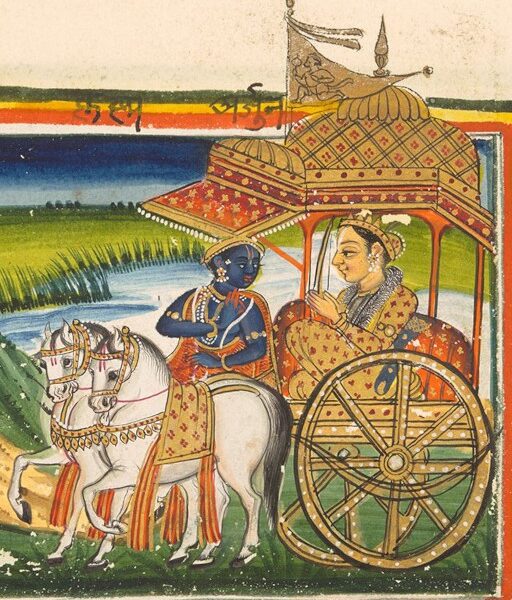
So then here, the Vedas are the principal scriptural evidence. So that’s established. That’s the first thing. You’re not getting it from the senses or anything else. They’re imperfect, so all that. So then nine principles are established based on that. And Kṛṣṇa is the Supreme Absolute Truth. He is omnipotent. He is the fountainhead of all relationships of love. So He is the Supreme Absolute Truth. So then He’s the ultimate goal that one’s trying to get to, right? He’s the omnipotent, so that means all these potencies, the material energy and all that, that is going on because of Him, right? The living entities are from Him. The internal potency is from Him. The external is from Him.
And He’s the fountainhead of all relationships of love and love. So what the living entity is looking for is that relationship and that love, right? But it’s been perverted because we want to apply it for ourselves, rather than a relationship to the Lord. Therefore, as it says, he has the tendency, then he has multifarious trouble. Right? Vyādhikāraṇa makes the point. So if we understand, no, it’s back in our relationship with the Lord, right? Then it works. So then we start here. Living entities are separated parts and parcels. Yes.
One devotee told me in the West, he told me that Kṛṣṇa is almost everything and that we are almost nothing. Meaning the living entities are insignificant.
So Kṛṣṇa is almost everything, but He’s not us.
Means, if you’re looking at it from the Māyāvāda point of view, is that everybody’s, you know, you are me and I am you and we’re all together, that kind of thing. Then yes, they’re separate.
Right?
From the Māyāvāda point of view.
Yeah, that’s the Māyāvāda philosophy.
Yeah. That’s why I said the less intelligent. Less intelligent means fool. Right? And Māyāvādīs like to sit on hills, right?
That don’t make sense?
You’re not piecing it all together. They like to sit on hills? Yeah. I mean, that’s just typical. You think of an Indian guru who’s sitting on a hill somewhere, right?
Okay, so… Just before you, just before. And so, because, and then, because you hear then another… So Kṛṣṇa is everything, He includes us, but we’re separated parts and parts, but we’re still coming from Him. So He is still, we are still, but we’re not, we are separated, so we’re separately conscious.
No, but Kṛṣṇa is everything. And we’re insignificant.
So we’re simultaneously part of Kṛṣṇa? Yeah, that’s why it’s cintā-bheda-bheda-tattva.
But to think that one has an existence separate from Kṛṣṇa is māyāvāda? One doesn’t have existence separate. Just because one’s separated doesn’t mean you have an existence separate from. But to think one does is māyāvāda? Yeah, that’s, yeah, solution.
And then to be aware of this connection and this is Kṛṣṇa consciousness? Yes, yes.
A person who’s, like, twenty years or something in Kṛṣṇa consciousness? Well, they’re probably looking at it from the point of the, just the māyāvāda element.
You know, because devotees are very, very careful about anything that gets too close to māyāvāda.
But what they’re making, the mistake is, see, the māyāvāda philosophy, or let’s say specifically, impersonal philosophy up to liberation, there’s technically no difference in the two, because it’s our process to get to the liberated stage, right? And then we continue from there to the platform of prema. But for the materialist, then he thinks getting to the stage of liberation is the ultimate goal, and that’s fine. That’s all you need to do. Right? So then that’s where the problem comes in. Does that make sense? So that’s where I will say devotees.
That you perform your duties without attachment to the results, that will liberate you. We say that, they say that. So this term, naiskarma-karma-yoga, like that, it’s not exclusively our term. The māyāvādīs also use the term. It’s just a standard method.
You know, just like we say ācman, we do ācman, and the other, you know, members of the pancarātra, they do it, the Vedic people do it, the smartists do it, everybody, it’s the same thing.
Does that make sense?
The difficulty is that they see it as the goal, the end. And therefore they don’t recognize the personal relationship with God. Right? But they can understand Brahman, that they’re Brahman, and come to the liberated platform. We also say the same thing. Right? But māyāvāda philosophy is when it’s only that, it’s exclusively mokṣa. Then it’s māyāvāda. But if it’s just part of the facts of what’s going on, then that’s the proper philosophy. And when Kṛṣṇa manifested the cowherd boys on the cows, and then the relatives, like the mother and father, they felt so much affection, even more so than for their own sons on cows.
And he played them more perfectly than they themselves. He was like more śrī-dhāma, or more than the actual, you know, like that. But then, so can you clear that up?
What’s to be cleared? I don’t know. It means if they’re not there, then their parents are going to get worried. So therefore Kṛṣṇa plays the part. How is Kṛṣṇa going to go back to Vṛndāvana with no cowherd boys and no cows? Right? It’ll be a problem. Lord Brahmā’s taken them. So He expands this, all the cows and the cowherd boys on the cows.
Right? For one year. And then when Brahmā comes back, because for him it’s just a moment, and then when he comes back, then he sees that they’re all Kṛṣṇa. But how does he play them more perfectly?
The point is like this. Would you have a problem if Shakespeare took one of the roles in his play and played it better than the actors played it? Because he wrote the script. Would you have a problem with that? No. Okay. So then, why couldn’t he play it better? So he knows how to be the perfect son, or the perfect, you know, everything. Because he’s created it, so he knows the full nature.
Yeah, I think there’s one part of the false ego that’s saying that, well, something must be mine, you know? Your desire is yours.
But no aspect of individuality, like personality? What does desire indicate?
We will. Huh? We will. Yeah, so that’s the individual. You and your friends go to the restaurant, you order one thing, they order another, and everybody orders something different. What’s that? Is that individuality? Yeah. Yeah. So, why is that there? Because there’s consciousness, that’s the soul. So free will, that is what you have. That desire, that independent consciousness, that’s what’s there.
Until, yeah. You understand? The problem is, is you misuse it.
You know what I’m saying? So the point is just like this. The criminal has gone into the bank, taken the money, and now he’s spending it. Right? So, is there a problem with money? No. Is there a problem with that specific money? No. What’s the problem? Stealing. Stealing the money. Stealing the money, okay, but what’s the problem in stealing the money? It belongs to somebody else. Because why do you call it stealing? Because he goes into the bank vault, takes out money, but then, you know, the bank manager goes into the bank vault and takes out money. So the action of taking money out, and we can say nobody takes out of the bank. Plenty of people come to, everybody comes to the bank to take money away from the bank. Right? So therefore, what’s the stealing? It’s against the rules. It’s not against the rules to get money at a bank and take it home. No permission.
Okay, but why do you need permission?
It’s not his money. Huh? It’s not his money. So the sense of possession, this is mine. That’s where it goes wrong.
You know what I’m saying? The bank teller deals with money all day.
But if they think it’s mine, there’s a problem. If they think it belongs to the bank, it’s not a problem. That’s why I was saying that the duty doesn’t change.
You know what I’m saying? The bank teller is there, and he thinks this money’s mine. And then he comes to the understanding that money’s not money, it belongs to the bank. Does his duty change? Does he do his duty better? Now that he has, yeah, that’s the whole point. Is that if you have, if you’re God conscious, you do your duties better because you actually understand what they’re for. Because the world is only for serving God. Right? You know what I’m saying? So from this discussion, it’s much more clear that I have no idea of my identity other than servant of Krishna. But that’s pretty good.
Isn’t that good? It’s solid. It’s eternal understanding. And the other understanding you have is not so eternal.
But it’s a philosophical understanding. Yeah, but what does it mean being an Ulster Scot? What does that do for you? Does that not set what your occupation is and what you should eat for lunch and what you should wear?
You know what I’m saying? So how does that help you? You’re born in this family, and you’re this guy’s son, and that’s your mother. Right? So how does that also decide all this for you? Right? Because they’re trying to tell you how you should dress and eat, and you’re telling them, hey, forget it, I’m going to do my own thing. Right?
So how does all this identity that one has… The only identity one has is that I can do whatever I like. So whatever I happen to be doing right now, that’s my identity. So if right now my identity is I’m servant of Krishna, then there shouldn’t be any problem. It’s no different than what you’re already doing in the way of it being theoretical.
But the difference is those others are changing. But this is real. This is actually real and eternal. And that false personality is made up of ideas?
Yeah, you could say. Some scars, yeah. Just of your impressions from previous activities and lifetimes.
Does that make sense?
Okay, then the living entities are His separated parts and parcels, because we’re just defining what the living entity is. We haven’t said whether they’re liberated or conditioned.
Right? So the first two adhikaranas that are establishing these elements, because to do that, because living entities are eternal, why? Because they’re from God. Why are they subordinate? Because, you know, their position, material nature, so you have to be able to describe all three. So that means you have to give Krishna as the Absolute, He’s omnipotent.
Then, in the third adhikarana, that He tends to enjoy material nature and His forgetfulness. So this brings in the sixth dasamu. The living entity, due to his constitutional situation, as a marginal entity, may come under the sway of the material energy. Right? So then He’s conditioned. Then, again, due to His marginal nature, the living entity in the liberated condition is free from the influence of material nature. Right? Because He’s marginal, He can come under. But because He’s marginal, He’s not material nature, so He doesn’t have to come under. But it works both ways. Just as it’s a problem that can get you in here, it’s also what will get you out. Because if we were from material nature, we’d never get out, because we’re just part of the scene. Right?
So, like that. Then, we have the living entity and everything in this material cosmos is simultaneously one and different from the Supreme Lord. Right? Is that what it says? Right. So, that then brings out this point I’m making there. Simultaneously one and different. So, Krishna is everything, because of the oneness. At the same time, we’re different.
But, because we’re different, it hasn’t reduced Krishna at all.
Right? Does that make sense?
Continue.
It means that there is only the Vaishnava culture we can experience that Achyutya Bhagavad Gita. Yes. So, all the other fields, they cannot, they stopped before. So, like, this living entity in the liberated condition is free of the influence of material nature. All the other fields are free of it. Is this a simulated progression?
No, because they can get you to the liberated platform. Yes. Means it depends, of course, what you’re talking about. But at least if you’re talking about Vedanta. Means anything below Vedanta won’t get you back. Means, you talk about the liberated state, but they don’t actually know what the soul is. Yes. Right? Because basically, whether they’re eternal or not is not so much. There seems to be the element that you can eternally situate yourself. But the element of the individuality than most of the philosophies, that’s not an established, that’s not a point. Either they’re not worried about it or, you know, they don’t consider it important.
You know what I’m saying? But Vedanta, with Vedanta, then when it comes to the liberated platform. So, because you’re looking at some aspect, you’re looking at the aspect of just that, instead of the difference between God and the living entities, what’s common. Because if you establish a relationship, you look for what’s common. Yes. Right? So, that is done. So, you’re Vishuddha-dvaita.
Right? Problem is, is because of that, then the Mayavadis could also take it that, see, yes, there is a commonality. So, therefore, we are gods. So, then Madhvacharya makes it very clear, no, it’s two, it’s dvaita. Like that. Right? And dvaita-dvaita is, you’re looking at it, that you can look at it both ways. You know, he’s God at the same time as Rasaraja, and you don’t have that element where he worries about it. So, the dvaita-advaita, these two perspectives become important when you’re dealing with the Raghunada-bhakti.
Right? But the cinta-bhedaveda-tattva, or dvaita and advaita are happening simultaneously, that’s generally not gotten into so much. That’s why we don’t have any difficulty dealing with all these other philosophies. Right? We don’t have a problem. You know, that the materialist is totally absorbed in his relationships and all, we don’t have a problem that there’s relationships. So, what we have a problem is that the relationships don’t include the Lord.
Right? So, that’s a different perspective. So, it doesn’t have to change the relationships, but, to bring it to its proper standard, there might be some adjustment in the detail.
You know what I’m saying? Because if you include God, you may have to make some adjustments.
You know what I’m saying? You know, it’s just like if, how do you say, you know, there’s two kids out in the backyard with their old tin can and some other things and some water and some leaves and a few sticks and they’re cooking lunch. Then if a third kid comes, it’s no problem. You just adjust a little bit and three can fit there. Probably even five can fit. You know, you can start a whole restaurant. Right? But if, you know, you wanted to invite somebody over for lunch and you might have to move the whole process into the house, in the kitchen. You know what I’m saying? So, there might need to be some adjustment depending upon how far away it is of reality of something to offer to Krishna.
Does that make sense? Because see, you have the difficult, that means in the universal form, then there we have the element of where Krishna is talking about whether he’s the cause of something or he is something.
You know what I’m saying? So, even your things that are sinful, the potency that you’re looking for in it is still him. Right? But it’s not, that way of relating is not him as a person. It’s only his potency. It’s the imminent element.
Does that make sense? So, if something is unauthorized, then it’s only that potency that you’re looking at. When it’s authorized, then you’re dealing with Paramatma. Right? But it has to be done for the person, right? To come to the devotional.
You know what I’m saying? To be Bhagavan.
You know what I’m saying? So, the devotee may use those elements to progress through.
Does that make sense? So, we don’t have any difficulty dealing with any of these aspects.
So, that means you can talk to anybody, anywhere, in any situation, and from that situation bring them forward in God consciousness.
Does that make sense? Because one sees how the whole philosophy works. In other words, it’s not just what is memorized so many points in the philosophy, but one understands how it works. That’s what this whole study is for, because we see how it progresses, right?
Because the living entities are part and parcel of the Lord, because as subordinates of the Lord, because the material and nature is there, therefore, you know, God is the ultimate goal. But some living entities don’t see it like that, right? But the only way that they will see it is if the Lord tells them, because He’s beyond.
So, it’s by that association, then one can come back to that position of serving the Lord. Yes? What did you mean by authorized? Authorized. In other words, the Shastra says this is a proper activity to do, right? Then you’re dealing with Paramatma, because then you’re dealing with the Lord and His sanctioning and all that. If it’s something that’s not authorized, there is still a quality of Saguna Brahman in it that you’re looking for. We will still, being in illusion, think it’s the dead matter, but it’s not. It’s the quality in Saguna Brahman that we’re trying to appreciate, right? You understand? But you can’t take it any further than that, because the activity itself is not technically authorized. But there’s been some connection made to the Lord, right?
But what one’s going to get from it is not as much as if the connection is made, you know, it’s authorized and it’s done to please Krsna.
Does that make sense?
At least it takes one out of the dreaming state, you know? Yeah. Because the philosophy is in reality? It’s in reality, and it goes into anything, so there’s nothing we can’t deal with. You know, that’s the point, you know.
So this is the philosophical. That’s very clear. You can take that philosophical and apply it into any topic. Right? So that means anything, anywhere, you can see in relationship to the Lord.
So we’re comfortable with all this, that we’ve seen it all?
You said that somebody is establishing a relationship with Krsna. Yes. Because that’s because he is the fountainhead of all relationships and love. So he’s the fountainhead. That means everything eventually goes back to there, because you’re dealing with energy. So energy, as long as it’s connected, it exists, but if it’s disconnected, it doesn’t.
So this idea that the quantumists have that, you know, there’s a star and it’s putting out light and the rays are going, and then when the light, it burns out, then the rays keep going. It doesn’t happen like that. You know, as long as it’s going, it’s connected. When it goes off, then they’re not connected anymore, so the light’s not there.
So, therefore, we’re still connected to the Lord, but we don’t see it, because we don’t want to see it. We want to be independent.
So if God’s the enjoyer, then how will we be the enjoyer? Because he’s so much better at it than we are. You know, so it’s just like… Yeah, you know what I’m saying? That’s the first thing, you go after the competition, right? So in this case, since God is everything, then you won’t be able to get rid of the competition. So, therefore, one is covered by illusion, so that one doesn’t know there’s any competition, any real competition. Of course, everybody else is a competition, but they’re not actually competition.
It’s like the two guys stuck in the…
This is the meaning of how, sleeping, you can perfect your life, go back to Godhead. So even though the camera’s sleeping, you can still perform this too. Yeah.
That you have two guys, right, out in the desert, delirious, and somehow or other they’re both seeing the same… same… what do you call it? Oasis. Oasis there. And they’re both fighting over the same coconut. You know, like that. So then they’re competition for each other, right? Yeah.
That’s the… That’s the thing.
Okay? There’s another thing. Look at the… What’s next?
Unless we should go through the details?
No.
Okay. Okay. Anybody else has this or only I have this? Hmm?
I don’t have it?
So this is an illusion.
Unless this is about the coconut, right? No, I have the coconut. No, no, I have the coconut.
So only you and I have this. Okay.
More clear there. Okay. And then when will others have this?
No, but I’m saying this much of it? It would take a week?
But this is not… Oh, you mean you’re still working on this? Oh, okay, okay, okay. Now I get it. He’s trying to think, he says, nobody’s here. All we have to do is copy it. No, but it’ll take a week. We’re doing a very good job of copying.
He’s actually with a pen and a ruler. No, he’s like that. Well, actually, he etches them. It’s just good. Yes. Okay.
So here is now thematic study part two, section one.
Man’s duty towards Godhead.
This is still a samandha, right? This is abhidheyan. Okay. Okay. So then we have here… We’ll also now go through, show what all the adhikaranas are. How many do we have?
Four adhikaranas.
Okay.
So, okay. And this has how many lessons? Thirty-five. Thirty-five. And then the next one is also… The next one has 17, but this is the second section of… Of this one. Okay. And then the last one is… Three. Three. Okay, so there’s another 20 after this. Okay, so that’s… So we’ve dealt with… Oh, okay. Okay, so it means the last three sections are the same size as the first one. Basically. So that was 46.
Oh, 35. Excuse me. Yeah, that’s right. Okay. Adhikarana one. Every living entity, being God’s parts and parcel, it is everyone’s duty to cooperate with him by performing transcendental loving service. Right? So now we’re taking… We have the same point, but it’s being taken to a further state, step. Right? You know that every living entity is part and parcel of Godhead. Right? And then subordinate. So here the subordination is by performing transcendental duty. Right? So this is very nicely… First we’re establishing just the nature of the living entity and how he is to be… his relationship with God, to be subordinate to the Lord. Right? So now we’re bringing in, because it’s abhidheya, then actually the devotional element here. Adhikarana two. Good work, salvation… Good work, salvation by knowledge, or perfection by mystic powers are all subordinate to the transcendental loving service of the Lord. Right? Because now we’ve taken it as the… How do you say? That someone… The individual who has that kind of consciousness, it’s still… That’s not going to get them anywhere. Right? It’s only by the consciousness given by the Lord and his associates.
Right? That then can make it work. So here it’s being brought out more again that the work itself, the good work, the knowledge and the perfection by mystic powers, that’s not going to… I mean, they’re all subordinate to the devotional service.
Before it was just to know God. So here it’s about the devotional service is they’re subordinate to that. They may be able to be engaged in the Lord’s service, but they don’t have a position separate from devotional service.
Then, such pure devotional service of God is attainable by the association of saints. See, again, the whole point is that the Lord and his associates, they’re the only ones that can give this.
Right? And four, Krishna is the ideal saint, so one should approach Sri Krishna through his transparent medium, spiritual master, and thus Sri Krishna will reveal himself, because he’s the origin of all saints. So he’s the Adi Guru. So you approach him through Guru and then being pleased to reveal himself. So we see there’s a similar… But now we get the flavor is more of the devotional process. So instead of being… It means it’s Gita, but it has that flavor that you’ll catch in Nectar of Devotion. Because Nectar of Devotion is just taking those points and exclusively dealing with those. It doesn’t… They establish the supremacy of the Lord and everything, but it’s the same topic, because there’s only Bhagavatam. Right? Does that make sense? But you’re going to have the element of, you know, the nature of everything, the definition of everything, the process and the goal. So depending where you’re emphasizing. And then Gita is dealing with the fundamental principles, while the Bhagavatam is dealing with the same principles, but on a level that has the sophistication of application, right? Of those who are following the Vedic culture.
They’ve already accepted all that. So it means Bhagavatam, you don’t have to establish the need to follow Vedic culture. They’re already following it. So now the need is to establish the devotional. And self-realization also doesn’t have to be established. Right? It’s application of self-realization in one’s life to develop love for Godhead. That’s what’s being discussed. So anything preliminary to that, that’s being discussed in the Gita. Right? Does that make sense? But it’s not that there’s more. Because there’s this idea, oh, if I read this scripture, I’ll get something more. No. There’s only this. We see here, is that again, what was in the six Adhikaranas before, is explained here in four. Same thing. But now it’s going to a deeper level. So you can go deeper and deeper, but it’s not that there’s going to be more points. It’s not that, you know, there’s God, there’s material energy, and there’s the living entity. But when I get to higher levels, then there’ll be something else also. You know. Yeah, does that make sense? No, it doesn’t. It doesn’t. It doesn’t change.
Okay, Adhikarana one. Every living entity, that means that was the four Adhikaranas. Now the Adhikaranas with the lessons. Right? Because the lesson brings out the detail. And that’s where, see, because the Adhikaranas, you see, they flow very nicely. And then the lessons are also doing that. But there’s things to establish that get in the way of that. So this is where the confusion comes up. Because we were wondering, well, why does this come in here? But to accept that every living entity is parts and parcels, or it’s their duty, or they have to cooperate, or they have to perform devotional service. These all have to be established.
Right? Does that make sense? So the lessons do that.
Lesson one.
Dr. Seuss is having some problems. See, he’s taking it so seriously, the heart, he said about sleeping. So, he’s just checking out the sleeping part.
He won’t be getting any more accessories if he doesn’t start recording them.
And I’m sure that will keep him up tonight, you know, being recording all night, recording anything.
Who did she know? Where have you been?
Sorry.
Oh, here we go. It’s the end. Okay.
Okay. Harikarana 1. Every living entity, being Godhead’s parts and parcel, it is everyone’s duty to cooperate with him by performing transcendental service. Right? So lessons one through seven. Lesson one. Every living entity, being Godhead’s parts and parcel, it is everyone’s duty to cooperate with him.
Okay, so the lesson one is the first Adhikarana. So, technically, what we always have to remember is that every lesson is an Adhikarana, or every point being made in the process of the panchanganya is an Adhikarana, but they’re still supporting the primary Adhikarana, which will be the thesis. Okay? So then in here, generally, we’re going to say, so the primary one means the first lesson will be the Adhikarana. The other ones we’re just referring to as lessons. Okay? Just in case somebody wants to get technical on you or something.
There are two types of living entities. A, those who are in the material world, and B, those who are in the spiritual world. Right? So Dasamula is describing that. Means there’s every living entity’s part and parcel. Right? Then there’s those who are conditioned, those who are liberated. Now, but it’s everyone’s duty to cooperate with him. So that means the liberated cooperate, but also the conditioned should cooperate. If the conditioned cooperate, then they’ll come to their natural position of what they’re supposed to be doing as a living entity. So being non-conditioned is their normal situation, so if they cooperate with the Lord, they’ll come back to that. If they don’t, then they’ll remain conditioned.
Lesson three. Those who are in the material world are subjected to threefold miseries inflicted by the material energy.
That was the point before. Because he has a tendency to enjoy, therefore he’s suffering. Right?
So… Yeah. If you’re in there, you’re subjected to these things. Now, whether they bother you more or less because of your attachment, the more you’re attached, the more they’ll bother you. The less you’re attached, the less they’ll bother you. Right? And if you’re attached to Krishna, then technically they won’t bother you. It doesn’t mean they won’t be there, but it’s just something you just work with and work around. You understand? When you want something to go a particular way and there’s any obstacle, it will bother you. But if you accept that there’s going to be all these obstacles, then it’s just something you deal with. That’s the difference. Like sometimes we notice that here, it’ll come up as a question in the devotee’s minds that if I’m a devotee, why should they be there? No, but that’s just the material energy. Those in the material world are subjected to threefold miseries. Right? We don’t see them happening in the Lord’s pastimes because they’re not in the material world. Right?
Does that make sense? In Bhauma-lila, there is no. So therefore, anything that appears like what’s here is only to enhance the pastime. Right? So this being a reflection of that, that means whatever comes up as an obstacle then can be used in the Lord’s service to enhance one’s relationship with the Lord.
Lesson four. The spiritualists remain in complete harmony with the plan of God by cooperation. Means if you cooperate with the Lord, then you’re in harmony. And then there’s no problem. So when one’s not in harmony, that there’ll be problems. You know, just like when you throw the rock into the water, you get concentric rings. So there’s harmony. So there’s no conflict. When you throw many rocks, then they conflict. Like that. So the point is the harmony.
Bhaktisiddhanta Sarasvati Thakur, in one of his papers, is called the Harmonist. You know, what it meant was how to create harmony between the living entity and the Lord. Right? By engaging material energy properly in the Lord’s service. So therefore the Harmonist.
Lesson five. The materialists are servant of passion and anger, born of demoniac principles, and are therefore punished by the external energy of Godhead Maya. Right? Like that. Because the Lord and His energy are non -different. So therefore the energy then takes care. So she represents the Lord, just as the spiritual master represents the Lord. So therefore Maya represents the Lord. So she is, you know, Godhead Maya.
And she’s, and being, you know, the representative of the Lord, then she’s got the authority and the potency to, you know, make it happen. Right? So it’s not that, you know, we’ll be clever and get around it. You know what I’m saying? Just like the forest means, if you think about it, in the recorded history of Western history, was there ever a problem with tsunamis?
You never hear about it. But just they work out so many other things like that. Now we’ve conquered material nature. She’s got a new one for you. You know? You know, the bubonic plague, got rid of that, got rid of smallpox, got rid of, you know, all these different things like that. And then she’s got AIDS. You know, or something. You know, she’s just, it’s not a problem. You know, she’s, she’s the, you know, Godhead Maya. So she’s, she’s got, she’s got…
Four times as creative as we are. Yeah, four times as creative.
Sporty spirit. Yes. Hmm? Sporty spirit. Yeah, yeah, yeah.
Okay, lesson six. So here it’s also, you see, passion and anger, born of demodiac principles. It doesn’t say passion, ignorant, passion, anger. Because anger represents ignorance, but anger being applied here is because the passion’s never fulfilled, so then anger’s always there. So therefore you always have that violence. So it’s activity, whereas ignorance can be… Yeah, just kind of… Just, you know, sleeping. Yes, sleeping. Yes. Stuck in the mud, or laziness, I’d say. Yeah. Like that, you know. So now we’ve moved on from that somewhere to the Abhidheya, and now we’re applying the sleeping and the laziness, right? So then it becomes passion and anger. So demodiac principles means it’s against service to the Lord, right? And is therefore punished. So it means all the things that go on in the world is punishment.
Right? Like that. You know, because now and again things work okay, but that’s because you have to stay here. You know, like that. So you have to have an idea that it’ll be nice, because you don’t have any alternative. One hasn’t shown interest in going back to knowing God. When you show interest in knowing God, then that’s revealed. But until that time, then one has to think, I’m going to be happy here.
Does that make sense? This is that our happiness here is actually only the idea that we will be happy. That’s it. Yeah. In reality, it’s not there. Prahlad Maharaj talks about it. It’s called Shruti Sukhat. The herd about happiness. You hear about it. You know what I’m saying? So that’s the thing.
Because when you’re there, it’s just like you hear about, you know, vacation would be so great, but when you’re there, you’re right in the middle of it, and there’s so many things to arrange, and you didn’t pre-book that, and you forgot about that, and, you know, then something happens, you know. So there’s all these obstacles and difficulties that supposedly had a good time. When you go back, you spent so much time and money, what are you going to tell your friends? It was great. Yeah, of course. You’ve got to, you know, otherwise they’ll say, ah, you’re an idiot. Because they’re going to tell you theirs was great, but it was exactly the same.
Like that. Right? That’s the way it is, you know. You lost your traveler’s checks, they lost their checkbook, you know, but it’s the same thing, you know.
There’s an analogy about that. I heard in one class in London, he said, he goes into this, there’s a queue of people, and they’re lining up to go into this circus tent, and it’s got lights and straws and everything, and it looks like all the music is playing, and then they queue up, and then when you get inside, it’s like, there’s nothing, it’s just like black, and then there’s a spotlight on one very strong, large man, who proceeds to beat you, beat you into like a pommel, and then you come off the other side, you know, and everybody’s like, you know, heating, and everybody’s like, what was it like, what was it like? And you’re like, yeah, it was great. Yeah. Something like that? Yeah. Because you don’t want to be the only one that’s going to get it, so. When people say, how are you? Yeah, fine. Yeah, yeah. I mean, you can go in and get a guy’s leg in the hospital bed with all the tubes and everything. Oh, yeah, no, okay. Better today, better today.
Yeah. What we can contribute some, you know, sometimes people get euphoric feelings, you know, like feeling of loneliness, when they jump with pressure, just adrenaline and blood, but you give something. Yeah, but I was saying, the point is, is that, but where is that coming from?
You know what I’m saying? If I put a flask of adrenaline on the counter, then, you know, your hair stand on end. No. No, the whole point is, it’s still Krishna. It’s just that there is a mechanics to do that. You understand, the spiritual platform, then it’s natural because the living entity is non-different from the spiritual form. So, therefore, the feelings and all that, then will create all these. But here, because we’re different, it all has to be done chemically. Right? So, the point is, is it still the potency that makes it work, because it’s dead matter, it’s the Lord. So, that doesn’t matter. The point is, is you’re euphoric because you were thinking that this would be good. You know what I’m saying?
Yeah, but I’m saying that for the one person, they’re euphoric and that’s great, and another person, they’re completely freaked out. You know what I’m saying? But same chemicals. It’s just how you interpret it. It’s not like there’s a lot of chemicals here. It’s just how you interpret the chemicals.
You know what I’m saying? The guy’s got to go on stage and do his speech, or he’s got to go up to the girl and tell her his affection. It’s the same chemicals, same butterflies, but one’s interpreted one way, and one’s interpreted the other way.
Does that make sense? Or you’re sitting out there in your chair and waiting to go into the principal’s office because he’s done something wrong. It’s the same butterflies. So it’s the same chemicals, just you interpret it differently.
Does that make sense?
I’m sorry if this class kind of removes all of our… Happiness? Yeah, all the different elements, and we think that there’s still something there in some corner, because it seems to be having that effect. I hope that’s good.
We’ll forget anyway. That’s true, that’s true. No, it’s true, but… We walk out, we go home, and then…
Lesson six. Such a materialist, when listens to the instruction of Godhead, i.e., Bhagavad-gita, attains the transcendent loving service of Godhead. So, the materialist, though they’re situated in passion and ignorance, or passion and anger, born of demoniac qualities, if they hear the instruction of Godhead, then they attain the transcendental loving service. So it’s not that, no, only the really pious… No. Anybody, it doesn’t matter who they are, they can attain to it. Lesson seven. The utmost important duty of mankind is therefore to cooperate with the Personality of Godhead. So that goes, every living entity’s being part and parcel of God is everyone’s duty to cooperate with Him. Right? So that’s… So it closes that… That… What do you call it? That logic.
Okay. Adhikarana two. Good work, salvation by knowledge, or perfection by mystic powers are all subordinate to the transcendental loving service of Godhead. Right? So that’s… And then, supporting lessons. Knowledge for salvation without attainment of transcendental loving service of Godhead leads simply to accept unnecessary sufferings. Because the nature of the living entity is to, you know, be happy in relationships. So to function outside of relationships and outside of the happiness that comes there is a problem for the living entity. Therefore, the impersonalist concept of salvation, their process, is going to be a trouble for the living entity. And the fun part is, they’re giving up the material, you know, the karma because of the trouble. Right? And it’s only a trouble… Because they, as the living entity, can’t, you know… The frustration of… How do you say? The relationship’s not working. Right? So… Because the passion produces anger. Right? And so then, in that case, then they get… They don’t want to be involved in that. No relationships, no this and that. Does that make sense? But the… Not functioning within that is also a problem. But, just as a karmic, they were very focused that if I do this, I’ll be happy. Right? And so, despite all the difficulties there, one pushes on. Right? So in the same way, once they get committed to the impersonal path, they go through the same problems, but just from the other side.
Does that make sense? But, you know, it takes them a while to figure out that this doesn’t work.
Does that make sense?
With that… You know, so that’s why you just go back and forth. Karma and beyond, karma and beyond. Because then, when this doesn’t work, then you go, OK, well, it must be that. You know? Does that make sense? So that’s always what’s…
Lesson ten. Real knowledge for salvation is as described in Bhagavad-gita. Right? So… Yeah. So what the Gita describes, or this Buddha -yoga, the devotional process, that’s real salvation. Other things aren’t actually real. Lesson eleven. Everyone, maybe he, either brahmana, ksatriya, vaisya, or sudra, or even less than a sudra, must cooperate in the transcendental loving service of the Lord. So, here, generally it always talks about brahmana, ksatriya, vaisya, or sudra. But here, it also always throws in, or even less. Right? So that way then you catch everybody. Right? You know? Otherwise, no one will be… Because the four are quite specific. But when you say less, then that’s a very wide range. You know? So everybody is caught in that, that, like that. So you don’t have to worry if they’re a nisadha, or a candala, or svapaca, or antija. It doesn’t matter. You know, it catches all of that.
Salvation… Yeah. So that’s… Whatever the position, one is supposed to serve the Lord.
Salvation is not obtained simply by dry speculative adventures, but by service of Godhead only. So, the others, it’s through knowledge, through the speculation, they think that will bring them to that platform. But it’s not. It’s a matter of… You… It’s the devotional service only. Because knowledge has to be applied. Results only come from an endeavor. Right? So that means you understand your position and apply it in service. Because beyond there is no service, because there is no engagement of the senses.
Right? So, salvation can’t give the result.
Lesson 13, Sri Krsna, the Personality of Godhead, is just like the sun. Therefore, one is at once liberated from the nescience of matter as soon as he surrenders to Sri Krsna.
Because he is the sun, therefore everything is illuminated. So I can surrender, so if we say, no, but I’ve surrendered, it hasn’t happened, and then maybe we should… Then we’re saying, no, I’ve done my part, God’s not doing His. Maybe it’s like we haven’t fully surrendered yet. We have to readdress that hard definition of surrender.
One should not desire to cooperate with Godhead conditionally for some material gain. Right? Otherwise it won’t be pure. And so then you still get a temporary result.
So one can do that, but one will end up with that temporary result. You know, like the lady who was praying to God to lift the bundle back up on her head, and He personally came, put it back on her head, and then disappeared. So then, you know, you know, it’s not the ideal approach.
Even if one agrees to cooperate, in Lesson 15, even if one agrees to cooperate with Godhead conditionally for some material gain, Godhead not only does satisfy one’s material wants, but also gradually takes him to higher life. So, He’ll grant it, but He’ll grant it in such a way that He’ll remove it.
Right? You want some facility, you’ll get the facility, but then He’ll also give the intelligence by which you see that that facility doesn’t satisfy you. You know? And so, because one’s attached to it, one doesn’t appreciate that. Like it was discussed this morning. You know this is what it is, but it’s still attached to the other position, but they don’t go to, they don’t work.
Yeah. And He says, gradually takes him. So He works it out, says that.
Adhikarana 3.
Such pure devotional service of Godhead is attainable by the association of saints. Lesson 16. No, that is 16, 17. By the mercy of Krsna, only one can attain to Krsna by such association of saints. So, by the mercy of Krsna, one gets the devotees. Right? And then by that grace of the devotees, one gets Krsna. That’s Krsna’s arrangement. It’s because, it’s, so you, one, you get Krsna by the grace of the devotees because they recommend you to Krsna and then Krsna accepts. Right? So here it’s bringing out this element because we’re trying to establish the, that the living entities are, how do you say, you know, subordinate, part and parcel subordinate to Godhead and they’re only going to attain perfection through devotional service.
Right? Like that. So we’re not getting into the fine points of devotional service because this is Gita. Right? So it is, its main thrust is sambandha. Right? But we have to remember within sambandha you’re going to establish the field, you know, deal with the desires, deal with needs and deal with the process. Right? So all these four elements are going to, going to come into it. Right? Does that make sense? And they’ll, define the process and define the goal but the emphasis is on the understanding of all that. Does that make sense? So that’s why even though this is dealing with, this is the abhidheya section of it, it’s still abhidheya within the definition of sambandha. Right? So that’s why it makes it different from nectar and devotion. Same philosophy but nectar and devotion will be applying it. Does that make sense? Well, here is why it’s, it’s worthy to be applied. Does that make sense?
Lesson 18. So, if one develops the sense of associating with the devotees, he is blessed by Krishna. So if you like to associate with devotees, you’re comfortable with devotees, then Krishna blesses you. Right? Because Krishna likes to associate with devotees. Right? So if you like to associate then it’s common ground. Yes? Sometimes I see devotees of different natures and some are very shy or they can’t just, you know, they can’t present them to the, to the devotees.
Okay. So is that all just due to Krishna? No, that’s, but the point is to get the association so when they speak or something’s going on you’re involved. It’s not that you have to go up and, hey, you know, homie, you know, it’s like, it’s not like that. But some devotees, even though they may be in fallen state, they still push to being in a pure form. Whatever works.
Yeah, it’s just conditioning of what, what, what will work. Conditioning or that enthusiasm.
you know, what he was telling me, they were, so they didn’t know, it was very early, they were very new in this, you know, quite early. I think it was back in the 60s or so. They saw that, you know, but the temple was at one place, many times the temple was small and so probably would stay in some other apartment or some other arrangement. And so then they had a car that would take Prabhupada there. And then, then I think later on the devotees would go over and visit it at Prabhupada’s house. I think the morning program, certain part of the program would take place in the temple but certain things would happen at Prabhupada’s place. So this devotee decided, you know, to, you know, because it was just Prabhupada going and the person driving and sometimes one other person came, I think, took Prabhupada over there. So they’ve got plenty of room in the car so they went and got in the car. They were in the car before Prabhupada came. Prabhupada came, got in the car and they were already there, you know, because they were so bold like that. They didn’t get tossed out, you know, like that. So they got right over there. I think they were informed about the, you know, etiquette and everything but still he who dares wins. You can always try.
It’s worse that I happen to get tossed out.
Okay, without associating, lesson 19, without associating with the saintly devotees, no one can develop love, love, develop God consciousness. There’s no question on your own you can do it. There has to be association. Right? So, so, you know, that’s the main thing. But, we can understand is that the association is the instruction. That’s the main, main element. But, by being with them one sees how that’s applied in their lives so that one can get something from there.
Adhikara 4.
Sri Krsna is the ideal saint.
So one should approach Sri Krsna through His transparent medium, the spiritual master.
And thus Sri Krsna will reveal Himself. Lesson 21. The last word of Sri Krsna is acceptable only to those who have undergone a transcendental training. Right? So that last word meaning how Krsna is saying, saying that one should surrender to Him and the devotee, you know, can, dedicates everything to Him like that. That will be only able to be practiced if one has undergone transcendental training. So, therefore, by approaching the spiritual master then only, and following that instruction can you come to that platform. Otherwise, people have been reading that verse for, you know, a long time but it’s not happening.
Lesson 22. Only one who is thus purged of all vices, he can pin his faith in the last word of Sri Krsna because if you have any attachment to vices, so vice here means anything that’s not connected to Krsna. It doesn’t, it means it’s broader, it means it’s how you say it. It’s more, you could say, which way is being applied, but you have the external form or vice will mean an activity that may not be properly sanctioned or is a sanctioned activity but one is overly emphasizing it. In other words, it’s not balance or harmony. Like eating is authorized but you overeat. You know, or you have some other thing about eating, you know. Does that make sense? You know, it means you have to, when you eat, then after taking the first mouthful, the second one, you have to throw at somebody or something. You know, it means, you know, it’s a problem. It’s like that.
You know, it’s that.
Okay. But the other thing is vice means any conditioning that means you’re going to not function in relationship to the Lord. Even if it’s considered a pious thing.
Twenty-three. Such a pure-in-heart devotee is not only rare but is very much dear to the heart of Sri Krsna.
So that’s the point. It’s a personal element and so then Krsna is very pleased. So they’re rare and it’s, you know, because you’re talking about even if the whole planet, all the human beings, took this position, it’s still rare. Because how many living entities are there in the whole universe?
So it’s not a problem of… Twenty-four. There are some typical signs on the person of such a pure devotee of Godhead to indicate his purity.
So, yes, so certain ways he behaves or, you know, he’s like Arjuna said. How does he talk? How does he walk? How does he be like that?
Then lesson twenty-five. In order to attain to the stage of devotional mode of service, one should guard against such destructive habits as are described in Bhagavad -gita. Right? So all the things that are… all the bad qualities come out through. In other words, the lust being applied in a way that it’s not… it can’t be used progressively. So those are going to be destructive.
Does that make sense? Like lust for money is greed. But if it’s done through proper performance of work, your occupation, not stealing, not taking another’s property, then you can purify yourself because it’s said you can engage your occupation in the Lord’s service. Right? But if it’s outside of that, where that greed is now being applied, you know, that you take other people’s money and stuff like that, then it becomes destructive.
In other words, what’s authorized is fine and what’s not authorized are against. But, still, the principle of why you’re involved in it, that’s still always a problem.
So it still has to go back to being connected to the Lord. Lesson 26. One can begin to practice such devotional services under a bona fide spiritual master. By doing so, one can gradually revive his God consciousness, even in this mundane world. Right?
Yeah. And that is then answered in the next point. God consciousness, the transcendent loving service of God that is never imposed artificially upon any living being, but is inherent in him, it can be revived only by practice. Because otherwise one would say, no, but, you know, it would gradually be done in this mundane world, but it’s not this place, it has to be something different than the mundane or only there. No, it’s the natural thing of the living entity. Otherwise someone may say, no, it’s just inherent, you’re just awakening what’s already there.
Okay? So then we’ll continue tomorrow.
Thank you very much.