
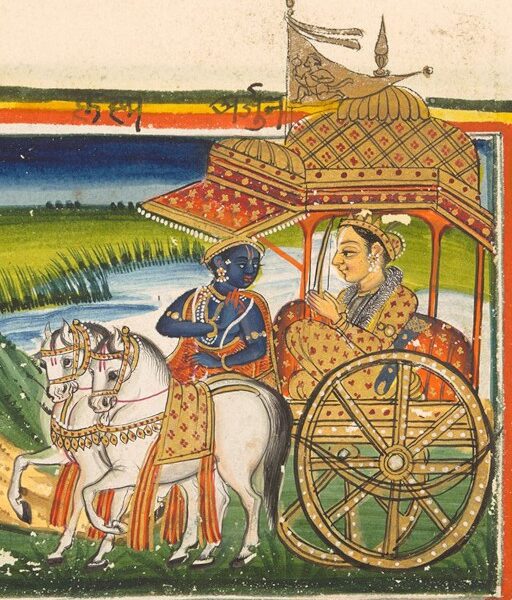
9.13. O Sanapritha, those who are not deluded, the great souls, are under the protection of the divine nature. They are fully engaged in devotional service because they know Me as the Supreme Personality of Godhead, original and inexhaustible.
The mahatma does not divert his attention to anything outside of Krsna, because he knows perfectly well that Krsna is the original Supreme Person, the cause of all causes. There is no doubt about it. Such a mahatma, or great soul, develops through association with other mahatmas, pure devotees. Pure devotees are not even attracted by Krsna’s other features, such as the four-armed Maha -Visnu. They are simply attracted by the two-armed form of Krsna. They are not attracted to other features of Krsna, nor are they concerned with any form of a demigod or of a human being. They meditate only upon Krsna in Krsna consciousness. They are always engaged in unswerving service of the Lord in Krsna consciousness.
You know, so 9, Chapter 9, now being, dealing with the elements of pure devotion, because we’ve established karma-yoga, jnana-yoga and everything, but then now about the pure devotion. So he’s saying that one develops into a mahatma by association, there’s no other point, because association and you’re hearing from them, so you’re, in other words, you’re hearing the philosophy, you’re seeing it practiced. So that, by that association, one can take that up oneself, right? And in this it’s saying that the mahatma’s only interested in Krsna, not even in any other forms of Krsna. It’s not that they have an aversion to the other forms, it’s just it’s not so attractive, right? It’s just like, let’s say, you have fruit, now fruit, you have your favorite fruit, right? So if all are available, you’ll eat your favorite fruit. So it’s not that you have an aversion to the other ones, it’s just that it’s nicer, so therefore that’s why it’ll always be, does that make sense? So everything is Krsna. So also they can understand the Brahman and Paramatma aspect, it’s just there’s no attraction, right? And if you’re always absorbed in thinking Krsna is a person, then there’s no need to deal with those other aspects. Does that make sense? Because even if you’re dealing with them, you’re dealing with them in connection with the person. So, does that make sense? Okay. So, so this is, then such a person is always then under the divine energy, under the internal potency, yes. Questioner 2 says, those who are attracted to the Mahavishnu form, so they are not pure devotees? No, they can be pure devotees, but just here we’re talking about, about Krsna, right? So those who are attracted to Krsna, that, those who are attracted, they’re also pure devotees. They’re just not pure, unalloyed devotees, that’s only in Brahman. But pure devotees, anyone in the spiritual world is a pure devotee.
Yes. Then what’s the difference between a pure devotee and a pure unalloyed, unalloyed devotee? Unalloyed means, that means there’s no mix, there’s no mix of anything for oneself. So even spiritual desires aren’t there in the way of that. In Vaikuntha, you can want to be on the same planet or want to be an associate or have the same features or same opulence, but that’s something that you want, like that. But in, in Braj, then they only want to please Krsna. So all their desires are simply in connection with how to make Krsna happy. There’s nothing, nothing separate, so that’s why it’s, it’s, it’s unique.
9.14. Always chanting My glories, endeavoring with great determination, bowing down before Me, these great souls perpetually worship Me with devotion. The mahatma cannot be manufactured by rubber stamping an ordinary man. His symptoms are described here. A mahatma is always engaged in chanting the glories of the Supreme Lord Krsna, the Personality of Godhead. He has no other business. He always, he is always engaged in glorification of the Lord. In other words, he is not an impersonalist. When the question of glorification is there, one has to glorify the Supreme Lord, praising His holy name, His eternal form, His transcendental qualities and His uncommon pastimes. One has to glorify all these things. Therefore a mahatma is attached to the Supreme Personality of Godhead.
So yeah, his point, he’s always, always glorifying the Lord, always engaged in the service. So again, we have the instruction and the practice, right? So here is that discussing about the Lord, it’s not a burden for them. They like talking about the Lord, they like thinking about the Lord, right? And then, because they’re thinking about the Lord always, then they’re going to be engaged in service. So that’s the application of the glories of the Lord, right? So it’s natural. It’s not, it’s not something that they have to worry about or think about.
And then, so that means that, technically speaking, a mahatma only means someone who understands the Personality of Godhead. If they don’t, technically they’re not a mahatma, right? You know, not what Kṛṣṇa is talking about here, because this section is on pure devotional service, right, the middle six chapters. So he’s not talking about someone who’s a great soul, meaning that they are on the liberated platform. He means someone who’s a great soul, who’s on the eternally liberated platform, right? Because otherwise, in comparison, yes, the liberated soul is advanced, he’s special, he’s a great person. But here, what Kṛṣṇa is talking about is someone who’s always absorbed in him as a person, right? So that is actually the great soul. Because the other one may be great, but tomorrow he’s not great, so you don’t really count him as great. Do you know what I’m saying?
Forest Magazine is not going to mention the guy who was a billionaire for three days. You know, it comes out, however it comes, it comes out, but if he’s not a billionaire when it’s published, then they’re not going to mention him, you know what I’m saying? Does that make sense? So therefore, someone who was liberated is not going to be mentioned as a mahatma.
Ten-three. He who knows me as the unborn, as the beginningless, as the Supreme Lord of all the worlds, he only, undiluted among men, is free from all sins.
As stated in this, they’re mentioning these things because there are all these mentalities that people will get distracted by. Mahatma is just, everyone decides a person’s great, so they call him a mahatma. It’s just kind of like a title, but the actual definition of mahatma means one who’s an advanced devotee, who’s always absorbed in hearing, chanting, serving the Lord. So then here also is that there are those who may say he’s supreme, or he’s unborn and beginningless, but not as the Supreme Lord. Or he’s the Supreme Lord, but he appeared at his particular time through the mode of goodness to just instruct or give us a direction. Does that make sense? So the impersonalist will take both of these positions, right? The beginning, unborn and beginningless is Brahman, but there’s no person. Or if he’s a person, then there is a beginning, right? And there’ll be an end, right? Because Brahman will be the ultimate. So it’s just a manifestation on goodness while we’re in passion, eagerness, delude, while he is like that. So then amongst that, he only, undeluded amongst men is free from all sin. So that means then the other one, still there’s sin. Now one may say he’s liberated, where would the sin be? But the sin we have to remember is sin is defined as not God conscious, right? And piety is God consciousness.
Does that make sense? As stated in the 7th chapter, 7.3,
Those who are trying to elevate themselves to the platform of spiritual realization are not ordinary men. They’re superior to millions and millions of ordinary men who have no knowledge of spiritual realization. So here we’re saying, yes, we’re acknowledging that someone who’s liberated is not ordinary, right? But we won’t count that as the topmost. But they’re not ordinary, right? And it says millions and millions. And so one such person liberated is superior to millions and millions of ordinary persons.
But out of those actually trying to understand their spiritual situation, one who can come to the understanding that Kṛṣṇa is the Supreme Personality of Godhead, the proprietor of everything, the unborn, is the most successful spiritually realized person. In that stage only, when one has fully understood Kṛṣṇa’s supreme position, can one be completely free from all sinful reactions? Because before that, there won’t be, because one will come back again, right? Because reaction means you’ll end up in an ordinary position within the material sphere. So the reaction of coming to the liberated platform is one will get bored in that neutral state, and one will again think of the material activities. So then they’re not completely free. The conditioning is gone, but the idea I’m the controller and enjoyer is still there. That will bring them back to here. Because controller and enjoyer means material. I am servant, right? If Kṛṣṇa is the supreme enjoyer, that’s spiritual. That’s transcendental. So even though they’re situated, right?
Yeah, trying to understand their spiritual situation, right? So that’s the point, situation. They’re not actually acting on the spiritual platform. They’re spiritually situated. Because on the spiritual platform, they do nothing. So you can’t say that they’re spiritually active.
Does that make sense? You’re only dealing with the situation. So they’re in the spiritual situation, but the consciousness technically is still material, right? It’s not detailed material. It means they have no attachment to anything specific in the material world, right? But it’s on that first platform of weakness of heart, right? Where they want to control and enjoy. So the principle is still there. Does that make sense? So this is tatastha, you know, to be situated spiritually but still have the material, the seed or the foundation of the material consciousness.
Right? Does that make sense? So in the same way as the Mahatma, they may be situated within the material world, but their consciousness is on the spiritual platform. Does that make sense?
Śrī Kṛṣṇa is therefore different from everything that is created, and anyone who knows Him as such immediately becomes liberated from all sinful reactions.
So He’s different from everything created. You know, it’s a bit… You’re saying it in a different way. Prabhupāda, in another place, mentions that Kṛṣṇa being the source of the material and spiritual worlds, that means He’s beyond spiritual, right? Because spiritual is the manifestation. And definitely spiritual will say it means not material, right? It’s above, like transcendental, right? But He’s beyond that. So He’s something else. Right? Does that make sense? So one who understands that, then is freed from everything, because he’s the source of everything. But with his spiritual potency, the internal potency, then he performs his pastimes.
Yes? When you say tatāstha-śakti, that’s… it can go both ways, right? Tatāstha simply means that the spiritual and the material are functioning at the same place at the same time. That’s what it means. So you have the individual jīvas, but then you have also just the potency. We are from that potency, but that potency itself is what… just like the souls and the body, how do those two stay together? That’s the tatāstha-śakti.
Right? You know, that the Lord’s holy dhāma and the material world are there at the same time. Right? You know, in the Bhauma-līlā, that’s tatāstha -śakti. Right? Because both energies are manifest at once. You know, we’re used to, there’s this one and there’s that one. There’s the material world, there’s the spiritual. But tatāstha means they’re both in the same place at the same time. So that’s… the point is, if we can appreciate that, it doesn’t matter which way you apply it. Material situation, spiritual consciousness, or spiritual situation, material consciousness. Right? Because if it’s there, then one has no problem. One’s in this material situation, the material body. Right? But the soulless is transcendental.
Right? So that’s the one aspect, whether they’re conscious or not. Adding the consideration of consciousness, now they may have material consciousness. Materially situated, they themselves are spiritual, but material consciousness. Right? So you have this, you know, all these different aspects where tatāstha is holding it together. Or, as the mahātmās, you have the material situation. Right? The soul is spiritual, but the consciousness is spiritual. Right? So those two are functioning at once. Right? Or we have those who may be within the spiritual phenomena. Right?
But… or not phenomena, manifestation. But they have material consciousness. Like the demons in Vṛndāvana. Right? Vṛndāvana, they’re in the tāṁ. So they’re situated within the spiritual realm. But their consciousness is material.
Does that make sense? Right?
Or you have… yeah, like that. Does that make sense?
So one who understands that Kṛṣṇa is beyond all this, then he is… then they’re liberated from all sinful reactions. Because then one understands things as they are. Right? Because being bound means being in illusion. When one understands Kṛṣṇa’s position, one’s not in illusion anymore. So one’s liberated. It’s that simple. You know? You know, we have… what do you call it? We were discussing yesterday. We have simplicity issues. We don’t like it so simple. Right? You know, I mean, some things, yes, simple. I’m God. Right? That’s simple. You know, that works. Okay. But, you know, other things, then you like it more complicated. Right? You know, more sophisticated. You feel better about yourself.
Ten-nine. The thoughts of my pure devotees dwell in me. Their lives are fully devoted to my service, and they derive great satisfaction and bliss from always enlightening one another and conversing about me.
Pure devotees, whose characteristics are mentioned here, engage themselves fully in the transcendental loving service of the Lord. Their minds cannot be diverted from the lotus feet of Kṛṣṇa. Their talks are solely on the transcendental subjects. The symptoms of the pure devotees are described in this verse specifically. Devotees of the Supreme Lord are twenty-four hours daily engaged in glorifying the qualities and pastimes of the Supreme Lord.
Their hearts and souls are constantly submerged in Kṛṣṇa, and they take pleasure in discussing Him with other devotees.
In the preliminary stage of devotional service, they relish the transcendental pleasure from the service itself.
And in the mature stage, they are actually situated in love of God. Once situated in that transcendental position, they can relish the highest perfection, which is exhibited by the Lord in His abode.
So this constantly being absorbed, so that means it can be done, but one should be looking for it. So one should be looking, trying to see how that can be done. And we know that of all the different aspects to be absorbed, Bhagavān, Paramātmā and Brahmān, Bhagavān is the ultimate. But the point is to be connected to the Lord.
And then ultimately it comes to always being about the person.
Okay, so then in the preliminary, they get transcendental pleasure from the service itself. They’re running the service that makes, the service itself makes them very happy. That’s why the kīrtana was great, or it was nice, you know, the lecture, or I did the service, it was so nice, you know, doing the decoration, or making something like this. But it says the mature stage, you’re actually situated in love of God. So whatever they’re doing, they’re thinking of the person and experiencing that in relationship to it. So it doesn’t mean that the enjoyment of the servant goes away, it just transfers to being absorbed in Kṛṣṇa. So that’s why the service is non-different.
Does that make sense? But to discern, then the point is made is that the person is still different. Otherwise, what will be the difference here?
Once situated in that transcendental position, they can relish the highest perfection, which is exhibited by the Lord in His abode. Because then it’s just the interaction between the Lord and the devotees. It’s not the service itself as the experience of the Lord’s pleasure and His interactive action, based on that service.
Does that make sense? So it’s just that, it’s not that the one goes away, it’s just the other. It’s just like you have a candle. So if you turn on the light, it’s not that the light from the candle goes away. It’s just that the other was so much more appreciated.
Does that make sense? You know, it’s the same principle as that, these other forms of Godhead. It’s not a problem with them, it’s just that Kṛṣṇa is the one that you’re absorbed in. So this idea is that, no, we only like Kṛṣṇa and Vṛndāvana. The gopīs and all other forms, we’re not interested in. That’s not the point, no. He’s just naturally attracted to that. But it’s not that he has a problem with the others.
Q. Could it be that the preliminary stage, that service is still impersonal? No, not necessarily it’s impersonal. It’s just that what is absorbed in… I mean, there will be that element, but I wouldn’t define it that way. That would be what Prabhupāda was talking about before, saying the tendency is towards the impersonal elements, that you’re using those, you know, the imminent more of being able to see Kṛṣṇa and things like this, rather than being able to perceive Kṛṣṇa directly. But in this is that we’re absorbed, the senses are absorbed in being engaged in the activity, and because that’s what we’re used to, then that’s where our happiness comes from. Because Kṛṣṇa is happy by the service, so we’re perceiving it through the medium, the happiness more through the medium, rather than the happiness coming directly from the source.
It’s just the difference is you want to do an activity for somebody, you did that activity, you’re very happy because the activity went well, and there’s that person’s pleasure. So that person’s pleasure, but it’s being appreciated through the activity. Does that make sense? But if that affection is even greater, then it’s not the activity that’s prominent, it’s the interaction with the person. So when just naturally it goes to what is that experience of interaction, as opposed to the medium of interaction.
Yes, you could, but it’s still, it can be the friends, it’s just what they’re doing, you know. They go out and do something, and that was great, yeah, we did whatever the activity, and they talk about the activity. But you can also just sit there and appreciate each other’s association. And if you do those activities, it would have been the feelings that they experienced between them during the activity that would be prominent, as opposed to the activity. The formal and informal would be whether it’s right or wrong.
So that would be there, like that.
10.
To those who are constantly devoted to serving Me with love, I give the understanding by which they can come to Me. A person may have a bona fide spiritual master and may be attached to a spiritual organization, but if he’s still not intelligent enough to make progress, then Kṛṣṇa from within gives him instructions so that he may ultimately come to Him without difficulty. The qualification is that a person always engage himself in Kṛṣṇa consciousness and with love and devotion render all kinds of service. He should perform some sort of work for Kṛṣṇa, and that work should be with love. For devotee is not intelligent enough to make progress on the path of self-realization, but is sincere and devoted to the activity’s devotional service. The Lord gives him a chance to make progress and ultimately attain Him. So the body-mind words are engaged in the Lord’s service. So if one is intelligent to be able to apply the process, understanding how the philosophy works, being able to see how to apply it, then that would be the natural state. But if one is sincere and does things to the best of his ability but doesn’t have such intelligence, then Kṛṣṇa from within, He’ll give direction, like that, so that one comes to that point. Does that make sense?
What does it mean, the work should be with love? The work should be with love. What is love? Why, what do you, what is the doubt?
What is love?
Love would mean that you’re doing something for the other person’s pleasure.
It’s not for yourself.
Because love is in the position of priogeny, so it would have some connection with the results, the results for Kṛṣṇa. That’s why the whole process is this thing of naiṣṭhikārmīya. So we can relate to, okay, material is this activity, spiritual means giving up the result. I mean giving up something.
So to give up the result, then that, we can relate to that. You understand? So that’s the form of it. But the real point is, is you’re doing that to please the other person. Or you’re doing it to please the other person. That would be then sacrifice, so naiṣṭhikārmīya. Then naiṣṭhikārmīya being applied, then that’s sacrifice. Because you want to please the other person. But it doesn’t mean that you don’t want to please yourself also. They’re pleased, you’re pleased, you know, that kind of thing. You’re doing it that when they’re pleased, then I’ll get done what I want. Like you sacrifice, you do something to please the demigod, and then you get what you want. You get elevation to heavenly planets or whatever it is you’re looking for. Does that make sense? But here is that you’re doing it to please the other person for their pleasure only.
Does that make sense? So then that would be the devotion. So that can only happen if it’s in connection with the Supreme Lord. Because if it’s not in connection with the Supreme Lord, there will be some motive.
You understand? If something’s in connection to the Lord and you’re dealing with that, then it can have the same element. But the point is, ultimately it’s the Lord. Then it will be on that path. Is it a case of one does one’s duty, and then there’s some affection arises, and then gradually one does the affection?
Yeah, naturally. It’s just by association. It means if it’s not natural, then by association affection arises. It means that’s what Krishna recommends, just immediately surrender. That’s the best. If not, you follow the process. So by performing your duties, then by that association, then affection arises. That’s right in the Vedic system. Since relationship is the most prominent, then duties are based on your rights and responsibilities in a relationship, whatever it may be, individually or as a group or as a body or like this.
So then if you don’t have duties, then how will relationship be expressed? Even if you’re doing it for yourself, at least you’re not disturbing the situation, other than your consciousness. The form is correct.
Does that make sense?
So that’s why the Vedic system uses these. But then due to ignorance, then we’ll consider irreligion to be religion. So that means not following the Vedas. That is religion.
And following the Vedas, that’s irreligion. Oh, this is not proper. You can’t do that in this age. Or generally speaking, when we say you can’t do that in this age, we just analyze this one point, is that what are they meaning? They’re actually meaning that they don’t like that. It’s something wrong with it. Not that, oh, this is perfectly fine and it’s great, but these people aren’t going to understand this, and we’re trying to work on that. No, you can’t do this.
Because that’s when the statement is being presented, that, oh, Prabhupada said this, but you can’t do that. It means that they don’t feel that it actually is religion. They feel that there’s actually inherently something wrong in it. Otherwise, why would he present it that way? It’s just like you want to give the tribal some gift, so you pull out some money, right? And you think, we’ll give this to them. And then your friend who is more knowledgeable in the jungle culture, then he stops you and says, no. He says it’s a nice offering, but he’s not going to appreciate a bunch of paper. You have to give them something that he would feel is of substance. Does that make sense?
So he’ll get a clay pot, or get a cow, or get a basket full of witchetty grubs, or something.
Does that make sense?
But that’s a difference than saying, no, this is not there. You get money, this is all nonsense, and this and that. It doesn’t work in this age. That’s all actually taking irreligion to be religion, and religion to be irreligion. Because one thinks that one’s particular perspective, that is actually culture.
And the Vedas are material because they’re temporary?
If they don’t work now? Yeah, because the Vedas are perushe, it’s eternal. Yeah, because if it doesn’t work now, eternal means always. So it’s atheistic? Yeah, it’s atheistic also. Besides being, you know, I say, irreligion is, you know, religion is irreligion, so it’s atheistic. So, but it’s a matter of application.
You know what I’m saying? It’s like if you want to cut something, the knife always works. But depending on whether you’re cutting it fine, or in bigger pieces, or the thing’s very hard, or it’s very soft, you may use the knife differently. So you have to know how to use. But it always works. So the Vedic rules always work. But it’s just know how do they apply in the particular situation.
Yes?
It’s interesting to notice that in our society, people from many different backgrounds come in, and then they throw everything into their own preaching, and it’s kind of a big mixture of all things. Yeah, yeah. But there’s one thing in common. What? Nobody likes the Vedic culture.
Right? Right? Because you can just say, you know, if I say, no, the Vedas, and this and that, and I don’t think, you know, and this, everybody will go, oh, okay. But if I say, well, that’s American, I don’t think that applies. They’ll go, what? Oh, that’s English. You know, that’s Aussie, or something like that. Oh, they do that in Romania. Then they just go, hey, well, you know, that’s socially incorrect. You know, you can’t talk like that. But if I say, oh, you know, it’s Vedic, it doesn’t apply. Then everybody, oh, okay, yeah. So that’s the common ground.
You know? You know, it’s just like amongst academics. They may not like each other, and this and that, and different have different, but they all don’t like the Vedic culture. Right? You know, that’s the one common point that you could say would hold all of them together.
So that shows its universal application. Why would everybody have a problem with it?
Like that. Yes? That’s so contrary to the original Vedic principle, that if somebody says it’s Vedic, therefore it’s immediately accepted. Yeah. It seems to me that an incredible propaganda program has been put into place to shift. Yeah, yeah. No, it’s just the natural doubts. Like before, two devotees could have an argument, and then somebody could have said, no, but Prabhupada said this. Bang. The argument is over. That nanosecond. No one even says one more thing. No one tries to finish their sentence. No one tries to, no, but, you know, you know. No, it’s just, oh, okay. You know what I’m saying? But now that’s not necessarily. So it’s just a matter of proper, you know, faith and conviction. You know, and understanding that the cultural elements are the application of the philosophy.
So it means it’s not as much the forms as it is the mood that goes with it. You know what I’m saying? So you can use. That’s why Bhaktivinoda Thakura or Bhaktisiddhanta Sarasvati Thakura were so dynamic, is that they could use the modern forms, but their perspective on the philosophy and all that and what is called didn’t change. It’s just that what you use. You know what I’m saying? For a preaching program, Bhaktisiddhanta would wear all kinds of things, you know, but, you know, his daily life, he would wear the standard clothes.
Also, he would use Sanskrit grammatical form in his presentation in English. Yeah. Yes. Yes. Like that. So there’s all kinds of cases that are used, the stuff that English wouldn’t even understand exists within themselves. Yeah.
Okay.
Okay. So the devotee is sincere like that. You know what I mean? In other words, he’s trying, very much trying to perform the activity as he’s understood it, but they’re not that intelligent. Kṛṣṇa will then, from within the heart, will give him that intelligence.
Look at that. 10.11. To show them special mercy, I, dwelling in their hearts, destroy with the shining lamp of knowledge the darkness born of ignorance.
Sometimes Mayavadi philosophers criticize the devotees because they think that most of the devotees are in the darkness of ignorance and are philosophically naive and sentimentalists. Actually, that is not the fact. There are very, very, there are very, very learned scholars who have put forward the philosophy of devotion. But even if a devotee does not take advantage of their literatures or of a spiritual master, if he is sincere in his devotional service, he is held by Kṛṣṇa Himself within his heart. So the sincere devotee engaged in Kṛṣṇa consciousness cannot be without knowledge. The only qualification is that one carry out devotional service in full Kṛṣṇa consciousness. Right? So if he’s carrying out in full Kṛṣṇa consciousness, then it’ll work. Kṛṣṇa will reveal.
Look at that. So it’s not that, oh, you know, one doesn’t apply oneself and then you’ll use the law what Kṛṣṇa reveals. No. It’s one is sincerely absorbed in trying to apply Kṛṣṇa consciousness.
The Mayavadi philosophers think that without discriminating, one can have pure knowledge. For them, this answer is given by the Supreme Lord. Those who are engaged, oh, one, okay. Mayavadi philosophers think that without discriminating, one cannot have pure knowledge.
For them, the answer is given by the Supreme Lord. Those who are engaged in pure devotional service, even though they be without sufficient education and even without sufficient knowledge of the Vedic principles, are still held by the Supreme God, as stated in this verse. Because their whole point is yād, so without discriminating, because knowledge means discrimination.
Right? So without discrimination, then they’re able to be, to advance. So the Mayavadis, in their practice, that couldn’t happen. So only someone whose condition, in their conditioned state, is intelligent would be able to take part in the process, would be attracted to or take part in the process. Right? Difficulty again, then, is their philosophy is based on the material conditioning. Right? You can advance because you have a particular kind of conditioning. But if all the conditionings are illusion, why should it matter which one it is? Yes? Do they have a concept of kripa, like mercy? But mercy would have to come from a person. Right? So there wouldn’t be. No, because they think it’s by their own endeavor.
Right? But if it’s all illusion, what does it matter how you endeavor within?
You know, it’s just like that. You know, in the mirage, whether you, you know, that oasis there, whether you climb up the coconut tree, get a coconut, bring it down and open it and drink it, or you just sit there under the tree, either situation, you’re going to be thirsty. You know, it doesn’t really matter. So somehow or another, it’s all illusion, but their endeavor within it gets the result they want.
You know what I’m saying? So it’s a problem. So for all their discrimination, they discriminate up to the point where, to the spiritual platform, but they can’t discriminate within spiritual. They can tell the difference between matter and spirit, but they can’t tell the difference of the variety of spirit. So that means they’re not that intelligent. So that’s why even sometimes they’ll be referred to as less intelligent.
As I said, they can’t tell. So as in the previous thing, but still, their position is still, much of the time, you know, worth millions and millions of ordinary persons, in that at least they can discriminate matter and spirit.
But since they can’t discriminate within spirit, it’s not the highest platform.
As I said, due to the contamination of material association through many, many millions of births, one’s heart is always covered with the dust of materialism.
But when one engages in devotional service and constantly chants Hare Kṛṣṇa, the dust quickly clears, and one is elevated to the platform of pure knowledge.
The ultimate goal, Viṣṇu, can be attained only by this chant and by devotional service, and not by mental speculation or argument. Because it’s not just discriminating to attain the Lord. It’s a matter of endeavor.
Do you know what I’m saying? You want something just because you’ve sat with your friends and you’re looking at the magazine and go, I think this investment is better. No, no, this one isn’t better. No, but look here. You know, here this guy says this and that. No, but look at the chart over here. You know, and this and that. They can go on arguing for days. Now, will either of them become wealthy by this? No. It’s only by investment.
Results only come from endeavor. So, of course, they’ve made the endeavor to discriminate between the two, and they will get the result of discriminating between the two. But that’s all they’ll get. They won’t actually get any result from the spiritual platform. Because you’re situated there, but it doesn’t mean you’re getting anything from it. Does that make sense?
You can be situated in the supermarket, but it doesn’t mean if you don’t interact you’re not going to get anything from it.
Does that make sense? So that’s why less intelligent.
The pure devotee does not have to worry about the materials and necessities of life. He need not be anxious, because when he removes the darkness from his heart, everything is provided automatically by the Lord, who is pleased by the loving devotional service of the devotee.
So you need not be anxious, because everything is Kṛṣṇa anyway, and He’s taking care. Why is the material energy here? Because we wanted it? No, because Kṛṣṇa arranged it. And so everything is there, everything is arranged. Now you do good work, you get good facility. You do bad work, you don’t get good facility.
So within the realm of piety, how do you define good work?
Is it according to śāstra or not? According to śāstra. Who’s defined śāstra? The Lord. So what does that mean? It means it’s more close to what He would consider correct. So it’s the correct activities.
Piety is the correct activities, but devotion means the correct attitude.
So I have correct activities, spiritual attitude, I get myself liberated. I have correct activities, I get heavenly pleasures. I have correct activities, spiritual mentality, I get liberated. I have correct activities, devotional mentality, I go back to Godhead.
You understand? So this element of… So the whole point is, is if you’re pleasing the Lord, then you get higher and higher results. So if you’re doing devotional service, why won’t Kṛṣṇa take care? Because He’s the one arranging the whole thing anyway. But you’ll get something only because you please the Lord. Now whether you know you’re pleasing the Lord or not, that’s another thing. So if you know you’re working to please the Lord, then why even better you wouldn’t get it?
Does that make sense?
This is the essence of the teachings of the Bhagavad-gītā. He said, Kṛṣṇa will take care. This is the essence, because this is… What is this verse? 10.11. So this is the fourth of the Catur-śloki of the Gītā. So He’s showing that He is involved in this process.
Okay. So 10.10, it seems to be the same kind of layout like in the Bhagavatam. You have two on sambandha, then the third is on abhidheya, and then the fourth is… I mean, excuse me. The fourth is prayojana. I mean, third is prayojana, fourth is abhidheya. So here, He dwelling within the heart, He takes care of all these things.
So that interaction, that reciprocation with the Lord, He’s removing the ignorance, He’s providing the facility. The point is that one is making that sincere endeavor to please the Lord. That’s what’s going on.
By studying the Bhagavad-gītā, one can become a soul completely surrendered to the Supreme Lord and engage himself in pure devotional service. As the Lord takes charge, one becomes completely free from all kinds of materialistic endeavors. It says, as the Lord takes charge. As you surrender, then that means Kṛṣṇa takes charge. It’s not the modern context that you surrender but you don’t get anything back. So they just want you to surrender so they can… No, here it’s you surrender, so Kṛṣṇa takes care.
It’s like the mother wants to feed the child, but the child’s not surrendering. They have their own ideas. So as this child surrenders, he gets fed.
You understand? It’s not a matter of that you surrender and then you want to be taken advantage of. No. That’s what we do as God, right?
But God doesn’t do that.
So He takes care of everything.
He gives the knowledge, right? He gives the facilities.
Lesson 45.
That’s a nice analogy, Mars. The child surrenders, he gets fed. If one surrenders to Kṛṣṇa, then he rewards. Yeah, he rewards. But here it’s the interaction that’s the important thing.
You know what I’m saying? The affection is what’s the important. But affection is always shown through a medium, right? That’s what makes it interesting.
So therefore the medium is there, the facility is there, the knowledge is there. But the facility we have, we’re detached from. And the knowledge is in connection to Kṛṣṇa. So devotional service, jñāna and vairāga, are automatic. So the point is, as you are detached, you can use more facility. If you’re more attached, you can work with less facility.
Lesson 45. The Archa-mūrti is the transcendental and identical representation of the Absolute Personality of Godhead for the benefit of those conditioned souls who want to approach Godhead. Because now we’ve been giving, what was that?
What a weird page. Okay, he’s both… So it’s possible because he is…
Confidential service of the Lord explained that any man can attain to transcendental loving service of Godhead by his own occupation, right? And this is possible because Godhead is both imminent and transcendental.
So here’s the last aspect in the further explanations of how He is transcendental.
9.26. When one offers Me with love and devotion a leaf, a flower, fruit or water, I will accept it.
In the third chapter, verse 13, Śrī Kṛṣṇa explains that only the remnants of sacrifice are purified and fit for consumption by those who are seeking advancement in life and released from the clutches of material entanglement.
Those who do not make an offering of their food, He says in the same verse, are eating only sin.
Because whatever one’s doing, all activities are supposed to be done as sacrifice.
So the ultimate sacrifice means to wish for it. So if one’s not doing that, then it’s only sin.
In other words, it’s no different than an animal, because that’s what an animal does. But you could say, but the animal does it and there’s no sin. Yes, but the animal’s an animal. He doesn’t have the ability to know that there’s something higher. So if one wants to redefine oneself as an animal, then that’s okay. You know, like that. You know what I’m saying? But, you know, it, it, it, I said, that definition would have limited social application. You know, some circles, maybe down at the professional wrestling rink, then, you know, it would have something, you know, that was the animal, you know, something like that. You know, it would work, you know. But, but, you know, if he goes out to dinner and all that, you know, in a fancy restaurant, he may not be able to pull that one off.
Does that make sense? Okay.
So, in other words, they’re very, every mouthful is simply deepening their involvement in the complexities of material nature. Right? Because you, it means another living entity is involved. If you’re eating something, if it has, if it has any benefit, then it had to be connected with something with life. Right? So then some other living entity is involved. So your connection with them, your, your debt to them. You know, the, does that make sense? It’s supposed to be offering, you’re not recognizing, so you’re not applying your intelligence. The mind is not absorbed. One’s deepening one’s attachments. So all these different things, one’s just becoming more and more entangled, as Prabhupada said, by every mouthful. Right? So we can understand, if one is taking prasad, then every mouthful is liberating you from these complexities like that. So one can remember that. And so then, if you have a bucket full of hollow milk, then that is a lot of mouthfuls of, you know, liberating, you know, liberating realization. Yeah.
Until one, you know, one gets so advanced until one goes into samadhi.
He was talking about sleeping his way back to Godhead, so maybe it’s possible. No, but you have to eat first to sleep. Yeah, yeah, so the bucket of hollow, and then sleep your way back. No, but you wouldn’t look at it as sleeping your way back to Godhead. You eat your way back to Godhead. That’s true. Is it quantity or quantity over quality, in this case? You’re meaning quantity of the prasad or quality of the prasad? You know, like advancement, you know, duty, you know, I’m getting free from material entanglement, you know, or is it like the quality of the meditation? The quality of the meditation. It means what’s Krishna consciousness always seems to have something to do with it. That seems to be the point Krishna’s making. Yeah, yeah. You know, so it’s not as much the activity as it’s the consciousness.
So even just like, even one rasamalai can be equal to, or can be even greater than a whole bucket of halva done without proper consciousness?
You can have both. Yes, but then the question comes is in this example. Now, what would you say to one mouthful of halva as opposed to one bucket full of rasamalai?
Yes, see, there was one’s own particular, you say, tastes were involved in this process.
That was immediately switched from halva to rasamalai.
Yeah, see, so, you know what I’m saying. So in other words, you win the argument that you don’t necessarily make any more advancement.
So, you know, if you’re ever roommates with him, walk in with a bucket of halva and he’ll leave you alone. If you’re offering a bucket of rasamalai, you’ve got problems.
Okay.
But preparing nice, simple vegetable dishes, offering them before the picture or deity of Lord Krishna, and bowing down and praying for him to accept such a humble offering, enables one to advance steadily in life, to purify the body and to create fine brain tissues, which lead to clear thinking. So here’s another place you’re saying taking prasad develops fine brain tissues, right? In other words, chanting develops fine brain tissues, milk develops fine brain tissues, and being in an aesthetic environment develops fine brain tissues. So all these processes and natural situations of Krishna consciousness, they develop the finer brain tissues, which will lead to clear thinking. So there’s clear thinking, understanding who you are, how the world, that’s finer brain tissues. All right? But it’s still, even you have finer brain tissues, it’s still by Krishna’s grace.
Above all, the offering should be made with an attitude of love, right? So that’s, so the mechanics are explained, but above all, then there’s love. Because there always is that element, they go together. The love is expressed through the activity, but one always has to remember that it’s the love that you’re trying to get to. So in the beginning there may not be so much, you perform the activity, but with time and trying to do that sincerely, then Krishna within the heart is giving that intelligence, removing that ignorance. All right? Then one can come to the platform to take up that activity with love. All right? So that should be added, not that I’m doing the activity now, I wasn’t so good at it before, but now I’m really perfect at it. No, no, no. Perfection is the affection, right? And since one’s doing it there, then to the best of one’s ability, one will be trying to perform the activity. Because if you have affection for someone, then you want that the activity, the result would go nicely for them. That means the activity has to be proper.
Does that make sense?
One devotee asked Srila Prabhupada, we are supposed to offer food with love and devotion. And he said, we don’t have it. But I don’t have it. We don’t have any love. And Srila Prabhupada said, are you chanting sixteen rounds? I said, yes. Are you falling for any of the mantras? I said, yes. He said, no, it’s your love and devotion. It means, in other words, we don’t have love on the platform of prema. But why would one be doing it? Why would one be chanting sixteen rounds, following the four-legged principles, offering the food? Why would you be doing that? The principle of serving the Lord has been accepted.
Could you help someone who does it to develop fine brain tissue? Can you do it? Why would you want to develop fine brain tissue? So I can control and enjoy the welfare. I don’t know that you need finer brain tissues to do that. You know what I’m saying? I mean, like Genghis Khan, he controlled most of the world that was known at the time. And I’m not sure that finer brain tissues would… The problem of… Yeah, yeah. Because he had some certain strict rules that kept his whole empire together. A guest comes to your house, you don’t take care of him. Death. You know. You take from someone else. Death. You know, you do this. Death. You know, that was it. It was a whole long list that you do this wrong, you get killed. There’s nothing in between. Like that. And that kept everybody very happy. So I don’t know that you were dealing with a lot of finer brain tissues. There might not even have been one finer brain tissue. I don’t know.
But maybe some jnanis? Some jnanis. The jnanis don’t want to control the world.
You know what I’m saying? So they’re two different… You know, the jnanis, they sit in some kind of… Unless it’s a really old university with these really tall windows, they sit in some office that’s not so light… I mean, other than the tube lights and all that. And you never hear of them. That’s true. You know what I’m saying? You understand? So it’s two different things. My doubt is that while this summer I was in Denmark, and some people, they expressed interest in chanting, but they had no concept of devotion. So they were not devotees at all. No, but by chanting, if they’re hearing from devotees, then by chanting, then they’ll get purified. Then they’ll be able to hear. But if they’re interested in kirtan by other groups that aren’t coming in parampara, but not interested in kirtan by what’s coming in parampara, then they’ll have a problem. So initially, it’s okay to motivate people to start chanting without actually including the Lord? And then later… I mean, you have a kirtan, but you probably wouldn’t give a one-hour lecture on chanting and leave God out of it. No. But having a kirtan and encouraging people to take part, that you do. Same with Prasad. I remember one devotee was saying that he came to the Sunday feasts. He was an absolute… He didn’t like the devotees, didn’t like… He was a complete atheist. But his friend was kind of interested. And so he would go, because it’s free and it’s nice. So then he would go along with them. And then after, I think, I can’t remember, it was seven weeks or nine weeks, he moved into the temple. Right? So the process works. That’s facts. Right? Seven weeks from a total atheist to a surrendered devotee. It’s not bad. I think in Bulgaria, they have one who came first time because he wanted to bomb the place. Okay. He moved in. He took a shower. He moved in. Okay. Cool. Yes. Well, actually, besides loving innovation, I heard Bhagavan saying that, actually, this process is for those who are very silent.
Yeah. Well, I mean, because there’s self-realization. So it’s… So… I mean, when we, you know, when we bring in just only self-motivated, because there’s so much benefit. Yeah, yeah. Yeah, yeah. We self-motivate, and maybe then we’ll get purified of that motive, but if you’re, you know, very self-motivated… Yeah, yeah. Yeah, yeah. Well, that’ll work. That’ll work. Yeah. Yeah. I just want to check what I heard is that you said that someone has to hear someone chanting Hare Krishna that’s connected to the crown. Yeah, yeah. And I was thinking of the Beatles. The Beatles. Well, you know, like… It means the ones under your sick. The Beatles, the band. The band, okay. Like, they’re all singing, you know, isn’t it? Yeah, but where’d they get the Hare Krishna maha-mantra from? They got it from Bhopal. Yes, so then… Okay, so if a band gets it from a devotee that was connected, and they’re still kind of singing it, it’s still… So, yeah, it’s some benefit. You know, it’s just… It’s just all the other stuff they’re talking about may not be so beneficial.
It’s not that now everything they sing is now spiritual.
That’s what I mean. I’ve just known people that they’re not devotee bands, but sometimes they’ve got the maha-mantra, and they’re singing it, and I’m wondering if there’s any benefit. But if they’re getting it from us, then there’ll be something. Yeah. Well, maybe a devotee that’s not practicing so full on, but it’s still… Yeah, well, then it’s, you know, it gets less and less as it goes, you know. Okay. I mean, you said there was that Avalon Baldwin.
Like that, you know. So Prabhupada’s there. He’s singing and all that. And as he was singing, it doesn’t mention it so much there, at least not in the Leela Amrita. I’m not sure if it mentions it in any other book. But all these musicians from all those big bands, they got up on the stage, and one was playing drum, one was doing the different things like that. So they’re all taking part. The Radhanath Maharaj says, I don’t know how long ago it was, maybe like 15 years ago, I think in the mid-90s. He was in Vrindavan, and he was, I think, down at Lloyd Bazaar, and he was sitting there for something, you know, at one of the shops. He was waiting or something. And then there was this devotee next to him. You know, he’s sitting and chanting and, you know, big neck beads and looked very, very serious, very great. And he was chanting and, you know, not paying attention to anything else. He didn’t know who he was. He’d never seen him before, you know. And Radhanath Maharaj says, you know, then he travels a lot, knows, you know, basically, and he remembers and all that. So he was just saying, you know, he didn’t know who he was, you know. He asked, you know, his name was, and he said his name, you know. And he says, oh, where, you know, what temple and this and that. He says, oh, I’m not in a temple. You know, he had never been in a temple. And so he was, I forget what it was, maybe Moby Grape or one of those, you know, big San Francisco bands.
And he had, after the Avalon Ballroom, that they made an announcement that the next day that Prabhupada would be having a program at the temple and that anyone can come. I think they even mentioned initiations. He came. He got initiated like that. And then, you know, after the initiations, he went back and was playing with the band. He was playing, you know, from then and he was involved in the band. You know, so this is in the mid -90s. So this had been, you know, since I think it was 68 or something was that program. So he’d been chanting 16 rounds following the regular principles since then. But he’d never lived in a temple.
So, like that. So it has effect.
But we don’t hear many of those stories.
You know, so I wouldn’t necessarily take that as a major.
Above all, the offering should be made with an attitude of love. Krsna has no need of food since He already possesses everything that be. Yet, He will accept the offering of one who desires to please Him in that way. The important element in preparation, in serving and in offering, is to act with love for Krsna. So how you prepare, how you’d serve, how you’d offer, then it would all be how it would please Krsna. So then, what things would please Krsna in that? Standards, you know, cleanliness, consciousness, all that would be naturally part of it. But it’s still the desire to please Krsna that’s important to Krsna.
The impersonalist philosophers who wish to maintain that the Absolute Truth is without senses cannot comprehend this verse of Bhagavad-gita.
To them, it is either a metaphor or proof of the mundane character of Krsna.
Just like some will say that the stories in the Bhagavatam, they’re just, you know, metaphors, this kind of thing, that they’re not actually real. Like that. So it’s the same principle.
So I take it as something mundane. But in actuality, Krsna, the Supreme Godhead, has senses, and it is stated that His senses are interchangeable. In other words, one sense can perform the function of any other. This is what it means to say that Krsna is Absolute. Lacking senses, He could hardly be considered full in all opulences. Like as we’re saying, you know, God has all opulence, and if He’s everything and all that, then why wouldn’t He have senses? Why would only the illusion have senses and He wouldn’t? Right? Just because we’re having a bad day and can’t get what we want with our senses, why is it therefore God can’t have any senses?
Right? Yes.
In the seventh chapter, Krsna’s explained that He impregnates the living entities into material nature. This is done by His looking upon material nature. And so in this instance, Krsna’s hearing the devotee’s word of love in offering foodstuffs is wholly identical with His eating and actually tasting. Right? So that’s why it’s through the mantra.
This point should be emphasized. Because of His absolute position, His hearing is wholly identical with His eating and tasting. Only the devotee who accepts Krsna as He describes Himself without interpretation can understand that the Supreme Absolute Truth, can eat and enjoy, eat food and enjoy it. This is enjoy, because it’s being offered. Like that. So, you know, sometimes the problem is defined by seeing, because you’re bringing, through seeing He eats it, and through hearing He eats it. So it doesn’t, doesn’t, for Him that’s not a problem. But that’s, that’s Krsna. He can do that. We, I mean, at least once you get past, I think, about two years old, these kind of processes, the inter-exchangeability of senses doesn’t seem to work. Right? Children, you know, food goes all over, and somehow or the other they, you know, become nourished. But after a certain age, you have to put it in your mouth. How about if you take acid?
Take acid. People talk about they can hear colors and stuff. Hear colors.
It says, it’s, it’s, at least in America, in, in, in court, you can prove that someone’s taken acid seven times, you can prove that they’re insane. So you can get them off of anything by pleading insanity. Would that mean that he’d let go of them? No, that was only once. Yeah, that was only once.
So he was talking about that one example, the devotee said, what about Hitler on acid? So he said, so that means Hitler could get off? And so he said, no, that was only once. It needs to be seven times.
Sorry.
Yes. About offering food, there are different… Can you do it within the bucket? Yeah, the bucket of Rasmalai, can you just offer the whole bucket? You have to take it out. Spoon in the bucket. Spoon. Okay. Yeah, okay. That would work. But now if, if you were on one side of the bucket and he was on the other side of the bucket, would you be using a spoon?
A lot of considerations.
There are different levels of offering food. There are different levels of offering food. I was thinking, so Krishna knows what level you’re on? He knows what level you’re on? What do you mean? He’s like, you’re at level 23, so now you’ve gotten through, you know, up to the higher level and now you’re dealing with a dragon. Sorry, sorry.
You see the Pujari offering, this Bhagavatam on Shirdi Day, and then he does different things, and then the Brahman thread comes out, and all these different things, you know, and whereas, you know, somebody else, you know, the Empowered Body said, you know, about bowing, offering before the picture, picture of the Deity of Lord Krishna, and bowing down and praying for him to accept such a humble offering. So then he’s saying that that’s also acceptable, like just like simple… But it’s all part of the same process. It’s just a matter of how much of the ritual is there. The point is, in the temple you use all that, so only those who are second initiated are making the offering. But in whatever situation one’s in, one makes an offering and follows this, so this is the principle.
Right? Does that make sense?
And then in the temple there’s a little bit more detail.
Is that… The main thing is the consciousness, though. Yeah, the consciousness, the one’s trying to do. But it’s not that, oh, I got the consciousness so I won’t bother with the endeavor. No, the two go together.
Since the endeavor is meant to awaken consciousness, it doesn’t mean that when consciousness is there, you give up the endeavor. Right? Does that make sense? That’s how the Mayavadis work.
Yeah. Yeah, didn’t you notice in the temples they have… It means on the offering wall there’s so many shelves?
Yeah, there’s so many shelves there. So depending upon what level you’re at, you’re using the shelves to put your offering.
I have to check that one. Yeah, yeah. You have to be careful. It’s like whether you use the counter or whether you use the shelf, like that can be making your offering.
Okay? Okay.
Twelve-five. For those whose minds are attached to the unmanifested, impersonal feature of the Supreme, advancement is very troublesome. To make progress in that discipline is always difficult for those who are embodied. Because if you’re working for nothing, it’s very hard to be inspired to work. Right? So if everything is unmanifested and personal, then what are you actually working for? So it’ll always be a problem.
You know, because we do have a mind. We do have senses. So it’s going to be a problem. If there was no mind, of course it wouldn’t be a problem, because who cares?
The group of transcendentalists who follow the path of the inconceivable, unmanifested, impersonal feature of the Supreme Lord are called jnana yogis. And persons who are in full Krsna consciousness, engaged in devotional service to the Lord, are called bhakti yogis. Now, here the difference between jnana yoga and bhakti yoga is definitely expressed.
The process of jnana yoga, although ultimately bringing one to the same goal, is very troublesome. Whereas the path of bhakti yoga, the process of being in direct service to the Supreme Personality of Godhead, is easier and is natural for the embodied soul. Because they’ll both bring you to the liberated platform. Right? Because they stay to the same goal. You could say, oh, that means the devotional service. No, the jnanis, their goal is not devotional service. Their goal is liberation.
All right? And so for the devotee, he comes to that point of liberation, you know, and then moves on to the transcendental world. Right? Does that make sense? So, therefore, they have that same goal. Right? For one, it’s their final goal. For the devotees, it’s not. For one, it’s the goal they’re trying to obtain. For the devotees, it’s just the situation that you function from. Right? So being liberated for the impersonalist is his goal. That’s his prayojana. For the devotee, being liberated is sambandha.
It’s the position he functions from.
Does that make sense? That’s where the impersonals have problem. When, because it’s being the goal as aniruddha, once obtaining it, it moves back to sambandha, to prajumna. Now what are they going to do with it? Because now they’re situated there, but then there’s desire from prajumna. So what desire can you have being on the Brahman platform, where everything is inconceivable, unmanifested, and impersonal? There is no desire. So as soon as there’s a desire, then you’re going to deal with qualities. And since you don’t understand Brahman is saguna with qualities, then you can’t move forward. So you’ll move back to the saguna of the material nature.
Right? Because of this element of anything that’s a goal, once getting it, then becomes part of the field.
Right? So the devotees never look at it as a goal. It’s always that it’s a situation which to serve Krsna from.
The individual soul is embodied since time immemorial. It is very difficult for him to simply theoretically understand that he is not the body. Therefore, the bhakti-yogi accepts the Deity of Krsna as worshipable because there is some bodily conception fixed in the mind. Right? He’s not doing it because Krsna doesn’t have a form. He’s doing it because he can only relate to things that are connected physically.
Of course, worship of the Supreme Personality of Godhead in His form within the temple is not idol worship. There is evidence in the Vedic literature that worship may be saguna or nirguna, of the Supreme possessing or not possessing attributes. Worship of the Deity in the temple is saguna worship for the Lord is represented by material qualities. But the form of the Lord, though represented by material qualities such as stone, wood or oil paint, is not actually material. That is the absolute nature of the Supreme Lord. It’s all His energy, so it’s all Him. So the point is that material energy is part of Him, but it’s Him that it’s part of. Not that He becomes part of material energy. Material energy is part of Him. So He can manifest wherever He likes. And so He defines how He’ll manifest. So that’s the arca-murti.
That’s the 46th of the conclusion. Where is the description of the arca-murti, what shastra? What shastra? It’s described in the Pancharatra. The first section is jnana, which means describing how the Lord, the Lord is non-different from the Deity. Yes? I was just wondering if you could explain that the Deity of Krishna’s worship, of course, it sounds bodily concept to me. Bodily concept, because we think He’s metal, or we think He’s stone, or like that. But at the same time, we know He’s not, so you get both of them running at once. But the point is that with time, the prominence is that this is Krishna, and not so much of the Deity. The other day, one of you asked me what the mantra was for one of the gopis. So when you’re explaining, Oh, it’s the marble? Is there no way I can say that? I mean, just saying, yeah, it’s just that the marble has those markings. But the point is, don’t worry about it.
No, no, I wasn’t looking for that. No, no, maybe that’s what it is, but it’s not something you’re really worried about.
Where is the description of how the Deity, what it actually, not that it’s all different, but what it looks like, what, you know? That’s the silpashastra.
So, Lesson 46. Matter is not, therefore, the ultimate cause of the universe. The ultimate creator is the powerful, while the material world is the power only.
So ultimately, God is the creator of everything. It’s coming from Him, not matter. It’s only the energy.
9.10. This material energy, which is one of my energies, is working under my direction, O son of Kuntī, producing all moving and non-moving beings. Under its rule, this manifestation is created and annihilated again and again.
It is clearly stated here that the Supreme Lord, although aloof from all the activities of the material world, remains the supreme director. The Supreme Lord is the supreme will and the background of this material manifestation, but the management is being conducted by material nature. Kṛṣṇa also states in Bhagavad-gītā that of all of the living entities in different forms and species, I am the father. The father gives seeds to the womb of the mother for the child, and similarly the Supreme Lord, by His mere glance, injects all the living entities into the womb of material nature, and they come out in their different forms and species according to their last desires and activities. All these living entities, although born under the glance of the Supreme Lord, take their different bodies according to their past deeds and desires.
So they’re coming from the Lord, but the point is that their consciousness is within the mundane, that they want to enjoy separately from the Lord. So based on that, then they take their birth. So we can understand that when the living is ejected into the universe, that all those living entities have been there before.
So it’s just a matter, because if he breathes in and out every three quarters of a second, then… does that make sense? So it’s an ongoing process.
So material nature then knows that this mentality is there, therefore this body is there, this situation is there, everything like that. She arranges all of it. But it’s still Kṛṣṇa’s potency that’s allowing it to happen. He’s the potent, and this is then the potency. So the Lord is not directly attached to this material creation. He simply glances over material nature. Material nature is thus activated, and everything is created immediately. Because He glances over material nature, there is undoubtedly activity on the part of the Supreme Lord. But He has nothing to do with the manifestation of the material world directly. This example is given in the Smriti. When there is a fragrant flower before someone, the fragrance is touched by the smelling power of the person, yet the smelling and the flower are detached from one another. There is a similar connection between the material world and the Supreme Personality of Godhead. Actually it has nothing to do with this material world, but it creates by His glance and ordains. In summary, material nature, without the superintendence of the Supreme Personality of Godhead, cannot do anything. Yet the Supreme Personality is detached from all material activities. Because the person is smelling the flower, you are not touching the flower.
But at the same time, you know you are able to be aware of the flower. In the same way, the Lord is connected, but He is not involved.
What we are establishing here is that the Lord is above and beyond all these things. Because then we see that the soul is beyond and then the Lord is beyond. And so whatever one is looking for has to come from just beyond. 9.11. Fools deride me when I descend in the human form. They do not know my transcendental nature as the Supreme Lord of all that be. Those who are thus bewildered are attracted by demoniac and atheistic views. In that deluded condition, their hopes for liberation, their fruitive activities and their culture of knowledge are all defeated.
People jeer at Kṛṣṇa because they are envious of the Supreme Personality of Godhead. Their destiny is certainly to take birth after birth in the species of atheistic and demoniac life. Perpetually their real knowledge will remain under delusion. Gradually they will regress to the darkest region of creation. So the devotees, they understand. So they are giving that knowledge. Everyone else is practicing it. Those who don’t, then it won’t work out so good. Summary of the main points. The highest reality is the Absolute Truth, the Supreme Personality of Godhead, Śrī Kṛṣṇa. The living entities are His parts and parcels, identical in quality with Him and eternally subordinate to Him. The material energy works under His supervision. The living entities have a tendency to enjoy separately from the Lord, and this is the cause of their suffering in the material world. Once conditioned by matter, they cannot free themselves by their own endeavor. Only the Lord as representative can restore them in their original position of transcendent loving service. The living entities can attain to this position by performing their duties in connection with the Lord. This is possible because the Lord is all -pervading through His potencies.
So that then summarizes this section. So we’re trying to establish the Supreme Lord and the living entities, the material energy. So we can see this is all sambandhi -jñāna. This has now been established nicely, so we understand who’s who and what’s what. And that then finishes the book.
Yes.
Is there any further questions on this?
Sir, do you know anything about the book, the next book? I have heard about the book. Okay. You haven’t seen it in a few days. I know about the book. It will come in the second lecture. But is He bringing the books?
Books are not ready.
Yes. It seems that as we advance, we really have to wake up to the fact that our identity is total illusion. Our external identity is, yes. Our condition, but our constitutional, that’s real. And so, when you realize that you really don’t want to wake up to the role that you’re temporarily playing, as you wake up, how much do you have to detach yourself from the role that you’re playing? Or is it as you increase your service and increase your love? Like I have children, and I’m attached to being their mom. No, that’s what the point is that the living entity is contained to their position by performing their duties in connection with the Lord. The point is that all those things have to be connected with the Lord. Well, it already has been. But no, has been is… You don’t want to be a has-been.
So I was just thinking that as I wake up more and more, I have to really… No, it’s just a matter of the duties remain the same.
It’s just who’s getting the pleasure from it. That’s what changes. Like you were giving that example the other day, of when the child, when the mom says, I love you, the child says, I love you, and you interview that woman. Well, actually, it’s not me who you really love, but I’m really…
And also, I just want to say that after hearing your classes, I don’t think I’m ever going to be able to say to somebody, well, if you don’t have children, you don’t know what it’s like to raise them, because you really have quite a grasp. Oh, okay.
Thank you.
The point is that the duty doesn’t change. And so… But what you’re adding is that Krishna’s involved, and that ultimately it’s Krishna, because what you’re saying is that you’re interacting with the children, but the point is, is the childness in the children is Krishna. So the difficulty is, we’re thinking it’s the body that’s creating that reaction, because we think the material energy is independently functioning. That’s why these last points are being made, is that material energy doesn’t function separately.
You know? So it’s actually Krishna’s potency that they’re acting in this way. So we may have that attraction to interact with this particular aspect of relationship, but we have to ultimately remember it’s Krishna. He’s actually… It’s his… It’s his… It’s… That quality is actually him. We think it’s the dead matter. And so, if we add in, if Krishna is making these arrangements, Krishna makes all this, and Krishna allows all this, and all these different things, then he’s involved, and we’ll find that there’ll be more taste in that than just that it’s just oneself and the family.
Does that make sense? So it’s not… Nothing’s lost. Something’s gained. But because something greater is gained, the other aspects aren’t as important. But it doesn’t mean that the form of it changes. You know what I’m saying? As duty and activity, one will always interact with the children as mother. That’s not going to change. But what’s going to change is your motive for doing that. Instead of being to please yourself, it’ll be to please Krishna. But it also seems to me that as you do make advancements, the relationship will change, because you won’t be in a relationship anymore. No, the form still stays the same. Mother takes care, you know, that their food, and their clothing, and their health, and their safety, and all that, that still remains. That doesn’t change. But thinking that you’re the, you know, supreme control of the universe to do that, that may change. Then we understand it’s by Krishna’s grace that you’re able to do these activities of a mother. I guess I’m, right now, I’m thinking of the example of Mother Visoda, looked inside Krishna’s mouth, and all of a sudden she, you know, got quite realized, you know, I’m not really, you know, she’s looking in and seeing all the universe, and so she actually got a different mentality.
Well, in other words, those things that, let’s say, you will, that, in other words, there’s a variety of activities that could be done.
And so you may choose those activities according to your particular attachment at the time. Right? That element may change. You know? But, you know, instead of, but it doesn’t mean that the activities will change. You know what I’m saying? So it’s like, let us say, they’re busy during the week, you’re busy during the week. And so, you know, you have your services and everything like that, and they have their activities. So then it would be very natural to get together on the weekend. Right? But due to attachment, you want them, you know, they have to call during the week, and they have to do this and that, and so these things that may not fit in so well, but because of the need and attachment, it’s going on. So as one relaxes on that, it may be one doesn’t do that anymore. You know what I’m saying? In other words, one’s adding those things, but getting together, interacting in the ways that generally parents and children interact, that won’t change. Does that make sense? Of course you have the element that, you know, when they’re, you know, when they’re bigger than three years old, then somehow other things start to change anyway. You know, it’s like that, you know. Hello. Hello, child.
My daughter died.
Now it’s going to be the devil who’s going to have to, like, stop things in our lives, because we know it’s not, because we know that the person is already dead.
It’s hard for me to give up this identity. No, but the point is that one has, one is playing that part in here, because one is, the point is it’s personal, right? It means we’re worried that the spiritual means impersonal, right? But we’re the parent, and someone’s the child, just like we’re the child and someone else was the parent, like this. So it’s all like that. So if they go back to Godhead and we’re connected to them, then that means we go back to Godhead. So it’s not a problem.
No, but it’s a role that’s played. It’s just like, let’s say, the drama goes on, and you have a particular part in the drama. You can’t say, well, I’m not that part in the drama. You can say I’m not that person. You can say, you can’t say, you can say I’m not King Lear, but you can’t say I’m not the person playing the part of King Lear.
Does that make sense? So you’re playing the part of the parent. But it doesn’t mean that you are the body that’s the parent and they’re the body that was the child. You’re the soul that was playing that part of the parent. They’re the soul that’s playing the part of the child. And because of that role, there is a connection. But at the same time, the connection’s not, you’ll eternally be the mother, they’ll eternally be the child. In the spiritual world, it may be something else. You know what I’m saying? Like that. But the, but the, but the, that, how do you say, that connection that’s all, one’s all part of the same mission and that, so everybody’s going to be together there. You know what I’m saying? So that they move on, but you’re able to do that part so they could grow up and so that they could perfect their life in Krishna consciousness, so then you have a role in that. Does that make sense? Those parts stay.
Yeah. Yeah. So it’s, it’s fine.
Sometimes I think, well, I don’t want to, I don’t want to wake up now. No, but the point is, is waking up doesn’t mean that it will be, that anything’s lost. That’s the whole point. Nothing’s lost.
Like that. Yeah. Suffering is there because we’re not awake. You know, when we’re awake, then great, she’s gone back to Godhead, you know, you know, the question is, is why am I still here? You know, it’s like that, you know, she went, you know, why am I here? You know, what did I do wrong? You know, like that, you know, so it’s kind of like, you know, she, you know, so then it’s, it’s a matter of that, you know, the situation is good, it’s fine, you know, and so then, then one, one moves forward, you know, so there’s, there’s no loss. That’s what Krishna says. There’s no loss or diminution. There’s, there’s nothing, nothing gets less. Right? Like that.
Yeah. Not woken up enough to understand that waking up is not a bad thing. Yeah. Because we’re worried that it means, oh, all this, no, it doesn’t mean, that’s why Krishna, that’s why this point is being made, it’s one of the adhikaranas. If it wasn’t adhikarana, you know, means it would, it would be a, a sub-point.
Yeah.
The confidential servants of Godhead explain that any man can attain to a transcendental loving service of Godhead by his own occupation.
Like that. So you can attain love of God by performing your occupation nicely. So the occupation isn’t lost. It’s just, we’re, we’re finding such taste in only recognizing half of the relationship.
If we add God into it, which is the other half, then it just gets better. It’s not that it’s, anything’s lost.
Does that make sense?
It doesn’t make sense.
Yes. I was wondering if you could explain what the duty of another is. Like, I see so many, we’re very much involved in the, when children are young, but when they grow up, then sometimes they’re devoid of mothers, then they just, you know, they’re not appealing, why, and, you know, devoid of Krishna, but I was wondering if you could tell the duty of us, even to our grandchildren, what is our duty to them? Like, even for the daughters, they’ll grow up to another family, do we still have duty there? Is it, It means, it means duties are there, but it becomes the element of how much, you know, what’s the opportunity? You know what I’m saying? The natural thing is, is that the opportunity is there. Generally, like the birth of the children is done at the mother’s house, not at the husband’s place, and stuff like this. So there’s all, so the idea is that when one takes up the grhastha ashram, then the form becomes, you know, all-encompassing.
And so then, the difficulty is, is that, that, one is distracted, right? And so all the pains and pleasures and everything that are there, you know, it’s very intense, right? And so then, then, but as one matures, one sees that, you know, it works, so it’s not as much is required, you know? Hmm? Yeah, physically. It means, so, as one goes, then one is able to appreciate, it means that those who are new at it, then they get so overwhelmed by it, they don’t actually have to be. And that as time you work out how to be Krishna conscious in these situations, so you can help them appreciate that. Does that make sense? So, the whole principle is there, because otherwise, without that kind of closeness, and, that it may not be appreciated.
Does that make sense? So that’s, that’s the whole idea that, the vanaprastha element basically means that, that, one has come to understand how to engage oneself, but in the process of doing that, you can give others advice on how they can apply that to themselves.
Like that. So that’s, that’s the idea. So, depending upon the situation, then, then, then the women can be more involved in the family interaction, or less, or a combination, it doesn’t matter.
Duty is that, you’re there to give direction, advice, support, like that kind of thing, and then it’s up to them how much they want you to be involved or not. And that, and understanding that, just as, one was, you know, so absorbed and that was complete in itself, when one was younger, that they’ll have a tendency to do the same thing. So when they involve you, you get involved. When they don’t involve you, you don’t worry about it. Because if you get worried about it, you’ll only be in anxiety, because it’s their life, it’s their kids. You know what I’m saying? Grandchildren aren’t your children. They’re the children’s children. So, so it has advantages both ways. One is when they’re, you know, when they’re yelling and screaming and making trouble, they’re their problem, not yours. You know? But at the same time is that the interaction with them has even more interest than with one’s own children. You know, it’s just, that’s the nature of the way it works. So, so the idea is that if one is satisfied in Krishna consciousness, then, and one sees how to perform those activities in connection to Krishna, then it doesn’t matter if there’s involvement with the family, it’s not a distraction, because you know how to be Krishna conscious in that situation. And if that opportunity is not there, you’re not bothered, because you just continue on doing your own personal development. You know? But that’s the hard part, because you’re actually not. In the mental plane, you are involved in a lot of No, but being concerned and all that’s there, but you still have to understand it’s their life.
But, so that’s why there’s, you know, one is, has the opportunity to be involved.
But the thing is, is you learn by those mistakes, so they’ll learn by them. Better that they don’t go through them. But if they’re, if they’re smart enough, they’ll learn by hearing. If they’re not, then they’ll have to go through it. You know? It’s just, that’s the thing. It’s their life. So one does the best one can. Well, it’s wild. It’s like, you know, we went through so much. Now we should apologize. And then, and then to watch our children going through the same thing. Well, that’s just material energy. It’s just the way, that’s the way it works. Whether you know Prabhupada or not, there’s still diapers to change. You know, they still cry at night. They still, you know, all these things. It’s, it, material nature doesn’t change.
Later years, then that’s, that’s, it’s still the, the influences are the same. You know what I’m saying? It’s just a matter of whether you’re a punk for Krsna or not. You know, that, that’s all. You know, that’s, that’s, so it’s, those things don’t change. What you can change is consciousness. So one tries to give them the, that association by which they’ll take that. But still they’re an individual and they have to make, because in other words, technically we’ve been involved with the body and because of that we have a natural situation to help in cultivation of the consciousness.
But the point is the soul and the consciousness, that’s them and that’s where that separateness is there. You know. So, so, but the medium used is, you know, the body, the mind, the senses, these elements, like that. That’s just the medium. Because you use that as the medium, you say it’s mother. You know what I’m saying? Okay. Does that make sense? Medium’s different, it’s a different relationship.
Does that make sense? So relationship is defined by the medium. Does that make sense? So, so these things, they don’t change. What changes is the consciousness and the seeing Krishna as part of that.
Does that make sense? Yeah. I really thought that day to day that our children’s lives would look different than what our lives look like. But they don’t. They look the same. You’re making the same mistakes, the same… That’ll always be there. No, that’ll always be there. What may change is the forms in which that is. Instead of being completely mundane, they may be more, you know, traditional or more Vedic. But the happinesses and distresses in the material world don’t change. They’re the same.
Everything’s exactly the same. Everything’s the same. Nothing changes. What changes is once… What one is looking for is their ability to deal with it and move forward. That’s what you’re looking for. But it doesn’t change.
You know what I’m saying? Because it’s the same knowledge to be learned and so therefore the same practices.
It’s just a matter of what’s the specific environment that you practice in.
That’s the difference.
If you see repeated nature coming in that family, does it break through that? It just means that, in other words, that particular kind of conditioning is the common ground on the material platform between those particular living entities. That’s why they’re in that family. You have that kind of consciousness, therefore you’re going to create that environment. They have that consciousness, therefore they’ll be comfortable in that environment.
So that’s why different living entities are put together.
It’s because there’s something common in the consciousness.
But as soul, then they all have the common ground of being devotee of Krishna. So that’s the ultimate common principle that one has to see. Because the other ones, one will deal with it and one will get through that. So if you’ve figured out how to get through it, then you’ll be able to help others in that conditioning get through it. That’s the whole idea of you’ve done something, then you can train others in it. That’s the idea of teaching. You’ve understood it, you’ve practiced it, now you teach others.
But because you’ve gone through that, it doesn’t bother you so much. You know what I’m saying? Well, that same conditioning that someone else doesn’t have, they may have trouble dealing with that. Right? But they have other conditionings they’ve gone through, they can deal with that. That’s why… Does that make sense? Yes.
Yes. In regard to the study guide, the author was considering that now that you’re finished, if you were to go back through the other cards and just show the connection to that. Oh, OK. What he was saying, depends on if you’re prepared to do that if you want to. But he’s doing that now. Right now? Well, we only have five minutes. No, just a quick reference. In the next five minutes. Oh, OK. So that means his idea is that he’ll be ready tomorrow. No. No. No. The timescale for when the next part will be ready is maybe seven days. Seven days.
That’s a problem.
Because basically, we have solid these next couple of weeks and then after that, I looked at, I wasn’t sure about it before, but there’ll be some traveling from, I think, the 11th through, I think, the beginning of the next month. I have to figure out what’s the day of the next month.
So, that’s the problem. Can he give us the book now and then, how do you say, we can use it for the next two weeks and then he can… I was discussing this with you, that the… No, no, I was just joking. The fact to get it ready is after two weeks, so that we can use it now for the two weeks, because then we’ll have plenty of time. He could give you the materials, the guts of the book, the overriding format that’s on the story. But does he have anything like the beginning of it? If he has the first little bit of it, that’s enough for two weeks, he could give us just that and then we could work with that for the next two weeks. And then he could finish it up and then when we come back, then we…
He’s the proofreader. Oh, you’re the proofreader.
So… I’m not the proofreader. I’m filming, so I know. Okay, so then, when would we be able to get something that we could work with? We’ll try to get something for tomorrow. For tomorrow. For the morning. Okay.
Okay. Okay, so then we can go over this and discuss anything on this at ten-thirty, and then we’re finished and then we’ll start tomorrow. Yeah, because the point is, it doesn’t have to be printed, it doesn’t have to be like that, it can just be loose pages, like that. And so we have this, otherwise then… Yeah, until the eleventh, I think.
Yeah.
No, it’s a full block. There were like two days here or there, but I figured that wouldn’t be worthwhile to just have a day and then again a gap and then another like this.
Yeah, they’re going to study and catch up on things and, you know, essays and that that haven’t been done and then we’ll start again. You know, try to run the same schedule.
Yeah, I’m not sure what’s the date, but it might be like first or second or something like that. I just have to look and see where’s the Monday or Thursday.
I just know eleventh is on this end, but I’m not sure what’s on that end.
Okay, so then we’ll continue with this. That’s all.
Śrīla Prabhupāda ki, samaveda bhakti-vṛnda ki, janata gaura-kṛtanandi.