
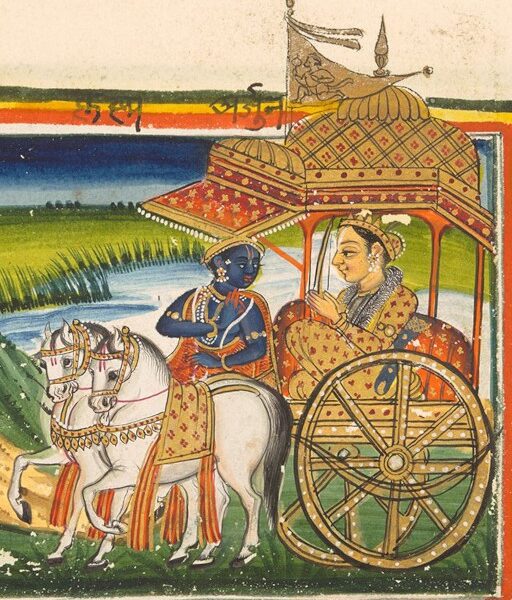
The less intelligent living entity does not know this, and therefore he foolishly goes to the demigods for some benefit. But the pure devotee, when in need of something, prays only to the Supreme Lord. Asking for material benefit, however, is not a sign of a pure devotee. A living entity goes to the demigods usually because he is mad to fulfill his lust. This happens when something undue is desired by the living entity, and the Lord Himself does not fulfill the desire.
The process is that the person somehow or another has this faith in the demigod, or the idea that the demigod will give him what he wants, so Kṛṣṇa gives that faith. But still, the demigod can’t award. The demigod is only an officer. The potency of the office comes from the Lord. So without the Lord’s sanction, there will be no benefit.
So the foolish person, as Kṛṣṇa is pointing out, thinks that they’re going to the demigod, they’re getting this result. What they’re not catching is that the result is coming because the demigod is going to the Lord. And not only that, the faith to worship the demigod is also coming from the Lord. So the intelligent person would go to the Lord.
Yesterday there was an idea that we don’t want to disturb the Lord. But it’s His process anyway. He has to give the faith. He has to give the sanction. It just appears that we’re not bothering Him. So the point is that since it’s going to Him and one’s a devotee, one would go with serving Him directly, praying to Him directly. The difficulty comes as praying to the demigod, you don’t mind asking for anything. And praying to Kṛṣṇa, then you’ll think about what it is you’ll ask for. So that’s the difficulty that comes up.
So the devotee, he goes to the Supreme Lord for everything. Now here he brings out a point, though, asking for material benefit, though, is not a sign of a pure devotee. Maybe a devotee, but not a pure devotee, right? There’s the mixed devotional element, right?
So then he means even if it’s mixed, still better to go to the Lord than the demigods. Because the demigod, it still has to come from the Lord. But it’s also pointed out as the living entity goes to demigods because they’re trying to fulfill a material desire, not a material need. Well, for the devotee, he’s connecting whatever is his desires to the Lord. So it takes on a different quality. So the devotee would avoid anything which would be, he has material desire that has no connection to the Lord. That he would want to try to avoid, right? Because that won’t be favorable in his devotional progress. But something needed that it can be engaged in the Lord’s service, but it may also have some of our own desire involved. Does that make sense? Still, it’s better to go to the Lord because that’s the process anyway. Kṛṣṇa’s awarding it. He just has this other method that you could go through because if you don’t want to go to Him, either because you’re afraid, since He’s the supreme control, He may not give you what you want. Which, as He pointed out here, He doesn’t necessarily fulfill it if it’s not useful. But it’s not that the demigod will give it either because it still has to be sanctioned by Him. In other words, activities that are beneficial, right? In other words, something pious. Because pious means it gives a benefit. The point is, who’s the benefit for? Does that make sense? You’re not offering something to Kṛṣṇa that doesn’t have a benefit.
And technically, one shouldn’t be doing something for yourself that doesn’t have a benefit.
Does that make sense? So that’s the point. If we look at it carefully, what can’t be offered to Kṛṣṇa won’t have a benefit for us. Like that. We may think it has a benefit, but it doesn’t necessarily have a benefit. Does that make sense? It’s a legal thing in court, at least in America. If you have a case going, if you can show that they’ve taken LSD seven times, then you can claim insanity.
Like that. So it’s not necessarily beneficial.
Right? Like that. So that’s why it’s not offerable, right? Does that make sense? Like that.
It doesn’t matter, same person. So it’s like we were hearing yesterday about, I think, Gauridas Pandita. Gauridas Pandita then installed Gauriṭāya deities, and Lord Caitanya had come for the installation.
And then, when the program was finished, Lord Caitanya said, Okay, I’m going now. Gauridas said, No, no, you have to stay. He says, No, but you have the deities. He says, No, but I want you. He said, Okay. And so then, you know, Lord Caitanya, Lord Nityananda, they went inside on the altar, and then the deities left.
They said, No, no, no. Like this. This went on for a while. After a while, no one could tell who was the original and who was the deity. Yeah. So, yeah, you don’t have to wait like that, of course.
Okay.
Yeah. So in other words, because it’s not a useful desire, therefore the Lord may not fulfill it. You know what I’m saying? You know, then you have the element of your karma. If it’s your karma, you have it, then it’s there. But otherwise, it may not be beneficial. So for the devotee, the Lord may not fulfill the desire. So going to the demigods and getting something that Krishna wouldn’t fulfill and then just dealing with the karma afterwards, that’s not going to happen?
Means, you have to be very, very careful is that, as we see, as Krishna gives faith in the demigod worship, you want it, Krishna gives it. So if you want faith that being happy separate from Krishna is possible, Krishna will give it. It’s what you want, right? Because he’s not going to interfere with your independence.
Does that make sense? So that’s the difficulty, is they’re worried that, you know, Krishna, because there’s a standard, then he won’t fulfill certain desires. But the demigod, it’s just kind of like it’s an office, so whatever you ask for, you have to be able to get. But you’re not calculating your karma and that, you know, the Lord’s sanction.
So the devotee then goes to the Lord for things. So if it’s something that you’d be embarrassed to ask the Lord, then one should self -question, is it worth asking for? Is it worth having?
Does that make sense? But in any case, you know, it makes one contemplate it. One sees the weakness in that desire, right? And if one is confident that, no, it’s something at this stage in life that needs to be there, and it’s according to occupational duty, and so therefore it’s not out of the, you know, out of line. So therefore, then if you go to the Lord for it, still that works better. Because in any case, whatever method you use, it’s still the Lord that has to sanction it. So why be indirect when you can be direct about it?
Because that will cultivate the relationship than trying to, you know, because if it was someone else, right? What would you say if you’re supposed to go to this person for it, but you don’t and you make some other arrangements? What would they say? They would probably be a little weird about it. Yeah, I mean, just straight going behind my back, you know, doing this and that. You know, they wouldn’t appreciate it. So, you know, why would it be any better in dealing with the Lord, right? The difference is you can’t go behind God’s back. Any method you try, still he’s the one sanctioning, no matter how far out it gets. But it would seem like if you had to speak with the prime minister, you would go to the secretary.
Yeah, but the secretary is for directly, it’s recognized that he’s the secretary for the prime minister. But here, instead of going to the secretary and the prime minister, you go to another minister and try to get it done there on your own. But what they don’t understand, why do they call it prime minister? Because the ministers have to take the sanction of the prime minister. Otherwise, if they could act independently, then what’s the meaning of a prime minister?
Does that make sense? So we don’t think that it’s because of lust. Lust means when one’s love for Krishna is being misdirected, then, you know, so here, lust, we would be inferring something very serious, right? Like that, so very focused, very intense.
Does that make sense?
So, yeah. So one’s not using necessarily one’s intelligence here. Because he says mad to fulfill his lust. So madness already indicates the intelligence is not there, right? But for the devotee, he understands there’s a desire here how to deal with this. You know, he has a family, he needs money, he needs this and that. But you go to Krishna, like that.
Because if you don’t go to Krishna, then you’ll have some other arrangement, and in that other arrangement, you’ll have faith in that, and so then it will lessen in Krishna. Yes? When I meet someone, sometimes I do, I don’t want to bother, you know, the top person because they’re very busy. So, like, I do go to somebody under him to get things that I feel are not so important to bother, like, you know, the temple president, you know, I would go to the temple commander or… Because that’s the authorized fashion of following the order of the temple president. But here in the demigod worship, they’re not considering, I don’t want to bother the Supreme Lord, so I’ll just go to one of the officers. They’re just going to the officer thinking the officer is giving the facility. How about for the devotees, though? If you do, like, not want to talk to Krishna so much. I don’t see devotees doing things that we have to manage.
Yeah, so, but the point is, is, here it said, the demigods cannot award benedictions to their devotees without the permission of the Supreme Lord. So the worship of the demigods and achievement of desired results are not due to the demigods but to the Supreme Personality of Godhead by arrangement. The less intelligent living entity does not know this, and therefore he foolishly goes to the demigods for some benefit. You know what I’m saying? So it’s a different situation. It’s just as much trouble. Because the Lord has to consider whether one is deserving or not and make a decision. So then, and the modes of nature are going to carry it out anyway. He doesn’t do it himself. So the demigods are going to carry it out, but whether they’re carrying it out because the Lord has directed them, because that’s coming from the Lord, or he’s doing it because they’re just working within the modes of nature. You know what I’m saying? There’s a difference whether they’re representing the Lord or they’re representing the modes of nature. So when we go to the demigod directly, then we’re dealing with the modes of nature. Though it’s still the same trouble for Kṛṣṇa.
Yeah, but then that’s a devotee. So that’s different.
You know, like you might pray to Lord Brahmā, the head of the sampradāya, that you might have the intelligence to, okay, we only have one head, we don’t have four, so we’re already at a disadvantage here.
You know what I’m saying? That’s the difference. But worshipping the demigods directly and thinking one will get some benefit, then one is misinformed.
Yeah, but there it’s because they don’t even notice. Because you go to the temple commander, but you’re not asking the temple commander to do something that the temple president wouldn’t sanction. But to the demigod, that’s kind of the motivation.
Unless it’s a śāstra thing, then they’re just going to the demigod because the śāstra says, but then they’re only seeing up to the demigod level. They don’t actually see the Supreme Lord, and these are all the Supreme Lord’s officers. So again, still, it’s uninformed.
You know what I’m saying? But here is something that the temple president has given, that if you need a broom, you know, the temple commander’s in charge of them. You don’t go to the president and ask for a broom, because then he’ll send you to the temple commander anyway. So this is a slight difference.
Twenty-seven, twenty-three. Men of small intelligence worship the demigods, and their fruits are limited and temporary. Those who worship the demigods go to the planets of the demigods, but my devotees ultimately reach my supreme planet.
If the demigods are part of the body of the Supreme Lord, why won’t one get the same result by worshiping a demigod as by worshiping Kṛṣṇa?
Here a point may be raised that if the demigods are different parts of the body of the Supreme Lord, then the same end should be achieved by worshiping them. However, worshipers of the demigods are less intelligent because they don’t know to what part of the body food must be supplied. Some of them are so foolish that they claim that there are many parts and many ways to supply food. This isn’t very sanguine. Can anyone supply food to the body through the ears or eyes? They do not know that these demigods are different parts of the universal body of the Supreme Lord. And in their ignorance, they believe that each and every demigod is a separate god and a competitor to the Supreme Lord.
So that means even you are going through the mechanics of the demigods, still the worship has to go to the Supreme Lord. It still has to go by that method. So that’s the point is then there’s no need to go through the demigods. Right? Does that make sense? Because the Lord giving His benediction, you approach Him and He gives the benediction, He’ll get His officers to fulfill it anyway. Like you go to the big man and say, I need this, and he’ll get his people to get it done.
You know what I’m saying? But it’s very different. You have a relationship with the person rather than you try to go to the small people because it still is they have to go to the big guy. Right? Does that make sense? And now we’ve given all this respect and everything to the little guy, but now he’s just going to go ask the big guy.
Right? So the respect and all that that is part of the relationship has been offered to the wrong person. You know what I’m saying? Because he’s not necessarily going to… He’s not there to represent you. He’s not your servant. You know what I’m saying? I mean, take it like that. I’ve done the service, so he has to… No. It’s that, you know, you want to worship the demigod, that’s your foolishness.
Does that make sense?
The results achieved by the demigods’ benedictions are perishable because within this material world, the planets, the demigods and their worshipers are all perishable. Therefore, it is clearly stated in this verse that all results achieved by worshiping demigods are perishable. And therefore, such worship is performed by the less intelligent living entity. Because the pure devotee engaged in Kṛṣṇa consciousness and devotional service of the Supreme Lord achieves eternal blissful existence that is full of knowledge, his achievements and those of the common worshiper of the demigods are different. The Supreme Lord is unlimited. His favor is unlimited. His mercy is unlimited. Therefore, the mercy of the Supreme Lord upon His pure devotees is unlimited.
So the demigod is working within the material sphere. So what benedictions he can give are also just material.
Does that make sense? So then you’re going to have to take this material result that you were too embarrassed to ask the Lord for, and now you’re going to have to ask Him to accept it. Right? We’re embarrassed that He should give it, but we’re not embarrassed that He should accept it. Does that make sense? The point is that He’s giving it and He’s accepting it.
So when it’s done in connection with the Lord in devotional service, the result is eternal. It doesn’t mean that the material medium of it will last eternally. Right? Because even if it did, what good is it for you? You know what I’m saying? If the material body, you leave the material body, there’s no value for you specifically that that material item is still there. You know what I’m saying? But the point is the soul is eternal. The results of the devotional service are eternal. That’s what you get when you approach the Lord. But if you approach the demigods, what you get is material result and the benefits are temporary. There is no eternal element to it because the eternal element is only there in connection with devotion. Right? Even when we see the impersonalists, then they may get a spiritual result, but it’s still temporary because it’s not. So only devotional service is eternal. Does that make sense? We have to make a difference between what’s eternal and what is a situation in eternity.
Does that make sense? One may be situated in eternity, but it doesn’t mean you are going to be situated in eternity eternally.
Does that make sense? That’s the mistake of the Mayavadis.
It’s also the mistake of the materialists. They think I will eternally be happy.
Like that. But their situation is temporary, so everything else is temporary. So then that’s really less intelligent.
Does that make sense?
So here it says the Lord is unlimited, His favor is unlimited, His mercy is unlimited, but you have to ask for it. Right? He’s not going to get in the way of your independence.
This is not one should not mistake that this is because the Lord is dependent upon the living entities. Unless you act, He can’t act. Right? Jaimini will present it that way. The demigods, we perform our activity, we should get the result. We don’t do the yajna. They can’t give the result because it’s the rule that for this activity you get this result. So then they turn it around that therefore the demigods are dependent upon us. Right? I did my karmakanda, yajna, then they have to give the result. But if I don’t do it, they can’t give the result. So it’s all up to me. I’m the one that makes the first move. Right? But with the Lord, it’s a matter of He’s not going to get in the way of your independence. Because affection, if it’s based on independence, then that has some meaning. You know what I’m saying? You go to the restaurant, you know, and the waiter takes care of you properly, then he’s being paid to do that. You know what I’m saying? But if you’re at home and someone takes care of you, a friend takes care of you, they’re not being paid. That gives more taste. Like that. So therefore the Lord is only, since everything’s His anyway, He doesn’t need to be paid, therefore He’s only interested in, you know, the real relationships. Does that make sense?
Yes? No? Very good. Okay. So lesson twenty-seven is the last of the reasons. Okay. When God descends, fools consider Him an ordinary man. Right? So this is all the point, is the Lord comes Himself to explain everything to the living entity. But the problem is the living entity has all these shortcomings. He doesn’t recognize the Lord. He thinks that someone else other than the Lord can provide things. Right? All these different difficulties that he has. He thinks that the Lord descending is material.
Right? Like that. And then, it means that idea of surrendering to the Lord when one becomes fearful. Right? So Bhagavatam, that’s one of the first things that’s dealt with. Uttara is surrendering to Krishna. Right? And you can see Krishna takes care so to remove that element of fearfulness. Like that? Does that make sense?
So now here’s the last of the reasons, is that the fool is considered an ordinary. So, there’s a lot of verses on this one. Of 9.11. Fools deride me when I descend in the human form. They do not know my transcendental nature as the Supreme Lord of all that be.
Okay. Comment on the idea that Krishna is a powerful human being.
The personality of Godhead who conducts the creation, maintenance and annihilation of the complete cosmic manifestation, cannot be a human being. Yet, there are many foolish men who consider Krishna to be merely a powerful man and nothing more. Actually, He is the original Supreme Personality as is confirmed in the Brahma-samhita. Isvara, Harabha, Krishna. He is the Supreme Lord.
Despite the… because the human being is not there before the creation, is there during the creation, is not there after the creation. But the Lord is there because to create means you have to be there before creation. Right? And to be able to affect the destruction, you have to be there afterwards. Right? Especially since there’s another creation. Right? Is that what it says? So, a human being means that… it means the Lord has to be beyond because He’s there before everything. And He’s still there after. And He’s there during. Right? We also don’t say, OK, He’s created it. He can create it. He can destroy it. But He can’t run it. Like that. That’s not very generous.
The person is so intelligent, he can create this fabulous thing, but he doesn’t know what to do with it.
And we’re so intelligent. We do. We’re the ones that know. That’s the point. Yeah. Despite the transcendental qualities of Lord Kṛṣṇa’s body, His full bliss and knowledge, there are many so-called scholars and commentators of Bhagavad-gītā who deride Kṛṣṇa as an ordinary man. And the fun part is they’re scholars. And they’re commentators. So, if they’re intelligent, why would they be commenting on something that’s not of intellectual value? Right? Something that they would consider beneficial for others. So, if He’s an ordinary man, why would He be saying all this great stuff? Right? Does that make sense? So, that would mean that they think that the material energy itself gives its own benefits. Right? It’s complete in itself and that all one’s necessities can be provided just from the energy itself. The problem is, is they don’t understand that the energy comes from a source. Right? Otherwise, how will it be energy? Right? Something’s only energy if there’s a source of it and it’s connected. As soon as it’s not connected to the source, it’s not any more manifesting energy.
The scholar may be born an extraordinary man due to his previous good work, but this conception of Śrī Kṛṣṇa is due to a poor fund of knowledge. Right? What I’m pointing out here is that they may be extraordinary, very special intelligence, very good qualities, piety, you know, so many things may be there. So, that’s there from a previous life. So, they’ve done good work in the past, but unfortunately their application to Kṛṣṇa then doesn’t have much benefit. That’s due to a poor fund of knowledge. The poor fund of knowledge means the fund of this knowledge of God that’s there is not very replete. Yes. Also, it’s interesting to notice that they derive Kṛṣṇa, but then from other humans they make gods. Yeah, yeah. They glorify. Yeah, yeah. There can be no god, but then, you know, there’s, what do you call it?
Just a baby, right? You know, like that. So, it’s just they create, yeah, it’s true.
Sports stars are usually gods. Yes, sports stars, celebrities. Who was telling me the other day that one place there was a definition of a celebrity is someone who, you know, full-time acts as a celebrity.
Famous for being famous. Yeah, yeah, basically.
Because it’s materialistic. That’s why we say they’re envious. Because the point is, if they’re not envious, then why couldn’t God also be God? But it’s kind of like the Māyāvādīs. They won’t go to a… They’ll say everything is God. Everything’s the same, right? It’s all one. Everything is God. And they’ll say everybody is God. Right? They’ll call each other Nārāyaṇa. So, but they won’t go inside a temple to see the deity. Like that. That won’t offer any worship to the deity. But they’ll, you know, another sannyāsī, they’ll give respect, they’ll, you know, Namo Nārāyaṇa, the whole thing. But not to the deity. So everything can be God except the deity. Right? So this is the… So that’s why we say envious. Is that underlying they’re actually envious.
Therefore, he is called mudha, for only foolish persons consider Kṛṣṇa to be an ordinary human being. So here’s another aspect of mudha. Because generally we’ll take mudha, meaning that he just works hard. You know, he’s a common laborer, you know, uneducated, uncultured. You know, that will be our, you know, you’d say, archetypical kind of idea of a mudha. But here we see that’s being extended that mudha is the mentality where they consider Kṛṣṇa to be ordinary. Like that. So that’s there. So they’re working very hard for whatever is their situation. Because even the person who’s educated in culture is working very hard, but for a purely mundane element.
Right? So that aspect is there. So it’s not necessarily that you have just, he’s just a mudha, and then just a Nāradhāma, and just a Māyāyā Pratyajñāna, like this, is that you can have all these, you know, nice mix. You know, like that. You know what I’m saying? You know, he’s a sura and a sura, you know, like that, with, how you say, his intelligence has been stolen by illusion. He’s therefore the lowest of mankind, and he has a donkey head with horns on it. Like that, right? Because demons have horns, and he’s a mudha. So, like that. You can get…
The foolish consider Kṛṣṇa an ordinary human being because they do not know the confidential activities of the Supreme Lord and His different energies. So we can see is that what Prabhupāda is pointing out is not the mundane, you know, the ordinary definition of less intelligent, because he’s already said, the scholar, he’s using the term scholar. He’s not saying so-called scholar, you know, or bogus scholar. He’s saying he’s the scholar, because by definition scholar means someone who’s well-educated and very expert in some branch of knowledge. Right? So, they’re a scholar, and he’s born an extraordinary man due to previous good work. So he’s already acknowledged all the things that the person is recognized for, but saying he’s still a fool because he doesn’t understand the Supreme Lord, who’s the source of all this knowledge. Right? You know, just like the demigod worshiper is approaching and not understanding that the whole process is the Lord’s arrangement. So they’re also ignoring the Lord, and the whole process of liberation is still sanctioned by the Lord. You want to get liberated? The Lord has to sanction it. You want a new car? The Lord has to sanction it. Like that. So it’s similar to the kami who’s very pious because it gives good results, but doesn’t get, but it goes back to… Yeah, doesn’t get, so therefore his results are temporary. That’s why his facility is temporary, his liberation is temporary. But for the devotees, they depend upon the Lord for everything, so then he’s cultivating eternal situation, eternally, with, you know, you know, good quality facilities. Fringe benefits. Yes.
I was thinking of those, but it’s not of this world, so that would mean it would be beyond the fringe. That’s true. Yeah. Right? Yeah. Beyond the fringe benefits.
So getting the fringe benefits, so you’re beyond the fringe. Yeah. Transfringe. Transfringe.
So you could be a transfrindentalist?
Transfringe dentalist. I like it.
Transfrindentalist. Like a little car. Yeah, good.
So then they wouldn’t know, they wouldn’t quite know what it means, so then they’d probably think maybe you’re a transgender dentist. Yeah. And they’d leave you alone. That’s true.
Okay. We’ll move on now.
Okay.
The foolish consider Kṛṣṇa an ordinary human being because they do not know the confidential activities of the Supreme Lord and His different energies. So they don’t know what’s beyond. Because if He has a form, we have a form, it’s mundane. He has a form, it must be mundane. So they don’t know about His activities beyond the mundane. Right? His qualities and activities. They do not know that Kṛṣṇa’s body is a symbol of complete knowledge and bliss. Right? Because our bodies are symbols of ignorance.
That He is the proprietor of everything that be and He can award liberation to anyone.
So if He’s the proprietor of everything, that means anything you want from the demigods He can give, the liberation you want, that’s also in His hand.
Because they do not know that Kṛṣṇa has so many transcendental qualifications, they deride Him.
You know, as Prabhu mentions, someone else they’ll make into a god and say all good things about Him, a god, then they’ll deride. But I guess unless you deride God, then someone else can’t be God. Otherwise there’d be two gods and that wouldn’t be right. So then, He’s not God. What is it? There was one, what was it? Guru Mahārāja Ṭhī. He was just like this kid. Like that. And His mother proclaimed He was God. And it had a big following. And this went on for years and years and years. And then I think He got out of hand or something. His mother wasn’t pleased with Him. So then she proclaimed He’s no longer God, but His other brother now is God. So everyone should stop worshipping Him as God and now start worshipping the other brother as God. Like that. They went to court last year. Oh, then they went to court. And what did the court decide? Who’s God?
Okay, that’s fun. Then they have to work it out in court. So that means they went to… So does that mean their mother wasn’t the highest authority anymore? Yes. You think that God could settle it Himself? Yeah, yeah, whatever it is. But now the question is, was it being covered in the Supreme Court? So then at least it has some… But it was just an ordinary court. That would be inappropriate.
God jailed for six months. It shows remorse. That’s what you… Oh, you’re just saying… Yeah, yeah, it shows remorse.
Says He’s sorry.
Nor do they know that the appearance of the Supreme Personality of Godhead in this material world is a manifestation of His internal energy. That’s why I said it’s a complete symbol of complete knowledge and bliss. Because He is eternity. He is existence. In other words, everything that is, is Him. He is existence. So therefore the form is knowledge and bliss. You know, that’s the symbol of that. He’s, of course, the other is already included, but you can see because of. Right? Is a manifestation of His internal potency. So His internal potency is arranging that. Right? That He’s appearing here. So He’s not appearing within maya. So they’re thinking that someone’s… You know, our appearance here is due to maya. So therefore God appears here, it must be due to maya. But He’s appearing here because of His internal potency. Right? His internal potency is arranging it. So He’s not walking around in the material world. It may be He’s walking around in His internal potency that is situated within the material sphere.
Does that make sense? Because He never interacts with the material energy. That means, you know, where He steps, He’s stepping on the internal potency. You know. Does that make sense? That’s why He put a lotus there. Right? Because that’s the internal potency.
Śrībhu and Nīlā. Nīlā is the lotus. The saṅdhini potency. So that’s the earth. When He steps, He’s stepping on saṅdhini, not on, you know, ignorance.
Does that make sense?
He is the master of the material energy. As been explained in several places, mama māyā duratyayā. He claims that the material energy, although very powerful, is under His control.
And whoever surrenders unto Him can get out of the control of this material energy.
So He’s in control of it. How it works is His laws. He gives the sanction. So if you surrender to Him, then everything will, then one can get out of the control of the material energy.
If a soul surrendered to Kṛṣṇa can get out of the influence of material energy, then how can the Supreme Lord, who conducts the creation, maintenance and annihilation of the whole cause of creation, have a material body like us? So if the soul can get out, then why would we consider, and that’s by God’s grace, why would we consider that God is part of this?
Does that make sense?
Yeah. Yeah, but I’m just thinking that when He descends, He could just like, like we put on a chatter, He would just put on some matter and walk around. Could, but why? We complain about the matter we’re in, so why would He, if He has a choice, why would He choose that? Good point. You know what I’m saying? Touché.
Is it touché because the first person, what you said was one Shay, and now they come back as two Shay, and so they defeated Him? He’s the French guy. Oh, okay. It means touch, right?
Poke. Touché? It’s in sword fighting? Yeah, it’s jousting. Yeah, exactly. It’s part of jousting. When you touch the guy back. When you touch the guy. It’s fencing.
Like in picket, or? No, no.
You can’t attack until you acknowledge it. You have to be in a stance. So you’ve accepted his argument, but then you’re standing back. And then defeated him. Okay.
Touché? That’s a fence move. That’s two Shay.
No, that’s two Shays. Yeah.
So this conception of Krishna is complete foolishness. Foolish persons, however, cannot conceive that the Personality of Godhead, Krishna, appearing just like an ordinary man, can be the controller of all the atoms and of the gigantic manifestation of the universal form.
The biggest and the minutest are beyond their conception, so they cannot imagine that a form like that of a human being can simultaneously control the infinite and the minute. Actually, although He is controlling the infinite and the finite, He is apart from all this manifestation. It is clearly stated concerning His yogam aishwaryam, His inconceivable transcendental energy, that He can control the finite and the infinite simultaneously and that He can remain aloof from them. Although the foolish cannot imagine how Krishna, who appears just like a human being, can control the infinite and the finite, those who are pure devotees accept this, for they know that Krishna is the Supreme Personality of Godhead. Therefore, they completely surrender unto Him and engage in Krishna consciousness, devotion and service to the Lord.
He has the universal form, which is so great, and then at the same time you have the atom, which is so small, because he is mentioning about the commentators here. So the shastra will describe the Lord as the universal form. At the same time, He is in the atom, between every atom. These are all shastric points. So they can understand, OK, like this, then the great, the unlimited, the Brahman can do that, because the Brahman is all-pervading and can do, but then how can a form that appears to us to be limited in time and space, how can that be in control of both of these? So they don’t understand His yogam aishwaryam, His inconceivable potency, that by that He is able to do, because He is beyond, He is functioning in the internal potency, while we are covered by the external. Does this make sense?
9.12. Those who are thus bewildered are attracted by demoniac and atheistic views. In that deluded condition, their hopes for liberation, their fruitive activities and their culture of knowledge are all defeated. Because they are thinking they are going to become perfect and happy by their liberation, their fruitive activities and their culture of knowledge. But it’s all defeated because it’s temporary.
Which type of devotees cannot taste the fruit of devotional service? There are many devotees who assume themselves to be in Krsna consciousness and devotional service, but at heart do not accept the Supreme Personality of Godhead, Krsna, as the Absolute Truth. For them, the fruit of devotional service, going back to Godhead, will never be tasted. Similarly, those who are engaged in fruitive, pious activities and who are ultimately hoping to be liberated from this material entanglement will never be successful either, because they deride the Supreme Personality of Godhead, Krsna. In other words, persons who mock Krsna are to be understood to be demoniac or atheistic. So they may take a position as a devotee. You go into many Hindu homes and they have their altar, they have pictures of Krsna or Rama, they don’t have any problem worshipping Visnu. But they’re not actually devotees, because they don’t accept that Krsna is the Supreme Personality and all others are servants. No, they’re all gods. So they’ll worship Visnu, no problem. You’re having a program, you’re having a kirtan, they’ll be there, they’ll be taking part, very enthusiastic. But then you could also the next day have a kirtan for Shiva. They’d be there, enthusiastic. And the next day for Shakti, they’d be there. Like that. So it’s no problem. Does that make sense? Yes. So Maharaj, what we’re talking about here is really the sincerity of somebody.
So how does one maintain that sincerity position?
So you have good intentions in your daily side, and obviously you might come across another anartha, let’s say for example, and it’s like, OK, well, I’m doing all the programs, but yet, hang on a minute, we really have to be honest with ourselves and ask ourselves what’s happening inside. So I guess my question is, how does one cultivate that sincerity and keep that sincerity?
Well, the main thing is that, as we see, it’s by desire. So simply wanting it is the basic principle.
And wanting it means that you have to show that you want it. It means you have to be making an endeavor. Because otherwise you can say, no, no, I want to do this, but we’re doing something else. You know, like that. So there has to be the desire for it and trying to take advantage of the opportunity to obtain it. Whether we’re expert at our endeavor, that’s another thing. But the desire is there to do that nicely. So this will be best cultivated in the association of devotees, because they have that mood, so by being around them, then we’ll have. So we can say, no, no, but that means the great, the pure, the one dropping out of the heavenly planets, or wherever we want them to drop from. But the point is that’s why this is society.
Because someone’s a devotee because there’s some sincerity. So wherever it’s manifest, it’s real. And wherever it’s not manifest, that’s the part that’s unreal. Because something’s unreal doesn’t mean the whole thing’s not real. Does that make sense? Right? So by having a broader association, then they can inspire each other, and that way make it more of substance. Or at different times, different persons are having everything, you know, having, are sincere. Does that make sense? You know, there’s somebody in the kirtan, and they’re fired up, and they’re involved, but some other’s on the corner over there, you know, doing something important, you know, on their telephone or something. You know, so the thing is, is it may not, may not, so you take advantage of those who are absorbed in the kirtan. Right? Does that make sense? You know, unless you just remember that you had some important thing to do, and then you go to the side and also do something on your phone. You know, like that. So in any case, it’s association.
Does that make sense?
Okay. So, in other words, here’s, now Prabhupada’s giving this direction, is that there, means they’re getting their fruitive results. They’re getting their liberation. Right? They’re getting their good qualities. But if none of that will give them, you know, enters into the spiritual world, therefore we can say it’s, you know, not very useful. Right? Like here. They’re defeated. Because, means they’ll lose those things, because you’ve done the work, you get the result. But then it’ll be lost. So then you have to do the work again. So it’s defeated.
Right? Does that make sense? It’s like, you know, you go in, you sit down, you eat the meal, so you’re victorious over hunger. Right? But then, just give it a few hours, and then it’s all lost. Yeah. And so then, again, you have to go out, go to battle. You know?
Yeah.
So both is that, whatever’s material will be lost, but that’s not actually the big problem. Means we’ll look at it, that’s the big, oh, because you’re going to lose everything. That’s not the big problem. Because everybody loses everything anyway. Right? The big problem is, is you don’t gain the transcendental situation.
That’s the problem.
You know? So in other words, one takes up devotional service, appreciating that Kṛṣṇa is the Supreme Personality of Godhead, rather than just a Godhead, or just a God. Right? It is a great offense, therefore, to consider Kṛṣṇa, the Supreme Personality of Godhead, to be an ordinary man. Those who do so are certainly deluded, because they cannot understand the eternal form of Kṛṣṇa. The Bṛhad-viṣṇu-śrīti clearly states, One who considers the body of Kṛṣṇa to be material should be driven out from all rituals and activities of the śruti and the śrīti, and if one by chance sees His face, one should at once take bath in the Ganges to rid himself of infection. And that kind of taking bath, generally speaking, means with your clothes on. You know? Yeah, because it means, you know, not only you become contaminated, your clothes and everything, so you take bath with all your clothes on.
That’s the standard.
So, here we’re saying that someone who doesn’t, means this Bṛhad-viṣṇu-śrīti, is making the point, Manu makes the point, if somebody doesn’t acknowledge the authority of the scriptures, then they shouldn’t be involved, you shouldn’t involve yourself with them on any level of śruti and śrīti, rituals, activities, relationships, anything, the śāstras recommend, right? The śāstra recommends that, you know, appropriate family and persons, and one marries into those, you have relationships, you deal according to those relationships, or if not, they have a position in society, you deal with them accordingly, all that, right? Because that’s what śāstra says is appropriate, right? But they don’t accept the authority of śāstra. So therefore, you shouldn’t do any of those activities in connection with them.
Does that make sense? Based on their position, right? Means if you meet them, and so the śāstra says you’re supposed to interact properly with people, that you’re doing because that’s your position, but it has nothing to do with theirs, right? But relationships will not be taken further than that, because they themselves don’t accept the authority that defines how you should deal with them.
Does that make sense? So here it’s taking it even farther that if they don’t accept Kṛṣṇa, who is the author of these scriptures, then they shouldn’t even do any ritual or activity that is defined in the Veda.
You know what I’m saying? The other one is you don’t get involved. This one’s going to point that they shouldn’t even be involved.
Does that make sense? So in other words, they should accept the transcendental position of the Lord, then someone’s qualified to deal with the scriptures and to deal with the various rituals that are there. So that’s why when we say all the scriptures, those are for the materialists, actually they’re not. The scriptures are for the devotees.
Technically, the non-devotees shouldn’t even deal with the Vedic literatures. But if they don’t, there won’t be a favorable environment for the devotees.
Does that make sense? Does it make sense?
It means if the materialists, if it’s not a general principle of following the rules of the Vedic culture, there won’t be an environment, there won’t be as favorable environment for the devotees. Like just let’s say, okay, in the 70s, then people would be more general, though sentimentally would be following Vedic culture. You know, so all the different, you could say, accoutrements of the Vedic culture were very easily available. All the varieties of cloth and chutters and ornaments and oils and everything like this, you know, gold, silver, it was all very easily available. All the different kinds of cooking, all the different kinds of, all this, does that make sense? It was very easily available because they were following the culture. Now as they’re giving up the culture, they’re giving up those things. It’s very hard to find these things now. So it means in the organization of management that those things have to, everybody has to follow the culture, but it’s not that they have to understand, they don’t have to expose, they don’t have to explain to anything, they just should surrender to following the culture. Yes, but if it’s explained, then there’s the chance that then they will, they will come up. The reason that, because it’s not explained, that’s why they’re leaving it. You know what I’m saying? There’s the illusion that I can get both. I can get all the benefits from what I like following from the Vedic, but at the same time, I can maintain that and get all the benefits that I see in a non-Vedic culture. And I’ll get them both at once, but that doesn’t work. You put one foot in one boat, one foot in another boat, then you’re going to end up in the water. You’ll be a night about.
That’s the difficulty. So the education has to be there, but you have the preliminaries. Yeah. The point is, the education is there, so they’re situated in the culture. By practicing the culture, you’re supposed to associate with saintly persons. Those saintly persons are supposed to be devotees. Right? And so then you’ll get the proper association and see that your approach to the Vedic culture has simply been materialistic. It hasn’t been actually what the purpose is for. So one will improve that quality.
Does that make sense? So that’s the idea.
Right? Does that make sense?
All the elements need to be renovated, get them switched on. Yeah, yeah.
People jeer at Kṛṣṇa because they are envious of the Supreme Personality of Godhead. Their destiny is certainly to take birth after birth in the species of atheistic and demoniac life. Perpetually, their real knowledge will remain under delusion. And gradually, they will regress to the darkest region of creation. Right? So their real knowledge will remain under delusion. So that means the soul is inherently, you know, in knowledge. But that will always remain covered because they’re not accepting Kṛṣṇa, who is the origin of that. Right? That’s how one turns, but comes, bahir-mukha. The living entity is situated on the transcendent, on the spiritual platform. There’s a happiness there. So there has to be a source. If you’re not the source of it, there must be one. Right? So inherently, the jīvas understand God is the source of that happiness. So if you want to increase that, then you have to turn and interact with the Supreme. Does that make sense? But if you don’t acknowledge the position of the Supreme, then what does that leave you? Right? So then that means that’s an illusion. So that will take you farther and farther away from the Lord. So that means we’ll get more and more, you know, the atheistic, demoniac life. And then that will slowly… It says gradually they will regress to the darkest region of creation. So they’ll just start going slowly, slowly, slowly.
Hmm.
This is a fun… But now if you take up devotional service, then it’s gradually, but it will go the other way quite quickly.
Does that make sense?
7.24 Unintelligent men who do not know me perfectly think that I, the Supreme Personality of Godhead, Krishna, was impersonal before and have now assumed this personality. Due to their small knowledge, they do not know my higher nature, which is imperishable and supreme.
So He’s established the higher nature. Bhagavan is the higher nature. So yes, God is impersonal, localized and personal.
Right? But the personal is the higher because it’s the support of the other two. Right? God’s higher than the creation because He’s the support of the creation. Right? The internal potency is superior to the external and to the jivas because it’s the source.
Does that make sense?
So He’s the source. So unintelligent men don’t know me perfectly. Right? It means they know Him to some degree, so they understand the aspect of Brahman, but they don’t understand that He’s always a person. And this Brahman element is just an aspect. Yes? What’s the argument to establish that the personality of Krishna as a person is superior to… The personality as a person. So you can be a personality and not be a person. Person, person, person. So that means like your dog has a personality, but you’re not a person.
Or you go into the living area or something and you look around at all the different things and it’s well arranged and you say, Wow, this has got personality. You mean like that, kind of. Is that what you mean? I don’t know. I got distracted by the… By the comment they should talk loudly.
I should tell them to stop doing that. They’re very uncultured.
They should learn to talk louder, then they won’t make a comment. Then whether you have focus or not, then you won’t be distracted. But that would still require that you focus on… Talking louder. Talking louder, yes.
But then you have to focus on bringing it. What’s the argument that establishes that personality is higher than the impersonal aspect? That the personality is higher than the impersonal. Because the impersonal is generic, while the personal is specific.
And all our endeavors for anything is to manifest the specifics of the general.
Right? Means there’s economy, there’s money, there’s wealth. So is that good enough? Or do you want to be involved with some of it?
Right? And that you have it, is that enough? No, it has to be involved with other aspects. You have money, if you don’t spend it, you don’t have any facility.
You know what I’m saying? So the point is, is that the personal is what one’s endeavoring for. That’s the inherent. Everybody’s doing that.
I could say the Mayavadis aren’t, but why do they all get together? Why do they… You know what I’m saying? All the Mayavadis are all in one place. They’re all sitting in Varanasi, they’re all sitting in Rishikesh or Haridwar. They’re not just spread all over, just permeating the Brahman. No, they all group together.
You know what I’m saying? So the personal is the natural of the tendency of the living entity. Now, one may say, yes, well, that’s the mundane, and we’re talking about the spiritual. But the soul is the spiritual. The body’s the mundane. The bodies don’t mind one’s here and one’s over there. You know what I’m saying? Does that make sense?
Yeah? They say man is a social animal. Man is a social animal. But why… But where does the social… What is the man? The body? You know what I’m saying? You know what I’m saying? You go to a morgue, you know, everybody’s got their spot, but it’s not that you come back in the morning, open one of the doors, and there’s, you know, a few of them in there having a party or something like that. You know, when you open the door, they give you a dirty look over something. You know, like that. You know, it doesn’t happen.
Does that make sense?
Yes?
Yeah, yeah. Because we take it for granted.
You know? And so we just… We act on a platform that is perfectly fine. But it’s not. So that’s the difficulty. It’s the lack of understanding God as a person and lack of understanding His supreme authority. That’s what creates all the difficulties. You know? That’s what creates the difficulties.
You know? But all the difficulties are coming, and because of the atheistic, demoniac nature, we think, oh, I just have to have a better plan.
Right? I didn’t quite work something out. I didn’t take into consideration that, you know, I bought on the, you know, on the, what do you call it, you know, my apartment at this particular place, and then, you know, but, you know, when the tsunami came, it wasn’t quite high enough, so I could get, you know, another place farther back and a little higher. Right? Because I wanted to see the beach, so the best place is not on the beach, but it’s a few kilometers back from the 50th floor. Right? You know? Does that make sense? It’s just, you know, my plan wasn’t quite so good.
Does that make sense? But the intelligent person understands the material world is what it is. Doesn’t mean that you don’t work with it, but you’re working with it because that’s your duties. For the materialist, he’s not doing it because it’s his duties. He’s doing it because, you know, he wants to get the results.
That’s all. Now, those who are intelligent, they see that there’s patterns. Of social dealing. So they know you have to do it like this. So you could say, on one level, well, they’re dutiful. But technically, they’re not actually dutiful. They’re only doing it because they know it’ll get that result, which is for themselves anyway. Right? Does that make sense? But, with them, there’s a concept of piety, so you would be able to explain the elements of proper performance of one’s duties, that everybody has specific duties. They would understand that because they’re more in touch with the laws, but they’re not more in touch with the lawmaker.
As they get bigger, they get more…
They say, when one of the leaves dries on the tree, it just, you know, falls off. When they were small, you wouldn’t notice it as they get bigger.
I guess it was just bonding or something.
Something tall and thin is making noise, so it should make some noise.
Is that…
Okay.
In the Brahma-samhita, it is stated that the personality of Godhead cannot be understood simply by study of the Vedanta literature. Only by the mercy of the Supreme Lord can the personality of the Supreme be known.
Therefore, in this verse, it is clearly stated that not only are the worshipers of the demigods less intelligent, but those non-devotees who are engaged in Vedanta and speculation on Vedic literature, without any tinge of true Kṛṣṇa consciousness, are also less intelligent. And for them, it is not possible to understand God’s personal nature. Right? So, just as for the activities of karma, one goes to the demigods for, Kṛṣṇa is giving the results. Right? It’s also for the study of knowledge, right, that He’s giving the results. So, in other words, anything that’s being attempted by the living entity, on karma, jñāna, yoga, the results are being given by the Lord, not someone else. So, the less intelligent will think that it’s not happening that way, or you can function separately from them.
So, you see, not only are the others less intelligent, because the jñānīs will go, yeah, yeah, worshiping the demigods, they’re less intelligent. No, they’re also less intelligent, you know, because it’s just the other side of the same materialistic concept. Right? And it says here, without any tinge of true Kṛṣṇa consciousness, they may be Kṛṣṇa conscious, but it’s not true. Like the commentator on Gītā is Kṛṣṇa conscious, but he’s not truly Kṛṣṇa conscious, because he doesn’t accept Kṛṣṇa as a person.
Right? So only those who accept Kṛṣṇa as a person are actually… And even then, even they accept Him as a person. Like Kaṁsa, I’m sure, accepted that Kṛṣṇa was a person. Right? He didn’t have any… Because he wasn’t afraid of his Brahman-ness. You know, ooh, he’s going to come on, come and, you know, overwhelm me in, you know, the Brahman. Like that. No, he’s worried he’s going to come and punch him in the head. Right? So… So… But he’s not true Kṛṣṇa conscious. It means you’re conscious of God as a person and it’s favorable.
You know what I’m saying? So that means it has to be free from karma and guilt.
So the karma that you think something of, of material facility is what’s going to make you happy or knowledge is going to make you happy. No, it’s Kṛṣṇa’s going to make you happy. And you can use, depending upon your nature and the, and the situation, the, the facilities or knowledge or both to serve Kṛṣṇa.
So whatever’s appropriate.
Right? So it’s not possible to understand it’s got a personal nature. Because only by His grace you can get that. Right? It’s not a matter of just knowledge because they read it but they don’t believe it. Right? Because if it’s there, you read it and if we’re just dealing with just intelligence, you’d accept it. Right? Like if I take out, you know, a certain amount of rocks and I put them here, you know, and then we count them and then we go, there’s four rocks. So is there something to doubt? No, because it’s just a fact. Right? So the śāstras are explaining the facts. Right? God is a person. But then they read that and go, no, no, that can’t be true. Right? It’s just like if I say, okay, you know, it says, now what about those rocks, you know, we really need, you know, all these rocks and then I, you say, yeah, I’ll leave the rocks there and then you come and there’s only two rocks. It’s kind of like, you know, then you don’t believe it. I don’t believe it. He only left two rocks. You know, I told him many times. You know what I mean? You understand? So what’s here? It’s a fact. There’s two rocks there. That’s it. Deal with it. Right? No, but he can’t deal with it. Why? Because the mind. So the impersonalists can’t deal with that God’s a person not because of their intelligence. They have plenty of that. No, because of their mind.
So that’s the point is intelligence alone will not give you, you know, understanding of God consciousness.
It’s only by Krishna’s grace. Because being beyond this intelligence, being beyond everything, then it’s not going to work just by our endeavor.
Our endeavor and Krishna being pleased with that. And when Krishna tells you how he’ll be pleased with it. It’s not that, you know, you have to figure it out. Right? It’s not one of those.
Does that make sense?
And then different people’s minds then whenever they hear that God’s a person, this is a person, then different people’s minds have a different reaction. Like, oh no, God’s a person and I can’t be God. Or, you know, like God’s laws are almost different. If God’s a person, yeah, or if you look at it, or you could even inverse the Mayavad principle. If God’s a person and that’s spiritual, then being material means you’re not a person. So I’m not actually a person. That’s actually materialistic point of view. There are just chemicals and electricity in the body.
So then what they should be trying to do is get some kind of, you know, some kind of way to be able to tune in into what’s, what, you know, like on your shelf there’s so many chemicals. You know, something to put a pair of headphones there with a very powerful way of that. And, you know, hear what’s the actual thinking of these chemicals because they may be, you know, they’re not distracted by all the other things in the lab and all that. They can just sit there and purely think. So they may be able to come up with some amazing, you know, insight into the creation and the origin of the universe and existence in general like this, right? But we’re not taking advantage because we’re a pile of chemicals but, you know, we’re doing so many things and get distracted but they don’t have any distraction. What else do they expect? They just sit there all day, you know, like that. You know, they pile urea out in the backyard that’s been sitting there, you know, they’ve been harassing you about for so long, you know, to do something about, you know, it may be, you know, coming up with great, amazing, you know, you know, philosophical points like that but just we’re not appreciating it. It’s just sitting out there growing weeds. My cousin is a chemist, I can ask. Yeah. So you sit like that, you know, and then after five years you see that, you know, that’s a new cutting edge, you know, cutting edge, what do you call that scientific theory and you’ll know what happened, you know.
All the chemicals in the body they cost like less than $10. Oh, we’re up to $10 now. That’s good. It used to be, yeah, what it was before. It wasn’t much, it was some, it was down in the cents. Do you remember? It was 96 cents? Yeah, something like that, you know, so it’s inflation, we’re up to 10 bucks now. Right. You didn’t remember the numbers. Copper’s more expensive. Huh? Copper’s more expensive. Copper’s more expensive. Oh, okay. Copper’s gone up. Silver’s also gone up.
So, if inflation is good, you have more self-worth.
You know, you can look on the things and calculate it, wow, copper’s up, silver’s up, even the zinc, wow, that means today I’m worth $11.17, you know, you can go out with it, you know, you know, proud, you know, things like that. Well, what’s with you today? You know, yeah, I’m, you know, I’m up, you know, how you say, 23 cents in value. Look at the bathroom scale and you’ve gained a pound. Oh, yeah, that’s another, yeah. So that means those guys from Guam, like that, they’re really worth a lot, you know, the Samoans, you know. And the bigger the body, then. Yeah, the more the value.
I have no idea. I think it’s got to do with the thought before, the focus. It was different philosophies because, it comes up because of not understanding Krishna as a person. Yes. Yes. So basically, it’s always going to fit into karma and jnana. It’s just a matter of what’s the detail of karma and jnana. Yeah. You know, how they approach it. But it’s always going to be these two. That’s why they’re always, the Prabhupada dealt with the one, then deals with the other. Like that.
Persons who are under the impression that the Absolute Truth is impersonal are described as abuddhaya, which means those who do not know the ultimate feature of the Absolute Truth.
And so, that means they’re less intelligent. In the Srimad-Bhagavatam, the ultimate feature. So they only know part. So, so, so, the impersonal element, we don’t have a problem with the personal element. We have a problem with the impersonal element, meaning that that’s it. You know? Does that make sense? You know, it’s just like someone invites you over for dinner, right? You know, and that, and then they serve an appetizer. And then that’s it. It’s kind of like you’re going to say, you know, what happened to the meal? And they say, that is the meal. You know? Then you understand they’re, they are, they are uninformed. Right? They don’t have enough, you know, that’s a poor fund of knowledge. They think that’s, that’s all there is. Poor fund of prasad. Yes.
So they don’t know the ultimate feature. So they don’t understand the, the, the full, that there’s the Brahman, Paramatma, and Bhagavan. So they only know Brahman or Brahman and Paramatma. Right? And then those who don’t even know that are less intelligent again. Right? But the materialists who just only know the material energy, then they’re even less intelligent. Right? It’s a feature of Brahman. Right? In other words, it’s, everything’s manifested because of the, of Brahman. So, but they don’t even know that it’s Brahman, so they’re even less intelligent. You know what I’m saying? Because all of us say, well, that’s a feature outside the Lord. No, it isn’t. It’s just, it’s Brahman. That’s why I said, it’s Brahman, but it’s, it’s, it’s not superior. Yes? Um, the only problem I’ve had about all this is the fact that, like, here we have, you know, only by the mercy of the Supreme Lord can the personality of the Supreme be known. I mean, the fact is, the only reason we’re at the level of realization that we’re at is because of Krishna’s mercy. Right. And so, like, you know, when I’m out doing book distribution and I meet an atheist, you know, one of the things I say is, well, the reason why you’re coming up with, you know, these ideas why God doesn’t exist is because God has given you the intelligence to see that He doesn’t exist. Now, it is because of their desire. Yeah, yeah. But, um, but everything’s, everything’s by Krishna, whether, whether you know or don’t know Him. Yeah. Of course. But it’s still according to your free will. You want to not know Him, then Krishna will arrange so you won’t know Him. You want to know Him, He’ll arrange so you can know Him. But it’s our own desire. So the atheist is in that position because that’s the position they’re interested in. Because they can say, why is an atheist? Well, you know, I was very religious and then, you know, an accident happened and, you know, my, you know, there was a car crash and my mom and my wife and my children all died so there’s no God. But that happens to other people too and they become more religious. So it’s not that that situation made it happen. So, well, okay. So actually what we really are dealing with is people’s fundamental desire. Yeah. That they don’t really want to acknowledge that there’s a Supreme Lord. So it doesn’t really have to do with what you’re learning scholarly or whatever. I don’t know, he was saying, you know, the less intelligent, the less intelligent and I keep thinking, well, but it’s due to Krishna and that they’re not allowed to know. Yeah, but they think they’re very intelligent. I mean, it’s just like someone who’s very proud, what’s the comment you make?
They have. Yeah. You know, it means you comment on the quality being manifest.
Someone’s uncultured, you comment on this being uncultured. You don’t comment on his intelligence. Right? The person who considers himself a big scholar, you comment on his intelligence.
Yeah.
He doesn’t want to and he he he he he thinks that through fruit of activity he’ll be happy. That there’s actually happiness in the world. So that’s why then he’ll be worshipping demigods so that he gets the facility and then with that facility he and his family will be happy.
They like making their position here better. Right. And so the demigod is you and you go to, you know. Yes, but still it’s less intelligent because the Lord is the one who actually sanctions. So if you wanted all that you go to the Lord. But then you go you go to Vaishnav and then actually what happens is you you learn to not really pay attention to the material situation.
Right. But there is some material situation. So the point is is is that arranged by the Lord or is that arranged by us?
By the Lord. Yeah. But the point is is you’re making the endeavor. So who’s allowing you to be successful in that endeavor? The Lord. So are we recognizing that?
You know what I’m saying? So the devotee is thinking that we’re recognizing because of Krishna’s mercy. He’s allowing us to recognize. He’s allowing you to recognize but only if you want to recognize. So you can’t leave it that it’s all happening just because when Krishna wants then it becomes whimsical on his part. The point is is you want to know you can know. You don’t want to know you don’t know. So to know because we say know is knowledge so therefore that’s more intelligent and to not know is less intelligent. So it’s just in other words the how do you say the the fruitive worker is less intelligent but he’s less intelligent he’s less intelligent of intelligent. He’s less less intelligent no actually he’s more less intelligent than the impersonalist who’s also less intelligent but he’s more intelligent than the the gross materialist who is more or less intelligent. Yeah so it’s it’s progressive in that it’s the situation is better for understanding the nature of things but if he doesn’t use it that way then on one level he’s just there’s no difference he’s just as unfortunate because if the person you know doesn’t know anything and you know he just sits down there at the fish market and moves the crates around he doesn’t know anything no one’s going to blame him but if he’s at the university sitting in the chair then if he doesn’t know anything then that’s even that’s a little more stupid you know what I’m saying so so that’s the the position is that and then ultimately because personalism is the real foundation then the impersonalist is even in a worse situation than than the food worker no means just even the the situation like it said between materialists you have two materialists means in other words if you can’t avoid being with the materialist if it comes down to being with the karmi or a jnani pick the karmi right the the mayavadi will be worse to be around because the karmi doesn’t really have a philosophy he’s just an enjoyer is there something else but that’s another that’s another application just like let’s say the weather now is cool right but then we go and somebody tells us about some new cool app for his phone so is it the same cool you know when you put that app on your phone then you’ll start seeing you know steam coming out of it you know different you know because it’s you know and then it’s really also you know you should only use that app in the summertime right you know like that because otherwise it becomes so by temperature cool yeah because it’s it’s two different meanings the devotee as jnani means someone who wants to know the lord as a person but the the generic term of jnani means someone who identifies with the academic field it is their identity you know and so so by studying the scriptures they consider themselves very intelligent and generally speaking therefore that’s their claim to fame so they consider themselves superior based on that principle does that make sense because we said of materialists you picked the karma not the jnani yeah because otherwise if you’re saying that you know you pick because where would the jnani be where would the intellectual materialistic intellectual be represented in that statement you know what I’m saying if the jnani is the devotee then where would the where would the intellectual be represented in if we just say karma you know the karma but it sounds like in that situation you would want to choose the jnani no but he’s he’s imbued with mayavad philosophy so when we say jnani one path between means you have to know the context if we say materialist and then the next word we say is jnani then we know that means that materialist which is absorbed in the path of knowledge and then if we say materialist and then we say karmic then that means the person absorbed in the the path of fruitive work does that make sense so when we’re using that then we don’t apply the jnani meaning the devotee who’s interested in like that does that make sense because you’re looking at it that of the devotee who is you know artha-arthartha and jagyasu then pick the jnani right but according to what we said there the jagyasu is very intelligent academically the jnani may not be you know what I’m saying the jagyasu he’s the one that you know is an academic and thinks he’s very intelligent so he’s inquisitive about you know the lord it sounds interesting intrigues his intelligence you know so therefore he wants to you know check it out and then after playing with it for some time he may see that there’s some validity here so he takes it up and then he comes to jnani or he may be satisfied and then moves on does that make sense just means is that knowledge means to know the lord it’s not based on academic ability right so here when we say jnani means one who’s in knowledge means knowledge of the lord that when we’re using the term scholars and stuff like that we’re indicating you know intellectual you know ability does that make sense so that’s why then there’s only two classes here there’s the fruitive worker and the intellectual right those are the two broad categories yes so that’s what we’re dealing with here so this whole run of verses the unintelligent men it’s all being directed at someone who is trying to get fruitive results and someone who’s trying to get intellectual results or trying to you know bring themselves to the brahman platform both of them are unintelligent because they don’t have enough information about the supreme lord I don’t know Maharaja you mentioned that not having information about the lord is due to lack of power and desire to know but is it possible that it’s just due to lack of luck lack of luck but what is luck what is luck sometimes random no because then we’re saying karma is random no the one person is lucky because he’s performed a pious activity to get that result and the other person didn’t perform the pious activity so he doesn’t get the result and then the situations they’re in are just according to that result the one person dealt with money nicely he had to care for it so he’s born into a family that either has money or there was some glitch there as he deals very nicely but you know there was some other element there so he’s born into a poor family but very quickly they come into money or some way like that so that we would say well that’s luck it’s not luck it’s that he’s performed the activity now what he does with that facility now that will define his future no no because there’s means you have to be able to discern between these two the material and the spiritual it’s you had a desire to do a proper activity therefore you got the result so if that’s material then you perform the material activity you got the material result but if you desire spiritual then that that that facility will be made the point is is to have faith in that doing the material activity will give you happiness you know it’s like that you know that the person’s just you know finished high school and this and that and doesn’t see much happening in his area and all that and so he decides he’s just going to go out traveling you know they say ok where are you going they have no plan they just take their backpack and go out and stick out their thumb on the road so where did that faith come from that by traveling that they would go they’d be safe they’d be happy and everything like that the Lord has given that faith that they’ve desired it right and they have the karma to get it right does that make sense now on the soul because the soul by nature is spiritual it’s not a matter of requiring some previous karma to get it it’s inherent in the soul yes even if you’re not sure about it if you’re not sure then you get something something there it seems to me it’s not just purely conscious desire it comes from a deeper consciousness is about as deep as you get because I wasn’t conscious that I want to know Krishna but I’m here and I’m getting yeah but if you think back at one point did you just kind of want to know what’s going on so then that’s where it starts because you don’t know who God is so you can’t say you’re just there wow I really want to know Krishna and God you know intimate relationships with His devotees and that loving exchange and all that but I know nothing about it you know how I even know that I don’t know it’s just you want to know so therefore Krishna sends the devotees now what you do with that you take it up nice you don’t take it up then whatever it is you want to do then you fade back into that academic can I put some light on academic scholars and jnanis academic scholar is in English jnani is in Sanskrit does that make sense jnan means knowledge jnani means one who you know deals with knowledge just like you have a bike and you have a bikie you know just like that that’s what they deal with you know what I’m saying you know the computer guy you call a techie right you know so it’s just the way it works those the only one who cannot understand so they also study but they don’t understand they cannot come to the point of studying a lot I’m kind of getting the idea that we’ve fallen into this situation where Prabhupada says that the person’s explained Ramayana the story of Ramayana and then afterwards somebody raises their hand and says can you explain you know whose brother Sita is Sita’s the brother of whose you know what I’m saying isn’t that what we’ve just been doing for the whole last hour and a half explaining what’s the jnani and what’s the karma jnani is the one who he studies the scriptures and he knows the Sanskrit words but he doesn’t understand the import of them that when God says that he’s the supreme that means he’s supreme as a person they think it simply means supreme as Brahman so the form that’s there is not actually the supreme manifestation it’s just a manifestation for convenience so that he can talk because Brahman doesn’t seem to talk so much does that make sense like that so that’s the mistake they’re making is they can’t see that God is a person but that’s only by the association of the devotees because this whole section is defining that it’s only when the Lord comes and gives knowledge that here you know the adhikarana 4 God himself comes or sends his confidential servants to reclaim these forgetful living entities forgetful living entities can know Godhead only if he explains himself or he’s explained by his confidential servants so the reason for that is that the living entities as karmis or jnanis they’re so absorbed that they can’t appreciate God’s position right so that’s why unless God explains it they won’t know does that make sense in the Srimad Bhagavatam it is stated that supreme realization begins from the impersonal Brahman and then rises to the localized Supersoul but the ultimate word in the absolute truth is the personality of Godhead right so it begins from the impersonal Brahman right here supreme realization you may get smaller realizations like you just realize that if you leave you know your cough drop sitting on the windowsill then the sun melts it and it makes a mess there and it’s really hard to get off in fact it removes the paint and then when it removes the paint then somebody notices and you get in trouble right so you come to that deep realization but it’s not the supreme realization that’s Brahman right but then that rises to localized and it comes to the ultimate word modern impersonalists are still less intelligent for they do not even follow their great predecessor Shankaracharya who has specifically stated that Krishna is the supreme personality of Godhead right because Shankaracharya there’s one book that he wrote it’s all about Radha and Krishna can’t remember the name of it but it’s quite long it’s not so short like some of his other works are short this one’s quite long it’s like 90 verses or something it’s quite big and it’s all explaining about the supreme position of Radha and Krishna and everything like that and if you ask the Shankarites about the book they won’t deny he wrote it because it’s so well known that he wrote this book but they have absolutely no idea of why he wrote it you know, why would he write that?
so they’re kind of bewildered it’s funny because I remember once asking one Mayavadi about it because I was trying to find the book he’s saying he just couldn’t conceive why he would write it so that’s to say the modern impersonalists are still less intelligent now we’re talking here when we’re talking less intelligent we’re talking about Jaimini and other great personalities like this that are well studied in the Vedic literature and have come to their conclusion is by worshipping the demigods through karma kanda or through the yoga system or through jnaya or Vedanta then you’ll know God that’s why he goes through and mentions these because these are key things he mentions Vedanta he’s mentioned the karma like this because if you have Jaimini you can defeat any of the other other four lower systems Vedanta will defeat Jaimini so if you deal with Jaimini or Vedanta you know, karma mimamsa means purva mimamsa utra mimamsa then you’ve covered actually all the philosophies though there’s details within and so so here he’s saying the modern impersonalists are still less intelligent than this because they don’t even accept you know what Shankaracharya has established and also Bhaja Govinda that was his last instruction was worship Govinda right? so they take well Govinda was the spiritual master so they mean worship his spiritual master no, he meant Govinda must be tough sometimes must be tough sometimes being my way getting the ends to meet each other and stuff like that oh it’s like any materialistic philosophy it always has a problem that’s why you get so many branches of it because somebody can’t make this meet but they get this to meet so then they that’s a new philosophy you know like that because these guys don’t accept how you put that together you know so it’s like that impersonalists modern impersonalists are still less intelligent for they do not even follow their great predecessor Shankaracharya who has specifically stated that Krishna is the supreme personality of Godhead impersonalists therefore not knowing the supreme truth think Krishna to be only the son of Devaki and Vasudeva or a prince or a powerful living entity this is also condemned in the Bhagavad Gita 9.11
only the fools regard me as an ordinary person so now we’ve come back around in that circle so the supreme truth means there’s supreme it means when you’re dealing but there’s always what’s on the absolute end you know the ultimate position so that’s Krishna as a person one cannot understand the supreme personality of Godhead Krishna or his form quality or name simply by mental speculation or by discussing Vedic literature one must understand him by devotional service right so therefore mental speculation means you’re getting into the very intellectual aspects you know in the way of Vedanta that or discussing Vedic literature means that also mental speculation can include any kind of intellectual endeavor like that discussing the Vedic literature so even you’re discussing the Vedic literature if you’re not discussing it in connection with Krishna it still won’t get you any benefit in the way of God consciousness one must understand him by devotional service when one is fully engaged in Krishna consciousness beginning by chanting the Maha Mantra Hare Krishna Hare Krishna Krishna Krishna Hare Hare Hare Rama Hare Rama Rama Rama Hare Hare then only can one understand the supreme personality of Godhead non -devotee impersonalists think that Krishna has a body made of this material nature and that all his activities his form and everything are Maya these impersonalists are known as Maya bodies they do not know the ultimate truth right so in other words if if they accept that Krishna’s form is Brahman but they don’t understand the personality aspect of Brahman then they’re a Brahmavadi but if they in any way think that Krishna’s form is in any kind of illusion whether it’s a better quality of illusion his incarnation the mode of goodness or anything like that you know even if it’s something considered you know nicer like that then still then that means you consider it Maya so that’s therefore the term Maya body so Maya body though it’s you know specific to that particular group of followers of Shankara it’s still very broadly applied you know what I’m saying does that make sense you know in other words God has a form you know he’s a person he’s a supreme person and this and that you know so then what does he look like oh he has no form why not because form is material so they said he has a form then he’s not so he’s a Maya body you know what I’m saying because otherwise then what’s on the roof there you know what I’m saying there’s one guy sticking out his finger there’s another guy sticking out his finger you know so so what’s going on there so if God has no form then why why is there a hand there and a body there why not just there’s an effulgence there Adam sticking out his finger you know Maya bodies they also follow scripture or read scripture based on means means the generic term that we’re making presenting here is that they means generally speaking they will otherwise why are they talking about God but whether they study the Vedic literature is another thing but when we specifically are talking about you know Haise when we generally use the term Maya body we mean those who study the Vedanta the Vedic literature they follow Vedic culture they use all the Vedic this and that and so most of the stuff we can talk they have no problem like you can bring a Maya body here in the Gurukula and say you know we study scripture here this and that they’ll look around and they’ll walk off and say this place is great right like that but the the the problem is though they know the scripture though they’re following the culture though they know Vedanta though they’re very intelligent but still ultimately they’re less intelligent because they can’t understand the Supreme Person as a person 725 I am never manifest to the foolish and unintelligent for them I am covered by my internal potency and therefore they do not know that I am unborn and infallible is infallible means beyond the modes fallible means you come under the control of the modes of nature infallible means you’re not under the control of the modes of nature so the Jiva is fallible but the Lord is infallible it may be argued that Sant Krishna was visible to everyone when he was present on this earth how can it be said that he was not manifest to everyone but actually he was not manifest to everyone when Krishna was present there were only a few people who could understand him to be the Supreme Personality of Godhead because otherwise they saw with their senses but still they can’t understand who he is in the assembly of Kurus when Sisupala spoke against Krishna’s being elected president of the assembly Bhishma supported him and proclaimed him to be the Supreme God similarly the Pandavas and a few others knew that he was the Supreme but not everyone he was not revealed to the non-devotees and the common man Duryodhana thought that they would be able when Krishna came as an envoy for the Pandavas he thought that we’ll just you know lock him up so they created this special seat and when he would sit on it then he would pull a lever and it would just go down into the earth and then they’d close it off and then problem solved so that means he didn’t know who Krishna was though he would get quite a bit of association Duryodhana you know it wasn’t that it wasn’t around and Krishna wasn’t around because when he comes to the palace you have to deal with everybody that’s there but he didn’t understand that you know but then he kind of thought something was not right with his perception when then you know the palace started shaking and the floor was breaking this monster peacock feather started poking its way up through the floor and then you know and then at one point Krishna came out in his monster universal form manifested you know then he kind of got disheartened and thought okay we’ll give up this endeavor we’re not going to be successful but of course you know Sakuni reconvinced him and gave him the spirit that no don’t give up you have a good cause it means that almost everyone when Krishna was on the earth had a tendency to impersonate impersonalism or just material materialist he says to the foolish and unintelligent so we can means here is ultimately is that foolish means is that God isn’t the one ultimately that’s arranging everything and the unintelligent here is the one who thinks that God doesn’t have a form and everything means they’re both interchangeable but you know you may have somebody who accepts God as a person but he goes to other people for things like that so that’s foolish right but here they’re unintelligent so it’s you know so I’m saying so you have both like that you have both you know so so many common people would see but you know they think he’s something special but they wouldn’t know how special they wouldn’t know he’s actually the supreme you know it’s just like this you see somebody who has good bodily features everyone notices and thinks you know generally positively so no one’s going to look better than Krishna you know so at least if nothing else they thought you know he’d look good at least and he has also a very big family he has a big family yeah yeah yeah one hundred and sixty thousand kids not bad so at least I assume that all his family members recognize him means that to some degree it’s said that the the the the the the the the the the the the the the the the the the the the the the the the the the the the the the the the the the the the the the the the the the the the the But at the same time as then, to wrap it all up, he says, but to others, to unintelligent non-devotees, he puts it all together into one. In other words, all the materialists. Then he was covered by his internal policy.
So then Monday we’ll start with Arnab. Actually, we have the next class, we’ll continue with twenty-eight, which will then bring us into the examples.
But further… Oh, I see, into the Upanayana.
I have just a question.
Since Krishna, when he came, not so many persons recognize him as a pure devotee. Can we say that it is by the mercy of the pure devotee, with Acharya, we want to increase the number of people who can recognize Krishna as a pure devotee? Yes. Because God reciprocates with you as you surrender. You don’t surrender, then how does he reciprocate, by not, by making it you’re comfortable in your surrender? Yes, but can we say that the desire of the pure devotee, if he’s there, means Krishna… Yeah, but the pure devotee doesn’t care about whether you are interested or not. That’s the difference. Yes. That’s why the devotees will preach. Krishna will preach. It means… Was Krishna preaching to Arjuna in the first chapter? No. He drives out there. He says, drive me into the middle. Krishna laughs. He thinks, this is going to be good. You know, drives out into the middle of that. So, you know, you want to see, you see. Like that. So the Acharyas give all kinds of commentaries of what Krishna was saying at that time. You know. Like that. And Krishna was kind of, like, poking him. You know. But then when Arjuna surrenders, then he instructs. So that’s the point. Surrender, so Krishna will instruct. But someone who’s not surrendered, the devotees still go out and, you know, expose the Krishna consciousness anyway. So that’s why, as a devotee, means if Krishna, means, a Dwaitacharya is Maha-Vishnu, he’s the supreme, you know, he’s the supreme Lord.
So then, why couldn’t he save them?
Because no one’s interested.
So, but the point is, is you can only be liberated by God’s grace. But God will only give that grace if you’re interested. So they’re not interested. So only the devotee can, will preach to you, even though you’re not interested. But just because he’s being preached to, how are you going to get liberated? So you have to have God in the form of a devotee. That would, that would be effective. Therefore, a Dwaitacharya prayed for Lord Caitanya’s descent.
Does that make sense? So the devotees following, you know, in the line of Lord Caitanya, they preach.
So that’s why it says, either him or his devotee. Hare Krsna, Hare Krsna, Krsna Krsna, Hare Hare, Hare Rama, Hare Rama, Rama Rama, Hare Hare, Hare Rama, Hare Hare, Hare Rama, Hare Rama, Rama Rama, Hare Hare, Hare Hare, Hare