As the embodied soul continually passes in this body from boyhood to youth to old age, similarly the soul passes into another body at death. The sober person is not bewildered by such a change, right? So this is the constitution of all living entities, right, from lesson one, that living entities are subordinate to Godhead, so twenty-two. The individual fragmental spirit soul is represented by Arjuna, and the Supreme Soul is the Personality of Godhead, Sri Krsna. They are not on the same level, as it will be apparent in the beginning of the fourth chapter. If Arjuna is on the same level with Krsna and Krsna is not superior to Arjuna, then the relationship of instructor and instructed becomes meaningless. Both of them are deluded by the illusory energy, maya. There is no need of one being the instructor and the other the instructed. Such instruction would be useless, because in the clutches of maya no one can be an authoritative instructor. Under the circumstances, it is admitted that Lord Krsna is the Supreme Lord, superior in position to the living entity. Arjuna, who is a forgetful soul, deluded by maya.
So here is also working on that, means we’re trying to establish that the soul is subservient to the Lord. One is that from karma, then that means then the results of work will go to the Lord, because if you’re subservient, then that’s the natural thing. It’s just like the son is living in the house of the father, he does work, then the money he makes then would be part of the family, things that wouldn’t be his personal money. In other words, if a dependent works under who you’re taking care of, then performs activities, then the benefits of that go to the person who’s taking care.
So then in this way, then by karma, the results would go to Krsna. And then if the, from the, from the platform of jnana, then they’re trying to say that the living entity and God are the same. So this is a problem, because the living entity is not, how do you say, the living entity is not equal, because otherwise how are they diluted? So now if we’re going to say, as the Mayavadis would say, because they’ll say there is no embodiment, no individuality, that therefore Krsna is just a manifestation of the mode of goodness. So if that’s there, then that would mean he would be diluted like Arjuna. Maybe, maybe less. Maybe Arjuna is more passionate and ignorant, and then this form that they so-called say would be Krsna, then it would be the mode of goodness. So it would be Visnu in the mode of goodness. So, but the point is, is that still under the modes of nature. So then what would be the value of his instruction? Right? And the, the, the Sankarites, the Mayavadis then take the Gita very seriously as a transcendental shastra that will uplift one from material existence, bring one to the platform of Brahman. How would that be possible if Krsna is also part of this material illusion?
Right? That’s, that’s the, the, the whole point is that their, their philosophy, they have serious, how do you say, authority issues. Right? That’s, that’s generally the position. Right? So it’s pretty standard. So then if we wonder, is that the, yeah. Means by culture they’ll follow, but ultimately they think that, OK, you follow now the guru, because you’re not so advanced. So when you become advanced, then there’s no difference. Right? Because if there’s no difference between you and the Lord, why would there be, why would there be any difference between you and the guru? Right?
So, yeah. So the, the point here is then this establishes that on both karma and jnana, the living entity is subservient. OK?
Fourteen through fifteen. O son of Kunti, the non-permanent appearance of happiness and distress and their disappearance in due course, like the appearance and disappearance of winter and summer seasons, they arise from sense perception, O Skayina Bharata, and one must learn to tolerate them without being disturbed.
O best among men, Arjuna, the person who is not disturbed by happiness and distress is steady in both, and is steady in both, is certainly eligible for liberation.
Because happiness and distress are just a sense perception. Right? We don’t have something, and then we feel if I get it, I will be happy. But that’s just a perception. Right? Because the point is, is it’s the getting of it that makes you happy, not the having of it. Because otherwise if the having of it was so important, then why having it, one then starts to think of something else to make you happy. You’d be happy. You know what I’m saying? Because you’ll say, oh, if I get this, then I’ll be happy. Yeah, you’ll be happy for the moment you get it.
Right? So it’s just the perception of the difference being, you know, how you say, crossed.
Does that make sense?
And then you also have the thing, it’s what one person calls happiness, another person wouldn’t.
Right? And that’s in everything. It’s like in their food, in their clothes, in how they, what they stay, you know, what they do, where they go. You know, one person would say that would be nice, another person would say that would be terrible. You know what I’m saying? So it’s just the sense perception.
Right?
So someone who’s not disturbed by happiness and distress, it’s not saying that happiness and distress aren’t there, but they’re not disturbed. It’s not that they become like a stone that they can’t tell that this is a happy moment or a distressed moment. It just, it doesn’t bother them.
You know what I’m saying? If it’s nice, great. If it’s not nice, then, you know, devotional service goes on. Does that make sense?
Okay.
And so then you see that the service goes on nicely in both of them. Right? Because otherwise it may go and then stop. That’s the difficulty. 16. Those who are seers of the truth have concluded that of the non-existent, the material body, there is no endurance, and of the eternal, the soul, there is no change. This they have concluded by studying the nature of both. Right? So the soul won’t change, so you don’t have to get worried about that the life is lost. That’s always going to be there. And neither should one get disturbed that the body and the situation, and remember when we say body, we mean specifically the body, the gross body, the subtle body, and the environment that it’s in. Right? Because the environment you’re in goes with the body. Right? It means you have a desire, the mind has desire, so then that creates the gross body. Right? That gross body will be in certain situations. Otherwise, how will you get, according to what you deserve, previous work, your actions and reactions? Right? Because the body just being there in a state, you know, floating in the space or something, is not going to give any response. Right? You put it in an environment, then you’ll say this is nice or not nice. Right? Does that make sense? So the point is, is the body and that environment are temporary.
Right? So one shouldn’t lament that it changes. Right? Does that make sense? And saying the change, one should not attribute that change to the soul. Right? We do that because we think we’re the body. Body changes, so therefore the life changes. No, the soul stays the same, the body changes. So the body’s temporary, the soul’s not. Right? So from both sides, it also, again, so it’s not that Kṛṣṇa is defeating these things from one side, He’s dealing with both at once. Right? Does that make sense?
Okay. Then, the difference between matter and spirit is that matter is ever-changing and spirit is eternal. Right? So this is one of the points we make, is you have to know the difference between matter and spirit. This is intelligence.
Right? Because cit, acit and īśvara means not understanding the difference between matter and spirit. Right? And then, within spirit, what’s Supreme Spirit and what is the subservient spirit? Does that make sense? Right? So cit and īśvara are spirit. Acit means material. And then, there’s a difference between cit and īśvara. Right? So it is still just a study. Because we’ll say cit, acit, īśvara, that’s knowledge. And then, we’ll also say here that the difference between matter and spirit, that’s knowledge. But it’s the same thing. It’s just, it just means, you tell the difference between matter and spirit, so that takes care of the karma part. But the difficulty is, is then the jñāna part, then they’ll make no distinction between spirit, so then you have to make that distinction there. So if you understand these three, right, within two categories, then you actually understand. Because then you won’t be distracted by karma or jñāna.
Right?
This is the beginning of the instruction of the Lord to the living entities who are bewildered by the influence of ignorance.
Removal of ignorance involves the reestablishment of the eternal relationship between the worshiper and the worshipable, and the consequent understanding of the difference between the part and parcel living entity and the Supreme Personality of Godhead. Right? So ignorance is beginning here, right? Because that’s the other point, is what is ignorance? How can ignorance be removed? Right? So that is removed by establishing the relationship with the Lord. Right?
So that’s being done by what is, by this knowledge, what is happening here? If I say, I reestablish the relationship, but that’s an activity.
What’s necessary before activity? Knowledge, right? Because you’re going to act based on knowledge. Right? So only when you have knowledge you can act. So that means until you know the difference between the living entity and the material energy and the living entity and the Lord, and that the material energy is temporary and the living entity and the Lord are eternal, only when one knows that, then you can establish the relationship. By doing that, then you, how do you say? Then you remove ignorance. Right? Because otherwise can’t tell between matter and spirit, and worshiper and worshipable. Then you’re going to be caught by either karma or jñāna. You’re going to be distracted by one of those.
One can understand the nature of the Supreme by thorough study of oneself. The difference between oneself and the Supreme should be understood as a relationship between the part and the whole.
Right? The living entities are always subordinate to the Supreme Lord. So one can study, thorough study of oneself, right? How everything’s functioning. Because we’re a part of the big whole. It’s not that we create. This’ll be the problem is you have this, what is it called? Anthropomorphic, I think. Is you start, you know, we start with man and then we think, okay, God’s like this because man’s like this. But then the idea is not that by studying man, then we can understand God because he’s the origin like this. They’re looking at it, no, no, we kind of create the concept. Right? But it’s the opposite is that if you have something small coming from something big, you have a drop of water from the ocean. By studying it, you can understand the nature of the ocean. Right? It means what it, how it’s constituted. But it’s volume that you won’t get by the one drop. Does that make sense? So that has to be seen. So by studying the self, one can understand is that, you know, there are feelings, the relationships, all that’s there like that. So that means it’s coming originally from the Lord. Right? But since we’re not the origin, we can’t judge God by, does that make sense? So the volume that the drop of water has, we can’t judge the ocean by that. We can understand the constitution. We can’t understand, it says understand the nature. We can’t understand the, the, the, how you say, you know, the detail like that. So, so we think everything should be happy and it should be eternally happy. That’s because God’s eternal and bliss. Right? We’re interested in knowledge. By having knowledge, we feel we’re secure. By having knowledge, we can act and get results. That’s because God is knowledge.
Does that make sense? So like that, it’s, it’s understood. You don’t judge then, okay, because I like things like this. God must like it like that. You know, say, no, I like to eat nice things. It means God likes these nice things. But what I call nice or what God calls nice, that may be different. But the principle is the same. That’s why you can talk on those principles.
Does that make sense? Means you’re talking to a vegetarian. You’re talking to a non-vegetarian. They’re both there. So you don’t have to talk about the, you just talk about that one of the, the senses are looking for something you’ll call nice, that you’ll call tasting. Like that. So the one will think of one thing, the other one will think of another. Right? But the point is that, but because that’s because taste is coming originally from God. God desires to taste. Therefore the, the, you know, the tongue and, and taste comes into existence, right? And then things to taste. So they can understand the origin of whatever it is they’re dealing with. Right? So they can be God conscious from whatever their position. Then being God conscious, you can understand is therefore, if you want to situate yourself nicely in sadhana and be consistent, then you have to situate yourself in goodness. Because passion and ignorance are always, means the material modes are always changing, but the passion and ignorance change much quicker. So therefore goodness will be the best out of the modes to work from. Does that make sense? So therefore one will choose food and other things in the mode of goodness. Right? Therefore the vegetarian diet. From that side. Right? Does that make sense? Not because one is good and one is bad. No, it’s good and bad based because Kṛṣṇa likes one and He doesn’t like the other. You understand? It doesn’t stand as good and bad on its own. And it’s, it’s, it’s good and bad is simply because it’s useful to, you know, in the Lord’s service.
Right? From the one side it’s uplifting and from the other, you know, the uplifting meaning that you’re not bound by the lower modes. And by the other side it’s devotional because that’s how God likes it. Right? So we, we always see is that generally how we tend to think falls outside of what actually is the standard. It’s always the opposite. Why is it opposite?
We’re in illusion. And so what does Kṛṣṇa say about religion in illusion? It’s going the wrong way. Yeah, it’s going the wrong way. Means what is religion you’ll consider irreligion, what’s irreligion you’ll consider religion. Right? So that means the thought pattern is reversed in the mode of ignorance. Right? The mode of passion is still in the same direction. But the problem is, is that the results are for yourself. That’s what makes it passion. The results are for the Lord. Then that’s naiṣṭhikārmya. So that’s goodness. Right? You do, it’s for the Lord to please the Lord. Then it’s pure goodness.
Right? Does that make sense?
The living entities are always subordinate to the Supreme Lord, as in the case of the master and the servant. Such clear knowledge is impossible to understand under the spell of ignorance. Right? Because the thinking pattern is reversed.
And to drive away such ignorance the Lord teaches the Bhagavad-gītā for the enlightenment of all living entities for all times. Right? So establishing, so Gītā is establishing what is the relationship between the living entity and the Lord. Right? So that means you have to bring the material energy into the proper perspective. Because we’re not the material energy. Material energy is not for our enjoyment. Right? And it’s not that material energy doesn’t exist. Right?
So then, so the Gītā does, that’s what it’s doing. Establishing the difference between matter and spirit by establishing the relationship between the living entity and the Lord. Right? So then you clear all doubts. You see, from so many angles, that’s at least this, this, these eleven to thirty, then he’s just giving all these different angles. And the interesting thing is each one of them deals with karma and yaṁ simultaneously.
Right?
Seventeen. That’s what pervades the entire body, you should know, to be indestructible. No one is able to destroy that imperishable soul. Okay? Now the Purport points to look for what is consciousness, what is the proof of the presence of the soul within the body. And what kind of person will think that the atomic soul is Viṣṇu-tattva. The consciousness pervades the entire body and that is the proof of the presence of the soul. Right? So consciousness is what establishes the soul. Not conscious, no soul. You have a rock, it’s not conscious. So there’s no soul. If you have a doubt, put it on the table, take a pin and very gently poke it. If it, you know, not enough to push the rock, just enough to poke the rock. You understand? A sharp pin, not a dull one. And if when poking it, the rock shakes, then there’s a soul inside. You understand? There are rocks like that. That’s how you tell. Right? Because they don’t like being poked. You know, because there’s a living entity inside. So if the rock doesn’t care, that means there’s no living entity. So there’s no consciousness. Right? So consciousness is the symptom. Other things you won’t be able to necessarily establish as the symptom.
The consciousness pervades the entire body and that is the proof of the presence of the soul. The influence of the soul is spread all over the body, as the influence of the active principle of some medicine spreads throughout the body.
This current of the spirit soul is felt all over the body as consciousness, and that is the proof of the existence of the soul. The material body minus consciousness is a dead body, and this consciousness cannot be revived in the body by any means of material administration.
Right? Therefore, consciousness is not due to any amount of material combination, but to the spirit soul. Because, right, Charvaka said that means it’s by special combination, therefore the life is there. But that means if you could take, and life would be there, then why is it once it leaves, you can’t do any, it doesn’t matter what combination you do, you can’t bring it back. Right? Does that make sense? So even great mystic yogis, this, that. So there’s nothing that they can’t do. Why can’t they bring back life? They can create a planet, but why can’t they bring back life?
Right? Because it’s the soul. It’s not a combination of matter.
Therefore, consciousness, okay. The soul is described as one ten-thousandth part of the upper portion of the hair, hair point in size, and is situated in the heart. Only the insane man can think of this atomic soul as all-pervading, Vishnu-tattva. Okay, so now we’ve established what kind of person will think. So insane. Okay. Now, what do the Mayavadis think?
Right? They think that the A equals B, B equals C. What is A equals C?
Mayavadis are insane. Right? So that’s the point.
Does that make sense? Very clear logic. Make sure everybody gets that. Yeah. That’s the whole point. So, yeah. So the point is, is they’re not insane because they’re able to perceive the soul. Their insanity is because they think the soul and God are the same. Right? That they can tell the difference between matter and spirit. That’s why we call them jnanis. They’re intelligent. But it’s not that a jnani can’t be insane.
Does that make sense? Generally, we take it insane means stupid. No. What do you say? I’m not sure if this group has heard it. How do you say it? Once there was a man, he was driving in his car, right? He’s going down the road. And then he got a flat tire. So he pulls over to the side like that. He notices that, you know, he’s pulled over in front of, you know, some insane asylum, you know, their place. So he, you know, gets there, jacks up the car, you know, takes off the lug nuts. You know, you call them lug nuts. You know, those bolts that hold the tire on. So he takes the lug nuts off, you know, and he puts them in the hubcap, right? And puts them there next to him on the side of the road. While this is going on, then, you know, it’s attracted the attention of one of the inmates of the insane asylum, right? So he’s, you know, there looking over the fence and watching what he’s doing. You know, he’s kind of doing and noticing the guy and all this and that. So then at one point, then the man from the insane asylum, he says, excuse me, sir. So you’re changing your tire here and all that. And, you know, don’t want to disturb. But if you keep the lug nuts in the hubcap there next to you on the road, if a car rides by, then they hit the hubcap, all the lug nuts go all over the place. You’re going to have to chase them all over. So why don’t you take that hubcap and slide it under the car? That way, then no one can hit it. And then the guy who’s fixing his tire, he says, that’s amazing. I mean, I never thought of that. He says, but how is it that, you know, you’re in the insane asylum? You know, he says, I’m in here for being crazy, not stupid.
Right? So the two different things. You can be highly intelligent and be insane. So that is Mayavadis.
2.18.19. The material body of the indestructible, immeasurable and eternal living entity is sure to come to an end. Therefore, fight, O descendant of Bharata, neither he who thinks the living entity, the slayer, nor he who thinks it slain, is a knowledge.
For the self slays not, nor is slain. Right? So in actuality, all this consideration of justice, this, that, that’s only for the platform of karma. Right? Because on the platform of karma, then your action gives a result within the material energy. So then there’s a right and wrong within the material energy. Right? Does that make sense? So that higher form, that’s dharma. Right? The lower form is just what’s the immediate, then that’s, that’s, you know, does that make sense? That will be your nitya, your artha. So in reality, the soul’s not, not doing this killing, the body’s doing. Right? But the point is, is the soul wants to be involved, identify with and be involved in that process.
Therefore, the soul is present there. And the soul identifying with it then feels it is, you know, being involved in this. Right? Does that, does that make sense? So because the soul identifies with it and identifies that they are doing it, that’s why then you, you give a reaction.
You understand? That’s where justice and judgment will be there. But what do you actually punish? You punish the soul. No, you punish the body. Right? But because the soul identifies with the body, therefore the soul feels it’s being punished.
You understand? So therefore Arjuna’s not actually killing, nor is anybody being killed, because he as the soul is not actually doing the killing, it’s his body’s doing. And for who he’s being killed, that they’re not actually dying, because the soul doesn’t die, it’s their body’s dying.
Does that make sense? That’s actually what’s going on. It’s just a very different way of perceiving it, looking at it. Does that make sense? You look at it that way, then there is no problems in the world.
You know what I’m saying? There’s nothing to get involved in. Does that make sense? Therefore, someone on this platform, this Brahman platform, then they’re not worried about things. Everybody else has so many issues and this and that. No, there’s nothing. There’s no issues. Right? But that is the neutral state. So the real dynamic spiritual platform is seeing that situation in connection with Kṛṣṇa.
You know what I’m saying? So that’s a lot easier, going from spiritual to devotional, is easier than from material to devotional. Right? Does that make sense? But you do have the element that there is the element of the individual, the soul, is performing an activity, because in the spiritual world the soul is performing the activity. Because the soul and the body aren’t different.
You know what I’m saying? The consciousness that they feel they are, that’s the same as there. So therefore the activities will look the same. But the platform of perception of it is from this platform.
Does that make sense? So in other words, that’s why the culture is there. So the culture is being seen by the soul as doing the activity. But the reality of the knowledge is he’s not doing the activity. Right? And the point is, is the activity is being done to please the Lord.
Does that make sense? So there’s a whole, you know, different perspective that’s there. Right? And we see, this is beginning of second chapter, right beginning of the instruction. So it’s immediately being given. Right? For the jñānīs that this would be given much later, you know, because it’s such an… Yes. The point is, it is very elevated for material thought. But on devotional thought, it’s just the beginning.
You know what I’m saying? It’s just like someone who’s an expert at cooking, like that, you know, and can do cooking. Then, you know, he’ll go in and go, okay, here are the pots, here are the spoons, these are what we have. Now let’s get into the cooking. Right? That’s just a moment to familiarize yourself with the kitchen. But for the person who doesn’t really, doesn’t actually know cooking, right? But they have an affinity for the kitchen, then all the stuff in the kitchen, that means a big thing. You know, so them giving you a tour of the kitchen might take an hour. Right? But for someone who’s actually a practicing chef, then, you know, it’s a, you know, 30 seconds. Okay, over here we have this kind of oven, we have these kind of pans, this, that. Just, you know, it’s standard stuff, you know, for good quality cooking. So now let’s get into the actual. Does that make sense? So we see is the Gita starts with this, and the Bhagavatam starts with this. They both start with understanding the difference between matter and spirit, and how the perspective from the Brahman platform.
Right? Because from that platform, it’s so easy then to see, if I’m not the body, and the body is therefore doing these things, but the body’s only doing these things because I have the consciousness, I want to be involved in that. Otherwise, if I wanted to do something spiritual, the body would do that. So it’s not that I have to do this. If I identify with it, the modes of nature will take it through its thing, because the body is dead matter. So how is it going to go through all these different things? Right? Unless the modes of nature take it through there. Right? Because you either work under the internal or the external potency. Right? So this external potency is just going to take us through the motions. Right? So the point is, is if I’m not under those modes, I don’t have to go through those motions, unless those motions are valuable in Krishna consciousness. Then the point is, is I don’t have to get involved on the platform of happiness and distress, because it’s not for me. It’s for Krishna’s pleasure.
Does that make sense? Right? So it makes it very easy. Does that make sense? The difficulty is staying on that level of consciousness. But once you’re there, then it’s very easy. Yes?
Yes. Yes, so is the mind. So is the intelligence. So it’s the modes of nature that make it appear alive. It’s only because we apply our consciousness there. It’s just like this.
Why do you pay a model so much money? They get thousands of dollars, you know, for whatever they’re doing, a shoot, a walk, or whatever. Why? It’s just clothes. What is it that the model can do that someone else can’t do?
But how do they create that attraction?
Confidence. Yes, that confidence. But how does that confidence and that attraction manifest? What’s the technical skill that they’re using?
Hmm?
No, no. Okay, move. What I’m saying, but you’re getting all these external forms. What are they actually doing? They’re projecting their consciousness into the clothes. So in other words, they become the clothes.
Do you understand? Just like the person is confident, he’s about, he wears any of that, and he walks around, oh, okay, like this. But here, that’s him. Then you’ll notice him. You won’t notice what he’s wearing. But here you have to notice what they’re wearing. You don’t necessarily notice the mind. You notice the clothes. Why? Because they can put their full energy into the cloth.
Does that make sense? So that’s what’s happening. Because you put your consciousness in it, therefore it appears alive. But it’s actually just functioning by the modes. You think of one thing, and then the modes, there’s just a natural pattern.
Okay, now let us take a pattern, okay? I have somebody who hasn’t eaten for three days, okay?
And then I bring him into a room where there is lots of prasad, okay?
What’s going to happen next? Eat crazy. But he also could not eat it, right? If we go by, what’s the guy’s name? Schroeder or whatever his name is, cat. You know, it’s like he could eat it, he could not eat it.
But the point is, he’s, the modes of nature, because he’s hungry, the next thing is he’s going to eat, okay? And then how much will he eat? A little bit? No, he’s going to eat more. So what’s going to happen after he eats?
That, but sleep, okay? You understand? So you say, and then, you understand, you just know what’s going to happen.
Why? Because that’s how the modes of nature arrange it. Does that make sense? So now we put our consciousness there, therefore it appears alive. But the mind’s not alive. The intelligence is not alive. It’s just the modes of nature.
You understand? Does that make sense? So there’s a specific, a small, you know, a small amount of the atoms of the mind, you know, of the element of mind, are then manifest within, you know, your subtle body. Because otherwise there’s, you know, a vast amount of the atoms of mind that are there that aren’t used in the manifestation.
You know what I’m saying? You have a covering of the universe that’s just mind, you know? And it’s, you know, ten times thicker than the previous one. It’s ten times thicker, it’s only ten times, you know, so it gets pretty, you know, it’s pretty thick. Yeah. You know, so when you say someone’s got a thick mind, you know, this is what it means. It’s really thick. Right? So that we make them as… Yeah. So there’s just a small amount manifest there, and so the modes of nature, according to what your, you know, action and results of your previous activities are, therefore that mind is going to go through the modes in a certain way. And because we’re under the modes, or we identify with that, we’re under the control of the modes, so we just go along with it.
Does that make sense?
Right? Does that make sense? Yeah? And so the longer you’ve been performing some activity, the more you will be sucked into that. Yeah, the more you’ll be sucked into it. So we call ourselves expert, but the point is, when it’s expert in performing the activity, it gets the result, but it also means we’re just so much more entangled.
You know what I’m saying? The guy who’s really a gross materialist, and the guy who doesn’t have that confidence, so it doesn’t really always go the way he wants, and so he doesn’t, like, put that much effort into it, means on one level it’s easy to make that person a devotee. Right? But the problem is, is he’ll be just as lazy as a devotee. While the materialist, it takes more to convince him, but once you’ve convinced him, he’ll work just as hard, because why is he working so hard? He has confidence that his endeavor will make him happy. So he has confidence by engaging in devotional service, then he’ll be happy, so he’ll work harder. You understand? So it’s just that natural thing. Does that make sense? So the point is, it’s connection to the Lord, which is of value. It’s connected, it’s good. Not connected, not so good. Yes? Or is there a Vedic example to explain how the mind is inanimate, but it appears animate, because of the consciousness?
Nothing comes to mind.
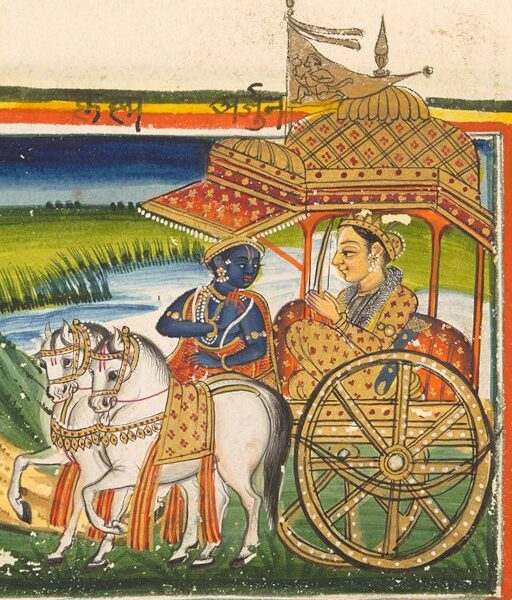
Yeah, nothing comes to mind. Is that one with the yin’s, ren’s on the chariot? Is that Vedic? Is that modern? Yeah, that would be that.
Means that’s showing that the mind controls the senses. Right? The horses are the senses, so therefore the reins control the senses. Right? But the driver’s supposed to be holding the reins, but he’s not exactly.
Yes? Maharajji said, consciousness is not the jiva, but it is the evidence that the jiva exists. It is the jiva, because the point is, that’s how you tell the jiva’s there. Because eternity is not being perceived. Right? Does that make sense? And you’ll sometimes see happiness, sometimes you see distress. Right? So sat-cit-ananda.
Of that sat you’re not seeing. Ananda you may or may not see, but cit you can see. Consciousness is there. Right?
Because that’s how we’ll say the person’s there. If he’s happy, then that’s a plus.
Yeah? Does that make sense? You know that something’s happened, you know, the person’s gone unconscious. Then what you’re looking for is consciousness. You’re not expecting that as soon as his eyes open he jumps up and goes, booyah, yeah, that was great, you know, like that. You know, he says, hey, you were just hit by a truck. Yeah, I experienced it. No, you don’t expect that. Right? So you’re looking for consciousness.
Does that make sense? You know what an interesting thing? You know, I use that term booyah. In Sanskrit it means again.
So another truck should come then. Again, yeah. Yeah, again.
For the soul there is neither birth nor death at any time. He has not come into being, does not come into being and will not come into being. He is unborn, eternal, ever-existing and primeval. He is not slain when the body is slain. So here Krishna’s made it very clear that, you know, in past, present and future there’s no, you know, coming of the jiva. Right? He’s always been there, always, you know, is now and always will be. Like that. So that idea is there. Yeah. So therefore he is never slain. You can’t slay. Because the point is, is what are you destroying? The material, you kill the body, but is the material energy lost? No. All it is, is it transforms.
That’s all. The jiva doesn’t transform.
That’s all. You know, consciousness may be transformed into the material and back into the spiritual. But the point is, is nothing is ever lost anywhere. Right? I mean, that’s I think that’s also a thing of physics, is that it’s just a matter of energy moving from one place to another. Right? You know, it means you eat the food like that and then afterwards, you know, then the bugs eat you, you know, and then somebody else eat the bugs and it just keeps going around in a circle. Right? You know, so that’s a, it’s a, what’s Surabhi’s point, right? You know, the circle of life, right? You know, so it’s just, the point is, is that energy doesn’t change.
You understand? So the soul doesn’t change because it’s eternal, but the material energy, then even though it itself is eternal, its manifestation is temporary and constantly changing. So that’s where we see the change. Right? Because we identify with it, then we feel there’s a loss.
Okay, how is it that the soul is free from the six changes of the body?
Right? The body is subject to six kinds of transformations. It takes its birth from the womb of the mother’s body, remains for some time, grows, produces some effects, gradually dwindles, and at last vanishes into oblivion. Like that.
Into oblivion, just gone. Right? The soul, however, does not deteriorate like material objects and has no byproducts. Therefore the soul is free from the six changes of the body. Right? So the soul doesn’t have any of that. Right? But when the soul is within the body, the body does that. Right? Whatever there’s life, you know, life symptoms, you’ll see these going on, but those symptoms are only manifest in the body.
Does that make sense? Then the other. Compare the consciousness of the soul with that of the super soul. The soul is full of knowledge, or full always with consciousness.
Right? Because consciousness and knowledge are the same.
They’re both chit. Right? That’s why activity and knowledge go together. Right? Therefore consciousness is the symptom of the soul. Even if one does not find the soul within the heart, where he is situated, one can still understand the presence of the soul simply by the presence of consciousness.
This consciousness of the soul is, however, different from the consciousness of the Supreme. Because the Supreme Consciousness is all knowledge, past, present, future. The consciousness of the individual is prone to be forgetful. When he is forgetful of his real nature, he obtains education and enlightenment from the superior lessons of Kṛṣṇa. Right? So the living entity is conscious of his field of activity. But the Lord, He is everything, so He’s conscious of all fields of activity, because all fields of activity is His field.
Right? So that’s the difference. He’s like the drop of the ocean and the ocean itself. Right? Consciousness is there. Senses are there, mind, intelligence. But the difference is, is He’s unlimited. You know? No restriction. At all times, all places, all circumstances. While we are limited to a particular time, a particular space, a particular circumstance. Right? Yes? Whenever you explain this simple philosophical point to some people, they just don’t accept it. What type of secrecy is required just to accept this kind of philosophy? What kind of secrecy is needed means the association of devotees. You know, that’s what we’re studying on the, how do you say, the Bhakti Mandala side of this. Right? This is the Tattva Mandala. The Bhakti Mandala then means is that the, one gets faith from the association of devotees. Right? And by that association, doubt is removed. And as doubt is removed, the faith is increased. Right? So then that means then the endeavor increases. Right? So as those doubts are removed fully, then the devotional service becomes steady. Because when there’s doubt, it’s not steady. Right? Because it may doubt, oh, I could be happy doing this material activity. Right? So therefore, if you’re doing a material activity, you’re not doing a spiritual. So the devotional service is unsteady.
Does that make sense? So when all doubts are removed, then one is steady. But that still is coming by the association of devotees. So we’re looking at, I’m performing my service and I’m moving, you know, from Shraddha to Sadhusangha to Bhajanakriya to, you know, how you say, to Anartha Nivritti, Nishtha, like this. But all that is happening only in the association of devotees. So the actual dynamic thing is the association of devotees.
Does that make sense? And the most important thing to do in the association of devotees is Shravanam Kirtanam. Right? And if that comes, you’re here, then you’ll do kirtan, then you’ll remember. Right? Does that make sense? And so being in the association of devotees, you see yourself as a servant. Right? Seeing yourself as a servant, then that becomes more intimate as a friend, and then there’s full surrender. So we see is that all that comes from the association of devotees.
Does that make sense? So all it is, is lack of association. That’s all. In other words, if you sit there more and talk more, then eventually it gets through.
Right? It’s just how long it takes to get through. That’s all. How thick the mind is. Yes, how thick the mind is.
Guru Nanak Devaraja used to say, you’ve got a thick layer, Baba. You’ve got a thick layer, Baba. You’ve got a thick layer, Baba. Okay, he’s of ignorance.
You’ve got a thick layer. Don’t, don’t, don’t. Yes. Guru Nanak Devaraja, I just wanted to ask, for our classmates to realize that when they ask you a question, it’s not just between them and you. That if we can make an endeavor to project our voice so that everybody can hear what we’re saying, because it’s very difficult for us to hear these questions because they’re not projecting their voice, and I’m sure everybody wants to hear. Yeah, yeah. No, that’s good. That’s good. But generally you’ll see is, unless, unless it starts into a tete-a-tete, but if it, when they speak, then generally the first thing I’m mentioning is taking their question and putting it into a statement. We all want to hear it. Yeah, yeah. No, that’s good. But I’m just saying, just in case, we always use that. You know, it’s just, it’s always better that it’s louder. Project. You have to make an endeavor to project your voice. But the problem is, is most of them didn’t, didn’t take any classes in speech and drama, so they don’t know how to do that.
Maybe before taking the class, there should be a prerequisite of a, you know, speech and drama 101, you know, like that, or for devotees 108, right?
Understanding the presence of the self simply by the presence of consciousness, I was wondering if you could tell us how to perceive consciousness.
Means basically the thing is that, that, how do you say, there is, generally you look at the life symptoms, you know, because the consciousness is there, the life symptoms are manifest. Consciousness is not there, the life symptoms aren’t manifest, because you might be able to appreciate the consciousness or not. If we’re interacting with somebody, it’s because of the consciousness, because that’s generally what we’re doing. But if we put it into, okay, the child’s are sleeping, you know, and the parents appreciating that, but they’re only sleep, they’re appreciating the sleeping. If it’s sleeping, if they’re dead, it’s not well appreciated, right? Or, you know, you know, the person is, you know, in a coma, so we don’t necessarily, but the point is, as long as that little thing on the thing goes beep, you know, like that, then we’re happy, right? You know, so that’d be, so it’s a life symptom. But the norm of what it’s talking about is consciousness is perceived because there’s the activity, and there’s only an activity because you’re conscious of it. I was thinking maybe, yeah, to refer you to the question, if the consciousness of the soul is more perceived than…
Yeah, yeah, yeah. Means that’s why you’ll say is that something is being done mechanically or is being done with feeling. With feeling means the consciousness is there. If it’s not done with feeling, means the consciousness is somewhere else, you know. But they’re conscious, that’s why they’re moving about like that. But since, like, I’m a soul, I’m a body, and another part, they say, like, I’m a body, I have a soul. When soul goes away, I’m dead, right? So, and further that, if I’m a body, I have a soul, then when some disease is there, some organs doesn’t work, so why the soul leaves the body? Why the soul leaves the body? It was just time to leave the body. You know what I’m saying? Means somebody, how you say, means one person, let’s say two people have an accident, right? So one person has an accident, it’s a mild accident. One person dies, the other person doesn’t. Why not? So it’s not that that situation created it. Does that make sense? You know what I’m saying? Two people have the same disease, so they go for the same operation. The operation was successful. One lives, one dies. Right? So the point is when the soul is supposed to leave, they will leave. And then all these other things, you know, go along with it. Does that make sense? The time is over, and you’re supposed to get a certain experience, so therefore you’re supposed to leave, and you got that experience at the same time. Right? So you had the experience of the heart attack, but the point is it’s not the heart attack that made you leave, because some people have heart attacks and don’t die. You know what I’m saying? So why is that? Because the point is it wasn’t time for the soul to leave.
Does that make sense? So it’s not the thing that makes the soul leave. No. The soul is just supposed to leave at that time.
Yes.
Not necessarily.
The animals are one thing, because they have their… So in other words, animals amongst animals, that’s left, but animals with humans, that’s… Because you’re not liable for anything that… You’re not liable for that which is outside your sphere. You know what I’m saying? What the animals do in the forest is not your problem.
Right? But your interaction with the animals, that you have some… That you can be conscious of how you’re going to deal with them. Does that make sense?
Yes, no? Like that.
So the thing is that premature death, it doesn’t exist actually. Premature death, no. It’s always on time. Somehow or another it’s right on time. It’s always right on time. You know?
I’m sure if you could see the Yamadus are sitting there and waiting.
Is there anything premature in a way? Anything premature? Yes. I guess the living entity thinking he’s intelligent or advanced.
That’s generally premature.
Suicide, would that be considered? Sorry? Suicide, would that be considered? Suicide, yeah, because that you’re arranging it. So that’s not… But if you get run over by a truck, then that’s… You were just supposed to be run over by a truck. What if you lie down on the street? But then the point is you are arranging that.
If you happen to be a bum who falls asleep on the side of the road, that’s another thing.
How come we have that term untimely death? I mean, that’s just generally a term of the general usage of the general populace. Because they’ll feel that if circumstances were what they would consider normal, they would have lived longer. Like if they’re young, then it’s untimely, like that. Or they were there out in their little boat, very happily going, and then some bigger boat went by and sunk their boat. But I remember when we say the mantra for…
If you get a benediction to not have to go through an untimely death, something like that. It would mean culturally what would be. In other words, that’s protecting you from the reaction that one would die at a time when culturally it would be untimely. But that’s the time you’re supposed to die. Anyway, does that make sense? So unculturally would be cultural usage. Because you’re in a family, you’re in this and that, but you’re only supposed to live that long, so that’s the way it is. Should we get back to having full faith that actually not a blade of grass moves without a sanction? No, it doesn’t move without a sanction.
Maharaj, you mentioned about consciousness. If it’s not present, like the model would put it in the clothes. If it’s not present, you mentioned, they don’t seem present, their consciousness is somewhere else? Yeah, but you can see that it’s somewhere else. You understand? Where does it go? It goes wherever it is. At home thinking of lunch, or thinking of your time out with your friends, or whether everybody’s going to appreciate what you’re doing. You know what I’m saying? Because you’re doing the activity and thinking about how people will respond afterwards. So you’re projected into the future. You’re not there. The consciousness is not there. So people notice that. So that’s why, even though we’ll talk mode of goodness and people will say, oh, well, that’s fanatic and stuff like that, and it’s natural we have desires and we have all these attachments. But the point is, where do you appreciate your desire and attachment? Where is it actually appreciated? In the future? In the past? In the present. Mode of goodness is in the present. So if you live a life in the mode of goodness, therefore you can appreciate every moment. You understand? This is also another example of the mode of ignorance, making religion into irreligion, irreligion into religion. What the materialist, the gross materialist is looking for, is what Bhagavad Gita is defining.
The only way to actually materially enjoy is to be in the mode of goodness. But the point is, is you can’t be in the mode of goodness actually, if you want to enjoy.
Right? So that means, you’re going to work that out, is that you see the enjoyment in relationship to the Lord. Then you’re enjoying, but it’s not your enjoyment.
You know what I’m saying? So, just like an example, let’s say you have a very good friend, and you do something for them so they’re happy. So, are you more happy at that moment, or more happy at a moment when you yourself are the one that’s directly involved?
The first one, right? So, people will admit that I’m actually, that the happiness is of a higher state when I’m involved in an arrangement that makes someone else happy. And the more happy they are, the more happy. You understand? But at the same time, we will make all our endeavor for us to be happy. These are all the effects of ignorance.
It’s just like, you present it, great, but when they go to do it, it will be the opposite.
Are the mechanics of… Loudly. Are the mechanics of projecting the consciousness into the future of past, or daydreaming and so on? Yeah, daydreaming is one of those. That’s how the teacher knows you’re not there. Yeah. Does the consciousness actually zoom around on a vehicle of mind then? Does the consciousness zoom around on a vehicle of mind? Yeah. If you want to put it that way, then yes. It’s just a matter of what kind of vehicle it is.
The point is, is when they say the speed of mind. Okay, you’re here now, right? Now think of your house back in your country, right? It’s not instant, but it’s very quick. So that’s the speed of mind. That’s how long it takes for the mind to get there. It actually travels there, the mind.
Someone else is traveling, so that means my mind didn’t go there. So the mind goes there, and then the consciousness is actually… You’re conscious of that, just like you’re conscious of your body. So it’s just whatever you focus on, then you’re conscious. So all these things are within the mind, so whichever one you become conscious of, then that’s where you could say the soul is. You know what I’m saying? Technically he’s there, but by consciousness he’s somewhere else.
Consciousness is within your field of activity as you apply it. Just like in the body, the consciousness is only… It means the consciousness pervades the body, but you’re only conscious of that aspect that you want to be conscious of. You know what I’m saying?
In that case, no?
The mind, the soul, is asleep or is just covered? It’s just covered. It’s just covered. But in the Upanishads you can call it like sleep, because they’re asleep to their actual reality of that, because when you’re asleep you’re unaware. But the point is, the soul is pure. It’s spiritual, but it’s covered by this impure consciousness. So therefore then the experience gained by the soul is material.
So what we’re doing now is simply, we’re not adding something, we’re simply removing the covering.
Does that make sense? But when we remove the covering, then one will understand oneself and understand the Supreme and one’s relationship. It’s not like the Mayavadis, when you remove the covering, then there’ll be nothing. Because their idea is that it’s illusion. Our point is it’s transformed.
The illusion is we don’t see whatever we’re dealing with in connection to the Lord. That’s the illusion.
Does that make sense? It’s like if I think this is a tomato, that’s an illusion.
Tomatoes aren’t this firm. So it’s not a tomato.
It’s not very ripe at least. Yeah, at least definitely less ripe.
And it’s also one of those square tomatoes like they’re trying to do for the Gita, like they pack them really nicely. This may have been the inspiration. But the problem is that… So now in removing my illusion, do I remove the rock?
No. The rock becomes understood as a rock. I think it’s a tomato. That’s the illusion. It’s not a tomato, it’s a rock.
So does that make sense? So when you remove the illusion of the material world, then you see the material existence of what it actually is. Not that it disappears.
You see everything as part of Krishna’s creation and Him in control of everything. And everybody under illusion being controlled by the modes of nature.
Does that make sense?
So how is it that the mind can take the consciousness knowing that the soul is superior? Because the soul identifies with it. Who’s superior? The parent or the child? The parent. The parent, okay. But where is the parent’s consciousness?
In the child.
Does that make sense? Right? You have this mature professional, you know, he’s a lawyer, she’s a doctor, you know, they’re top in their field, they’re published, they’re like that, they’re well respected, you know, they make millions, like this and that. But when their child is born, what are they thinking of? Like diapers, you know, stool, urine, you know, baby formulas, you know. And you can say that there’s such elevated consciousness, so why would… Because it’s by choice. It’s by attachment.
Does that make sense?
Yes. Loudly, loudly. One can expand one’s body. One can expand one’s body. Are you talking from personal experience?
So you’re here now and you’re also at home cooking breakfast.
That would be good. Then you can go back and eat it. And then you can ask yourself, how do you like it? Yeah, that could also work. Never be lonely, right? We have that, like, expanding oneself into nine.
So like we’re spreading… Kardama. Okay, Kardama. But that’s… The yogi can do that. They’re spreading their consciousness into nine bodies. They’re spreading their consciousness in nine, yeah. That’s called mind. Means everything goes. Mind goes, everything goes. It’s just more of the same. You know what I’m saying? There’s… There’s… There’s unlimited amount of material atoms. Right? So they can be manifest into forms. The amount of forms that are here is nothing compared to the volume of material energy. And that’s only what’s manifest.
You know what I’m saying? Just like let’s say you have your body. You’re sitting there. Now let’s say the person is manifesting strength.
Right? So that means any part of the body can manifest strength.
Yeah? Does that make sense? But the point is is it’ll be manifest where you specifically want it.
Right? You know, in the hand or in the foot or, you know, in the head or, you know, whatever it is that you’re… Does that make sense? And so then…
Then…
The point is is the su… Shakti has all… means is all these three energies. So it’s a matter of manifestation is which… which… what is being manifest where for what purpose.
You know what I’m saying? So we have the material energy but it’s still the su-Shakti.
So this is what we see. This is what… This is how much manifestation is necessary to accommodate the living entities. Right? So if he has, you know, eight more bodies what’s the big deal? Right? You know, how much… How much… How many atoms does it take up? Right? You know? Compared to what’s there. So it’s not a big deal. Right? It means yogis get very distracted by that that it’s such a big thing. But for devotees what’s the big deal? One body is already enough problems so let alone having nine of them. Right? You know what I’m saying? Does that make sense? So that’s the point.
That’s generally the thing with yogis. They distract themselves. Isn’t it? Yeah. It means… It means yogis… Karmis, jnanis, yogis they’re distracting themselves like that. They’re not seeing what the actual reality is because they’re distracted by their particular particular illusory idea of happiness.
You know what I’m saying? It’s just like you know, it means you know, they think if I can fly around that would be special and the mosquito is flying around. You know, it’s like that. It’s not like it’s that special. You make it into something special.
You know what I’m saying?
Yeah, that’s what I was mentioning before is that through the mind then it’s perception that makes it. You know, that was the point that we were saying before what was it that we first started off with.
I’m going to kind of move Oh, it was in the purport.
Yeah, it was in the purport that we were talking about something.
See, that’s how you know that Shastra is Krishna because whatever you want to find you can’t you can only find it by His grace. You can be looking right at it and still not see it. So, that’s how you know Shastra is Krishna.
Appearance of happiness or stress, it was… Yeah, maybe that we were talking about is perception. So, it’s just you perceive it that way. Otherwise, you know, to someone else that’s not happiness.
You know what I’m saying?
We need a break today. I don’t know, does anybody else need a break today?
Yeah, okay. So, then we’ll stop for a few minutes. Where were we?
Oh, okay, we were on the first, we did the first paragraph, right?
No, we were on the second paragraph, right? Yeah, because we dealt with just the first, first, first of Atma Tattva’s points, the six changes.
Yes? We were talking about during the break that this concept of the mind traveling to somewhere, if, if, if I’m conscious of the house where my grandparents live, I’m conscious of it in the way it was. It’s not like my mind is traveling, they’re physically perceiving it as it is. So, how to understand this traveling? The point is, is that we’re saying is that it takes that much time. So, it doesn’t matter where it’s going to, it takes that much time. So, that was being referenced too. When we say there’s, there’s the speed of mind, that’s the speed. Then there’s the speed of wind.
Does that make sense? So, these are different rates at which you can travel.
I think, I think maybe the question is more, where is that image stored that the mind is actually visiting? Because the house maybe doesn’t exist. It’s, it’s, it’s stored within the citta, you know, within the consciousness.
So, the point is, is that, you know, that’s, that’s what we remember, that’s what we forget. Krishna doesn’t forget anything.
Right? So, technically, if he doesn’t forget it, means it still exists in that way. It’s not manifest, but it still exists. So, that, how could you remember it?
You know what I’m saying? Because you can get back into even more detail than you thought of when you were maybe there. You know what I’m saying? By contemplating, you can think of more and more detail.
When you think that it’s, it’s not now, present, it’s, it’s maybe mode of ignorance because it’s, you’re thinking of the consciousness. It’s controlled by ignorance because it’s in the past, but the point is, is do you use it connected to Krishna or not? Somebody’s connection to Krishna, that’s solely what defines it as Krishna conscious.
You know what I’m saying? It’s not that the activity, we have a tendency to say the activity is what’s Krishna conscious.
And so that is, that basically you could say is true if we’re chanting, worshiping the deity, taking prasad, because generally a devotee would be conscious of Krishna during those activities. So of course one can be distracted and not, but that would be the general. So we tend to therefore think that in all things it’s the activity that makes the Krishna conscious, but it’s not, it’s the connection to Krishna that makes the Krishna conscious.
Yeah, because we’re saying we’re chanting Hare Krishna, but the point is, is no, we’re making, we’re vocalizing sound.
So the point is, is the sound we’re vocalizing is about Krishna, and we’re doing that to please Krishna. So therefore it’s Krishna conscious.
You’re vocalizing sound.
No, no, no. You’re vocalizing, it means when you’re chanting, it means the mechanics is you’re making sound. You know what I’m saying? So therefore it’s not that because you’re talking it’s Krishna conscious. The point is, is what you’re, when you’re chanting, what you’re talking is Krishna. But when you’re talking otherwise, if you’re talking about something connected to Krishna, then it’s Krishna conscious, and if it’s not connected to Krishna, it’s not Krishna conscious. It’s that simple. You know what I’m saying? Because that’s why, you know, the questions will come up, you know, like in the class, it’s like, well, the Pandavas are gambling, and so they’re devotees, so how can they be Krishna conscious during that activity? The point is, is being conscious and performing an activity are two different things. Right? They go together, but they’re two things. You know what I’m saying? So the point is, is one can apply Krishna consciousness to all situations, but the situations don’t, that’s not what makes the Krishna consciousness. Now, of situations, there are those that are considered, you know, more standard than more favorable, only because they’re more pleasing to Krishna. Does that make sense? That’s the point. Yes. Is memory a function of mind? No, it’s intelligence. Intelligence. Yeah. Memory is part of the intelligence. But you’re being able to remember or not, that’s the super soul. And so the intelligence is the one that uses the memory? No, no. The mind uses the memory. The intelligence, this intelligence simply, I mean, intelligence will also use the memory, but the point is, the intelligence is this discerning facts. So that’s what it does. Right? So the memory then holds all those facts. And what is that memory that holds the facts? It’s the faculty of the intelligence. Of the intelligence. So, and then, what’s the difference between that and then some scars with some scars stored and then chipped up? Means that will be in the memory. Because the point is, is when you, in other words, memory is in one place, now who uses it, that’s another thing.
Right? Because ultimately the point is, is it’s the mind that’s using.
Right? You perceive something, what is it being perceived with? The senses. The senses, right? So what’s controlling, what is, what is allowing the senses to analyze the situation? Intelligence. Intelligence, right? So that then comes into the mind. Right? So then the mind will then, first thing, will reduce it down to what is important, right? Because so many things are coming in. Like we’re talking that they’re also cutting things out in the kitchen and making lots of noise. Right? So you reduce it down to what’s important. Right? Then, then you go, then the mind, the third step is it goes into the memory and pulls out whatever information is relevant for that situation.
Does that make sense? Then the fourth is it decides whether it likes that or not, or what, you know, what it wants to do with it, then the fifth is it actually does something with it. That’s how the mind works.
And not, what’s the, so that’s in the memory that’s part of the mind, and then there’s this grandparent’s house that was in the That’s in the memory. In the memory also. Yeah. Okay.
So nothing’s stored in the consciousness.
The point is, is consciousness is being conscious.
Right? Then what you put, what you are conscious of, then that’s there. The point is, is in the conscious of Krishna, then Krishna’s in the memory. Right? So then you have something more. Now, you can now access that memory and therefore deal further or not. You know what I’m saying?
That, that’s what the seed is. So the, the seed of karma is the desire to do something again based on what has already been done. You know what I’m saying? But the point is, is that’s being arranged even if you remember it or not.
Even if you’re conscious of it, why not? It’s like you don’t know what, what you’ve done in the last lives, but it’s there. Someone remembers it.
Yes? So Maharaj, with the practice of chanting the holy name, we’re simply cleaning out all these unwanted impressions. Yeah, you’re clearing them out because they’re, they’re wanted because you think you can become happy from them. Right? Happy or, you know, some way generate an identity from them. You know, even if it’s not a good memory, you know, but still it’s your identity, you know. Does that make sense? You know, the persons that were there on site at 9-11, it’s not a good memory, but it identifies them as a particular group. You know what I’m saying? So then when they talk to others, it’s part of the, you know what I’m saying? And this cleansing process is not exactly deleting it, but just cleaning it. Well, it doesn’t have any meaning. You know what I’m saying? I mean, if that’s not important for your identity, then it, like so many other unlimited things, are, you know, just not so important. Yeah. You know, like that. Or then you see, then you read, you know, that no one’s doing anything, and so therefore happiness and distress, then you remember that situation, and then you contemplate, well, actually no one’s doing it. It’s just the modes of nature arranging that, and then living entities want to be, identify themselves with these activities. They have the desire for, though they technically aren’t doing it, the modes of nature arrange it. So actually it’s just all the modes, so therefore we shouldn’t get worried about it. The soul is actually pure. Then you don’t have any hatred, you don’t have any other things like that. Does that make sense? So it can be used in a useful way.
Mars, so the mind, if it has an impression, it’s like if you have a strip of film, and then you have the impressions on the film, so then one, this state of transcendental happiness, one realizes there’s nothing beyond this, and he relishes and rejoices in the self, with the pure mind, so then the pure mind has no… It doesn’t have any material in it, but it has spiritual impressions, it has spiritual impressions. The point is, the mind is a function that is there, the point is, is the mind covered, and therefore is managed by the modes of nature, or the mind is not covered, and it is managed by the internal potency.
And those impressions on the mind, they’re like stamped by the mind, different concentrations of the modes of nature? It means the impressions are going to be according to the modes of nature, yes, because otherwise in one situation somebody will… the impression it was good, another person it was bad.
So the idea is, in the Vedic concept, is samskara means that you’re going to put yourself in situations where the impressions are good. Right? Does that make sense?
We say this out-of-body experience and stuff like that, we read so many things, so that the out-of-body experience, the soul goes outside the body? No, it’s all stated, just the consciousness. Oh, it’s the consciousness? Means the subtle body may go around, you know, like this, but you know, they say so many things, but you know, they also say they’re God, they also say they’re the body. You know, the funny part is this, they’re the body, but you can have an out -of-body experience. So, you know, it doesn’t make sense. The point is how much there’s a validity to what they’re saying, it doesn’t have much meaning. You know what I’m saying? So all these kind of new age-y things, the point is whatever anybody is dealing with, if there is any substance to it, it’s because it’s based on the actual reality of God’s laws, but the point is it’s not seeing the connection with God’s laws, it makes the position weak, and it makes it speculative, so they’ll take one thing, you know what I’m saying? The out-of-body experience, but you know, how do they know it wasn’t just a dream? You know what I’m saying? It may be, it may be out, it may be a dream, it may be, you know, so many of these astral travels, you know, so it’s just, how do you know what’s there? The point is, is the mind can focus and create so many things, so it’s not necessarily that the man is turning himself into a crow, you know what I’m saying? Stuff like that, or it’s just a matter of, within the mind, he is, but whether in actuality the subtle body is taking on that form, that’s not so, he’s just expert at, within his mind, doing that. You know what I’m saying?
Yeah. Makes sense. Yeah. The point is, is due to lack of knowledge and too much mental speculation is there and whatever sounds good then, you know, becomes, you know, inspiring and this and that, so these things are. Because the point is, is it’s enough trouble getting good experiences within the body, which takes a lot of effort and all that, so why this out-of-body experience, notice the out-of-body experience, do they have much control over it? No, it’s just happening, so that’s the whole thing, it’s just happening and I’m experiencing and, you know, like this, so wouldn’t the mode of ignorance be a prominent element? Because mode of goodness means you’re in control of it, you know what’s going on. Yes.
Yeah, but the point is, is you’re visualizing, it’s not necessarily, you, that’s not the point, the point is, is it’s, in the visualization, it’s not that the subtle body’s not involved, but the point is, is it’s not that that’s necessarily exactly what you’re doing, the point is, is that’s how you word it, it works for you, it works for the other person, you know what I’m saying, but the point is, is it’s being done on that subtle platform, but there’s so many elements of subtle energy that go on, I mean, the turtle sits out at sea, right, but by concentration, by meditation, it hatches the eggs, which are on land, you know what I’m saying, so there’s so many wonderful things that are there, so it’s, they’re, so for us, they’re not, they’re not as such, it means they’re classified within what you call mystical, because there was, but there’s no mystique for us, there are others there as mystique, for us there’s not, it’s just, okay, they can do great as long as it’s working, you know, but the point is, is the focus is just really good, you can, able to put the energy and apply the energy and do that, you know, so it’s just a matter of the focus is great enough to do that, so some have that kind of focus, or they have the focus but they don’t apply it there, you know, the other person applies it in business, he’s very good at that, the other person applies it, you know, in, in, in science, he’s good at that, someone else applies it in business, they’re good at art, they’re good at that, so it’s, it’s wherever you apply it, then one becomes developed like that, yes, is that, yeah, means the variety of questions is good, but we always have to keep in mind, how are we going to use it, you know what I’m saying, so it means, in other words, if there’s some doubt, so then it’s conflicting with some other aspect, that’s one thing, but the point is, is how do we apply it in Krishna consciousness, right, in other words, it’s not just, oh, it’s a point of interest and we go off and just talking like that, otherwise then it becomes, you know, nice, but it’s not, it doesn’t have any, we’re not going to use it, does that, does that make sense, like that, otherwise we get, I mean, this is one of those things, we come up with the point, what I said was an example, so then now the topic becomes the example rather than the actual topic, so unless that top, that example becoming the topic, then that will be brought back to the actual topic, then it has validity, but if it was just, oh, that was interesting, that was nice, okay, then it, you know, has something, okay, the Shastra and all that has some, you know, validity and all that, but it, does that make some sense, because otherwise, like this, we can go off on a lot of things, very interesting tangents, you know, as I was saying, so the point is, is the tangent is not a problem as long as we’re going to see it connected back, does that make sense, okay, I don’t know if you read that part, okay, next one, 22, O Partha, how can a person who knows that the soul is indestructible, eternal, unborn and immutable, kill anyone or cause anyone to kill, how can a person who knows that the soul is indestructible, eternal, unborn and immutable, kill anyone or cause anyone to kill, how can a person you know, fifteen, you know, fifteen hundred, you know, dollar Gucci, you know, however the shirt, you know, got a rip in it, you know, so then it’s like death and then you put on a new one and then you go out to the party, so then there’s, you know, like that, so, but the point is, is it’s like that, it’s just changing clothes, okay, the soul can never be cut to pieces by any weapon, nor burned by fire, nor moistened by water, nor withered by wind, right, so that means that the soul can function in any of these environments, is that the body is burned, so that means living entity can function in fire, or live in water, or live in air, does that make sense, like that, because they’re not disturbed by these, it’s just the body particularly happens to be, so then they have a body that suits that, then it works, yes. And we’re not supposed to ask how this body would materially function? How this body would materially function, not exactly, no, it just means there’s the pathology, there’s the dominance of that element, so it functions in that environment, so it means in fire, it means the fire element is prominent.
Okay, does the soul become one with God after liberation? Even after being liberated from illusion, the living entity remains a separate entity, as is evident from the teachings of the Lord to Arjuna. Arjuna became liberated by the knowledge received from Krishna, but he never became one with Krishna, right, so he became something else, and he says, now I understand all this and that, but it’s not that at that point that Arjuna, you know, then this great, you know, this great white light, he became emanating like that, and then Arjuna and Krishna became one, and this great, you know, how you say, bright spark of white light went off into the sunset of the red light, you know, like that, no, it didn’t work like that, like that, he fought on the battlefield.
Okay, yes. There is a description in the Krishna book that actually happened with one of the demons. Yeah, yeah, no, no, that means they merged, but they can come back out again, that’s the point. It’s just like we said, you can put the drop of water into the ocean, you can take the drop of water back out.
Does that make sense? Because the drop of water doesn’t become the whole ocean, ocean already exists.
Does that make sense?
So, but you see is that it merged into Krishna, but Krishna didn’t become it, because they’re saying if by merging you become God, but the point is, is then why wasn’t there a transformation in God, then that would mean that God would become the living entity. But it’s not that they both merged into each other, you know what I’m saying. The ocean’s the ocean, then the drop of water is the drop of water from the ocean. But it’s not that the drop is the ocean or it becomes the ocean, it becomes a drop of water in the ocean.
Yes?
Is there a difference between merging in Ramana and the description of merging into the body of the ocean? It’s the same thing. But where does Brahman come from?
It means, yeah, it means the soul always exists, so existence doesn’t change like that. It means the variety of activities, variety of experiences, that changes, that’s constantly. But the point is, is the soul itself doesn’t change. Krishna doesn’t change, the soul doesn’t change, but the activities that they may perform and the interactions, therefore the experiences gained, that’s unlimited.
This individual soul is unbreakable, insoluble, and can be neither burnt nor dried. He is everlasting, present everywhere, unchangeable, immovable, and eternally the same. So from so many different angles, just to make sure. No weapon, burnt by fire, he can’t be dried either, like that. He’s not burnt, but can he be dried up, like that.
He can’t be moistened by water, but can he maybe, you know, disappear into the water, or you know, all these different things, like that. Does that make sense? So this means, in other words, means, yeah.
Okay, what kind of existence does the moment aspire to after liberation? What is the designation of the intelligent soul?
After liberation from material contamination, the atomic soul may prefer to remain as a spiritual spark in the effulgent rays of the Supreme Personality of Godhead. But the intelligent souls enter into the spiritual planets to associate with the Personality of Godhead. Right? You know, so the point is, because if you just go into this effulgent rays, then where, what do you do? How long can you stay there? How long can you just be doing nothing? Right? So if one’s intelligent, one knows not so long. So therefore they go to the spiritual planet and associate with the Lord. Otherwise, does that make sense? Like that. So it means that they’re not so intelligent if they go to the Brahman. Does that make sense to you? Like that.
And that points me, present everywhere, it means when he says present everywhere, it doesn’t mean that the individual soul is everywhere. It means souls are everywhere.
Does that make sense? Because the impersonals will try to take this and say, see, he’s unchangeable, so therefore the body, so it’s something else that merges into. Brahman is unchangeable. It’s, you know, everywhere, so he becomes that. So that’s what they’re trying to say.
What is the meaning of immovable? Immovable.
I think he’s not going to be adjusted from his actual position. If you’re in a position and you move them from there. Does that make sense? So he’s in the position that he’s satchitananda, he’s not going to be moved from that. Right? There can be the transformation that the covering may be there or the application of the consciousness or the energy is applied in a different way, but his actual position of still being satchitananda won’t change.
It’s not like cheese that you can move it.
Does that make sense? There is no space. There’s no space.
Yeah, it means it’s not controlled by space. It means the all- accommodating potency is there, but there’s no ether as an element. Yeah, like that. So therefore he’s not limited to a specific spot. But the point is to interact with the Lord, then that’s done through a particular form and a particular environment.
Does that make sense?
It is said that the soul is invisible, inconceivable and immutable. Knowing this, you should not grieve for the body.
So what is the process to understand the existence of the soul? The soul is inconceivable by human empirical knowledge and therefore is not possible to prove the existence of the soul experimentally beyond the proof of spriti. We have to accept this truth because there’s no other source of understanding the existence of the soul. Since the soul is spiritual and the soul is so small, there’s no way it can be perceived.
Right? So the point is this, because it’s atomic, why the term atomic is used?
Because it’s the smallest. Yeah, because it’s the smallest. Because atomic means that it’s indivisible. Right? So what scientists now call an atom is not actually an atom. Just like before, that I remember, what they called molecules now, before they called those atoms. Then when they understood that there was something within that, now what they call, then what they saw within that, that now they call the atoms. But as they keep going and going, after a while they have all these other names, but they’re still attached to the idea that it’s an atom. You know, but I mean, okay, they call it that. Then at some point, then they’ll have to see that the atom is what can’t be perceived. Because it’s smaller than that. There’s no subdivision. So the soul is atomic because he’s, so how will they perceive?
Yes? So this example, sometimes people use when they preach, they say that some scientists, they measure the weight of the body before it was there, and then when the soul left the body, they made some… That was because, but that’s not the soul, because you have to know that soul and the subtle body also go. So that might be some weight of the subtle body. So it’s not the soul, actually. No, no, the soul is one ten thousandth the tip of the hair. You know, so how much that’s going to… But of course, then there is also the weight of that, but how they’ll measure the spiritual from the material. Like, I think there’s a past time where Ravana came across Narada Muni, and I’m not sure what caused it, but he pulled out his sword and tried to… I think Narada Muni was saying something of this. So he tried to kill him with his sword, but the sword just goes right straight through. You know, but it’s not mystical, it’s that because the sword’s material and he’s spiritual, so there’s no connection. So he’s trying so many times and this and that, nothing works. And then afterwards, Narada Muni, after he gets tired of that and figures out, okay, maybe this guy’s a little different than everybody else, then Narada Muni says, you know, you can’t hurt me with your sword, so you’ve done no harm to me. So based on that, then there would be naturally no correction, no punishment. But since you intended to hurt me, then there must be some correction. So one of the so many curses that Ravana had is from Narada Muni for that incident. I’m not sure which one it was. That’s the one that monkeys would spit on him. You know, stuff he’s got so many.
He’s got lots of them.
Yeah, so they wouldn’t be able to measure the soul, but because the subtle body, the mind, intelligence, false ego, is made of material elements, then they could possibly weigh that.
So that’s the point. Because the subtle body goes with the soul.
So we have to accept from Shruti. That’s why the basics, the first point of the Dasa Mula, Shruti must be accepted. It’s not a matter of not accepting it. It has to be accepted. We don’t understand it. That’s fine. Right? We can’t doubt the point. We may have a doubt of our understanding of it or how to apply it. So therefore, there’s inquiry. But one can never not have faith in Shruti, in the Shastra.
That’s the point. So to put it onto a platform, maybe this, maybe that, or things like that, that’s mundane. It’s not a spiritual discussion to say, well, maybe Prabhupada was right here, but maybe, you know, because this was back in the 60s and 70s, maybe now it doesn’t apply. This is not a spiritual point. It’s, you know, it’s purely, it’s pure unalloyed materialism. It doesn’t have any spirituality to it at all. Because you can’t doubt it. You may not understand how to apply it, you know, or why Prabhupada would say it. Then you inquire, submissively.
Right? Then you can understand. But without that process of accepting authority, then one’s intelligence will not become imbued with the chit potency. So one will not understand. And then due to false ego, I’ve been around a while, or I’m older, or, you know, in the material world, I’m considered, you know, intelligent or mature or expert. So therefore, if I don’t understand it, there must be something wrong with it. But all these different angles are still just materialism.
Does that make sense? So the point here is that it can only be understood from authority. It’s just the way it is. It’s beyond the experience. So, we get convinced of that by other examples. But the point is, is we have to accept that that’s the way it is. It said, that was the point before, is that, no, not in this way. In the Upadesa Mrida studies, that the… No, it is in here. Yes, in here. Means it’s in the later part of the chapter. Only the Lord Himself or His devotee, they come to give us understanding of this. Otherwise, there’s no understanding. It’s not. It’s beyond. You can’t use something of one material to measure something that has something beyond it. You know what I’m saying? You can use mercury to tell temperature because mercury is affected by temperature.
You know what I’m saying? But you wouldn’t use something else. Does that make sense? So, only if it has a connection with temperature, can it be used. But the point is, is spiritual is beyond material. So, there’s nothing within the realm of spiritual that can measure… I mean, within the realm of material that can measure spiritual. Therefore, we have to accept that the only way to know it is through the scriptures. So, scriptures say, this is how you perceive.
Okay? Right? So, then tomorrow now, now He’s given that full understanding of the soul, right? That full knowledge of the nature and position of the soul. Now He’s going to start all His various tricks. You know, using… Even if you want to use all these material philosophies, still you’re wrong. Right? You know, that’s the next. The next one.